Sunday, January 16, 2022

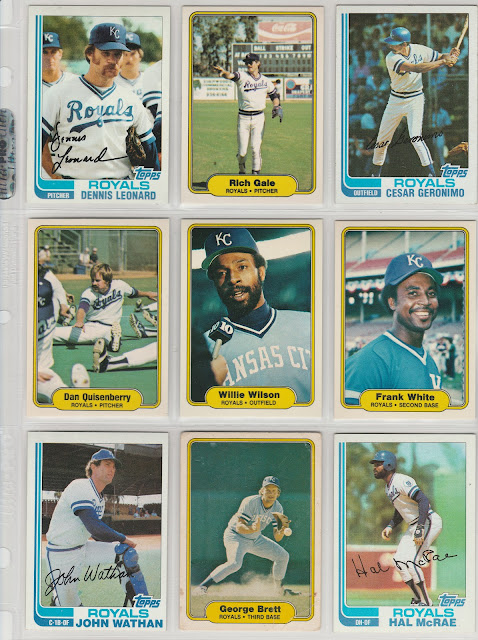
I love the 80s - 1982 Kansas City Royals

 This is a series of posts on a 1980's Frankenset. Each page features a different team, with 9 of my personal favorite cards from that year's team. You might find players repeated, you'll definitely see brands repeated, but hopefully you'll agree that there are some interesting selections from the 1980s!

I'd never suggest that the 1981 Baseball Strike was a good thing, but there were teams that took advantage of the break to change their fortunes. The Kansas City Royals had a miserable 1st half of 1981, falling 10 games under .500 and slipping to 5th place in the standings. The second half was another story. The Royals finished the second half in first place, securing a spot in the post season. They were bounced quickly by the Oakland A's in 3 straight games, but the Royals showed the fight that made them major players from the mid 70s through the mid 80s.


1982 was in many ways a more successful season than '81 for the Royals, with one big difference. This time, they would miss the post season altogether, though they finished with a 90 - 72 record. DH Hal McRae set a franchise record with his AL-Best 133 RBI, Dan Quisenberry paced all closers with 35 saves, and the franchise took a step towards securing a brighter future by drafting pitcher Bret Saberhagen. They missed the postseason in 1982, but were poised to return again soon.


The Cards:

Topps #495 Dennis Leonard - Leonard was the Royals' Ace in the late 70s. He was a 3 time 20 game winner, leading the AL in Starts and Innings Pitched in 1981. He was the only AL pitcher to exceed 200 innings pitched that season, given the time lost to the strike. He was also 3rd in Strikeouts and had a pair of shutouts, both of which came during a stretch of 7 starts in 26 days following the strike. The heavy workload and a pair of broken fingers made for a less than stellar 1982, in which his ERA ballooned about 5.00 for the first time in his career. The following season, the injury bug struck again and he'd essentially be out of baseball until 1986. He tore his patella tendon in a 1983 start, missed all of 1984, and would only make a pair of starts in 1985 for the Royals. Leonard continued his rehab, and returned to the team to make 30 starts at the age of 35. He retired as the Royals' All-Time Leader in Games Started, Innings Pitched, Complete Games, and Shutouts.

Fleer #408 Rich Gale - Gale was a 1978 Topps All-Star Rookie, but didn't get a trophy on his card as Topps decided to leave out the Cup from 1979 through 1986. That season, Gale won 14 games and finished 4th in AL Rookie of the Year voting. He started a pair of games in the 1980 World Series, with a no-decision and a loss. He and Leonard were an effective one-two punch in the late 70s for the Royals, but Gale had a rough time in 1981. He would be traded to San Francisco that off season, and by 1985, found himself pitching in Japan. He was on the mound for his team (the Hanshin Tigers) in their 1st ever Japan Series clincher. Gale is probably known more readily today for his work as a pitching coach, both in the big leagues and for a handful of teams in the minors.

Topps #693 Cesar Geronimo - Geronimo came to the Royals in 1981 as a role player after spending nearly a decade in Cincinnati as the primary Center Fielder for the "Big Red Machine." Geronimo was a 4 time Gold Glove winner in Cincy, and was closing out his career as a 4th outfielder for the Royals in the early 80s. His Gold Gloves weren't mirages or based on the success of his team. He passed the "eye test" in Center Field, sure, but also had favorable rankings in some of the new-school metrics as well. He was annually at or near the top of the leaderboard in Total Zone Runs and Range Factor. Geronimo joined the Reds from the Astros in the same trade that sent Hall Of Famer Joe Morgan to Cincinnati. Following his playing days, Geronimo co-founded a baseball academy in the Dominican Republic that focuses on teaching its students about life skills, English as a 2nd Language, and fiscal responsibility along with the standard fare of baseball training. He helped to establish a similar Academy in Japan for the Hiroshima Carp, that focused more specifically on baseball, as the students also attended a separate school. 

Fleer #422 Dan Quisenberry - The Early 80s were the peak years for the Royals' closer. Dan Quisenberry was the AL Saves leader 5 times, and Royals' Managers loved to give opposing offenses a Pop "Quiz." He was known for his unorthodox submarine-style delivery to the plate, and for writing poetry off the field. For a detailed and engrossing biographical essay, check out this link from the SABR Bio Project He appeared in all 6 World Series games in 1980, and had 4 appearances in the 1985 World Series, including a victory in Game 6. He's the Royals' All-Time Leader in ERA, and is 2nd in team history in Saves. Quisenberry, like his former Manager Dick Howser, passed away from brain cancer. 
 
Fleer #427 Willie Wilson - If you look up "triple" in the dictionary, there should be a picture of Willie Wilson there to help illustrate the concept. Wilson led the AL in Triples 5 times, and finished his career with 147. That's 56th overall in MLB history, but 3rd overall if you're looking at players whose photo is in color, behind just Roberto Clemente and Stan Musial. His 1980 season was historic. In addition to his 15 triples, he totaled 230 hits and scored 133 runs. Those figures all were best in the AL. He was 2nd in Stolen Bases with 79. He'd go on to win a batting title in 1982. He did all this while playing an elite Left field. Similar to Cesar Geronimo, Wilson was a regular visitor atop the league leaderboard in range factor and total zone runs. Wilson is the Royals' All-time leader in stolen bases, with 612. 

Fleer #426 Frank White - The late 70s and early 80s were a who's-who of the greatest Royals of all time and I don't mean Prince Charles. Frank White was the Royals' second baseman throughout their decade plus run of contending for the AL West title, starting in 1973 until his retirement in 1990. White was a defensive dynamo, racking up 8 Gold Gloves. The 5 time All-Star wasn't a slugger like Brett or a burner on the bases like Wilson, but he was a steady presence up the middle of the diamond for nearly 2 decades. His 2,006 hits are 2nd all-time in Royals history. 1982 was probably his best offensive season overall, hitting .298 with 11 homers and 10 stolen bases and a 114 OPS+. He terrorized the Yankees in 1980, earning ALCS MVP honors by hitting .545 in the series including a homer and stolen base. It was his defense that made him an all-time great. Reggie Jackson quipped of White "he's saved as many runs as I've driven in."

Topps #429 John Wathan - John Wathan was a rare breed - a catcher would could steal a base! In 1982, Wathan had a career high 36 steals, almost unheard-of for a backstop, and set a major league record for the position. Wathan was also able to hit for average, including a .305 mark in 1980, when he even garnered a few MVP votes. Following his 9 year playing career, Wathan was a coach and then Manager for the Royals and Angels. Since 2008, he's held the role of 'special assistant to the Director of Player Development' for the Royals. He's a baseball lifer, having worked as a scout, roving instructor, coach and a really fast catcher!

Fleer #405 George Brett - I won't share that infamous George Brett Story, or that other infamous George Brett Story - but suffice it to say, Brett is famous and infamous. He's Mr. Royal, leading pretty much every offensive category in team history, as well as being the leader of the team's first rise to prominence in the 70s and 80s. Brett's 3,000th hit is a bit of a funny story - he was picked off first base after getting it. But what was impressive to me is that it was his 4th hit of that game. That's on-brand for George Brett, going a bit above and beyond. Brett was a triples machine in his own right - when Wilson wasn't the league leader, Brett was leading the league in the late 70s / early 80s, including 20 triples in 1979. His 1980 season was even better, as the AL MVP led the league in all three triple slash categories, going .390/.454/.664 and an OPS+ of 203. Brett won 3 batting titles, in 3 different decades - 1976, 1980, and 1990. The 13 time All-Star was of course a first ballot Hall of Famer, joining the Cooperstown club with fellow 1975 Topps rookie Robin Yount in 1999.

Topps #625 Hal McRae - McRae moved from outfield in Cincy to become a slugging DH in the American League, providing much needed balance to the Royals' offensive attack in the 1970s. McRae was a key member of the Royals through the 1986 season, and later became manager of the team, known for his fiery demeanor and will to win. While his homer totals don't appear eye popping, McRae was still the premier DH for the majority of his career. His Career OPS+ of 123 shows how he was a step above the rest of the league at the plate. McRae finished his career with over 2,000 hits and over 1,000 RBI. 

Monday, January 10, 2022

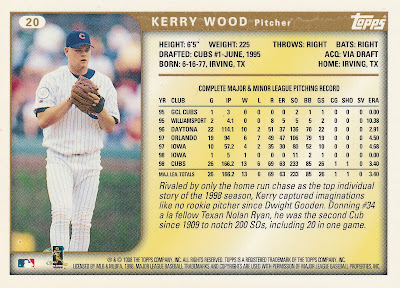
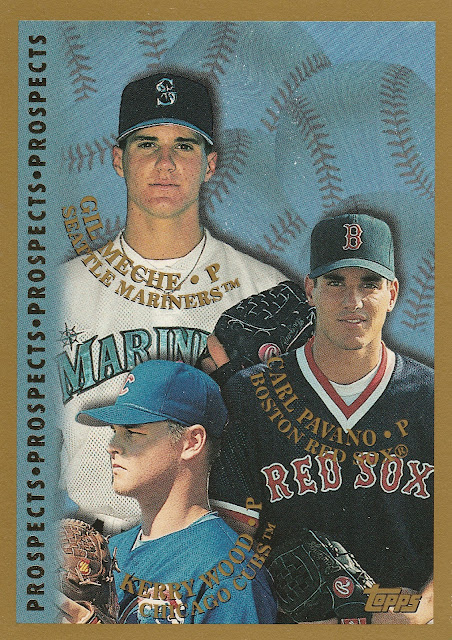
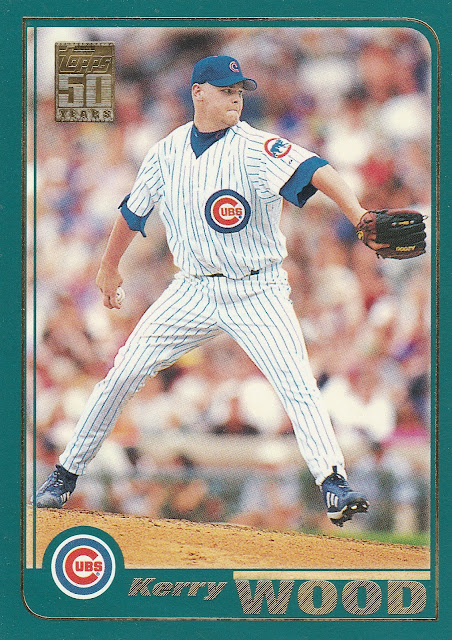
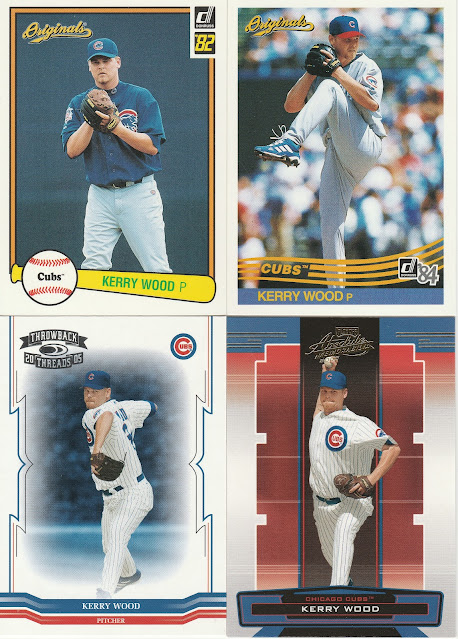
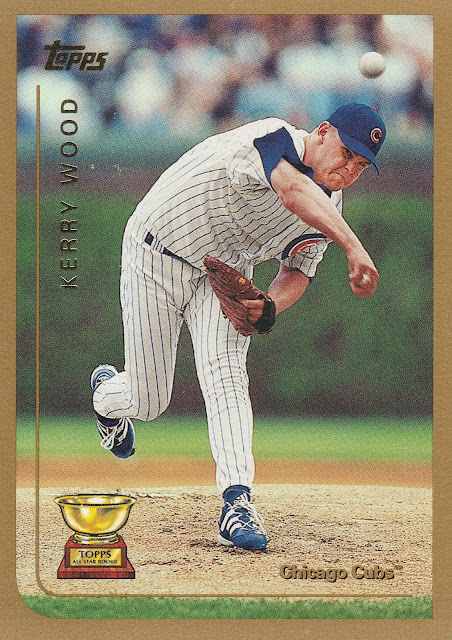
1998 Topps All-Star Rookie Right Handed Pitcher Kerry Wood


If you see this from the batter's box, you are in for a long day. Kerry Wood in 1998 was the NL Rookie of the Year, so of course he was Topps' first choice for right handed pitcher on their All-Star Rookie Squad. That season, Wood piled up the strikeouts (the most by a Chicago Cub since Hall of Famer Fergie Jenkins in the 1970s), and won 13 games. He had one Complete Game,  which was a shutout, but we'll talk about that game in a bit.


Topps went as far as to say that Kerry's rookie campaign was comparable to Dwight Gooden's phenomenal debut season, and the story of Kerry's season was second only to his teammate Sammy Sosa's chase with Mark McGwire to un-seat Roger Maris as the single season Home Run King. He led the NL in H/9 and K/9, but his electric stuff could be a little tough to harness at times. His 85 walks ranked in the top ten in the NL that year as well as hitting 11 batters and uncorking 6 wild pitches. Sometimes a little wildness can go a long way towards baffling the opposing batters.


The Cubs made Kerry a first round pick in 1995, selecting him out of high school in Grand Prairie, TX. Wood would start to show signs of the pitcher he'd grown into as a senior, when he fanned 152 batters in a little over 80 innings. He had a 0.77 ERA and was a perfect 14-0. His first full professional season came at the age of 19 for the High-A Daytona Cubs. He went 10-2 with a 2.91 ERA, striking out 136 batters in 114.1 innings pitched. The Cubs were willing to take the good with the bad, as the walks piled up alongside the Ks throughout his minor league career. In 1997 with the Orlando Rays and Iowa Cubs, he allowed a combined 131 walks in 151.2 innings. Despite the wildness, Wood returned in 1998 with a mission to make the big league roster. He would make just one start at AAA, striking out 11 of the 17 batters he faced before being called up to the Cubs.


Wood's magical rookie season was curtailed by "elbow soreness" that kept him out of the rotation for the final month of the season. He'd return to make a start against Atlanta in the NLDS, taking the loss after allowing a single run over 5 innings. In Spring Training of 1999, Wood tore his UCL, nearly ending his career. A season of rehab and recovery was needed to get him back on the mound and he was able to rebound to have several excellent seasons in the Cubs' starting rotation.


From 2001 - 2003, Wood averaged 200 innings pitched with 700 Strikeouts and an ERA+ of 122. He pitched a gem similar to his rookie season masterpiece (which we'll get to in a bit), when he tossed a 1 hit, 14K shutout against the Brewers in May of 2001. Along with Mark Prior, Wood formed a fearsome 1-2 punch at the top of the Cubs' Rotation and helped propel the team to within one game of the World Series. Wood was the starter of Game 7 of the 2003 NLCS against the Marlins, and even hit a home run to try to help his own cause, but the curse of the Billy Goat was still lurking in the shadows of the Friendly Confines. The Cubs would lose an ugly 9-6 game to the Marlins, and the following season the injury bug would bite Wood again. He would miss nearly 2 months of the 2004 campaign with a strained triceps muscle. 2005 ended prematurely with an injury in August, and 2006 and 2007 were nearly lost completely due to knee injuries and then a torn rotator cuff. 

Wood made the decision to shift from the rotation to the bullpen, and in 2008, he made a big splash, saving 34 games for the Cubs and striking out 84 batters in 64.1 innings. 


Following the 2008 season,  the Cubs opted not to sign Wood and he tested the free agent waters, landing in Cleveland. He would serve as the closer again, saving 20 games and sporting a league average ERA+ of exactly 100. He was traded at the 2010 trading deadline to the Yankees, where he pitched in middle relief setting up Mariano Rivera. He was his old electric self again with New York, recording a 0.69 ERA over 24 appearances. He allowed just 2 runs over 26 innings, striking out 31 batters down the stretch. In the Post-Season he allowed 2 more runs, 1 to the Twins and 1 to the Rangers, but overall pitched very well.


Wood returned to the North Side in 2011, and pitched the final two years of his career in the Cubs' bullpen. He's 3rd All-Time in strikeouts for the Cubs, even though he's 28th in innings pitched. 


Of course his signature moment came in his rookie season. Wood fanned 20 Astros in just his 5th career start. There are many tributes written about this game, but here are a few of my favorite tidbits:

-Out of 122 pitches thrown, only 7 were hit into fair territory. 
-Only 3 of those made it out of the infield.
-The lone hit he surrendered was an infield single that kicked off the glove of 3B Kevin Orie. Arguably it could have been ruled an error.
-The very first pitch of the game was a wild fastball that bounced off the mask of home plate umpire Jerry Meals.
-Houston's Shane Reynolds actually pitched a great game himself, striking out 10 and allowing just one earned run over 8 innings.

It has been argued that this was the greatest game ever pitched - even though he allowed a hit and also hit Craig Biggio (then again, who hasn't hit Biggio?). Bill James developed a formula to grade starting pitchers which is widely used and called the Game Score. 

Kerry Wood's game score for this outing was 105, the highest score of any pitched game before or since. 

Compare that to Clemens in 1986, his 20K game had a game score of 96.
Clemens in 1996, his 20K shutout had a game score of 97. 
Don Larsen's Perfect Game in the 1956 World Series? His Game Score was 94.
Sandy Koufax threw a perfect game in Sept of 1965 with 14 Ks - that game score was 101. 


Sunday, January 9, 2022

I Love the 80s - 1982 Philadelphia Phillies

 This is a series of posts on a 1980's Frankenset. Each page features a different team, with 9 of my personal favorite cards from that year's team. You might find players repeated, you'll definitely see brands repeated, but hopefully you'll agree that there are some interesting selections from the 1980s!

1981 saw the Phillies attempt to repeat as National League and World Champions. A strong 2nd half vaulted the team into the playoffs, where they came up just short losing the 5th and final game of the NLDS to the Montreal Expos. During the year, Pete Rose passed Stan Musial as the National League's all time hits leader, and Steve Carlton recorded his 3,000th career strikeout. The individual accolades were nice, but the team had higher aspirations.


With the window to win starting to close for the veterans like Rose and Carlton, the team would make a few moves to try to make another championship run in 1982. They cut ties with 33 year old Bob Boone, turning to Ozzie Virgil Jr and Bo Diaz to be the new every(other)day catchers, traded for starting pitcher Mike Krukow to solidify the rotation, and decided to turn to veteran SS Ivan DeJesus to bolster the middle infield. None of these moves would prove fruitful in the long run, with the last trade suffering mightily in hindsight as the return for that investment in DeJesus was future Hall of Fame Second Baseman Ryne Sandberg and veteran Larry Bowa, who provided roughly the same production as DeJesus in 1982. Still a strong presence in the NL East, the Phillies would stay close all season but ultimately finish in 2nd place. 


 The Cards:

Donruss #42 Steve Carlton - In 1982, Carlton was his usual superlative-laden self, winning the Cy Young Award (his 4th), on the back of a league leading 6 shutouts. He was also the NL's best with 23 victories, the last Phillie to win 20 games in the 20th Century, and led the NL in strikeouts for the 4th time. If you're more new school than old-school, you may be pleasantly surprised to know that not only were the counting stats good (Leading all NL pitchers in batters faced, innings pitched, complete games, and Games started), he also led the NL in FIP! Carlton was a no-doubt Hall of Fame case, pairing the 4 Cy Young awards with 2 World Championships. He was a 10 time All-Star, and is one of just 4 players in MLB history to surpass 4,000 career Strikeouts. 

Fleer #251 Tug McGraw - McGraw was another of the Phillies 35+ year old veteran stars in the early 80s. Arguably his finest season came in 1980 as the 35 year old closer for the Phightin' Phils. He finished the regular season with a 1.46 ERA and an ERA+ of 260. He notched 20 saves, but finished another 28 games for the Phillies, striking out 75 batters. He was a member of the 1969 Miracle Mets (but did not pitch in the World Series), and an integral part of the 1980 World Champion Phillies. The 2 time All-Star was a solid to spectacular relief arm for nearly 20 seasons in the big leagues. He struck out nearly twice as many batters as he walked over more than 1,500 innings pitched. McGraw was best known for his signature pitch, a devastating screwball.

Topps #781 Pete Rose - Few players can lay claim to establishing a team's identity the way that Pete Rose did for the Phillies. They were a very good team in the mid to late 70s, but were often on the losing end of battles with in-state rivals the Pittsburgh Pirates as well as Rose's former team, the Big Red Machine Cincinnati Reds. When Rose left Cincy for Philly in free agency, the fortunes of both teams flipped. As mentioned above, Rose became the all time leader in hits in the National League in 1981, but more importantly, his style of play and leadership helped get the Phillies over the hump against their NL East rivals and win the 1980 World Series. The team hadn't been to the World Series in 30 years, and hadn't won a world series game since 1915! Rose changed that culture in Philadelphia.

Donruss #606 Lonnie Smith - Lonnie Smith is possibly the most underrated player of the 1980s. In the Phillies championship season, Smith led the team in Stolen Bases, but also sported an OPS+ of 130, finishing 3rd in Rookie of the Year voting. Used sparingly in 1980 and due to the strike-shortened 1981 season, his first full season would be 1982. He was traded to Saint Louis, where Smith would finally get the chance to play everyday. He was an All-Star and amassed 6.2 WAR, placing 2nd in the NL MVP race. He hit .307 with 68 Steals and scored a league leading 120 runs for the wild run and gun Cardinal offense that won the 1982 World Series. He'd win 3 World Series championships in the 1980s, for three different teams- the Phils in 1980, the Cardinals in 1982, and the Royals in 1985 - playing key roles on defense, at the plate, and on the bases. The last season of the decade was his best- leading the NL with 8.9 WAR, certainly an MVP worthy season. However, he compiled that season for the lowly Braves, finishing well out of contention and out of sight, out of mind for MVP voters.  Time would catch up to Lonnie and his 1990s career paled in comparison to his 1980s numbers. He'd retire with a 118 OPS+, and a triple slash of .288/.370/.420. It amounted to a solid MLB career that doesn't get talked about that often.

Fleer #258 Mike Schmidt - Not too often do you see Schmidt sporting a full beard - nearly mistook him for Bill Walton! The Hall of Fame Third Baseman was right in the middle of his prime career years, the reigning NL MVP from 1980 and 1981. His 1982 season may have seen a slight dip in batting average, but he led the league (again) in OBP and Slugging. He was also right in the middle of a run of 9 consecutive Gold Gloves (he'd add one more before his career was over), and 5 straight Silver Slugger awards. In all, he'd be a 10 time All-Star, 10 Gold Gloves, 6 Silver Sluggers, 3 MVPs (80,81, and 86) and is generally regarded as one of the best third basemen of all time. He was the NL HR king 8 times, and his 548 career homers still ranks 16th, even after the steroid era saw 13 more members join the 500 HR Club. 

Topps #581 Ron Reed - Reed's career in many ways is reminiscent of Dennis Eckersley in miniature. Reed started his career in the Braves rotation and was pretty good. He was an All-Star in 1968 as a rookie, and followed it up with an 18-10 record in 1969. Reed transition from the rotation to the bullpen in 1976 for the Phillies, and became a mainstay in their relief corps until after his 40th birthday. Reed was essentially the team's closer in 1982, saving 14 games and sported a 2.66 ERA over 57 appearances. For his career he started 236 games and finished 300 as a reliever. He faced over 10,000 batters and still had a better than league average ERA+ of 108. Fun fact about Ron Reed - before playing baseball, he played for the Detroit Pistons for 2 seasons, averaging 8 points and 6.4 rebounds a game.

Donruss #441 Gary Matthews - "Sarge" came to the Phillies after the 1980 World Championship season from Atlanta in exchange for the legendary Bob Walk. Matthews was known for a blend of power and speed and was extremely durable. He played all 162 games for the Phillies in 1982, and would go on to show his skills at their peak in the 1983 NLCS. His three homers against the Dodgers powered the "Wheeze Kids" to the 1983 World Series, earning him MVP honors in the process. Matthews was the 1973 Rookie of the Year and was an All-Star in 1979 with Atlanta. He'd go on to have a magical season with the Cubs in 1984, leading the NL in walks and OBP, scoring 101 runs to mark his career high. Matthews finished his career with 2,011 hits, 234 homers, and scored 1,083 runs.

Fleer #260 Manny Trillo -You have to be pumped when you can wear a "World Champions" patch on your jacket. Trillo was the Phils All-Star/Gold Glove/Silver Slugger winning second baseman in the early 80s, earning each accolade at least once between 1979 and 1982. Timely hitting in the 1980 NLCS made him the MVP of the Series. He hit .381 with 4 RBI for the Phils against Houston. He won all 3 of his Gold Gloves with the Phillies, but he was highly regarded for his defense throughout his career. He was best known for his rifle throwing arm, somewhat rare for a second baseman. His defensive prowess was so tantalizing that it was the subject of a controversy in Oakland during the team's three-peat in the mid 70s. In 1974, A's Owner Charlie Finley wanted Manny to be on the active roster so badly he tried to coerce infielder Mike Andrews to sign a statement saying he was injured to make room for Trillo on the roster. The move was met with a near team-wide mutiny, and it took a ruling from MLB Commissioner Bowie Kuhn to re-instate Andrews and restore peace in the locker room. Trillo was then traded after the 1974 series to the Cubs in exchange for Billy Williams. 

Donruss #189 Sparky Lyle - Best known for his seasons in Yankee pinstripes. Lyle was a 16 year veteran pitching for elite teams in both leagues. He was a late season acquisition of the Phillies in 1980, and was not eligible for the post-season. His 14 innings of work down the stretch included a pair of saves and a miniscule 1.98 ERA. He's known as the first AL reliever to win a Cy Young award (1977), and one of the first to enter the game with a signature song playing to announce his arrival on the mound. (The same music used by High School graduations all over the country as well as Macho Man Randy Savage, "Pomp and Circumstance") Lyle credits Red Sox great Ted Williams with the advice that made him a big leaguer. Williams told him he'd never make it to the show without a slider. After perfecting the pitch in the minor leagues, Lyle would debut with Boston during the 1967 Impossible Dream Season. Lyle is quoted as saying "when Ted Williams told you something, you tried it."


Thursday, January 6, 2022

Throwback Thursday


Is there anything sweeter than Sweet Lou? How about Sweet Lou, presented by Coca-Cola? One can of Coke has 39 grams of sugar. That's pretty sweet!


This card is from 1981, and of course it has a pretty much identical design to 1981 Topps, save for the Coke logo in the corner. Of course, Coca-Cola and the Tigers have been linked to each other for a long time. The Georgia-based soda giant was one of Tiger great Ty Cobb's first big investments. 


At first glance, nothing too special about these early to mid 70's cards (maybe you notice that the position "Outfield" is missing from Jesus Alou's card), but flip them over and see... 


O-Pee-Chee! I don't really keep any kind of checklist for these, but I picked these up on eBay for a reasonable price. Everything in this post came my way in either November or December.


My brother pointed out this 1963 Fleer to me, and I sent one to him for Christmas. But I kept the saved search in eBay and eventually found this one to add to my own collection. The buy it now prices are out of control right now, but the auctions are the way to go if you can find one. 


Roberto Clemente - good at baseball.

Wednesday, January 5, 2022

Wallet Card 2022


 It's a New Year, which I love because it is a highly subjective and completely arbitrary unit of time. That means that it's time for another new wallet card!  Here's my 2021 Wallet Card, a 1987 Topps Barry Jones. He looked like he'd seen some things... but he didn't see 2021 coming, did he? Here's all my past wallet cards (I switch them out once a year)- 


2023 is going to fill the first page to signify how long I've been back in the hobby. Exciting! Can you guess what card I will use next year? I've actually already picked my 2023 Wallet card, but before we get ahead of ourselves, let's take a look at Wallet Card 2022:


We're back on a 1980s Donruss kick, and our future's so dangerous, we gotta wear goggles! Chris Sabo was a favorite of mine - the Reds were my National League team growing up as my dad's side of the family is from Ohio. I've probably owned dozens of copies of this card over the years, but I found a nice clean one to stuff in my wallet for another trip around the sun.

Do you have a wallet card? Do you keep the same one or switch them out every now and then?