Showing posts with label 1999 Topps All-Star Rookie. Show all posts

Monday, March 21, 2022

1999 Topps All-Star Rookie First Baseman Brian Daubach


The path to the big leagues can be a long one - it was certainly the case for Brian Daubach, who was a rookie at the ripe old age of 27. It wasn't for lack of effort - in fact the slugger from Belleville, IL would become affectionately known as the charter member of the "Dirt Dogs," the role players that helped the early 2000s Red Sox finally overcome the Curse of the Bambino.


Daubach hit 21 homers in his first full season in the big leagues, while hitting a robust .294/.360/.562 slash line. He had a torrid month of August which included 7 homers and a .327 average. His slugging pct for the season would have ranked in the top 10 in the AL if he had enough plate appearances to qualify. Pair that with his long road to the big leagues, and it's a great story - worthy of a spot on Topps' All-Star Rookie Team. 


Drafted in the 17th Round by the Mets in 1990 out of high school. He would spend several seasons in the minors in the Mets' org with less than impressive totals - his highest slugging percentage in his first 6 seasons was .401, and his career season high in homers to that point was just 10. Then, his reputation took a hit during the player's strike in Spring Training of 1995. Daubach was placed on the Mets' replacement players' roster with other minor league Mets, playing in Spring Training games while the MLBPA was still on the picket line. As a result of crossing the line, Daubach was barred from ever joining the Players' Association. Heading into 1996, he'd even been told by a manager that he'd never be a major leaguer, and perhaps that was enough to motivate him to prove the critics wrong. He was just starting to see some progress (22 Homers in 1996) when he became a minor league free agent. He contemplated playing in Japan, but ultimately took an offer with the Florida Marlins. He slugged over .500 for the first time in his professional career, and the following season had his breakout with the Charlotte Knights, the Marlins' AAA affiliate. He led the International league in Extra base hits, and earned a call-up to play for the big league squad in September of 1998. 


The Red Sox were intrigued by his power potential that had blossomed at the right time. Daubach would hit 20 or more homers for the Red Sox in his first four seasons - a feat accomplished just 4 other times in team history. Ted Williams, Tony Conigliaro, Jim Rice, and Nomar Garciaparra being the others. He was rewarded with a $2.325 Million Dollar deal for 2002, where he would once again hit better than league average (111 OPS+) with another 20 homers for Boston. The Team would have the choice between bringing back Daubach to play first, or they could take a flier on a young player just cut loose by the Twins. The Sox chose Ortiz, so Daubach was on the move again.

Daubach spent a season in Chicago, where he'd play first base, DH, and both corner outfield positions. He hit just .230/.352/.388 in his lone South Side season, and was left looking for another gig that offseason. 2004 would bring him back to Boston, ostensibly as an insurance/injury replacement. He'd find his way into the lineup just 30 times that summer, but Red Sox fans were happy to have him all the same. He would return to the organization that drafted him in 2005, splitting time between the AAA Norfolk Tides and the Mets. He hit pretty well in Norfolk, with 16 homers and a .325 average. He would spend one more season in the minors, moving over to the Cardinals' AAA team in Memphis before retiring and getting into coaching. He is currently the hitting coach for the AAA Rochester Red Wings, and was the manager in Harrisburg when the Nationals drafted Bryce Harper. 


Monday, March 7, 2022

1999 Topps All-Star Rookie Outfielder Carlos Beltrán


Ok cats and kittens, let's talk Carlos Beltrán. The folks at Topps love a good overnight sensation story, and Beltrán was ready to deliver it. He skipped AAA and jumped to the big leagues to stay in 1999, shocking many by winning the AL Rookie of the Year award. So of course he was also headlining the 1999 Topps All-Star Rookie Squad.


A 2nd Round pick in 1995 out of Puerto Rico, Beltrán was well-known in Kansas City circles, but not considered a major league prospect in his first few pro seasons. He had a great glove, and was even named KC's best defensive minor league player in 1997. In 1998, he forced his way into the Royals' future plans by making a meteoric rise through the system. Still just 21 years old, he was promoted mid season to AA Wichita, where he hit .352/.427/.687 in 47 games. He was also stealing bases and playing elite defense in Center field. The surprising totals earned him a September call-up. He had started the year as the 93rd ranked prospect in baseball and found himself as the 14th by the time spring training rolled around in 1999. He made the Opening Day roster and began making his mark in the big leagues from there.


The early 00s Royals were probably one of the most exciting cellar dwellers in baseball. The outfield alone consisted of Beltrán, Johnny Damon, and Jermaine Dye. Well, at least for a little while. The Royals weren't major players in free agency, and at the time really struggled to re-sign their talented youngsters. Damon was traded in 2001 before the season started, then by mid season Dye was off to Oakland to join him. Beltrán stuck around a bit longer, through some fairly lean years. His talent was enough to keep fans interested and invested in the Royals, where he could be counted on for 20+ homers, 30+ steals, and Gold Glove worthy defense for parts of 7 seasons. He was a legit 5-tool player, and coming up on his prime (and free agent) years, which meant it was only a matter of time before he was traded.


In 2004,  the Astros spent big in the offseason to add Roger Clemens and Andy Pettitte to their starting rotation. They already had future hall of famers Craig Biggio and Jeff Bagwell in their lineup, but there was one position that had been a glaring weakness for some time. The Astros needed a center fielder. When the team pulled off a three-team deal in June, they finally found the man they'd been missing. Houston execs gushed about Beltrán, and they got exactly the player they were hoping for. In 90 regular season games, he belted 23 homers, stole 28 bases, and had a 135 OPS+ to go with 4.5 WAR. That was just an appetizer for the post-season. In the NLDS against Atlanta, he went 10-22 with 4 homers and 9 RBI. He scored 9 runs and stole a pair of bases. He played equally well in the NLCS, hitting 4 more homers, scoring 12 times in the 7 game series and producing a WPA (win probability added) of .82 for the series, which trailed only the great Albert Pujols. The Astros were eliminated in that final game, but for that brief time, Beltrán made his value clear.  


Now a free agent and just entering his prime at age 28, Beltrán made his way to New York to try to make a legacy for himself and the Mets. Things didn't go quite as he planned, though hindsight shows that he was even better in New York (129 OPS+) than he was in Kansas City (111 OPS+). He was undone again by the Cardinals in the post season of 2006, losing in 7 games in the NLCS. Beltrán had the the final at bat in the series, and was locked up by an Adam Wainwright curve ball, which some Mets fans still hold against him. All told, he spent 7 seasons in Queens. Despite 5 All-Star Appearances and 3 Gold Gloves, Beltrán was often blasted by the New York media for the team's inability to win titles. He was well respected by his teammates and coaches, but just like his time in KC, as his contract came to a close, the writing was on the wall that a move would be made.


Just shy of the trading deadline in 2011, the Mets sent Beltrán to San Francisco in exchange for pitcher Zack Wheeler. Beltrán hit well for his new team down the stretch, slashing .323/.369/.551 with 7 homers, but the Giants finished 2nd in the NL West and missed the playoffs. A free agent again, Beltrán attempted the old fashioned "If you can't beat 'em, join 'em" strategy and signed with the St. Louis Cardinals. He had a pair of All-Star campaigns, as well as more post season glory. In the 2012 NLDS, he hit .444 with a pair of homers. He tormented the Dodgers the following year in the NLCS with 6 hits including the Game 1 walk off winner. 

He returned to New York in 2014, now as an elder statesman and reserve outfielder. He'd reach the post season in 2015 for a cameo appearance (1-4), then again with the Rangers in 2016 as a DH. The only thing left for Beltrán, with all his personal success in the post season and in his career, was to find a way to bring home a championship for his team.


In 2017, he'd get his chance. He was a well-loved and well-respected icon among his teammates, and they even jokingly held a funeral for his outfielder's glove in July, as Beltrán had become at that point more of a player/coach and pinch hitter. He was always a student of the game and like his coach Alex Cora, extremely adept at reading opponent's signs and tendencies.

R.I.P. Beltrán's legacy?

Now at this point, we have only the various accounts of other teammates, coaches and opposing players to guide what Beltrán did as part of the 2017 Astros' sign stealing scandal. What seems most damning is that his name was only one singled out among the players in the official report of the investigation. What his exact role and level of involvement was, we might never really know. Certainly he was working to help his team win by any means necessary and certainly crossed a line. His coach Alex Cora would say as much - but also wanted to make it crystal clear when he said that this wasn't a two man operation. Cora shared responsibility for the scandal with the whole team, didn't say he was any less guilty, but also didn't think what happened with Beltrán after the investigation was totally "fair."

Beltrán was hired to manage the Mets shortly before the news of the sign stealing scandal was released. he would resign his position before ever taking the field as manager, and hasn't returned to baseball since. He did just get hired by the Yankees of all teams to be an analyst for their broadcasts in 2022 (if MLB has any broadcasts is still up in the air at the moment). 

So, tally it all up - a Rookie of the Year, 2X Silver Slugger, 3X Gold Glove winner, 9X All-Star, and "World Series Champion" with some legit career numbers. His post-season career was quite impressive, earning him the nickname Señor Octubre. Out of all the people involved with the scandal, so far he seems to have been negatively impacted the most. It didn't hurt Marwin Gonzalez, George Springer, A.J. Hinch, or Alex Cora in the long term- it remains to be seen how Carlos Correa and Jose Altuve fare with their next contracts, but chances are they'll get paid well too.  

Maybe we'll get to hear more from Beltrán in the future about his role in all of this. He's scheduled to appear on the 2023 Hall of Fame Ballot, so one way or another we're bound to hear plenty of other people talk about it. 

Monday, February 28, 2022

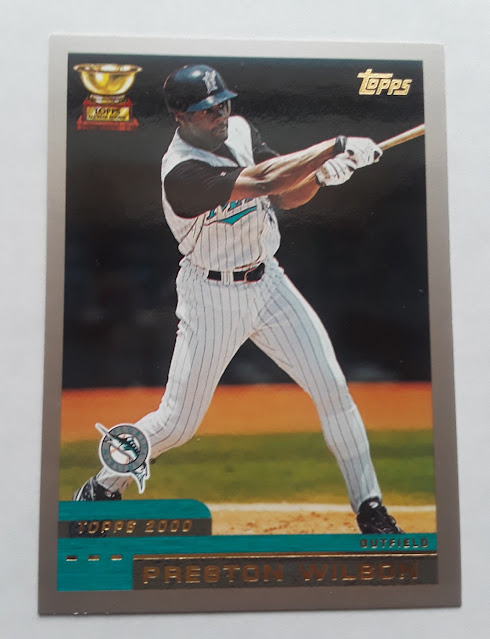
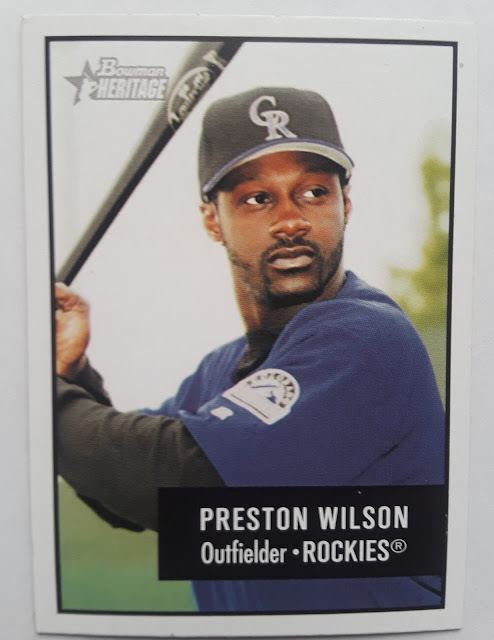
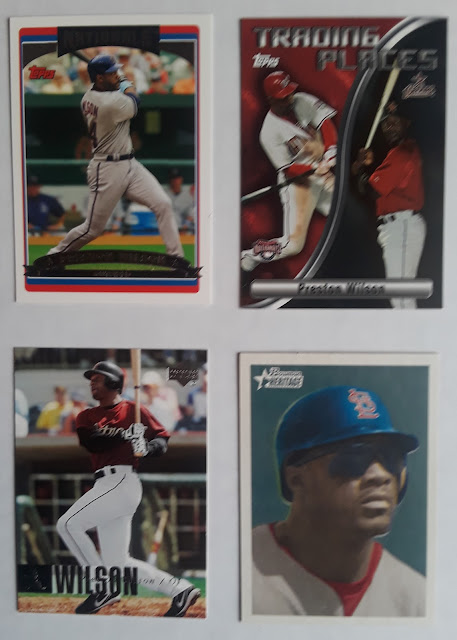
1999 Topps All-Star Rookie Outfielder Preston Wilson


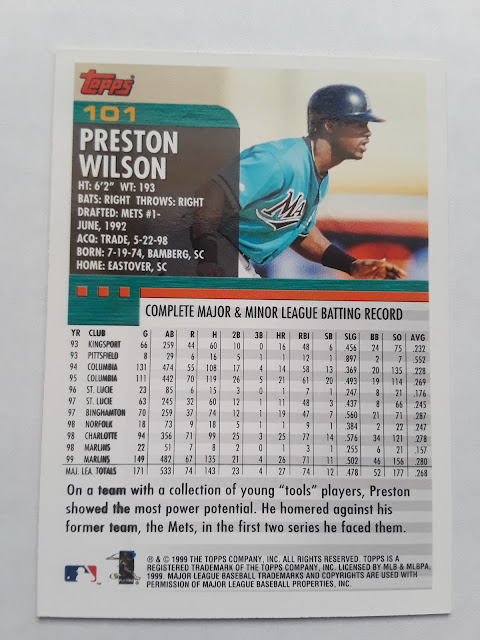
Preston Wilson arrived in the big leagues after a very long journey that took him from the first round of the 1992 MLB Draft, to 4 top-100 prospect listings, to a winter spent playing baseball in Australia. After a 5 year minor league sojourn, Wilson had arrived in Queens, only to be traded away after just 8 games for the Mets. Wilson was big time prospect coming to Florida in exchange for the Marlins' brand new catcher Mike Piazza. 


His first full season came in 1999, and he was able to show power and a little speed for an exciting and young rebuilding Marlins team. He'd finish 2nd in the NL Rookie of the Year voting and had a strong season, with a 119 OPS+ and hit 26 homers to go with 11 stolen bases. He was a great choice to join the 1999 Topps All-Star Rookie team.


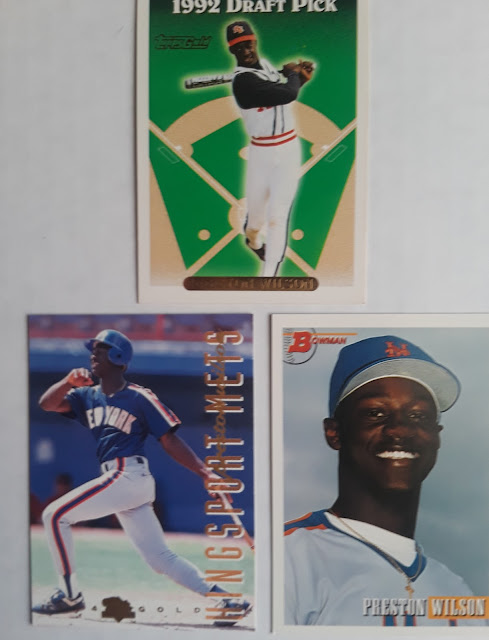
Wilson was the 9th Overall selection in the 1992 MLB draft, picked by his adopted father Mookie's former team, the New York Mets. To get the potentially awkward subject out of the way, Mookie Wilson's brother Richard was Preston's biological father, but it was Mookie that became Preston's mother Rosa's husband and raised Preston as his own son. So Mookie is technically Preston's uncle, but was also his father as far as Preston was concerned, and officially adopted him. Families are complicated, but it is clear that Preston was well loved and well raised by his parents. Preston was just 17 when he was drafted, and started his pro career with the Kingsport Mets in 1993. Before joining the Mets, he was the 1992 High School player of the year, and hit well for the 1992 18U USA National team. 

Wilson had no trouble launching the ball out of the park, hitting 17 homers in his first pro season, then at least 20 a year after that. In 1996, he played in just 23 games because of injuries to his wrist and shoulder. This had little to no impact the following season, as he hit 30 homers across 2 levels in the Mets organization, and then traveled down under for the Australian Winter League. I couldn't find any stats for his time with the Newcastle Hunter Eagles, but by the Spring of 1998, Wilson was poised to make his long awaited big league debut. He played in just 18 games for AAA Norfolk Tides before being called up in May 1998. His debut consisted of a 3 for 4 game with a stolen base and a run batted in. Each base hit, he was able to briefly visit with his dad, Mookie, who was the Mets' first base coach at the time.


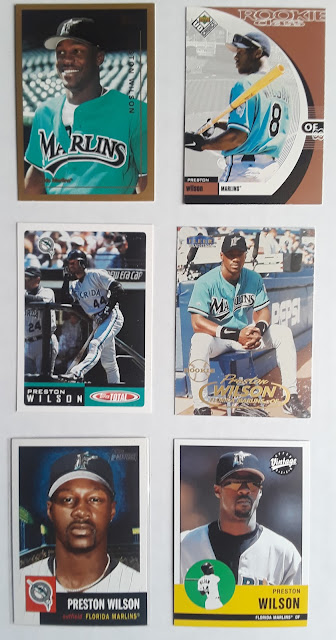
Wilson's trade to the Marlins included a demotion back to AAA, where he nearly hit 30 homers again, showing he was more than ready for a shot at the big leagues. Wilson would have an even better sophomore season, when he joined the 30-30 club in 2000. He was known for big power, but his swing also was conducive to strikeouts. In 2000, Wilson struck out 187 times, which was the most in the Majors, and nearly broke the long time record that Bobby Bonds held. Over his 4 full seasons with the Marlins, Wilson averaged 26 homers and 82 RBI per year. 


Wilson was traded to Colorado prior to the 2003 season, and the Rocky Mountain air was kind to Preston. 2003 would include career highs for Wilson across several offensive categories, and he led the National League with 141 RBI. 2003 was also Preston's lone all-star season. Wilson went 1 for 2 in the Midsummer Classic.


So, once a player has been a Topps All-Star Rookie, led the league in a few different offensive categories, made an All-Star team . . . what's left to check off? A World Series win, of course! Wilson started 2004 off slowly in Colorado, and was traded to the newly minted Nationals in Washington. He ended up playing what would amount to roughly one season with the Nats before being traded mid season to Houston, just in time to make a run at the post season. The Astros fell short, but the 2006 season would give Preston another chance to play the role of 2nd half star. Wilson was released at the deadline and picked up by the Cardinals, and he solidified the team's outfield rotation, providing a little power (9 homers in 33 games) and a little good old fashioned veteran leadership. Along with a strong cast of characters, the Cardinals would prevail in the World Series against the Detroit Tigers. Wilson appeared in all 5 games and picked up a pair of hits, scored a run, and drove in another. 


Following the 2006 championship, Wilson returned to St. Louis for an encore, but injuries limited his effectiveness and he played in just 25 games. Wilson worked hard to get back, and even played for the Independent League Long Island Ducks for 48 games in 2009 before deciding to retire. After his playing career, the charismatic and outspoken Wilson became a regular on Houston Astros and Florida Marlins broadcasts, and has dropped in as an MLB Network analyst from time to time as well. 

Wilson was recently interviewed for a Sports Illustrated article about declining participation of African-Americans in Major League Baseball, and his experiences and insights bring an important story into focus. You can read the article here -  and there's quite a bit to unpack inside. Wilson is also active on Twitter, his handle is @PrestonWilson44

Monday, January 17, 2022

1999 Topps All-Star Rookie Second Baseman Warren Morris


Many Topps All-Star Rookies have a fun anecdote or two about their path to the big leagues, and Warren Morris is no different. He's best known for his College World Series heroics, and he was also an Olympian, helping Team USA Baseball win Bronze in the 1996 Summer Games. Three years later, he was the Pirates' everyday second baseman as a rookie. His offensive stats were just about league average for a second baseman, but coming in his rookie year, average is very good. His 73 RBI led all NL rookies and were the most by a Pirates' rookie since Ralph Kiner! He collected his first major league hit on Opening Day, a double. He had a torrid first half, hitting .301 with 11 doubles, 9 homers, and 47 RBI. All this made him the obvious choice for the Topps All-Star Rookie team.


The Pirates acquired Morris along with former top prospect Todd Van Poppel from the Rangers close to the Trade deadline in 1998. Morris would be given the chance to be the team's second baseman when the Pirates decided to part ways with Tony Womack before the start of the 1999 season. Morris made his case for the spot in the Arizona Fall League in '98, leading the short season league in slugging percentage, a stat that was never Womack's strong suit.  


Morris was originally drafted by the Texas Rangers out of LSU in the 5th Round of the 1996 June Draft. Morris still found time to lead Team USA in homers in the 1996 Summer Games while hitting a robust .409. Before winning Bronze in the Olympics, Morris was the hero of the 1996 College World Series. He had missed two months of the season and was batting ninth in the order for LSU after breaking his hamate bone early in the season. The Junior would come to the plate in the bottom of the ninth against Miami with two outs, a man on third, and his team trailing by a run (which was knocked in by future Red Sox Skipper Alex Cora). Morris swung at the first pitch curve ball, hoping to make solid contact and keep the line moving, but the ball kept carrying and sailed over the fence for a dramatic walk off win. 


Morris' rookie season with Pittsburgh would be his best in the big leagues. After hitting 15 homers in his rookie year, he'd hit just 3 in 2000. Much was made of his slugging ability in his previous stops in College and the Olympics, and he also had 19 homers and 103 RBI in 1998 for the Rangers and Pirates' AA affiliates. He had a 5 hit game in June of 2000, and a 4 hit game in September, but he wasn't able to translate that to consistent success at the big league level. While he had a career high 31 doubles in 2000, the rest of his offensive stats dipped and the sophomore slump was enough for the Pirates to move on from Morris to former Twin Pat Meares at second in 2001. He would split the 2001 season between AAA and the Pirates, and hit well in the minors, with a .305 average and an OPS over .800, which made him an intriguing option for several teams the following year.


In 2002, the Minnesota Twins picked up Morris after being released by the Pirates, but he was used by the Twins in just 4 big league games. In June, he was traded from the Twins' AAA affiliate to the Cardinals minor league system, and by the end of the season had found his way to Pawtucket via waivers, now playing for Boston's AAA affiliate. He played well enough to pique the interest of the Detroit Tigers, who gave him the everyday 2B job for the 2003 season. He was still a sneaky power bat at the bottom of the order, and had developed into a very good defensive second baseman. He was helped along the way under the wing of Bill Mazeroski, whose tutelage helped Morris to lead the NL in Range Factor for 2B in 2000. For Detroit, Morris appeared in 97 games and added another 6 homers to his career totals. In 2004, he spent the entire season in AAA Toledo, again showing signs of a decent bat and a slick glove. Both Cleveland and Milwaukee gave him a look in the minors in 2005, but Morris decided to call it a career at that point. He returned home to Alexandria, LA to his wife and infant twin daughters and took a job with a local bank, where he's been employed ever since. His degree from LSU is in Zoology- Geaux Tigers!