Showing posts with label Boston Red Sox. Show all posts

Monday, March 21, 2022

1999 Topps All-Star Rookie First Baseman Brian Daubach


The path to the big leagues can be a long one - it was certainly the case for Brian Daubach, who was a rookie at the ripe old age of 27. It wasn't for lack of effort - in fact the slugger from Belleville, IL would become affectionately known as the charter member of the "Dirt Dogs," the role players that helped the early 2000s Red Sox finally overcome the Curse of the Bambino.


Daubach hit 21 homers in his first full season in the big leagues, while hitting a robust .294/.360/.562 slash line. He had a torrid month of August which included 7 homers and a .327 average. His slugging pct for the season would have ranked in the top 10 in the AL if he had enough plate appearances to qualify. Pair that with his long road to the big leagues, and it's a great story - worthy of a spot on Topps' All-Star Rookie Team. 


Drafted in the 17th Round by the Mets in 1990 out of high school. He would spend several seasons in the minors in the Mets' org with less than impressive totals - his highest slugging percentage in his first 6 seasons was .401, and his career season high in homers to that point was just 10. Then, his reputation took a hit during the player's strike in Spring Training of 1995. Daubach was placed on the Mets' replacement players' roster with other minor league Mets, playing in Spring Training games while the MLBPA was still on the picket line. As a result of crossing the line, Daubach was barred from ever joining the Players' Association. Heading into 1996, he'd even been told by a manager that he'd never be a major leaguer, and perhaps that was enough to motivate him to prove the critics wrong. He was just starting to see some progress (22 Homers in 1996) when he became a minor league free agent. He contemplated playing in Japan, but ultimately took an offer with the Florida Marlins. He slugged over .500 for the first time in his professional career, and the following season had his breakout with the Charlotte Knights, the Marlins' AAA affiliate. He led the International league in Extra base hits, and earned a call-up to play for the big league squad in September of 1998. 


The Red Sox were intrigued by his power potential that had blossomed at the right time. Daubach would hit 20 or more homers for the Red Sox in his first four seasons - a feat accomplished just 4 other times in team history. Ted Williams, Tony Conigliaro, Jim Rice, and Nomar Garciaparra being the others. He was rewarded with a $2.325 Million Dollar deal for 2002, where he would once again hit better than league average (111 OPS+) with another 20 homers for Boston. The Team would have the choice between bringing back Daubach to play first, or they could take a flier on a young player just cut loose by the Twins. The Sox chose Ortiz, so Daubach was on the move again.

Daubach spent a season in Chicago, where he'd play first base, DH, and both corner outfield positions. He hit just .230/.352/.388 in his lone South Side season, and was left looking for another gig that offseason. 2004 would bring him back to Boston, ostensibly as an insurance/injury replacement. He'd find his way into the lineup just 30 times that summer, but Red Sox fans were happy to have him all the same. He would return to the organization that drafted him in 2005, splitting time between the AAA Norfolk Tides and the Mets. He hit pretty well in Norfolk, with 16 homers and a .325 average. He would spend one more season in the minors, moving over to the Cardinals' AAA team in Memphis before retiring and getting into coaching. He is currently the hitting coach for the AAA Rochester Red Wings, and was the manager in Harrisburg when the Nationals drafted Bryce Harper. 


Sunday, January 2, 2022

I love The 80s - 1982 Boston Red Sox

 This is a series of posts on a 1980's Frankenset. Each page features a different team, with 9 of my personal favorite cards from that year's team. You might find players repeated, you'll definitely see brands repeated, but hopefully you'll agree that there are some interesting selections from the 1980s!

In 1981, which was more red? The Boston baseball team's faces, or their stockings? The season began without two of the biggest stars for the 70s teams, namely Carlton Fisk and Fred Lynn. The deadline for major league teams to tender contracts to their players was December 20th, 1980. The contracts for Fisk and Lynn were not mailed until the 22nd, effectively making them free agents. While the team was appealing the decision, Lynn was traded to the Angels (technically the teams made a separate trade the same day of Lynn's free agent signing, the trade is unofficially viewed as partial compensation for losing Lynn), but Fisk was another story altogether. The team tried to re-sign him, but the catcher found greener pastures in Chicago with the White Sox. Fisk would add the extra twist of the knife Opening Day 1981 by hitting the game winning homer against his old team in his first visit to Fenway. The rest of the 1981 season was not much better - even though the Red Sox finished 10 games above .500, they still managed to end up in 5th place in the AL East.
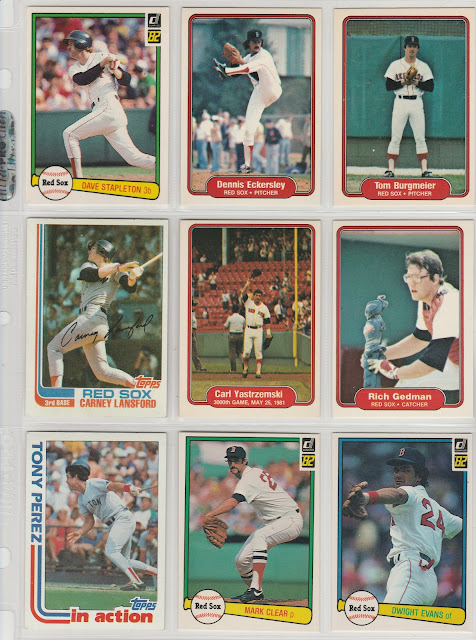


In 1982, The Red Sox surprised a lot of people by starting very hot, at one point winning 13 of 14 games during a stretch of April ball. After surging into first place, they remained atop the Eastern Division until July. There were a handful of feel-good stories as well, like the homecoming of sorts for Worcester, MA kid Mark Fidrych. "The Bird" signed a free agent deal in February with the Red Sox, but his big league career was over. Ted Williams returned to the field in the Red Sox first ever "Old-Timers" game, making a highlight in the outfield with a shoestring catch. Some might have quipped that he should have been playing alongside Ted in that game, but 42 year old Carl Yastrzemski was having an excellent season, reminding fans of the player they had cheered for two decades in the shadow of the Green Monster. As Yaz was putting the finishing touches on his career, Wade Boggs was just getting his going. While still trying to find a permanent position, Boggs forced his way into the lineup by hitting .349 over 106 games all over the Boston infield, settling at third. The good vibes weren't enough to win a pennant, however, and the Sox finished third behind the Orioles and the Division winning Brewers.

The Cards:
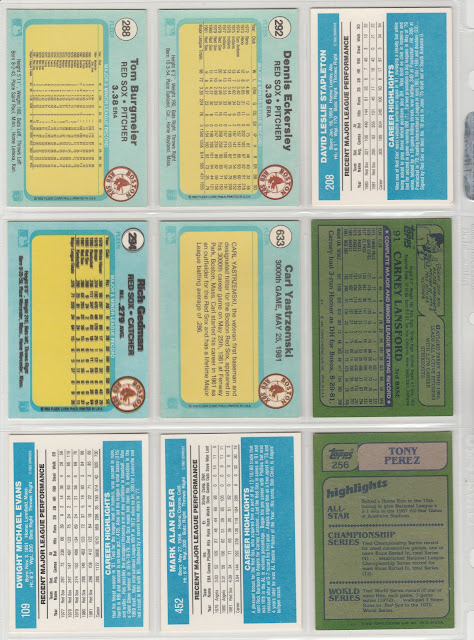
Donruss #208 Dave Stapleton - Runner-up for the 1980 Rookie of the Year award behind Joe Charbonneau of Cleveland, Dave Stapleton was a versatile infielder, sharing time with Yaz at first base and with Jerry Remy at second. By 1982, he'd spell Yaz and Tony Perez at first base more often than not, because of his defensive chops. And yes, Stapleton was regularly used as a late inning defensive replacement during the 1986 season. OK, yes, he replaced Buckner in Game 5. But not Game 6. . .   

Fleer #292 Dennis Eckersley - Eckersley recorded his 100th Career Win in 1982, which might not seem like that big of a deal, but it would in hindsight frame the first of two halves of his Hall of Fame career nicely. Eck was still a starter in 1982, going a not-that-lucky 13-13 for the Red Sox. He'd go on to many years of success as a bullpen arm, notably in Oakland with a World Series victory in 1989. He'd finish his career with 197 wins and 390 saves. He was the first pitcher to have both a 20 Win season and a 50 Save season.

Fleer #288 Tom Burgmeier - Born in St. Paul, MN, Tom Burgmeier was an early target for Twins' scouting Director Jim Rantz. It would take a long journey through the Houston minor league system and a few seasons with the Royals before the Twins could add him to their bullpen, and by the time he reached his prime in 1980, he was off to Boston to make his lone All-Star appearance as the Red Sox Closer. After 745 major league appearances, Burgmeier became a pitching coach, serving in that capacity for several organizations over a couple decades starting in 1991 with the Royals.  

Topps #91 Carney Lansford - Lansford arrived in Boston as part of the Fred Lynn trade, and did a lot to take the sting away from losing the former MVP. Moving from California's pitcher friendly Anaheim Stadium to Fenway prompted a significant spike in his batting average. Lansford won a batting title in 1981, but still wasn't a good enough hitter to keep his job as the Red Sox everyday 3rd baseman. Lansford would be traded to Oakland following the 1982 season, and very nearly won a 2nd batting title in 1989. He had an identical .336 batting average in 1981 and 1989, but fell just short of Kirby Puckett's .339. Lansford did beat Boggs by 6 points, so he's got that going for him, which is nice.

Fleer #633 Carl Yastrzemski - As mentioned above, Yaz was playing in his age 42 season in 1982. It was his 22nd major league season, all with Boston. You've heard the stats before, but just as a refresher, he was the Triple Crown winner in 1967, leading the AL in HR, RBI and Average. He was also the MVP that year, and led the AL in Slugging and OBP as well. Oh, and hits, and runs scored. And Total Bases. And he won a Gold Glove that year. And he stole 10 bases, too. He only ground into 5 double plays all season that year. My favorite Yaz tidbit though is from 1965. When Satchel Paige returned to pitch one final MLB game for the Kansas City A's, only Yaz was able to get a hit off the ageless wonder. Paige, supposedly 59 years old at the time, pitched 3 innings and it was the double by Yaz in the first as the only blemish on his scoresheet. 

Fleer #294 Rich Gedman - Another Worcester, MA guy (like Mark Fidrych), Rich Gedman was the 1981 runner up for the Rookie of the Year behind the Yankees' Dave Righetti. Gedman split catching duties with Gary Allenson in 1982, playing an even 92 games each. Gedman had more hits with his bat to ball skills, while Allenson's patience at the plate netted him more walks. Gedman's calling card was throwing out runners trying to steal. He led the AL in caught stealing three straight seasons from 1984 through the championship run in 1986. Following his breakout 1984 season when he hit 24 homers, he earned the reputation of "feared hitter" not unlike his teammate Jim Rice. Gedman drew intentional walks 24 times in his two All-Star seasons, almost twice as many as Rice over the same period. Gedman was set to be a top free agent following the 1986 World Series, but strangely found no takers. (The world would later learn this was a direct result of collusion by the owners, who all agreed not to offer big free agent contracts that offseason). Gedman would re-sign with the Red Sox, but missed the first month of the season and all of Spring Training, which resulted in a career worst .205 average in 52 games. He was most closely comparable to the career of Salvador Perez by age 26, but after the lost season of 1987, he never regained his potent bat or his regular gig behind the plate for the Red Sox. 

Topps #256 Tony Pérez - "Big Doggie" was several years removed from his Big Red Machine years with Cincinnati, and in 1982 managed just 6 homers for the Red Sox. While he was no longer the same hitter he was in years prior, he was still a highly respected and highly coveted bench bat. He would go on to play several more seasons first with Philadelphia then back again to Cincinnati, never far from Pete Rose, just in case he needed someone to drive him in from second base. His is often mentioned as a comp for other power hitters of his era still waiting to get into Cooperstown like Dave Parker, Dwight Evans, and until recently Harold Baines. Pérez was elected to the Hall of Fame by the BBWAA in 2000.

Donruss #452 Mark Clear - Another player acquired for Fred Lynn, Mark Clear notched 9 saves and won 8 games for the Red Sox in his first season in Boston. In 1982, he was an AL All-Star selection, and had a career high 14 victories, all coming in relief. Originally signed by the Phillies to be a starter, poor mechanics led to back problems and an early release from his contract. Clear cleaned up his delivery (thanks to his uncle, who was the Angels' bullpen coach) and rehabbed with a back brace before signing a minor league deal with California. Once converted to relief work, he thrived. He was an All-Star his rookie season with the Angels, and was well on his way to a solid MLB career. 

Donruss #109 Dwight Evans - Somehow Evans managed to fly under the radar again in 1982. Despite hitting 32 homers and driving in 98 runs and leading the league with a .402 OBP finished a distant 7th in the MVP balloting (let's be fair, though, the right guy won (Robin Yount)). Evans is the Rodney Dangerfield of the Red Sox. Did you know that he's 2nd all-time in games played by a Red Sox player, trailing only Yaz? Evans also has 8 Gold Glove awards, easily the most by a Red Sox outfielder, and trailing only the best of the best in MLB history- Mays, Griffey Jr., Clemente, and Kaline. He hit more homers in the 1980s (256) than any other AL player.


Monday, October 12, 2020

1998 Topps All-Star Rookie Outfielder Mark Kotsay


In College, Mark Kotsay was the Big Man on Campus, starring for the Cal State Fullerton Titans in the 1995 College World Series. In 1998 with the Marlins, he looked like he might be a fish out of water. Young and unproven, Kotsay was given the tall order of taking over Right Field in place of Gary Sheffield. He finished the season with more games played than any other Marlin, and was near the top of the list in most of the team's offensive leaderboards. His 20 outfield assists were the most in the National League. You better believe that was enough to make Mark a member of the 1998 Topps All-Star Rookie team.


Kotsay found success at every level of play - in 1994 he played in the Cape Cod league following his freshman year at baseball powerhouse Cal State Fullerton. 1995 saw him set a record with a .517 average in the 1995 College World Series. His team would win their 3rd straight CWS, and he walked away with the Golden Spikes award. In 1996, he was selected by the Marlins as the #9 Overall pick in the June draft, played on Team USA in the 1996 Summer Olympic Games, and made his pro debut for the Kane County Cougars. By 1997, he had made it all the way up to the big leagues for a two week cup of coffee in July. The Marlins organization had big plans for Kotsay - little did he know that the team would win it all in 1997 - then blow it all up for the next season, totally re-making the outfield from the season before.


Kotsay would play 3 full seasons for the Marlins, playing a combo of Centerfield, Right, and 1st base. He didn't have the power numbers he displayed in college, but he definitely still had the contact skills. Kotsay was used near the top of the lineup and he piled up the hits. In the field, he continued to show off a cannon for an arm, leading the NL in assists in his rookie year and again in 1999. He would be traded to San Diego just before the 2001 season began. 


The Padres made Kotsay their everyday Centerfielder, and he continued to display line drive power to the gaps and excellent contact numbers. His outfield assists dwindled down to just 4 in his first season in San Diego, but that was mostly due to the word getting around that trying to take the extra base against him would usually end in embarrassment for the runner. From 2002 through 2004 he would again lead the league in assists as a Centerfielder, surpassing double digits each year. 2002 would also prove to be one of his best offensive seasons, hitting .292 with 17 homers and a 122 OPS+. Following the 2003 season, Kotsay was on the move again, as the Oakland A's traded Terrance Long and Ramon Hernandez to make him their leadoff man and centerfielder. 


Kotsay responded with a career high 190 hits, which was the most by a lefty in Oakland in more than 40 years. He also set a career high batting average, hitting .314 despite playing half of his games with the huge foul territory in Oakland, known to suppress those stats. One reason he was so successful in Oakland was his ability to limit strikeouts. In 2005 he struck out at a rate of once per 11.4 ABs, which was the 2nd best K rate in the American League. He'd get his first taste of post season play in 2006, hitting a home run against the Twins in the ALDS, and adding 4 more hits in the ALCS in a losing effort against the Tigers. The injury bug bit him in 2007, playing in just 56 games and a career low .214 average over that span. 


Kotsay was on the move again after that lost season, traded to Atlanta in January. He'd have a rare highlight for Atlanta in August of 2008, going 5-5 and hitting for the cycle. With Atlanta uncharacteristically out of post season contention, Kotsay was dealt again mid-season, going to the Red Sox to help their playoff push. Kotsay was happy to join Boston, as he listed playing in a World Series as his few remaining goals. He was quoted as saying after the trade "the respect of your peers is what you play the game for, and nothing else." He was eager for another shot at a championship with a talented team. He provided depth in the outfield and a valuable bat in the post season, hitting .300 in the ALDS and adding 7 more hits in the ALCS, but the Red Sox were bounced out by the Rays. He would be used as a reserve in 2009 by the Red Sox, then was dealt at the trade deadline again to Chicago. With the White Sox, he would spend more time as a DH than at any time in his career, and was no longer the everyday player he once was. His reputation was that of a "grinder / gamer" but at this point his goal was to provide leadership and defense when called upon. He'd get another post season shot in 2011 with Milwaukee reaching the LCS again, but falling just shy of the World Series.

He'd finish out his career back in San Diego, closer to his wife and kids in Southern California. He had been not so subtly hinting at a reunion for the past few years with the Padres, stating in an interview that he would call the team himself and inquire about an opening in the offseason. The veteran leadership would segue perfectly into coaching. He would retire in 2014, then return in 2015 as the Padres new hitting coach. He would move on to Oakland in 2015 as a bench coach, and recently has been one of the top names for managerial jobs in Boston, San Francisco, and Pittsburgh recently. Another spot opened up today on the South Side, could he be in line again for the role?

For his MLB career, Kotsay had 1,784 hits, scored 790 runs and drove in 720 more. He had 123 outfield assists, and was widely regarded as one of the better outfield defenders in the league by his peers. He was named to the Omaha (College World Series) Hall of Fame in 2014, and was named College Baseball's Player of the Decade for the 1990s. 

Do you have any Mark Kotsay memories? I'd love to read them in the comments below. 

Thanks for reading!


Monday, July 13, 2020

1997 Topps All-Star Rookie Short Stop Nomar Garciaparra


With some players, there's very little mystery. Will they have what it takes to perform at the highest level? Do skills at a young age translate to the big leagues? In the case of Nomar Garciaparra, it was obvious from the beginning that something special was happening. Nomar's rookie season was among the best of all-time. He was a complete player right out of the box. He was the AL leader in hits and triples. He hit .306 with 30 homers and he scored 122 runs. He stole 22 bases, while playing excellent defense at a premium position. He ran away with the Rookie of the Year award, so of course he was the selection at Short Stop for the 1997 Topps All-Star Rookie team.


He was an All-Star, won a Silver Slugger award, finished 8th in the MVP vote, and was a unanimous Rookie of the Year for the Red Sox. All of this came after a rough 24 games in 1996 at the big league level. That short stint was all he needed to make the necessary adjustments. He was no stranger to taking a big leap into unfamiliar waters. 


As a college freshman, Nomar was a walk-on with the Team USA Olympic baseball team. He ended up as their starting short stop, and the team finished 4th in the 1992 Summer Games. His college career at Georgia Tech was fairly impressive. He was the 1992 ACC Rookie of the Year, and his 1994 season is one for the ages. He hit .427 with 26 doubles, 11 triples, 16 homers, 73 RBI and 33 stolen bases. Not too shabby.


Nomar was selected 12th overall by the Red Sox in the 1994 MLB June draft. His first taste of pro ball wasn't overly impressive. In 28 games for the Sarasota Sox, he hit a respectable .295 with one homer and 5 stolen bases. The following year his hitting took another step back, with a .267 average at AA Trenton, but he did flash the glove and the wheels, stealing 35 bases. Nomar was being promoted each season, but hadn't really had a breakout performance by 1996. In AAA Pawtucket, everything came together quickly. He torched the ball to the tune of .343/.387/.733 in 43 games. The torrid pace forced the Red Sox to make a move, calling the youngster up to the big leagues in August. 


Nomar's rookie season was tremendous, but he wasn't just a one hit wonder. He excelled in his time at Fenway Park, hitting a robust .323/.370/.553 over 9 seasons. His second year, he was the AL MVP runner-up, leading the Red Sox in runs scored and runs batted in. If not for the fact that he was splitting votes with his teammate Mo Vaughn, he might have been the outright winner that season. He followed that campaign up with a pair of batting titles, including an incredible .372 average for the year 2000. He led the AL in intentional walks that season as well. His best season in Beantown is hard to pick - was it his rookie year? His 2 batting title years? 2002, when he led the AL with 52 doubles? 2003 when he had 120 runs scored to go along with 13 triples, 37 doubles, and 28 homers? The Red Sox ran on Nomar for nearly a decade, and his play inspired the team despite not resulting in the ultimate prize of a World Series victory. A wrist injury limited him to just 21 games in 2001, snapping a string of 4 straight top-10 MVP finishes. Injuries would define the end of his Boston tenure, even though they were sandwiched between a pair of productive seasons. 2004 was truncated by an Achilles' heel injury, keeping Nomar out of the lineup until late June. He was hitting .321 for Boston when he was traded as part of a 4 team blockbuster with the Twins, Expos, and Cubs. Boston was after a defensive upgrade, securing the services of Doug Mientkiewicz and Orlando Cabrera, and Nomar found himself heading to Wrigley Field. Nomar would miss out on the Red Sox' World Series win, though his former teammates voted to give him a partial share of the World Series pot and sent him a World Series ring. The fact is that the Red Sox might not have attracted the big name free agents like Pedro, Schilling, and Manny Ramirez without a star like Nomar to build around. Ironically the team's egos were mostly sidelined for the championship run, but Nomar's contract extension dispute was the lone exception. While he didn't play with arrogance, the Red Sox certainly treated him like a malcontent before shipping him out. 


The Cubs were disappointing in his year and a half in Chicago, and so was Nomar. He would play in just 62 games for the Cubs in 2005, missing 3 months due to a groin injury. The injuries that slowed Nomar at the end of his Red Sox career were not the same ones that derailed his Cubs career, but hurt his future earnings all the same. Thankfully for Nomar, the Dodgers had deep pockets, and were more than happy to pay for his services. Things were looking up for Nomar in his first full season in LA, and he was coming home after growing up in Southern California just minutes from Chavez Ravine. He would return to the All-Star game for the final time, and racked up 2.5 WAR, his highest total since his 2003 season. He had a 120 OPS+. which was decent, but still a shadow of his former self. The next year his production slipped and he was moved around the diamond to accommodate other players like James Loney at first base. Injuries towards the end of the year didn't help. 2008 was nearly lost before it began for Nomar, when he suffered a microfracture in his hand. He would return to Short Stop for the first time since 2005, but was now relegated to fill-in and bench duty. He would play in just 55 games as his playing time and production fell off dramatically.


He would play one final season in the big leagues, signing a one year deal with the Oakland A's in 2009. Over 65 games, Garciaparra hit .281 as a DH/first baseman. For his career, he was a .313/.361/.521 hitter. if not for several seasons derailed by injury and the general wear and tear, he might have reached 2,000 career hits. He was even better in the post season over his career, hitting .321/.386/.589 in 32 playoff games. His career was cut short by injuries, but his peak was certainly Hall of Fame worthy. He certainly falls short in counting stats over his career, but when he was at his best, there were few players that could match his skills on the diamond.


Any specific Nomar memories you'd like to share? I'd love to read them in the comments below. Thanks for reading!

Monday, June 22, 2020

1997 Topps All-Star Rookie Catcher Scott Hatteberg


In his rookie season, Scott Hatteberg lived up to the expectations of a first round selection, hitting .277 with 10 homers for the Red Sox as their primary catcher. To make the Topps All-Star Rookie Team, you have to have a mix of potential and production, and Hatteberg was able to deliver both in 1997.


He had a brief visit to the big leagues in 1995, getting a hit in his first MLB plate appearance. Another cup of coffee came in 1996, but it was 1997 where Hatteberg got his first opportunity to make an impact at the big league level. He started the season as the personal catcher of Aaron Sele, but hit his way up from once every five days into a platoon with Bill Haselman, and eventually was the main man behind the dish. Haselman, who broke training camp as the presumptive starting catcher, finished the season playing in just 67 games to Hatteberg's 114. 


Hatteberg was selected 43rd Overall by the Red Sox, a supplemental first round pick that the Red Sox were granted for losing Mike Boddicker to free agency. Hatteberg was one of the catchers for Team USA in 1990 for the Goodwill Games and the World Cup. He was a star for Washington State (where he first teamed up with Aaron Sele), and was the team captain. Once he was drafted by the Red Sox, the organization took their time to develop their young prospect. He would make quick work of the Rookie league and Single A level, but would repeat AA twice, then AAA two more times. But by 1997, Hatteberg was out of minor league options, and he was all but guaranteed a spot on the 25 man roster. 


The timing for Hatteberg could have been better in Boston - just as he was getting a chance to be the man in Boston, an even bigger prospect was making his way through the ranks and would make his presence felt in 1998. Jason Varitek became the everyday catcher for the Red Sox by 1999, with Hatteberg playing in just 30 games. This was due in part to a serious elbow injury Hatteberg suffered which gave him nerve damage in his throwing arm. After a four month recovery period, Hatteberg was "back," but not the same. The book on Hatteberg was that you could steal bases against him - and that was before he had to re-learn how to grip and throw a baseball. His catching days (and by extension his baseball career) was in jeopardy. Despite this injury, the Red Sox continued with Hatteberg behind the plate for two more seasons. They even tried him at third base briefly in 2000, but his arm troubles were not improved by the longer distance. Following the 2001 season, the Red Sox traded Hatteberg to the Rockies for Pokey Reese. Two days later, Hatteberg was a free agent. 


One of the reasons the Red Sox kept him around for so long with a bum elbow was that he could still provide value on offense. He would become the prototypical example of "Moneyball" strategy when Oakland signed him in the 2001 off-season. As detailed in the Michael Lewis book and played for comedic effect in the film of the same name, Hatteberg was going to be able to continue his MLB career by converting to 1st Base, and provide his greatest skill - getting on base. The Moneyball approach was to identify those players that were undervalued by everyone else, but provided something that few other players could. Hatteberg was ostensibly replacing the big bopper Jason Giambi, who signed with the New York Yankees. But GM Billy Beane was not asking Hatteberg to hit 38 homers and drive in 120 like Giambi did in 2001. Instead, he just wanted Hatteberg to get on base. His first season with the A's he did exactly that - his .374 OBP was a then-career high for a full season. He did provide some bonus power, as well - he had 15 homers in the 2002 season, including a walk-off winner that clinched the A's 20th consecutive victory early in September. 

With Oakland, Hatteberg had some of his best offensive seasons, hitting double digit homers each year, a career high 82 RBI in 2004 and a .269/.355/.396 slash line across 3 seasons. 


Like many players in their later seasons, Hatteberg had honed and perfected the skills that made him a big leaguer in the first place. He actually posted a higher triple slash in his final 3 seasons in Cincinnati than he had in his years playing for Oakland. His OBP improved even more as he would provide a valuable bat in the lineup. The Reds made room for Hatteberg at First Base, trading Wily Mo Pena and moving Adam Dunn to the outfield. In 116 games in 2007 he slashed a career high .310/.394/.474 with 10 homers. Hatteberg had 1,153 career hits and a .361 OBP. He walked more times than he struck out, and more times than he drove in runs. Despite a reputation as a less than stellar defender behind the plate, he retired with a .992 fielding pct as a Catcher and First Baseman combined. 

Do you have any Scott Hatteberg Stories? I'd love to read them in the comments below. 
Thanks for reading!

Monday, May 4, 2020

1996 Topps All-Star Rookie First Baseman Tony Clark

Tony the Tiger? He's Gr-r-r-r-reat!

Tony Clark was a prototypical Topps All-Star Rookie Candidate. The Switch hitting slugger was a mid season call-up and made major contributions to his team's offense. Clark also had a great story of making it to the show after possibly having his career derailed before it began. Over just 100 games for the Tigers, Tony crushed 27 home runs, to lead the team.


Tony the Tiger had a mixture of those impressive stats and impressive moments. He had a 2 HR game in September of 1996 - the first blast cleared the roof in Right Field at Tiger Stadium, which was often the benchmark used to measure whether new Tigers sluggers were legit or not. Clark slugged .503 in his rookie season, finishing 3rd in the AL Rookie of the Year voting.


Drafted by the Tigers in the 1st Round in 1990, Clark was a 2-sport star in high school in San Diego. Clark broke a single-season scoring record set by Basketball Hall of Famer Bill Walton. His senior season he averaged nearly 44 points per game. His pro contract with the Tigers allowed him to play College Basketball and baseball in the summers. At San Diego State University, Clark suffered a back injury falling on a teammate's foot during practice that ended his 1991 baseball season before it began. He would return the following season, but played in just 26 games. He did play well when he was on the field, slashing .306/.372/.588 for low-A Niagra Falls. After another season with just 36 games played, fans may have begun to wonder if  Clark was going to be a bust. He decided to leave San Diego State to focus solely on Baseball. 1994 would be a make or break year for Tony, so he chose making it by way of breaking it - he crushed 23 homers and drove in 99 runs over AA and AAA. He spent most of 1995 in AAA Toledo, where he would again slug the ball hard, and he earned a late season call-up to join the Tigers.


Clark's best MLB seasons came during his time in Detroit. He averaged 31 homers and 98 RBI each year from 1996 through 1999. Injuries would bite him again in 2000, playing in just 60 games, but once again he would bounce back to make his lone All-Star appearance in 2001. He hit 156 homers and had over 500 RBI in his time with the Tigers, and became just the 13th Switch Hitter to rack up 30+ homers in a season in MLB history. His OPS+ during his Tiger tenure was a strong 121.


Clark's career following his time in the motor city was a series of bright starts followed by injury woes and then more comebacks. He hit home runs in his first game played with Boston, the Mets, and the Yankees. At each of those stops along the way, Clark would struggle repeat his Tiger success. Clark was no longer being utilized as an everyday player. It may have just taken time for him to adjust to the new role. After joining the Diamondbacks in 2005,  Clark would surprise everyone by hitting 30 homers, and doing it in just 349 at bats. He had career highs in batting average, slugging, and OPS at age 35. Young players looked to Clark for advice and he was nominated to be the team's player representative for the MLBPA. 


Clark's experience as a player rep got his foot in the door with the MLBPA following his playing career. In 2013, after spending time as the deputy executive director. Clark was promoted to head the union, and has been the Executive Director ever since. Clark is still highly respected by players, rookies and veterans alike think of him as the go to guy for any questions they have about the baseball life, both on the field and as union members.

Clark retired from playing in 2009, with 251 career homers, the 13th highest total among all Switch Hitters. He hit homers from both sides of the plate in the same game 10 times, which ranks favorably compared to the great power hitting switch hitters like Mantle, Murray, Teixeira, and ... uh, Nick Swisher? He also has a unique claim to fame - hitting home runs in Japan in 2004, in Puerto Rico in 2003, and all Continental U.S. time zones in between, he has the All-Time record for most time zones homered in during MLB games.

What are some of your Tony Clark memories? 

Monday, December 9, 2019

1995 Topps All-Star Rookie Right Handed Pitcher Hideo Nomo


The Dodgers were no strangers to great pitching (like Koufax), and no strangers to phenoms (like Fernandomania). With Hideo Nomo, they once again found a player that elevated the game. Nomo came to the Los Angeles Dodgers as just the second Japanese-born player in MLB history. And unlike Masanori Murakami in the 1960s, Nomo came to the United States with no contractual restrictions. Nomo was here to stay.

Nomo was the clear favorite for National League Rookie of the Year, and not just because he played for the Dodgers. Following in the footsteps of Karros, Piazza, and Mondesi, Nomo won Rookie of the Year honors leading the National League in Strikeouts and Shutouts. He broke the Dodger rookie record for Ks, and his 11.1 K/9 rate broke Sandy Koufax's team record. The only factor working against him for the award was the debate over whether or not the 26 year old was truly a "rookie" having excelled for years in Japan's Nippon Professional Baseball.


In Japan, he had been passed over in the 1988 NPB draft due to "poor control," but he would perfect his signature forkball in the Industrial League in Japan, representing Nippon Steel in Osaka. His performance earned him a spot on Team Japan in the 1988 Olympic games, which finally drew the attention of NPB clubs.
Nomo debuted in professional ball in 1990, leading the league in Strikeouts with 287. Over his 5 seasons in the NPB with the Kintetsu Buffaloes, Nomo had 13 shutouts and struck out over 1200 batters in just over 1000 innings pitched. In 1994, Nomo was hurt for much of the year, and pitching for a new coach who believed in pitching through pain. The new coach was an All-Time Great NPB pitcher who commanded a great deal of respect. At the same time, Nomo was eagerly hoping to prove his abilities against a new set of challenges. After consulting with agents in the United States, Nomo opted to retire from the NPB at the age of 26. The rules of the league allowed him to become an unrestricted free agent for any other league. Kintetsu would retain his rights if he returned to pitching in the NPB.


The Dodgers would wring all they could from Nomo's arm, having him toss an average of 200+ innings in his first 4 seasons. Nomo would not reach the dizzying heights of his rookie campaign again, but he would continue to strike out batters at a blistering clip. He joined Dwight Gooden as the only two MLB pitchers to strike out 200+ batters in each of his first 3 seasons. In 1996, Nomo made history again, tossing a no-hitter at Coors Field (this is before the humidor was installed, by the way.). He is still the only pitcher to toss a no-hitter in the rare air of Colorado.


As a hitter? Well, no one would confuse him for Shohei Ohtani, though he would find some power later in his career. He would hit his first MLB home run in 1998, just months before being traded to the New York Mets.


Nomo would bounce around the league after leaving the Dodgers, but he would continue his assault on the all-time strikeout leaderboard. In 1999, Nomo reached 1,000 career strikeouts. He was 3rd fastest to reach the milestone in MLB history. Nomo would also lead the AL in Ks in 2001 pitching for the Red Sox. He would also toss another no hitter, becoming just the 4th pitcher to toss a no-hitter in both leagues. The 2001 No-hitter came at Camden Yards in Baltimore, and he is the only pitcher to toss a no-hitter at that ballpark, too!


Nomo would return to LA beginning in 2002, and he would pitch for 3 more seasons in Southern Califonia. His career in a Dodgers' uniform included an 81-66 record and 1,200 Ks in 1,217 innings.


After being becoming a free agent before the 2005 season, Nomo signed with Tampa Bay and had a less than Nomo-like season, and he was released after 19 starts. That number is significant, as Nomo was due an additional $700,000 if he made 20 starts for the Rays. The Yankees signed him to a minor league deal and he finished out the year at their AAA affiliate. He would spend 2006 with the White Sox organization, but did not get a call-up.

His career appeared to be over, but he would appear in the Venezuelan Winter League pitching for his former catcher, now manager Carlos Hernandez. He signed a minor league deal in 2008 with Kansas City, and would make 3 relief appearances for the Royals before being designated for assignment. He would retire officially in July of 2008, with over 200 victories combined between the NPB and MLB. He was inducted into the Japanese Baseball Hall of Fame in 2014.

What are your favorite Hideo Nomo stories?

Monday, November 4, 2019

1994 Topps All-Star Rookie Outfielder Manny Ramirez


Every team he played for had a "Manny Being Manny" story. Whether it was leaving his paycheck behind in his cleats on a road trip, or leaving the field of play to use the restroom inside the Green Monster. Manny Ramirez was a player who moved to the beat of his own drummer. Antics aside, Ramirez would show from his rookie year on that he was one of the best hitters to ever play the game.


He was a pre-season lock to be the 1994 AL Rookie of the Year, and while he didn't quite meet that expectation, there was little reason to think that he was anything less than a budding superstar. He played in just 91 games in the strike shortened season, ranking 2nd among rookies in Homers, RBI, Doubles, and hits.


Ramirez was born in Santo Domingo, Dominican Republic, but attended high school in New York City. His family moved to NYC when Manny was 13 years old, and by the time he was a high school Senior at George Washington High school, he was already a legend among those that had seen his offensive prowess. His Senior year, he batted .650 with 14 homers in 22 games. He was a first round draft pick of Cleveland, and made a steady climb up the minors, hitting double digit homers at each stop along the way. Across AA and AAA in 1993, Manny hit .333 with 31 homers and 115 RBI. By 1994 he was ready for the show.


Over his 8 seasons in Cleveland, Ramirez made 4 All-Star teams, and won 3 Silver Slugger awards. He would appear in 10 different post-season series with the team, slugging 13 homers over those games. Even when not hitting, he contributed to his team's offense by scoring runs after drawing walks. While he was never mistaken for an adept fielder in left field, his bat more than made up for his limited range. His Cleveland career included over 1,000 hits and 232 homers with a .313 average. While they did not win a World Series during his time there, the team would not have been the dynasty they became in the 90s without his bat in the middle of the lineup.


In Boston, the young talent matured into a savvy veteran with very few weaknesses at the plate. During his Red Sox tenure, Manny won a batting title (2002), a home run title (2004), and a World Series MVP award (2004). He was an All-Star in all 8 seasons with Boston, and won 6 Silver Slugger awards. In those 8 seasons, he had over 1200 hits and 274 homers.


None was celebrated bigger than this one, a walk off winner in game 2 of the 2007 ALDS.


To many, Manny's time in Los Angeles was disappointing. He was not able to lead the Dodgers to a World Series, even though he hit .391 after being acquired by the Dodgers half way through the 2008 season. He would hit .500 in the NLDS against the Cubs, and .533 against the Phillies in the NLCS in a losing effort. The following season he ran afoul of the league's drug testing, and was suspended for 50 games, testing positive for a drug that can be used to mask steroid use. He would still be eligible for post season play, hitting .308 in the NLDS and a homer in the NLCS. He would run into injury issues in 2010, losing his regular role in LF. After being ejected for arguing strike one with an umpire in a pinch hitting appearance, the Dodgers placed Ramirez on waivers.


He would finish 2010 with the Chicago White Sox, then signed with Tampa Bay in the off season. He had a strong Spring Training, but struggled early in the 2011 season for the Rays. It was then revealed that he had tested positive for another PED, and Ramirez abruptly retired. He would attempt comebacks in 2012 with Oakland, 2013 with the Rangers, and in 2014 with the Chicago Cubs, but each time he ended the season without a major league at bat.


Is Manny a Hall of Famer? He's already in the Hall of Stats and the Hall of Merit - but those 2 failed drug tests seem to have made the decision for the BBWAA writers already. In his 3 years on the ballot so far, he has yet to reach even 25% of the vote.

Sunday, October 6, 2019

It Ain't Over til It's Over


I'm not going to sugarcoat it - things look bad right now for the Minnesota Twins, facing an 0-2 deficit to the New York Yankees in the ALDS. The first two games could hardly have been much worse, thankfully none of the Twins were injured, save for their pride. HOWEVER! The Yankees haven't won that 3rd game yet, and the series turns to Minnesota tomorrow. It might be unlikely, but why don't we take a look at what unlikely looks like? Why not take a look at some ways that a series can turn around? It might make me feel better, OK? Rays fans, I see you too - hope this helps a bit.


1981 NLDS - Dodgers come back against the Houston Astros

1981 included a Divisional Series because of the strike that split the season into two parts. The Dodgers actually had the home-field advantage, though they lost games 1 and 2 on the road. Not much of an advantage when Houston only had to win one in LA.

But the Dodgers were up to the task, thanks to stalwart starting pitching, including a complete game from Fernando Valenzuela in Game 4, leading to a duel between Jerry Reuss and Nolan Ryan, who was working on regular rest and was Nolan freakin' Ryan. Reuss tossed a shutout, and the Dodgers bats had just enough to win 4-0. Garvey would hit .368 in the series including a game 3 homer that sparked the comeback. The Dodgers did it without Ron Cey, though he would be back in time for the World Series, where he was the MVP.


1982 ALCS - Brewers defeat the California Angels

Don Sutton tossed 7 scoreless innings in Game 3, Ben Oglivie blasted a homer and Cecil Cooper hit a 2-run single in Game 5 to power "Harvey's Wallbangers" to a series victory. The series was so close that the ALCS MVP ended up being Angels OF Fred Lynn in a losing cause. Robin Yount struggled for the Brew Crew in the series, with a .250 average and no extra base hits.


1984 ALCS - Padres defeat the Cubs

Game 4 - Postseason vet with ice in veins, Steve Garvey, blasts a 2 run walkoff homer, setting up a winner-takes-all finale.

Game 5- Carmelo Martinez draws a 4 pitch walk, a bunt moves him to 2nd, then Tim Flannery gets a key hit right through the wickets of Leon Durham. Goose Gossage locks down the win by pitching the last two innings.


1995 ALDS - Seattle Mariners defeat the New York Yankees

Now in the Divisional Series era, the ALCS and NLCS is stretched to 7 games, but the new Division series remains best of five. The Yankees jumped out to an early 2-0 lead against a Seattle team that had already tested their mettle in a tie-breaker game over the Angels.

Back in the Kingdome, the Mariners leaned on Randy Johnson for a gutsy seven innings. He struck out 10, and the Mariners won 6-4. Game 4 was a seesaw game until Edgar Martinez crushed a grand slam in the 8th off John Wetteland.

The Game 5 finale was one of the best games in playoff history. The lead would change hands 6 times, David Cone threw 140 pitches for the Yankees, Randy Johnson came in to relieve in extra innings, but the final rally came in the bottom of the 11th. Joey Cora singles, backed by a Griffey single, and Edgar Martinez was back again to be the hero, lacing a liner down the left field line, scoring both runners in an epic finish.


1999 ALDS - Red Sox defeat Cleveland

The format of the 5 game series was now the current 2-2-1 version by the time this series was played.

Both teams won their home games in decisive fashion, including a ridiculous 23-7 rout in game 4 by the Red Sox, in which John Valentin drove in 7 runs. Nomar hit over .400 for the series.

Game 5 included quite a lot of early offense, including 2 homers by Jim Thome. Troy O'Leary matched Valentin's 7 RBI in the game, but the real story was the relief appearance of Pedro Martinez. Martinez was coming off 4 scoreless innings in Game 1 before leaving due to injury. In Game 5, Martinez came in to an 8-8 tie game, and no-hit Cleveland for 6 relief innings, pitching on fumes but still striking out 8 batters.


2001 ALDS - Yankees beat A's

oh. The Yankees are on this list, too? Do I have to? Fine.

People remember "The Flip" by Derek Jeter, but Mike Mussina out-dueled Barry Zito (When Zito was Zito!) in that game, and the only run came on Jorge Posada's Solo homer.

Mariano Rivera was at his best, closing out a pair of the final three games in his usual dominant fashion.


2003 ALDS - Red Sox over the A's

The Red Sox are free to share some mojo with the Twins this year, I'm sure they won't mind if it means beating the Yankees.

In 2003, it was Jason Varitek with a key block of the plate that started a chain reaction of base running blunders that swung momentum back to the Red Sox in Game 3. David Ortiz had a clutch 2 run double in Game 4, and Pedro dominated in Game 5, with Manny Ramirez providing the offensive production to give the Sox the series win.


2012 NLDS - Giants defeat Reds

Ryan Vogelsong gave the Giants a boost with a gutty performance in Game 3, with the win ultimately going to Sergio Romo in relief. Game 4 had a Pedro-like relief appearance by started Tim Lincecum, and Buster Posey crushed a grand slam in Game 5 that proved to be deciding runs, with Romo coming back to get the save.

The Giants would go on to win the whole thing, taking the World Series crown, just like the Dodgers did in 1981. Twins, take notes, and ask Romo for tips.


2015 ALDS - Toronto defeats the Rangers

At this point the pattern becomes familiar - Marco Estrada comes up big in game 3, with Troy Tulowitski providing a key hit. Game 4 included big offense from the Jays winning 8-4 behind an R.A. Dickey start (and in spite of a disastrous David Price Relief appearance.). Game 5 is remember for Bautista and the bat flip heard round the world, but Marcus Stroman provided 6 strong innings for the Jays to keep the game close.

So! That's encouraging. Never mind that the team going up 2-0 will win the series about 90% of the time. Just need to get something started for Game 3 - a strong start, some timely hitting, and then worry about game 4 after that.