Showing posts with label Chicago Cubs. Show all posts

Monday, January 10, 2022

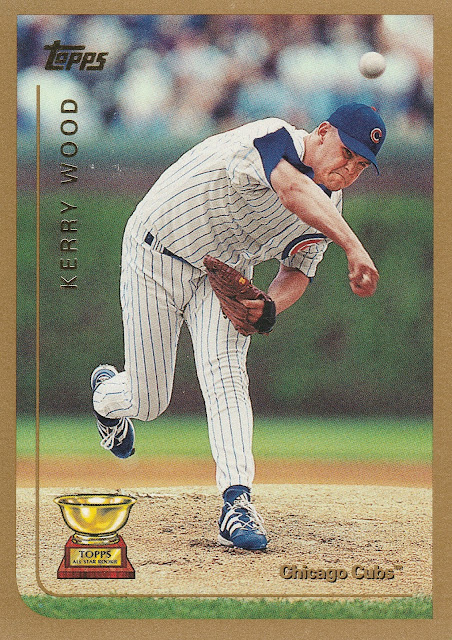
1998 Topps All-Star Rookie Right Handed Pitcher Kerry Wood


If you see this from the batter's box, you are in for a long day. Kerry Wood in 1998 was the NL Rookie of the Year, so of course he was Topps' first choice for right handed pitcher on their All-Star Rookie Squad. That season, Wood piled up the strikeouts (the most by a Chicago Cub since Hall of Famer Fergie Jenkins in the 1970s), and won 13 games. He had one Complete Game,  which was a shutout, but we'll talk about that game in a bit.
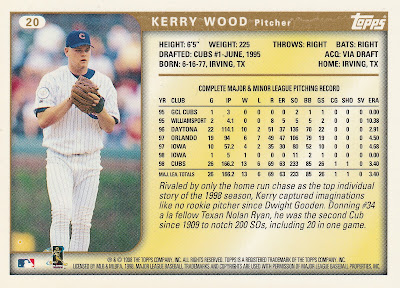

Topps went as far as to say that Kerry's rookie campaign was comparable to Dwight Gooden's phenomenal debut season, and the story of Kerry's season was second only to his teammate Sammy Sosa's chase with Mark McGwire to un-seat Roger Maris as the single season Home Run King. He led the NL in H/9 and K/9, but his electric stuff could be a little tough to harness at times. His 85 walks ranked in the top ten in the NL that year as well as hitting 11 batters and uncorking 6 wild pitches. Sometimes a little wildness can go a long way towards baffling the opposing batters.
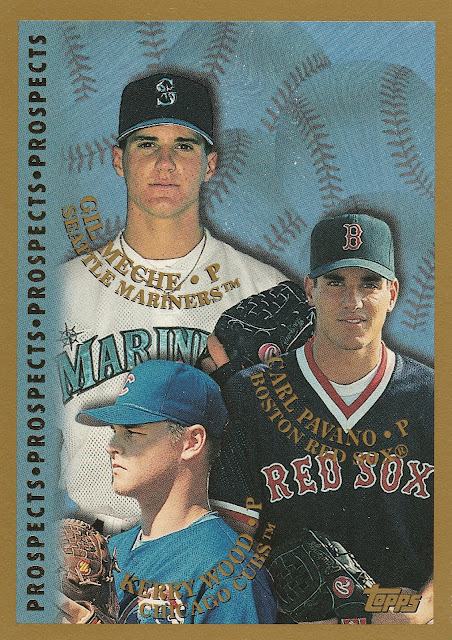

The Cubs made Kerry a first round pick in 1995, selecting him out of high school in Grand Prairie, TX. Wood would start to show signs of the pitcher he'd grown into as a senior, when he fanned 152 batters in a little over 80 innings. He had a 0.77 ERA and was a perfect 14-0. His first full professional season came at the age of 19 for the High-A Daytona Cubs. He went 10-2 with a 2.91 ERA, striking out 136 batters in 114.1 innings pitched. The Cubs were willing to take the good with the bad, as the walks piled up alongside the Ks throughout his minor league career. In 1997 with the Orlando Rays and Iowa Cubs, he allowed a combined 131 walks in 151.2 innings. Despite the wildness, Wood returned in 1998 with a mission to make the big league roster. He would make just one start at AAA, striking out 11 of the 17 batters he faced before being called up to the Cubs.
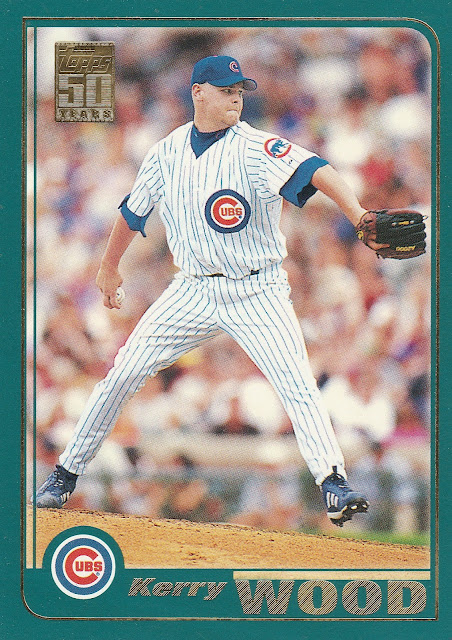

Wood's magical rookie season was curtailed by "elbow soreness" that kept him out of the rotation for the final month of the season. He'd return to make a start against Atlanta in the NLDS, taking the loss after allowing a single run over 5 innings. In Spring Training of 1999, Wood tore his UCL, nearly ending his career. A season of rehab and recovery was needed to get him back on the mound and he was able to rebound to have several excellent seasons in the Cubs' starting rotation.
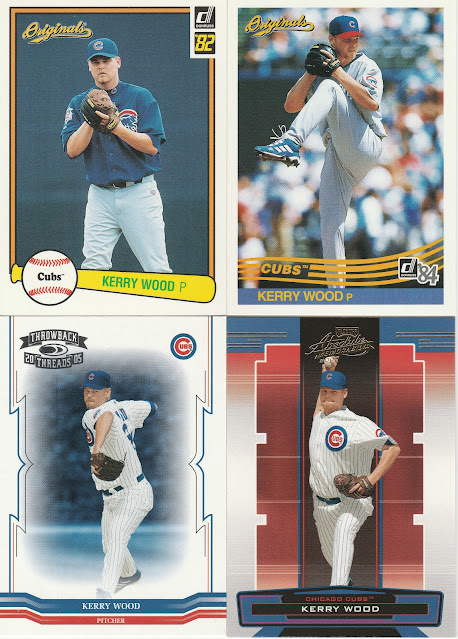

From 2001 - 2003, Wood averaged 200 innings pitched with 700 Strikeouts and an ERA+ of 122. He pitched a gem similar to his rookie season masterpiece (which we'll get to in a bit), when he tossed a 1 hit, 14K shutout against the Brewers in May of 2001. Along with Mark Prior, Wood formed a fearsome 1-2 punch at the top of the Cubs' Rotation and helped propel the team to within one game of the World Series. Wood was the starter of Game 7 of the 2003 NLCS against the Marlins, and even hit a home run to try to help his own cause, but the curse of the Billy Goat was still lurking in the shadows of the Friendly Confines. The Cubs would lose an ugly 9-6 game to the Marlins, and the following season the injury bug would bite Wood again. He would miss nearly 2 months of the 2004 campaign with a strained triceps muscle. 2005 ended prematurely with an injury in August, and 2006 and 2007 were nearly lost completely due to knee injuries and then a torn rotator cuff. 

Wood made the decision to shift from the rotation to the bullpen, and in 2008, he made a big splash, saving 34 games for the Cubs and striking out 84 batters in 64.1 innings. 
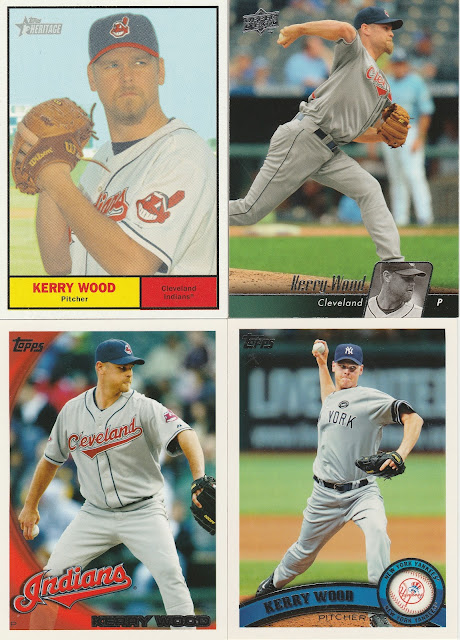

Following the 2008 season,  the Cubs opted not to sign Wood and he tested the free agent waters, landing in Cleveland. He would serve as the closer again, saving 20 games and sporting a league average ERA+ of exactly 100. He was traded at the 2010 trading deadline to the Yankees, where he pitched in middle relief setting up Mariano Rivera. He was his old electric self again with New York, recording a 0.69 ERA over 24 appearances. He allowed just 2 runs over 26 innings, striking out 31 batters down the stretch. In the Post-Season he allowed 2 more runs, 1 to the Twins and 1 to the Rangers, but overall pitched very well.


Wood returned to the North Side in 2011, and pitched the final two years of his career in the Cubs' bullpen. He's 3rd All-Time in strikeouts for the Cubs, even though he's 28th in innings pitched. 


Of course his signature moment came in his rookie season. Wood fanned 20 Astros in just his 5th career start. There are many tributes written about this game, but here are a few of my favorite tidbits:

-Out of 122 pitches thrown, only 7 were hit into fair territory. 
-Only 3 of those made it out of the infield.
-The lone hit he surrendered was an infield single that kicked off the glove of 3B Kevin Orie. Arguably it could have been ruled an error.
-The very first pitch of the game was a wild fastball that bounced off the mask of home plate umpire Jerry Meals.
-Houston's Shane Reynolds actually pitched a great game himself, striking out 10 and allowing just one earned run over 8 innings.

It has been argued that this was the greatest game ever pitched - even though he allowed a hit and also hit Craig Biggio (then again, who hasn't hit Biggio?). Bill James developed a formula to grade starting pitchers which is widely used and called the Game Score. 

Kerry Wood's game score for this outing was 105, the highest score of any pitched game before or since. 

Compare that to Clemens in 1986, his 20K game had a game score of 96.
Clemens in 1996, his 20K shutout had a game score of 97. 
Don Larsen's Perfect Game in the 1956 World Series? His Game Score was 94.
Sandy Koufax threw a perfect game in Sept of 1965 with 14 Ks - that game score was 101. 


Monday, July 13, 2020

1997 Topps All-Star Rookie Short Stop Nomar Garciaparra


With some players, there's very little mystery. Will they have what it takes to perform at the highest level? Do skills at a young age translate to the big leagues? In the case of Nomar Garciaparra, it was obvious from the beginning that something special was happening. Nomar's rookie season was among the best of all-time. He was a complete player right out of the box. He was the AL leader in hits and triples. He hit .306 with 30 homers and he scored 122 runs. He stole 22 bases, while playing excellent defense at a premium position. He ran away with the Rookie of the Year award, so of course he was the selection at Short Stop for the 1997 Topps All-Star Rookie team.


He was an All-Star, won a Silver Slugger award, finished 8th in the MVP vote, and was a unanimous Rookie of the Year for the Red Sox. All of this came after a rough 24 games in 1996 at the big league level. That short stint was all he needed to make the necessary adjustments. He was no stranger to taking a big leap into unfamiliar waters. 


As a college freshman, Nomar was a walk-on with the Team USA Olympic baseball team. He ended up as their starting short stop, and the team finished 4th in the 1992 Summer Games. His college career at Georgia Tech was fairly impressive. He was the 1992 ACC Rookie of the Year, and his 1994 season is one for the ages. He hit .427 with 26 doubles, 11 triples, 16 homers, 73 RBI and 33 stolen bases. Not too shabby.


Nomar was selected 12th overall by the Red Sox in the 1994 MLB June draft. His first taste of pro ball wasn't overly impressive. In 28 games for the Sarasota Sox, he hit a respectable .295 with one homer and 5 stolen bases. The following year his hitting took another step back, with a .267 average at AA Trenton, but he did flash the glove and the wheels, stealing 35 bases. Nomar was being promoted each season, but hadn't really had a breakout performance by 1996. In AAA Pawtucket, everything came together quickly. He torched the ball to the tune of .343/.387/.733 in 43 games. The torrid pace forced the Red Sox to make a move, calling the youngster up to the big leagues in August. 


Nomar's rookie season was tremendous, but he wasn't just a one hit wonder. He excelled in his time at Fenway Park, hitting a robust .323/.370/.553 over 9 seasons. His second year, he was the AL MVP runner-up, leading the Red Sox in runs scored and runs batted in. If not for the fact that he was splitting votes with his teammate Mo Vaughn, he might have been the outright winner that season. He followed that campaign up with a pair of batting titles, including an incredible .372 average for the year 2000. He led the AL in intentional walks that season as well. His best season in Beantown is hard to pick - was it his rookie year? His 2 batting title years? 2002, when he led the AL with 52 doubles? 2003 when he had 120 runs scored to go along with 13 triples, 37 doubles, and 28 homers? The Red Sox ran on Nomar for nearly a decade, and his play inspired the team despite not resulting in the ultimate prize of a World Series victory. A wrist injury limited him to just 21 games in 2001, snapping a string of 4 straight top-10 MVP finishes. Injuries would define the end of his Boston tenure, even though they were sandwiched between a pair of productive seasons. 2004 was truncated by an Achilles' heel injury, keeping Nomar out of the lineup until late June. He was hitting .321 for Boston when he was traded as part of a 4 team blockbuster with the Twins, Expos, and Cubs. Boston was after a defensive upgrade, securing the services of Doug Mientkiewicz and Orlando Cabrera, and Nomar found himself heading to Wrigley Field. Nomar would miss out on the Red Sox' World Series win, though his former teammates voted to give him a partial share of the World Series pot and sent him a World Series ring. The fact is that the Red Sox might not have attracted the big name free agents like Pedro, Schilling, and Manny Ramirez without a star like Nomar to build around. Ironically the team's egos were mostly sidelined for the championship run, but Nomar's contract extension dispute was the lone exception. While he didn't play with arrogance, the Red Sox certainly treated him like a malcontent before shipping him out. 


The Cubs were disappointing in his year and a half in Chicago, and so was Nomar. He would play in just 62 games for the Cubs in 2005, missing 3 months due to a groin injury. The injuries that slowed Nomar at the end of his Red Sox career were not the same ones that derailed his Cubs career, but hurt his future earnings all the same. Thankfully for Nomar, the Dodgers had deep pockets, and were more than happy to pay for his services. Things were looking up for Nomar in his first full season in LA, and he was coming home after growing up in Southern California just minutes from Chavez Ravine. He would return to the All-Star game for the final time, and racked up 2.5 WAR, his highest total since his 2003 season. He had a 120 OPS+. which was decent, but still a shadow of his former self. The next year his production slipped and he was moved around the diamond to accommodate other players like James Loney at first base. Injuries towards the end of the year didn't help. 2008 was nearly lost before it began for Nomar, when he suffered a microfracture in his hand. He would return to Short Stop for the first time since 2005, but was now relegated to fill-in and bench duty. He would play in just 55 games as his playing time and production fell off dramatically.


He would play one final season in the big leagues, signing a one year deal with the Oakland A's in 2009. Over 65 games, Garciaparra hit .281 as a DH/first baseman. For his career, he was a .313/.361/.521 hitter. if not for several seasons derailed by injury and the general wear and tear, he might have reached 2,000 career hits. He was even better in the post season over his career, hitting .321/.386/.589 in 32 playoff games. His career was cut short by injuries, but his peak was certainly Hall of Fame worthy. He certainly falls short in counting stats over his career, but when he was at his best, there were few players that could match his skills on the diamond.


Any specific Nomar memories you'd like to share? I'd love to read them in the comments below. Thanks for reading!

Sunday, June 21, 2020

I Love The 80s - 1982 Chicago Cubs


This is a series of posts on a 1980's Frankenset. Each page features a different team, with 9 of my personal favorite cards from that year's team. You might find players repeated, you'll definitely see brands repeated, but hopefully you'll agree that there are some interesting selections from the 1980s!

In 1981, the Cubs finished 6th in the NL East, posting a losing record in both halves of the season. The team dumped their General Manager in May, opting to go with no GM until the off season, when they would hire Dallas Green to take the helm. The delay had a lot to do with the team's ownership transition - the Wrigley family was out by the end of the 1981 season, with team ownership now handled by the Tribune Company. 


The new owners were in the right place and the right time for two franchise altering moves. In January of 82, the Cubs swung a trade with the Phillies to acquire 22 year old prospect Ryne Sandberg. The Tribune Company already controlled the broadcast rights, and the Chicago flagship news and entertainment channel WGN. WGN-TV would broadcast Cubs games all season, with a new announcer who moved across town from the White Sox booth, the legendary Harry Caray. Even though Sandberg had a promising rookie campaign and Caray was bringing his 7th Inning Stretch tradition to Wrigley Field, the team did not fare much better than they did the year before. They would now finish 5th in the NL East, allowing for the familiar refrain of waiting til next year for the "Lovable Losers."


The Cards: 
Donruss #151 Leon Durham - The "Bull" was the Cubs' everyday Right Fielder in '81 and '82. He was the team's premier power hitting threat, leading the team in homers both seasons. His 1982 season was very impressivc - his triple slash of .312/.388/.521 were all career highs, and he was an All-Star and Silver Slugger in the outfield. Durham also had a career high 28 stolen bases, presenting a strong balance of speed and power. Durham was a 10 year MLB veteran and was just shy of 1,000 career hits, scoring over 500 runs and driving in 530 more. 

Topps #484 Ivan DeJesus - DeJesus was the big name returned to the Phillies in exchange for Ryne Sandberg, and at the time there was a lot to like from the Phils perspective. They were obtaining an everyday short stop with speed and defense in exchange for a prospect that to that point had not made the case he could stick at short. DeJesus was a Dodgers' prospect in his own right, traded to the Cubs in 1977 because he was blocked by the steady and talented Bill Russell. He would lead the NL in Runs scored in 1978 for the Cubs, and twice stole 40+ bases in a season. Following the trade, he would put in a pair of good seasons for the Phillies, but at that point he was near the tail end of his playing days. Nicknamed "El Pulpo" (The Octopus), DeJesus led the NL in assists twice, and putouts by a Shortstop in 1981. He would go on to success as a manager in the minors. 

Fleer #601 Jerry Morales - 81/82 was Jerry's 2nd tour with the Cubs, having played with them previously from 1974 through 1977. '77 was his All-Star season, when he hit a career high .290 as the team's Center Fielder. He was the NL leader at the break with a .331 average. The All-Star game itself was maybe not the best memory, as Goose Gossage knee-capped him with a fastball in his lone plate appearance. Morales was a star in Puerto Rico's Winter Leagues and is widely considered to be one of the finest fielders in that league's history. Morales retired after 15 MLB seasons, having hit 95 career homers and drove in 570 runs. 

Fleer #588 Bobby Bonds - The final 45 games of Bobby Bonds' career were as a Chicago Cub in 1981. Bonds was known in his prime as one of the best base stealers and power hitters in the big leagues. Bonds had over 330 Homers and more than 450 steals in career, while also driving in over 1,000 runs. By the 1981 season, Bonds had been relegated to a reserve role, and was caught stealing more times than he was successful. He was a 3 time all-star (the MVP of the 1973 midsummer classic), a 3 time gold glove winner, and led the NL in runs scored twice.

Fleer #587 Tim Blackwell - The mustache that launched 1,000 ships! Blackwell is known for that bushy soup strainer, but also had a lengthy career in baseball as a catcher, then as a manager throughout the minor leagues. 1980 was his best season, catching in 103 games for the Cubs, and setting career highs in nearly every offensive category. Credit is due to his hitting instructor Cubs great Billy Williams for re-tooling his swing, allowing him to be more successful. Blackwell was also known as great defender behind the dish, and led the NL in double plays in 1980, thanks to his strong arm. Blackwell's last games came in 1983 with the Angels' AAA team, which is also where he began his coaching career. 

Fleer #589 Bill Buckner - Buckner's ankle and foot issues were already long chronicled by the early 80s, but he surprised many by stealing 15 bases in 1982 to go with 15 homers. Buckner was a doubles hitter, leading the NL in that category in 1981 and 1983, and had 498 2-baggers in his career. His lone All-Star appearance came in 1981, when he hit .301 and was a doubles machine. 1982 was a year of firsts, Buckner had his first of 2 200+ hit seasons, and topped 100 RBI for the first time in his career. People will remember him for the error in the 1986 World Series, but the fact is Buckner was a good to great first baseman once he moved to that position from the outfield. He was at or near the top of the leaderboards for assists, putouts, and range factor. 

Donruss #504 Doug Bird - Bird was a league leader in 1982, though not in favorable categories - he led the NL in homers allowed, and also earned runs allowed. On the bright side, he committed 0 errors in the field and he led the league in lowest walk rate for the 2nd time in his career. Bird started his career in Kansas City as a reliever, garnering 20 saves as a rookie in 1973. Bird was the Cubs' Opening Day starter in 1982, going 7 solid innings and earning the win. Bird came to the Cubs from the Yankees in 1981 in a trade that netted the Yankees Rick Reuschel. 

TCMA Baseball's Greatest Hitters #7 Lou Brock - Is this a Cubs card? Is this a Cardinals card? No matter where you stand, Lou Brock probably could've made it there before you. Brock was the All-time stolen base leader for both a single season, and for a career when he retired. The Cubs 1982 trade for Ryne Sandberg may be the one that finally atoned for the Lou Brock trade that send the speedy outfielder to the Cardinals in 1964. The Hall of Fame outfielder is a member of the 3,000 hit club and was a 6 time All-Star. He was named the 1974 MLB Player of the Year by the Sporting News. 

Fleer #590 Bill Caudill - Caudill had a career year in 1982 - just not for the Cubs. He was traded to the Yankees before the year began, then was flipped to Seattle, where he appeared in 70 games. He had a 12-9 record and a 2.35 ERA. Caudill was a prankster, the most publicized prank was stealing the keys to the "tugboat" the Mariners brand new bullpen car on Opening Day. He earned the nickname "Inspector" for taking a magnifying glass to opponent's bats, looking for hits. His entry music from the bullpen was "The Pink Panther Theme." "You've got to have fun to win," said Caudill. Caudill was also famously one of the first clients of super-agent Scott Boras!


Monday, April 27, 2020

1996 Topps All-Star Rookie Right Handed Pitcher Alan Benes


Move over Dizzy and Daffy, the 1996 Cardinals have a new Sibling-fueled 1-2 punch against National League hitters. Big brother Andy was the Ace of the Cardinals' rotation in '96, but Alan matched him with 3 complete games and both authored shutouts during the season. Benes the younger was named the National League's Rookie Pitcher of the Year, which is a solid foundation to be named to the Topps All-Star Rookie squad as well.


Alan's 13-10 record and 32 starts ranked 3rd on the Saint Louis staff. He struck out 131 batters and his 6.2 K/9 rate was second only to his big bro for the Cards. Benes proved that he was ready for a bigger challenge, getting a start in the 1996 NLCS against Atlanta legend Greg Maddux. While he took the loss, he showed poise and polish allowing a pair of runs over 5 tough innings.


The Cardinals made Benes their 1st round pick in 1993 out of Creighton University. He was a standout for the Bluejays, the same school that Bob Gibson excelled at in the 1950s. Benes helped Creighton make an appearance at the 1991 College World Series, and was named the Missouri Valley Conference Pitcher of the year in 1992. You can see Benes in this clip rocking a rally cap (uniform #29, about 32 seconds in) during "the throw" in the '91 CWS.
Benes would rise through the ranks in the Cardinals system quickly. In his second pro season he jumped from Single A to AAA, Ranking #14 by Baseball America. The following year he was the #5 Prospect in all of baseball and by the end of 1995, his third pro season, he was making his MLB debut.
In his cup of coffee in 1995, Benes struck out 20 batters in 16 innings.


In 1997, his second full season, Benes was establishing himself as one of the best pitchers in the game. By July he ranked 3rd in the league in Strikeouts, and his 2.89 ERA had him in 6th place in the NL. A shoulder injury ended his season, and nearly finished his career. His ERA+ for the shortened 1997 season was a robust 144, 44% better than the average NL pitcher. Benes would miss all of the 1998 season and made just 2 appearances in 1999.


Benes would adjust to a role in the bullpen with the Cardinals in 2000, but his strikeout stuff had left him following the shoulder issues. He would move on to the Cubs in 2002 and 2003, appearing in 10 games, then on to Texas to conclude his MLB career with an attempt to return to an MLB starting rotation. He made 4 starts for the Rangers, allowing 20 runs in 15 innings pitched. Benes would go on to be a scout and instructor in the Cardinals organization.

Benes is another one of those Topps All-Star Rookies who showed tremendous talent, only to have that potential undone by the misfortune of injury. Alan's best season was also his brother Andy's best year - the two combined for 31 victories in 1996 en route to a division championship, and took the NLCS to 7 games.

Benes was inducted into the Creighton University Hall of Fame in 2011.

Do you have any Alan Benes stories? I'd love to read them in the comments below. Thanks for reading!

Monday, March 30, 2020

1996 Topps All-star Rookie Catcher Jason Kendall


Some might say that Jason Kendall had catching in his blood. That's because his father Fred Kendall was also a MLB catcher, with a 12 year career for several teams. Jason spent little time making a name for himself- earning a trip to the All-Star Game in his rookie year. He hit .300 and turned in stellar defense behind the plate, quickly creating a rapport with his pitching staff. Kendall finished 3rd in the NL Rookie of the Year balloting.


Right from the start, Kendall was a rock - Catching 130 games in his rookie season. He also was stingy with strikeouts, with just 30 Ks in 471 plate appearances. Few catchers in the league in 1996 combined his level of defense and hitting ability, let along first year players, so he was the obvious choice for the 1996 Topps All-Star Rookie Team.


Kendall grew up in Southern California (his dad played several seasons in San Diego) and attended high school in Torrance, CA. He was already a talented hitter -- He hit safely in 43 consecutive games from 1990 to 1992 which tied a National record.


The Pirates drafted Kendall in the 1st round - #23 overall. He worked his way quickly through the Pirates' minor league system, mixing great defense, hitting for average, and speed. Kendall stole 14 bases for AA Salem and then in AAA in 1995 hit .325/.414/.448 and stole 10 more bags. He was more than ready for the big leagues.


Kendall had a serious ankle injury in 1999 that could have derailed his career. He would would come back strong the following season, even hitting for the cycle in 2000. Over his Pirates tenure, he became their all-time leader in games caught, stole 140 bases, and slashed .306/.387/.418 over 9 seasons. 


Once Kendall was traded from the Pirates after the 2004 season, Kendall began a nomadic pilgrimage around the big leagues. He spent 2 and a half seasons with Oakland, half a year with the Cubs, 2 years with Milwaukee and a final year in Kansas City.  He made his first post season appearance of his career in 2006 with Oakland, facing off against the Twins. Kendall's rate stats fell off considerably at this time, at one point he had the lowest slugging percentage among all qualified MLB hitters, and in another season (2007) had the lowest OBP and 2nd lowest slugging in the league.


Despite those declining stats, Kendall still had a great reputation in the league as a tough competitor. His ability to block pitches in the dirt and call games made him an asset even as shoulder issues hurt his ability to throw out base stealers. He continued to pile up hits, too, and surpassed 2,000 career hits in 2009. At the time, he was just the 8th full time catcher to reach that milestone. He also holds a record for most stolen bases in a single season by a catcher in the modern era, when he swiped 26 bases in 1998. He was known for crowding the plate - he ranks 5th all-time in HBP.

Let's hear your Jason Kendall stories! Anyone read his book Throwback

Monday, March 23, 2020

1996 Topps All-Star Rookie Outfielder Todd Hollandsworth


Todd Hollandsworth was the NL Rookie of the Year in 1996, joining the ever growing list of Dodger phenoms to break into the big leagues. With similar tools to 1994 RoY Raul Mondesi, Hollandsworth flashed power, speed, and a strong outfield arm. He spent a good part of 1995 recovering from various nagging injuries, in 1996 it was his turn to fill in for the regular centerfielder, Brett Butler.


Todd hit 12 homers, stole 21 bases and had a 113 OPS+ while playing all three outfield positions. There is quite a bit of copy written bout Todd as a "gamer" aka a player who "plays the game the right way," and Brett Butler was even quoted as saying that Todd was never thinking "How cool do I look?" in a Clint Eastwood-esque get-off-my-lawn.


Todd had a big year in 1994 for Albuquerque, paving the way for his big league debut. He bashed 19 homers, drove in 91 runs, and stole 15 bases. It was his third season in a row with double digits in homers and steals, and he finally managed to get his strikeouts under 100 for the season. He was always a doubles machine, and had 31 for the Dukes in '94, the highest total of his minor league career.


Hollandsworth was the Dodgers' 3rd round selection in 1991, having lost picks in rounds 1 and 2 as compensation for adding Darryl Strawberry and Kevin Gross. They would add a 3rd rounder though as compensation for losing Kirk Gibson to Kansas City. He was born in Dayton, OH, and went to High School in Bellevue, Washington. As a Senior he hit .368 with a pair of homers, and was named "Athlete of the Year" by the Seattle Times and was a member of the Washington All-State Team. In addition to baseball, Hollandsworth also played for the Newport High Football squad (he rushed for over 1,000 yards) and their basketball team.


Following his Dodgers tenure, Hollandsworth spent time with 7 different teams- Colorado, Texas, Florida, Atlanta, the Cubs, and in his final MLB season, he played for both Ohio franchises. Hollandsworth didn't become the toolsy superstar hinted at by his rookie year, but he was a solid 4th outfielder for 12 MLB seasons. His best seasons were 2000, split between LA and the Rockies, and 2002, which was split between the Rockies and Rangers. The following season, Hollandsworth became a World Series Champion as a member of the Florida Marlins.

After his playing career, Hollandsworth has been a broadcaster for several teams, currently a member of the Marlins tv broadcast team.

Let's hear your Hollandsworth stories! Thanks for reading!

Sunday, January 26, 2020

I Love the 80s ; 1981 Chicago Cubs

This is a series of posts on a 1980's Frankenset. Each page features a different team, with 9 of my personal favorite cards from that year's team. You might find players repeated, you'll definitely see brands repeated, but hopefully you'll agree that there are some interesting selections from the 1980s!

The Cubs were squarely in "Wait 'til Next Year" mode in 1980 and 1981, finishing 6th of 6 teams in the NL East in both years. They ever so slightly began to improve their fortunes in '81, with a second half finish good for 5th place, though they still sported the worst record overall that season, and narrowly avoided 100 losses in 1980. 


Lenny Randle was granted free agency in October of 1980. Bruce Sutter would be traded in December of 1980 in exchange for Leon "Bull" Durham from the Cardinals. Dennis Lamp was traded in March of '81 to the White Sox, Lynn McGlothen followed across town in August. Tim Blackwell became a free agent after the 1981 season. Bill Caudill was traded as a PTBNL in April 1982, so none of the players shown here made it to 1982 as a Chicago Cub. Given the team's record, a little roster turnover was probably a good thing. The Cubs drafted Billy Hatcher and Joe Carter in 1981, and shortly after 1982 began, made a franchise altering deal with Philly to acquire a light hitting shortstop named Ryne.


The Cards:
Donruss #551 Dick Tidrow - Tidrow was a pretty good middle reliever for the Cubs in 1980, and led the Club in appearances. He notched 6 saves and sported a 6-5 record with a 2.79 ERA to go with his imposing moustache.

Fleer #302 Lynn McGlothen - Lynn led the Cubbies pitching staff with 12 victories and 2 shutouts in 1980, but started just 6 games in 1981, relegated mostly to bullpen work before being traded to the ChiSox at the deadline. His best years came in his mid-twenties with the Cardinals. He went 44-40 with 9 shutouts over those 3 seasons in Saint Louis and was named the the All-Star team in 1974. He would finish his playing career with the Yankees in 1982. Tragically, McGlothen died in a fire at the age of 34 two years later.

Topps #692 Lenny Randle - Lenny speaks five languages, and in addition to being a baseball player, he was a recording artist and erstwhile stand-up comic. Randle was the primary 3rd baseman for the Cubs in 1980, while leading the Cubs in triples.

Donruss #559 Tim Blackwell - Tim is known for his bushy moustache, but he was a serviceable back-up catcher as well during his playing days. The switch hitting Blackwell was the #1 catcher for the Cubs in 1980, hitting 5 homers and driving in 30 runs over 103 games. All of those were career highs, and following his playing days he became a long-time coach and manager throughout the minor and independent leagues. 

Topps #590 Bruce Sutter - The Hall of Fame closer saved 28 games for the Cubs in 1980, which led the league for the second straight year. He was the NL Cy Young winner in '79, after saving 37 games for the Cubs with a very good 2.22 ERA. He would be named to his 3rd of 6 All-Star squads in 1980 as well. He was a top 10 MVP vote-getter 5 times. 

Fleer Star Stickers #80 Bruce Sutter - Over his career, Sutter notched exactly 300 saves, which seems low to the modern crowd but was among the highest all-time when he retired. His 1979 Cy Young still stands out as an oddity for a relief pitcher, but he finished in the top ten of voting for the award 4 other times. His second full season with the Cubs probably deserved more attention than it received. He saved 31 games and struck out 129 batters in 107 innings that year, 1977. His 1.34 ERA was tiny, but his ERA+ was a staggering 328, meaning he blew his competition out of the water. He finished 6th in the voting behind 5 20 game winners. 

Topps #574 Bill Caudill -  Bill led the Cubs in ERA in 1980 with a 2.19 mark over 127 innings pitched. He had a rocky 1981 season, with an ERA north of 5, and would find himself trying to rebuild his resume in Seattle. He had a very good season in 1982 with the Mariners, and once he was converted to full time relief, even made an All-Star team as a member of the Athletics. 

Fleer #301 Lenny Randle - Lenny was known for his speed, and was a 2 sport athlete in college, playing both baseball and football. Randle found a home in Italy after his final MLB season, and hit a staggering .477 for his Italian League team in 1983. Randle had over 1,000 MLB hits, but his most famous blow came as a member of the Mariners, when he tried to make a slow rolling ball go foul with some "wind-aided" assistance. 

Topps # 331 Dennis Lamp - Along with Tidrow, Sutter, Bill Buckner and Tim Blackwell, the 1980 Cubs may have been the league leaders in soup strainers. Lamp tossed the only other Cubs shutout besides the 2 from McGlothen in 1980, though the rest of his starts that year ended up surrendering more runs than any other National League pitcher. Lamp would find greater success out of the bullpen, particularly in 1985 with Toronto, when he had a perfect 11-0 record in 53 regular season appearances, and 3 scoreless appearances in the '85 ALCS against the Royals. While KC ultimately prevailed, Lamp was able to turn out the lights on their offense each time he took the mound.


Monday, November 4, 2019

1994 Topps All-Star Rookie Outfielder Manny Ramirez


Every team he played for had a "Manny Being Manny" story. Whether it was leaving his paycheck behind in his cleats on a road trip, or leaving the field of play to use the restroom inside the Green Monster. Manny Ramirez was a player who moved to the beat of his own drummer. Antics aside, Ramirez would show from his rookie year on that he was one of the best hitters to ever play the game.


He was a pre-season lock to be the 1994 AL Rookie of the Year, and while he didn't quite meet that expectation, there was little reason to think that he was anything less than a budding superstar. He played in just 91 games in the strike shortened season, ranking 2nd among rookies in Homers, RBI, Doubles, and hits.


Ramirez was born in Santo Domingo, Dominican Republic, but attended high school in New York City. His family moved to NYC when Manny was 13 years old, and by the time he was a high school Senior at George Washington High school, he was already a legend among those that had seen his offensive prowess. His Senior year, he batted .650 with 14 homers in 22 games. He was a first round draft pick of Cleveland, and made a steady climb up the minors, hitting double digit homers at each stop along the way. Across AA and AAA in 1993, Manny hit .333 with 31 homers and 115 RBI. By 1994 he was ready for the show.


Over his 8 seasons in Cleveland, Ramirez made 4 All-Star teams, and won 3 Silver Slugger awards. He would appear in 10 different post-season series with the team, slugging 13 homers over those games. Even when not hitting, he contributed to his team's offense by scoring runs after drawing walks. While he was never mistaken for an adept fielder in left field, his bat more than made up for his limited range. His Cleveland career included over 1,000 hits and 232 homers with a .313 average. While they did not win a World Series during his time there, the team would not have been the dynasty they became in the 90s without his bat in the middle of the lineup.


In Boston, the young talent matured into a savvy veteran with very few weaknesses at the plate. During his Red Sox tenure, Manny won a batting title (2002), a home run title (2004), and a World Series MVP award (2004). He was an All-Star in all 8 seasons with Boston, and won 6 Silver Slugger awards. In those 8 seasons, he had over 1200 hits and 274 homers.


None was celebrated bigger than this one, a walk off winner in game 2 of the 2007 ALDS.


To many, Manny's time in Los Angeles was disappointing. He was not able to lead the Dodgers to a World Series, even though he hit .391 after being acquired by the Dodgers half way through the 2008 season. He would hit .500 in the NLDS against the Cubs, and .533 against the Phillies in the NLCS in a losing effort. The following season he ran afoul of the league's drug testing, and was suspended for 50 games, testing positive for a drug that can be used to mask steroid use. He would still be eligible for post season play, hitting .308 in the NLDS and a homer in the NLCS. He would run into injury issues in 2010, losing his regular role in LF. After being ejected for arguing strike one with an umpire in a pinch hitting appearance, the Dodgers placed Ramirez on waivers.


He would finish 2010 with the Chicago White Sox, then signed with Tampa Bay in the off season. He had a strong Spring Training, but struggled early in the 2011 season for the Rays. It was then revealed that he had tested positive for another PED, and Ramirez abruptly retired. He would attempt comebacks in 2012 with Oakland, 2013 with the Rangers, and in 2014 with the Chicago Cubs, but each time he ended the season without a major league at bat.


Is Manny a Hall of Famer? He's already in the Hall of Stats and the Hall of Merit - but those 2 failed drug tests seem to have made the decision for the BBWAA writers already. In his 3 years on the ballot so far, he has yet to reach even 25% of the vote.

Sunday, February 10, 2019

Lovably Losing - The 1956 Topps Chicago Cubs Team Set


One of the fun things about a completed set is deciding how you want to organize it. I have the 1956 Topps set in a binder, sorted by team, in the same order that the teams finished in the 1955 Standings. In 1955, the Chicago Cubs finished in 6th place in the National League with a 72-81 record.


The Cubs were in the thick of the pennant race for the first half of 1955, but the second half saw the team fade to 6th place. It was the final season for play-by-play announcer Bert Wilson, known for catchphrases like "I don't care who wins as long as it's the Cubs!" and "Bring on the Bears" when the Cubs' chances for the pennant had begun to fizzle out. Wilson was hired to be the Reds TV announcer starting in 1956, but he passed away from heart failure in the off-season. Despite a team that was largely unchanged from the 1955 club, the Cubs would slip to last place in the National League in 1956.


1955 was the team's 40th in Wrigley Field, and their 80th in the National league. Their dynasty from the 1900s was now a distant memory, and it had been a decade since their last pennant. There was reason to be optimistic for the future, however, with their superstar short stop just beginning to blossom. Unfortunately for the Cubs, they would not finish in first place again until 1984.


The Cubs' best hitter in 1955 was that aforementioned superstar Shortstop, Ernie Banks. Banks was signed by the Cubs to be Gene Baker's roommate a couple years earlier. Baker had been signed from the Kansas City Monarchs, with Banks taking his place as the Monarchs' regular shortstop. A couple years later, it would be Banks and Baker making their Major League debuts together in 1953.


In 1955, Banks crushed 44 homers and drove in 117 runs while playing every game of the season. He led the National League in extra base hits and made his first All-Star Game. He would become a first ballot Hall of Famer, 2 time NL MVP, with over 500 career homers. He was "Mr. Cub" from the very beginning.


The pitching staff was fairly uneven in 1955, led by Bob Rush, who went 13-11 with a 3.50 ERA. Rush led the National League in FIP, which is a measure of pitching independent of fielding. He had a microscopic walk rate, and was stingy about giving up homers, and had decent strikeout totals for the season.


Rush was a two time All-Star for the Cubs (1950 and '52), and did so despite losing 20 games in 1950. Rush would move on to the Milwaukee Braves in 1958, and pitched in the World Series in a losing effort against the Yankees.


The Cubs added the future Hall of Famer Monte Irvin to the team for the 1956 season. He had spent the previous 7 seasons with the New York Giants, cementing his place as a great hitter and outfielder. 1955 would be his last major league season, playing whenever his balky ankle allowed. Over 111 games, Irvin hit .271 with 15 homers and 50 runs batted in.


Irvin was considered by many of his contemporaries and by current historians to be the best outfielder in the Negro Leagues in the 1940s, and executives in both leagues considered him one of the best suited to break the color barrier, in talent and in temperament. He would join the Giants in 1949, and along with Willie Mays they would carry the Giants' offense to pennants in '51 and '54, the second of which also resulted in a World Series victory. Irvin was selected to the Hall of Fame in 1973 by the Negro Leagues Special Selection Committee. His Negro Leagues career with the Newark Eagles also included a championship in 1946 and a pair of batting titles.


The 1955 Cubs' hitters finished last in the league in strikeouts (the most), and last in walks (the fewest). Thanks to Ernie Banks and several players reaching double digits, they did rank 5th in home runs.
Hank Sauer had a down year, hitting just .211 with 12 homers. The offense didn't really get going, which put a great deal of pressure on the pitching staff.


Sam Jones, who would win 20 games in 1959, lost 20 in 1955. He did toss a no-hitter in May, however, becoming the first African-American to pitch a no-hitter in the majors. The team's closer, Hal Jeffcoat, would be traded to the Reds for 1956 for Hobie Landrith, a reserve catcher that the Cubs hoped could provide an upgrade in a starting role over Harry Chiti.


Bob Speake had a nice season for the Cubs as a reserve in 1955, hitting 12 homers, essentially platooning with the 38 year old Hank Sauer. Speake would be back in the minors for 1956. The Cubs were finding their groove as the lovable losers in the mid 50s - a place they would stay for decades to come.