Showing posts with label Cleveland. Show all posts

Monday, January 10, 2022

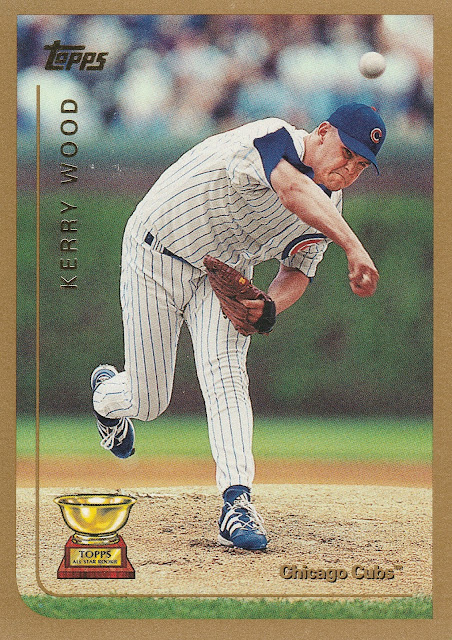
1998 Topps All-Star Rookie Right Handed Pitcher Kerry Wood


If you see this from the batter's box, you are in for a long day. Kerry Wood in 1998 was the NL Rookie of the Year, so of course he was Topps' first choice for right handed pitcher on their All-Star Rookie Squad. That season, Wood piled up the strikeouts (the most by a Chicago Cub since Hall of Famer Fergie Jenkins in the 1970s), and won 13 games. He had one Complete Game,  which was a shutout, but we'll talk about that game in a bit.
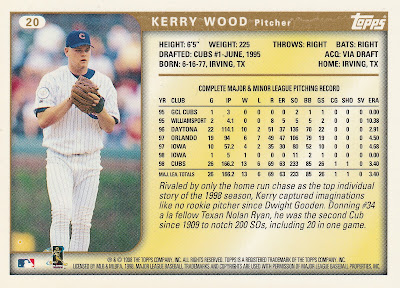

Topps went as far as to say that Kerry's rookie campaign was comparable to Dwight Gooden's phenomenal debut season, and the story of Kerry's season was second only to his teammate Sammy Sosa's chase with Mark McGwire to un-seat Roger Maris as the single season Home Run King. He led the NL in H/9 and K/9, but his electric stuff could be a little tough to harness at times. His 85 walks ranked in the top ten in the NL that year as well as hitting 11 batters and uncorking 6 wild pitches. Sometimes a little wildness can go a long way towards baffling the opposing batters.
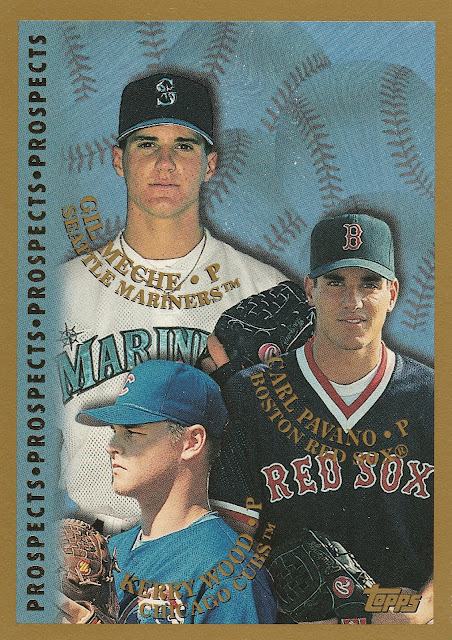

The Cubs made Kerry a first round pick in 1995, selecting him out of high school in Grand Prairie, TX. Wood would start to show signs of the pitcher he'd grown into as a senior, when he fanned 152 batters in a little over 80 innings. He had a 0.77 ERA and was a perfect 14-0. His first full professional season came at the age of 19 for the High-A Daytona Cubs. He went 10-2 with a 2.91 ERA, striking out 136 batters in 114.1 innings pitched. The Cubs were willing to take the good with the bad, as the walks piled up alongside the Ks throughout his minor league career. In 1997 with the Orlando Rays and Iowa Cubs, he allowed a combined 131 walks in 151.2 innings. Despite the wildness, Wood returned in 1998 with a mission to make the big league roster. He would make just one start at AAA, striking out 11 of the 17 batters he faced before being called up to the Cubs.
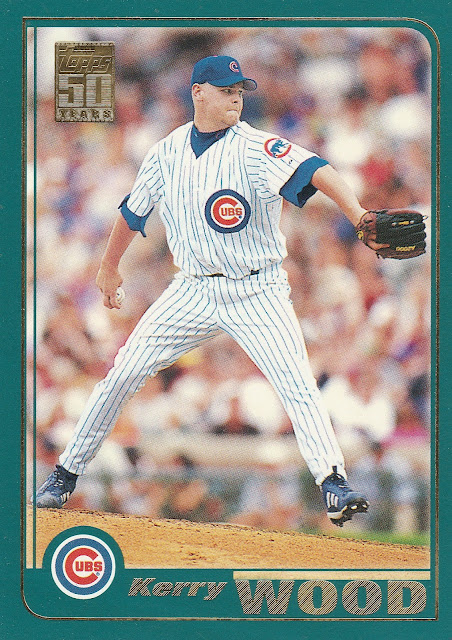

Wood's magical rookie season was curtailed by "elbow soreness" that kept him out of the rotation for the final month of the season. He'd return to make a start against Atlanta in the NLDS, taking the loss after allowing a single run over 5 innings. In Spring Training of 1999, Wood tore his UCL, nearly ending his career. A season of rehab and recovery was needed to get him back on the mound and he was able to rebound to have several excellent seasons in the Cubs' starting rotation.
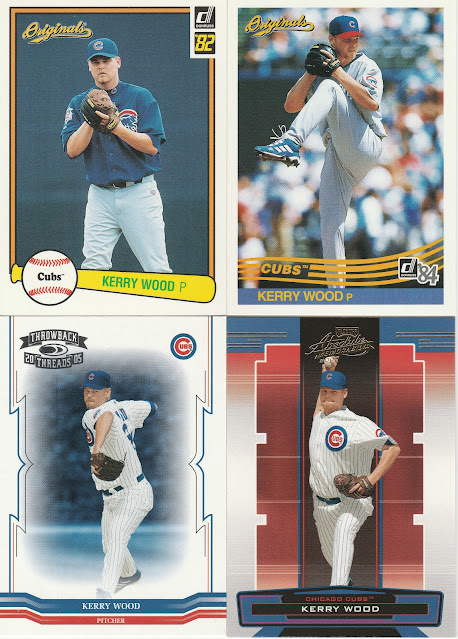

From 2001 - 2003, Wood averaged 200 innings pitched with 700 Strikeouts and an ERA+ of 122. He pitched a gem similar to his rookie season masterpiece (which we'll get to in a bit), when he tossed a 1 hit, 14K shutout against the Brewers in May of 2001. Along with Mark Prior, Wood formed a fearsome 1-2 punch at the top of the Cubs' Rotation and helped propel the team to within one game of the World Series. Wood was the starter of Game 7 of the 2003 NLCS against the Marlins, and even hit a home run to try to help his own cause, but the curse of the Billy Goat was still lurking in the shadows of the Friendly Confines. The Cubs would lose an ugly 9-6 game to the Marlins, and the following season the injury bug would bite Wood again. He would miss nearly 2 months of the 2004 campaign with a strained triceps muscle. 2005 ended prematurely with an injury in August, and 2006 and 2007 were nearly lost completely due to knee injuries and then a torn rotator cuff. 

Wood made the decision to shift from the rotation to the bullpen, and in 2008, he made a big splash, saving 34 games for the Cubs and striking out 84 batters in 64.1 innings. 
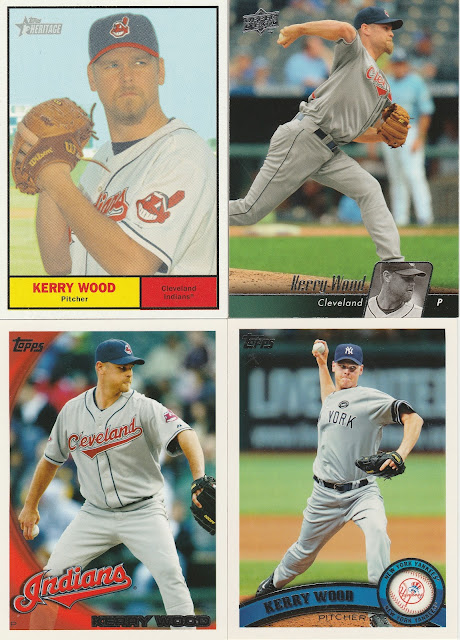

Following the 2008 season,  the Cubs opted not to sign Wood and he tested the free agent waters, landing in Cleveland. He would serve as the closer again, saving 20 games and sporting a league average ERA+ of exactly 100. He was traded at the 2010 trading deadline to the Yankees, where he pitched in middle relief setting up Mariano Rivera. He was his old electric self again with New York, recording a 0.69 ERA over 24 appearances. He allowed just 2 runs over 26 innings, striking out 31 batters down the stretch. In the Post-Season he allowed 2 more runs, 1 to the Twins and 1 to the Rangers, but overall pitched very well.


Wood returned to the North Side in 2011, and pitched the final two years of his career in the Cubs' bullpen. He's 3rd All-Time in strikeouts for the Cubs, even though he's 28th in innings pitched. 


Of course his signature moment came in his rookie season. Wood fanned 20 Astros in just his 5th career start. There are many tributes written about this game, but here are a few of my favorite tidbits:

-Out of 122 pitches thrown, only 7 were hit into fair territory. 
-Only 3 of those made it out of the infield.
-The lone hit he surrendered was an infield single that kicked off the glove of 3B Kevin Orie. Arguably it could have been ruled an error.
-The very first pitch of the game was a wild fastball that bounced off the mask of home plate umpire Jerry Meals.
-Houston's Shane Reynolds actually pitched a great game himself, striking out 10 and allowing just one earned run over 8 innings.

It has been argued that this was the greatest game ever pitched - even though he allowed a hit and also hit Craig Biggio (then again, who hasn't hit Biggio?). Bill James developed a formula to grade starting pitchers which is widely used and called the Game Score. 

Kerry Wood's game score for this outing was 105, the highest score of any pitched game before or since. 

Compare that to Clemens in 1986, his 20K game had a game score of 96.
Clemens in 1996, his 20K shutout had a game score of 97. 
Don Larsen's Perfect Game in the 1956 World Series? His Game Score was 94.
Sandy Koufax threw a perfect game in Sept of 1965 with 14 Ks - that game score was 101. 


Sunday, July 26, 2020

I Love The 80s - 1982 Cleveland

This is a series of posts on a 1980's Frankenset. Each page features a different team, with 9 of my personal favorite cards from that year's team. You might find players repeated, you'll definitely see brands repeated, but hopefully you'll agree that there are some interesting selections from the 1980s!

In 1981, Cleveland hosted both the MLB All-Star Game, and the NBA All-Star Game. One of those All-Stars made history in May of 1981 by pitching a perfect game. Lenny Barker's gem is the most recent no-hitter for Cleveland. The team finished a game above .500 with a respectable 52-51 record. In the competitive AL East however, that still meant a 6th place finish. The starting pitching was a strength, but the team was let down by some especially bad offensive numbers. 


1982 started and everyone had cold bats - literally! The home opener required the removal of 500 tons of snow from the field and the game time temp was 38 degrees with a windchill of just 17! The rest of the year was marred by injuries to key members of the team, and the result was a 78-84 record, placing Cleveland squarely back in 6th place in the AL East. While they finished at the same place in the standings, they were 17 games back of the lead instead of just 5 games back in 1981. Manager Dave Garcia resigned at the end of this year, ending a tenure that began in 1977. One bright spot - the broadcast team was joined by Cleveland legend Bob Feller. The team at one point won 11 straight games that season, the longest winning streak for the team in the 1980s. 


The Cards:
Donruss #263 Bo Diaz - Diaz was the backup to Ron Hassey in 1981, but it was Bo that made the 1981 All-Star Roster along with Starting Pitcher Len Barker instead of Hassey. Diaz was the team leader in homers that season... with 7. He did actually have decent power, hitting 18 the following season along with 85 RBI for the Phillies in 1982. He would make another All-Star squad in 1987 as a member of the other Ohio team, the Cincinnati Reds. While he allowed the most stolen bases of any catcher in the NL in 1982, he also had the highlight of throwing out the Giants' Robby Thompson 4 times in the same game. He was from Venezuela, and playing in the VZ Winter League, set a record with 30 homers in the short season that lasted for several decades. Diaz was tragically killed in an accident on his roof in 1990, still just 38 years old.

Fleer #374 Rick Manning - I know they tend to play Fenway's left field shallow, but this seems a bit extreme for Rick Manning, who is obviously shown taking grounders. Throughout his MLB career, he was found all over the outfield, but was the everyday Center Fielder for Cleveland in 1981 and 82. Manning was known to be both speedy (25 stolen bases in 1981), and lackadaisical on the basepaths, being admonished frequently by manager Dave Garcia for not beating out more infield hits. His defense was well regarded, having won a Gold Glove in 1976, but he was not a particularly fearsome hitter, having a career OPS+ of just 85, well below league average. Manning found himself embroiled in scandal early in his career, involving Dennis Eckersley and the Hall of Famer's first wife. Following his playing career, Manning joined the Cleveland broadcast team, starting in 1990, where he still works today.

Donruss #198 Duane Kuiper - Cleveland seems to be a baseball announcer factory - Kuiper is a long-time Giants' commentator, beginning in 1986. Kuiper was Cleveland's second baseman and, similar to Manning, was more adept in the field than at the plate. His 14 RBI in 1981 is somewhat explained by the strike shortened season, but Nelson Cruz is already more than half way there following this weekend's series in Chicago. Kuiper was not expected to drive in runs, however, he was there to prevent them. Particularly in his heyday from 1977-1979, Kuiper was an outstanding defender, twice leading the league in Fielding pct. Kuiper's lone MLB home run came against future White Sox broadcaster Steve Stone. 

Topps #360 Len Barker - On May 15th, 1981, Len Barker threw a perfect game against the Toronto Blue Jays. He was just 25 years old, but already in his 6th MLB season. The prior year, he finished with a 19-12 record for Cleveland, leading the AL in strikeouts. He'd repeat that feat again in 1981 and make his only All-Star Appearance, with the team hosting the festivities. The perfect game was somewhat surprising given Barker's penchant for wildness. While he sported a blazing fastball, it was at times erratic. His 1980 strikeout crown also came with a league leading 16 wild pitches and 92 walks. Standing 6'5", Len's nickname was "Large Lenny," and his big night in 1981 ended up as one of the team's highlights of the season. He would be traded to Atlanta mid-way through 1983, returning the speedy Brett Butler and third base prospect Brook Jacoby. Barker's career after his Cleveland tenure was rocky - bone spurs in his elbow suffered early in 1983 were never fully addressed medically, and he was not able to regain the success he had in the early 80s. 

Fleer #628 1981 All-Star Game - Less than 10,000 fans witnessed Len Barker's perfecto in May. Things were much different in August, with baseball returning from a strike that had lasted for months. The game set a record for the highest attendance ever at an All-Star Game, exceeding 72,000 attendees. Cleveland's Bo Diaz and Len Barker represented the host city. Fernando Valenzuela started for the NL, and they staged a come from behind victory behind 5 home runs. Montreal's Gary Carter won the MVP thanks to his 2 home runs, though the winning runs were driven in by Mike Schmidt in the 8th inning. Tigers Ace Jack Morris got the start for the AL, much to the chagrin of the Cleveland fans, who wanted their ace Barker to get the honor. Pete Rose set a record by starting at the 5th different position of his career. 

Topps #685 Bert Blyleven - To acquire Blyleven, Cleveland sent a small army to Pittsburgh after the 1980 season. The trade was somewhat bittersweet, as injuries in 1982 limited him to just 4 starts. He was hitting his groove again in 1985, making the All-Star team for just the second time in his career. He led the AL in complete games (24!), shutouts, innings, and strikeouts, departing for Minnesota in the middle of the season. He would finish his career with 60 career shutouts, by far the most of his era, and 3,701 strikeouts, thanks to a fastball that was paired with two different but equally devastating curve balls. Bert continues this team's announcing tradition, having been paired with Dick Bremer on Twins' telecasts since 1996. 

Topps #573 Rick Waits - Waits was known during his Cleveland tenure as a "Yankee killer," though his career splits show a 9-12 record against New York, he did have a 3.35 ERA in 28 starts, including 3 shutouts. He also was an accomplished singer, singing the National Anthem for Cleveland on several occasions. In 1982, Waits had terrible luck, pitching to a 2-13 record, and was done in by a high walk rate, and uncharacteristically shoddy defense behind him. His ERA was more than a full run higher than his FIP that season, which measures his pitching independent of fielding. Following that tough season, Waits was included in the trade that exchanged Rick Manning for Gorman Thomas. In Milwaukee, Waits was converted to the bullpen, and had decent success in the 1984 season, with a 109 ERA+ over 74 appearances. Waits has been a coach in Italy and China, as well as serving as a pitching coach for the Mets and Mariners in the minor leagues.

Topps #54 Ron Hassey - Bo Diaz and Ron Hassey were probably better described as a pure platoon rather than a starter and backup in 1981. Diaz caught 63 games, Hassey 61. Ron actually had more plate appearances, but Diaz was much more successful, hitting .313 to Hassey's .244. The low average was a surprise, as he hit .310 the year before, the highest average for any catcher in the AL in 1980. Hassey had a 14 year MLB career, usually serving as a platoon partner or backup. His best season came with the Yankees in 1985. He hit a robust .296 with 13 homers. He also led the AL in passed balls that year, in no small part to catching knuckleball artist Phil Niekro. He was known for his strong arm, and in 1981 led the AL in caught stealing pct. His career .993 fielding pct is top 50 all-time in MLB history. He caught 2 perfect games in his career, having been behind the plate for Len Barker's gem, later catching the perfect game thrown 10 years later by Dennis Martinez in 1991. Hassey was a member of the 1989 Oakland A's World Series Championship team, though he didn't play in the series. 

Topps #630 Joe Charbonneau - One of the more extreme "Sophomore Slumps" was suffered by Joe Charbonneau in 1981. Following a pleasantly surprising 1980 Rookie campaign, Charbonneau had back issues that sapped his power and speed. He hit just 4 homers and played in just 48 games for Cleveland in 1981, followed by 2 homers in 22 games in 1982. By 1983, Charbonneau was out of big league ball. He missed nearly all of 1983, playing in just 11 games for Cleveland's AAA affiliate, then tried to latch on in 1984 with Pittsburgh, but did not get a call up after 123 minor league games. In 1980 he finished 10th in the AL in OPS and was the AL Rookie of the Year, but the combo of high expectations and injuries made his return next to impossible. He appeared in the film "The Natural" as one of Roy Hobbs' teammates. 


Sunday, April 26, 2020

I Love the 80s - 1981 Cleveland

This is a series of posts on a 1980's Frankenset. Each page features a different team, with 9 of my personal favorite cards from that year's team. You might find players repeated, you'll definitely see brands repeated, but hopefully you'll agree that there are some interesting selections from the 1980s!

In 1980, Cleveland finished in 6th Place in the AL East with a 79-81 record. The following season, the team finished above .500, but still finished in 6th place in the highly competitive AL East. 


The bright spot of the 1980 season was rookie Joe Charboneau, who inspired a hit song in the Cleveland area with his team leading 23 homers. Outside of his performance, not much went well for the Cleveland 9. 1981 featured a much improved pitching rotation, but unfortunately the team struggled to score runs. "Super Joe" was suffering through a sophomore slump, and the rest of the team offered very little power. The team hosted that year's All-Star Game at Cleveland Municipal Stadium, held in August due to the 1981 Strike.


The Cards:

Topps #39 Tom Veryzer - Former Topps All-Star Rookie Tom Veryzer was Cleveland's starting Short Stop in 1980 and 81. In 1980, he had a career high .271 batting average over 109 games. He was a reserve on the 1984 Cubs Division Championship team.

Topps #697 Rick Waits - 1980 was the third straight 200+ inning season for Rick, who recorded a career high in season strikeouts. Over his peak, Waits hurled 10 shutouts and won 74 games for Cleveland.

Fleer #402 Gary Gray - Gray was an outstanding player in AAA, hitting .305 with 17 bombs in 1979. In 1980, he had a brief stint with Cleveland before moving on to the Mariners. They played  Gray in AAA Tacoma, where he once again showed power and hit for average. He was finally getting an opportunity to play regularly in Seattle in 1981 when the strike interrupted his season. He had hit 13 homers before the strike, but by the time the league returned to action, other players were inserted into the lineup as everyday players. He would also go on to play in the Mexican League for three seasons.

Topps #738 Bert Blyleven - A new addition to the Cleveland staff in 1981, Hall of Famer Bert Blyleven was the team's ace. He was not given the best run support in Cleveland, and finished with an 11-7 record. He had 9 complete games and tossed a shutout. He led the team with a 2.88 ERA and had a league best 5.6 WAR. Injuries would limit him to just 20 innings pitched in 1982, but he would come back strong and would have one of the best seasons of his career in 1984, when he finished 3rd in the Cy Young voting.

Donruss #82 Joe Charboneau - The 1980 AL Rookie of the Year Joe Charboneau had one of the best debuts of a player to have it all come crashing down. After his rookie season, Charboneau played in just 70 more MLB games over 2 seasons.

Fleer #404 Bo Diaz - Cleveland Catcher Bo Diaz led the team in homers in 1981, with 7. He split duties with Ron Hassey and Chris Bando, after being the backup in 1980. Diaz was named to the All-Star team in 1981, and had a great 1982 with Philadelphia. He came to Cleveland in a trade with Boston for Dennis Eckersley and Fred Kendall. He would become an All-Star again in 1987 with Cincinnati.

Kellogg's 3-D Super Stars #54 Joe Charboneau - In 1980, Charboneau hit .289 and cracked 23 homers with 87 RBI for Cleveland. He starred in the California League in 1978, then he hit again in 1979 in the Southern League, hitting .352 with 21 homers. He got his chance with Cleveland in 1980 because Andre Thornton was injured, but the injury bug would bite Charboneau back the following season. He was famously quoted saying that "Baseball has peaks and valleys - when you're hurt, it's even valleyer."

Topps #612 Duane Kuiper - Kuiper had 4 seasons as the everyday second baseman for Cleveland. In 1980, Kuiper played in just 42 games. He led the AL in fielding pct in in 1976 and 1979. He is probably best known today for his second baseball life as a long time announcer for the San Francisco Giants. His lone career MLB Home Run? He hit it off long time Cubs and White Sox broadcaster Steve Stone.

Fleer #401 Mike Paxton - A Memphis pitching legend, Paxton starred for Oakhaven High and then in College at Memphis State. He was named to the Tennessee Sports Hall of Fame in 2008. He came to Cleveland in the same trade as Bo Diaz. In his first year with the club in 1978, Paxton struck out 4 batters in a single inning. The 5'11" hurler had a somewhat bowlegged gait and earned the nickname "Bulldog." He would pitch in just 4 games in 1980, and would retire after a pair of minor league seasons.


Wednesday, April 1, 2020

Phil Niekro's in his 80s, so here's Phil Niekro in the 80s


Happy Birthday to Philip Henry Niekro, 81 years young today. Since he's in his 80s, I thought I would take some time to appreciate his work in the 1980s, his 3rd decade in the Major Leagues, where he would reach some important milestones and accolades.


Score released the only Phil Niekro card of 1988 to show his full career stats. Score instantly gained a reputation for their card backs, not only because of its full color photo (which Upper Deck would make mainstream the following year), but the clever and informative text below the career totals. In the case of Niekro, the career was left to speak for itself, and it had plenty to say!


1980 - 15-18, 3.63 ERA;  League Leader in Games Started, Losses, Homers Allowed. Gold Glove Winner. Roberto Clemente Award.

In 1980, Niekro had already pitched with Atlanta for 16 seasons, winning 218 games and appearing in a total of 608. Despite leading the NL in losses, this could still be considered a "good" Phil Niekro season. He earned a Gold Glove for his defense, and gave his team 38 starts and a pair of relief appearances.


Niekro was the winner of the Roberto Clemente award in 1980 as well, becoming the first pitcher to win the honor, given to a player who exemplifies sportsmanship and community involvement. In his case, it was in recognition his work with the Atlanta ALS (Lou Gehrig's Disease) Foundation.


1981 - 7-7, 3.10 ERA, 116 ERA+

In 1981, the league endured a player's strike that split the season into two halves. Niekro appeared in just 22 games, the lowest total since his rookie year of 1964. After allowing the most homers in the league in 1980, he found some kind of magic with his knuckler to drop his HR rate to just .4 HR/9 innings. He allowed just 6 long balls over his 139 innings pitched.


1982 - 17-4, 3.61 ERA; NL All-Star, Gold Glove award. 5th Place finish, NL Cy Young voting.

At first glance, 1982 may have been Niekro's best season of the 80s. He won 17 games for the Braves in the midst of a pennant race, made the All-Star team, and won his 4th Gold Glove award. The Cy Young voting of course loved his league leading .810 winning percentage for a contending team. He did have the lowest walk rate of his 80s seasons, issuing just 2.8 free passes per 9 innings. He would once again vault above 200 innings pitched, and started 35 games for Atlanta, despite missing the first two weeks of the season with a rib injury.


1983 - 11-10, 3.74 ERA; Gold Glove Award

1983 was a season of challenges and disappointments for Phil, his final full season in Atlanta. He had another solid season in terms of durability, however his walk rate spiked, leading to an ERA+ of 98, the first time his season rate fell below league average since 1966, the year before he became a full-time starter. The team had moved on from Manager Bobby Cox to hire Joe Torre. Niekro had been on record as early as 1977 as being interested in the manager position, likely as a Player/manager to start. Instead, the season would conclude with a much less encouraging exchange with the front office, with Atlanta's top brass suggesting that Niekro hang up his spikes. Niekro likened the falling out to a divorce, pointing out that with the exception of his wife and children, everything he had was bought and paid for with Braves paychecks. Team Owner Ted Turner, a long time fan of Niekro tried to extend an olive branch with a roster spot, but Niekro had made up his mind to move on.


1984 - 16-8, 3.09 ERA, 123 ERA+; AL All-Star

Now in a new uniform for the first time since the Braves moved from Milwaukee to Atlanta, Niekro would take his talents to the Big Apple and would try his luck tossing knuckleballs for George Steinbrenner. He would arguably have the best season of the decade in his first season with the Yankees. He posted the lowest ERA and highest ERA+ despite switching to a league that had a DH and learning how to retire a new crop of hitters. He reached 3,000 career strikeouts in July, and was named to his 5th and final All-Star squad. This was thanks to his fast start to the season, going 11-4 with a 1.19 ERA leading up to the break, including a 4-0 April.


1985 - 16-12 4.09 ERA; League Leader, Walks allowed

Niekro once again topped 200 innings pitched for the Yankees, and had a personal high-water mark for Strikeout rate in the 1980s, exceeding 6 Ks/9. Perhaps the most impressive start as a Yankee was his last. Coming into the season, Niekro needed 16 victories to reach 300 for his career. He had 15 with about a month to go in the season. A late trade reunited Phil with his brother Joe, who were gaining on the Perry brothers in a heated sibling rivalry for the most combined career wins by brothers. Coming into his final start of the year and sitting on 299 victories, he and his brother were more concerned for the health of their father, who was staying in a hospital in Wheeling, West Virginia. Niekro Sr was a Coal Miner, and had taught the signature knuckler to both Niekro brothers as children. Steinbrenner had arranged for the game to be broadcast by phone to the hospital, and Niekro's father was able to listen in as his son became the oldest 300 game winner, and oldest to throw a 9 inning shutout. His brother Joe was the first to greet Phil on the mound, who had eschewed the knuckleball for the majority of the start, to let Phil know that his dad had been listening in. Phil was able to present his dad with the game ball the next day.


1986 - 11-11, 4.32 ERA

Now at age 47, Niekro was released by the Yankees after Spring Training, but quickly snapped up by Cleveland. Niekro was happy to continue to chase down the Perrys with his brother Joe, who was still in pinstripes. They would combine for 20 wins in 1986, still 4 wins shy of the record. Phil had another season just below league average with a 98 ERA+, but finished with over 200 innings for the 19th time in his career.


1987 - 7-13, 6.30 ERA  (With CLE, TOR, and ATL)

Niekro's final season in the majors was a mixed blessing. In June, Niekro defeated Detroit to earn the 530 career victory for the Niekro family, passing Jim and Gaylord Perry for the most all-time. With the team out of the playoff race and holding several aging veterans, Cleveland would trade away Niekro for a pair of young players to the surging Toronto Blue Jays. Niekro was excited for what might be his final chance to play in a World Series. Unfortunately, his 3 starts with the Blue Jays resulted in 2 losses. His final start in Toronto ended in the first inning, after which he would be released. Niekro only had one goal left in mind - to finish his career with his original team. The final home game of the season would set the stage for Niekro to make one more appearance with the Braves. He signed a contract for $1, and made the start with a starting lineup that included Jeff Blauser at Short Stop, who was -2 years old when Niekro pitched his first game. That game, also against the Giants, featured Hank Aaron, Eddie Mathews, Felipe Alou, Rico Carty for the Braves - Willie Mays, Willie McCovey, Matty Alou for the Giants. His only batter faced in that contest was Jim Davenport, against whom he induced a ground ball out. In his final game, Niekro was crusing through the first three innings until he ran into trouble in the fourth. Braves skipper Chuck Tanner pulled Niekro while the team was still leading, wanting to keep Niekro from being the pitcher of record in a loss. Chuck Cary came in to relieve Niekro with the bases loaded and promptly gave up a Grand Slam. Niekro was on the hook for 5 of the 6 runs allowed in the inning.


Niekro being born on April Fool's Day feels fitting for a pitcher who was the master of fooling hitters with his signature pitch. Cleveland teammate Tom Candiotti also threw the inscrutable pitch, and said that talking about knuckleballs with "Knucksie" was like talking about lightbulbs with Thomas Edison.

Monday, November 11, 2019

1995 Topps All-Star Rookie Outfielder Marty Cordova


Marty Cordova had a 9 year MLB career following a 6 year minor league climb. By the time Cordova made the major league roster in 1995, he had learned all the right moves to make him successful at the big league level. He was named the 1995 AL Rookie of the Year after hitting a career best 24 homers and stealing 20 bases. 


Marty would set a record by hitting a homer in 5 straight games; hitting streaks would be a hallmark throughout his career. Cordova arrived in MN fully grown - debuting at the age of 25. I can vividly recall thinking that Cordova looked like the biggest and baddest dude on the team in those early days.


Cordova was a 10th round selection by the Twins in 1989, the same draft that netted 1991 AL Rookie of the Year Chuck Knoblauch, and Twins ace Scott Erickson. Cordova had already been drafted once before in 1987 by the Padres out of high school, but he opted for school at Orange Coast College in Costa Mesa, CA. Throughout the minor leagues, Cordova flashed considerable power, and shifted from SS to 3B to the outfield. He was the 1992 California League Player of the Year, thanks to 28 homers and 131 RBI to go along with 13 steals. He cleaned up his early defensive struggles as well, making just 2 errors in over 130 minor league games in 1993. Cordova was ranked a top 10 MLB prospect for 3 straight years,  finishing  #4 overall in 1994.


His rookie season was his high water mark for homers, but it could be argued that his 1996 season was even better. He would reach career highs in average, doubles, and RBI that year, filling in as the offensive leader of a team that lost Kirby Puckett to injury and Kent Hrbek to retirement.  Cordova's 23 game hitting streak is still the 4th longest in Twins' history. With Cordova in the outfield and Knoblauch in the infield, the young Twins would show promise throughout the mid to late 90s, but inexperience would be the team's Achilles Heel. Cordova would be hampered by injuries to his back towards the end of his Twins tenure. He would be granted free agency following the 1999 season.


Cordova would sign with Boston in January of 2000, but was let go in Spring Training due to those nagging injuries. He would find a suitor quickly, though, as Toronto swooped in to sign Cordova to a one year deal. He would play in just 62 games for the Jays, hitting a career worst .340 slugging percentage. He was able to have a bounce back season with Cleveland in 2001, topping 20 homers for just the second time in his career. The comeback would earn him a 3 year deal with Baltimore, but he would again struggle with durability, missing the final season of his deal entirely, and playing in just 9 games in 2003. The most notorious injury, of course, was the tanning bed incident, in which Cordova suffered burns on his face when he fell asleep during a tanning session. Cordova would attempt another comeback in 2005 with Tampa, but opted to retire before the end of spring training.

For his career, Cordova drove in over 500 runs in 9 years, despite never hitting 25 homers in a season. His arm in the corner outfield, and his speed early in his career showed the promise of a very talented player.

Monday, November 4, 2019

1994 Topps All-Star Rookie Outfielder Manny Ramirez


Every team he played for had a "Manny Being Manny" story. Whether it was leaving his paycheck behind in his cleats on a road trip, or leaving the field of play to use the restroom inside the Green Monster. Manny Ramirez was a player who moved to the beat of his own drummer. Antics aside, Ramirez would show from his rookie year on that he was one of the best hitters to ever play the game.


He was a pre-season lock to be the 1994 AL Rookie of the Year, and while he didn't quite meet that expectation, there was little reason to think that he was anything less than a budding superstar. He played in just 91 games in the strike shortened season, ranking 2nd among rookies in Homers, RBI, Doubles, and hits.


Ramirez was born in Santo Domingo, Dominican Republic, but attended high school in New York City. His family moved to NYC when Manny was 13 years old, and by the time he was a high school Senior at George Washington High school, he was already a legend among those that had seen his offensive prowess. His Senior year, he batted .650 with 14 homers in 22 games. He was a first round draft pick of Cleveland, and made a steady climb up the minors, hitting double digit homers at each stop along the way. Across AA and AAA in 1993, Manny hit .333 with 31 homers and 115 RBI. By 1994 he was ready for the show.


Over his 8 seasons in Cleveland, Ramirez made 4 All-Star teams, and won 3 Silver Slugger awards. He would appear in 10 different post-season series with the team, slugging 13 homers over those games. Even when not hitting, he contributed to his team's offense by scoring runs after drawing walks. While he was never mistaken for an adept fielder in left field, his bat more than made up for his limited range. His Cleveland career included over 1,000 hits and 232 homers with a .313 average. While they did not win a World Series during his time there, the team would not have been the dynasty they became in the 90s without his bat in the middle of the lineup.


In Boston, the young talent matured into a savvy veteran with very few weaknesses at the plate. During his Red Sox tenure, Manny won a batting title (2002), a home run title (2004), and a World Series MVP award (2004). He was an All-Star in all 8 seasons with Boston, and won 6 Silver Slugger awards. In those 8 seasons, he had over 1200 hits and 274 homers.


None was celebrated bigger than this one, a walk off winner in game 2 of the 2007 ALDS.


To many, Manny's time in Los Angeles was disappointing. He was not able to lead the Dodgers to a World Series, even though he hit .391 after being acquired by the Dodgers half way through the 2008 season. He would hit .500 in the NLDS against the Cubs, and .533 against the Phillies in the NLCS in a losing effort. The following season he ran afoul of the league's drug testing, and was suspended for 50 games, testing positive for a drug that can be used to mask steroid use. He would still be eligible for post season play, hitting .308 in the NLDS and a homer in the NLCS. He would run into injury issues in 2010, losing his regular role in LF. After being ejected for arguing strike one with an umpire in a pinch hitting appearance, the Dodgers placed Ramirez on waivers.


He would finish 2010 with the Chicago White Sox, then signed with Tampa Bay in the off season. He had a strong Spring Training, but struggled early in the 2011 season for the Rays. It was then revealed that he had tested positive for another PED, and Ramirez abruptly retired. He would attempt comebacks in 2012 with Oakland, 2013 with the Rangers, and in 2014 with the Chicago Cubs, but each time he ended the season without a major league at bat.


Is Manny a Hall of Famer? He's already in the Hall of Stats and the Hall of Merit - but those 2 failed drug tests seem to have made the decision for the BBWAA writers already. In his 3 years on the ballot so far, he has yet to reach even 25% of the vote.

Monday, September 30, 2019

1994 Topps All-Star Rookie Left Handed Pitcher Brian Anderson


The 6'1" lefty from Ohio made a big impression in 1994 for the Angels early on. Anderson hurled 8 shutout innings against the Yankees, earning the victory, one of three straight victories to start the season. He was just a year removed from pitching in college for Wright State. If not for a fractured thumb suffered in May, he may have had a much more  impressive rookie campaign. The player's strike ended his season while he was still regaining his early season form.


His swift rise to the majors, his first round pedigree, and his early season success was enough to land him a spot on the 1994 Topps All-Star Rookie team.


Anderson had a stellar college career-- in his junior and senior season he recorded more strikeouts than innings pitched. His final season in 1993 included 98 Ks and just 6 walks. He was a 3rd Team All-American in 1992, and was the Angels' first round selection (#3 Overall) in June of 1993. He set records at Wright State for single season Ks, victories, innings pitched, and complete games.


Anderson spent little time in the minor leagues, as a college pitcher with a track record of success, there was little left for him to prove, and the Angels were anxiously awaiting his arrival. He would only pitch in 4 minor league games in 1993 before his promotion the big leagues.


The quick promotion may have prevented Anderson from developing his craft. Rod Carew is probably reassuring Anderson that at least his doesn't have to pitch to him. In 1996, Anderson was traded to Cleveland for Jason Grimsley after a pair of frustrating but solid seasons at the back of the Angels rotation.


In 1997, Anderson would get his first taste of the post season, and it suited him well. Cleveland used Anderson out of the bullpen, and he made 6 appearances including a win in the ALCS and a save in the World Series. Following this, Anderson was still a pitcher looking for a home, and he was one of the more intriguing arms available in the expansion draft for the Rays and Diamondbacks.


Anderson was the first player selected by the Diamondbacks, and became the first pitcher to toss a shutout for the team. He topped 200 innings pitched in the team's inaugural season, and led the national league with a criminally stingy 1.0/9 inning walk rate. The flip side of that stat was the league leading 39 homers allowed. Undeterred, Anderson would again shine in the post season, going 7 strong innings against the Mets in losing effort in 1999, then again performed well in 2001, limiting damage in 4 appearances, winning a game in relief in the NLCS against Atlanta, and providing a day of rest inbetween the starts from Curt Schilling and Randy Johnson in the World Series.

He would return to Cleveland in 2003, and his defense let him down, allowing 27 UNearned runs in his 23 starts. The Royals acquired Anderson for the second half, seeing the better peripheral numbers and the rotten luck. He would go 5-1 down the stretch for the Royals, finished with career bests in victories, ERA, and complete games.

He would finish his career after a UCL injury in spring training for the Rays in 2008. He had been trying to recover from a pair of Tommy John surgeries. The relationship with the Rays would prove fruitful, along with a connection to longtime Reds' announcer Marty Brennaman and has led to his 2nd career, as the announcer for Rays TV.

Anderson finished with 10 Wins Above Replacement, and an 82-83 record in 13 MLB seasons. His 1.96 career walk rate per 9 innings is in the top 100 All-time.

Sunday, March 31, 2019

Cleveland 1956 Topps Team Set


One of the fun things about a completed set is deciding how you want to organize it. I have the 1956 Topps set in a binder, sorted by team, in the same order that the teams finished in the 1955 Standings. In 1955, Cleveland finished in 2nd place in the American League with an 93-61 record.


Baseball in Cleveland was big in the mid-fifties with a championship in 1948 and another World Series appearance in 1954. Even with that success, baseball was still second fiddle to the great football team that shared space in Municipal Stadium. The Cleveland Browns were NFL champions in 1950, 1955, and 1956. appearing in the Championship game every year from their first NFL season in 1950 until that 56 title. The team was also 1st in their previous league for 4 years leading up to their joining the NFL, a full decade of division/league titles with their star QB Otto Graham.


On the baseball diamond, the 1956 Topps set is interesting as much for what is missing from the 1955 team as for what remains. The team parted ways with Hall of Famers Larry Doby, Ralph Kiner, and Hal Newhouser following the 1955 season- yet retained a talented and formidable core of players.


Even if you counted the seasons by Kiner and Doby, the best hitter on the 1955 squad was Al Smith. "Fuzzy" was the AL leader in runs scored, and was the team leader in hits, doubles, walks, stolen bases, batting average, and of course runs scored. His big season would take him to his first All-Star game, and rank him 3rd in the AL MVP voting.


Smith was an under-the-radar minor star in the 50s - he amassed 1,458 career hits in the majors, having been signed to play in the majors from the Cleveland Buckeyes in the Negro American League. For the Buckeyes, Smith was signed as a 17 year old and led the league in doubles and triples in his 2nd season. He was signed after being scouted on the same day as pitcher Sam "Toothpick" Jones. Smith was a 2 time All-Star and appeared in the World Series in 1954 and again with the White Sox in 1959. During Game 2 of that series, Smith was absolutely soaked with beer by a fan who knocked over a cup reaching for a home run by Tommy Davis.


Cleveland had a tremendous year from their pitching staff, but the biggest surprise was the amazing debut of 22 year old Herb Score. The lefty had a 16-10 record, and struck out a league leading 245 batters in just 227 innings. He was named AL Rookie of the Year, and made his first All-Star team.


He followed it up in 1956 with another season in which he led all AL hurlers in strikeouts, and also had a league leading 5 shutouts, and winning 20 games.  He suffered a freak injury in 1957, struck in his left eye by a line drive that effectively ended his season. He would return in 1958 only to have a torn tendon in his elbow, pitched in the majors for the last time in 1960, and by 1962 he had retired from baseball. He would start as a TV broadcaster in 1964, but was best known for his radio voice for Cleveland for more than 30 years.


When Herb Score burst onto the scene, he was replacing the great Bob Feller in the rotation. Score was even called a "left-handed Bob Feller," which was a very high bar that he would approach only in 1955 and 1956. For Feller, those would be his last two MLB seasons, pitching sparingly for Cleveland, the only team he would ever suit up for.


The Hall of Famer was a legend in the game, and his carefully crafted public persona as a crotchety old man brought decades of fodder for broadcasters and journalists alike, who would regularly name-check Feller anytime they wanted to talk about "the state of pitching today." In his day, Feller was nothing short of remarkable. Despite missing nearly 4 seasons in the prime years of his career, Feller still had 3 no-hitters, 44 career shutouts, and won 268 games. He was a 7 time strikeout leader, and would easily have won nearly that many Cy Young awards if the accolade was given in his prime.


Cleveland acquired Chico Carrasquel in the Larry Doby trade, and Chico did not replace Doby's bat. Instead it would fall on 22 year old rookie Rocky Colavito and veteran Vic Wertz to make up for the vacuum in the lineup left by Doby's departure in '56. Al Rosen was the 1953 AL MVP and was a fixture in Cleveland's lineup for the first half of the 1950s, but his career stalled out in 1956 with just 15 homers. Bobby Avila is credited with being MLB's first major star born in Mexico - he was the AL batting champ in 1954.


You can take your pick of Hall of Fame pitchers here-- Early Wynn, Bob Lemon, and Bob Feller all received the call from the Hall after their playing days were over. Score had a great 1955, but was 3rd on the team in victories - Wynn won 17 and Bob Lemon won 18. All three would win 20 games apiece for Cleveland in 1956. Don Mossi pitched beautifully out of the bullpen in '55, with a 2.42 ERA (a 166 ERA+) in 57 appearances.  Ray Narleski saved 19 games as the team's closer.


Jose Santiago pitched in 17 games for Cleveland in '55, with a 2.48 ERA. Hal Naragon hit .323 as the reserve catcher in 57 games, and Jim Busby came over to be the regular centerfielder for Cleveland in 1956 after a season split between the Senators and the White Sox.