Showing posts with label 1998 Topps All-Star Rookie. Show all posts

Monday, January 10, 2022

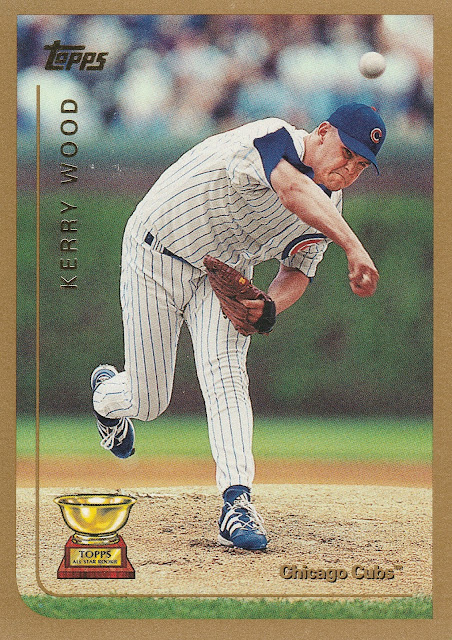
1998 Topps All-Star Rookie Right Handed Pitcher Kerry Wood


If you see this from the batter's box, you are in for a long day. Kerry Wood in 1998 was the NL Rookie of the Year, so of course he was Topps' first choice for right handed pitcher on their All-Star Rookie Squad. That season, Wood piled up the strikeouts (the most by a Chicago Cub since Hall of Famer Fergie Jenkins in the 1970s), and won 13 games. He had one Complete Game,  which was a shutout, but we'll talk about that game in a bit.
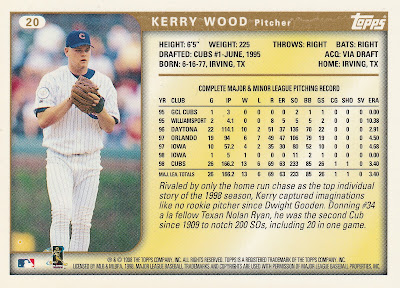

Topps went as far as to say that Kerry's rookie campaign was comparable to Dwight Gooden's phenomenal debut season, and the story of Kerry's season was second only to his teammate Sammy Sosa's chase with Mark McGwire to un-seat Roger Maris as the single season Home Run King. He led the NL in H/9 and K/9, but his electric stuff could be a little tough to harness at times. His 85 walks ranked in the top ten in the NL that year as well as hitting 11 batters and uncorking 6 wild pitches. Sometimes a little wildness can go a long way towards baffling the opposing batters.
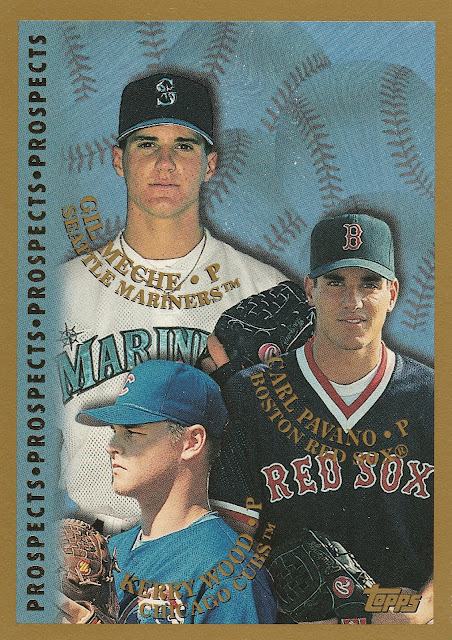

The Cubs made Kerry a first round pick in 1995, selecting him out of high school in Grand Prairie, TX. Wood would start to show signs of the pitcher he'd grown into as a senior, when he fanned 152 batters in a little over 80 innings. He had a 0.77 ERA and was a perfect 14-0. His first full professional season came at the age of 19 for the High-A Daytona Cubs. He went 10-2 with a 2.91 ERA, striking out 136 batters in 114.1 innings pitched. The Cubs were willing to take the good with the bad, as the walks piled up alongside the Ks throughout his minor league career. In 1997 with the Orlando Rays and Iowa Cubs, he allowed a combined 131 walks in 151.2 innings. Despite the wildness, Wood returned in 1998 with a mission to make the big league roster. He would make just one start at AAA, striking out 11 of the 17 batters he faced before being called up to the Cubs.
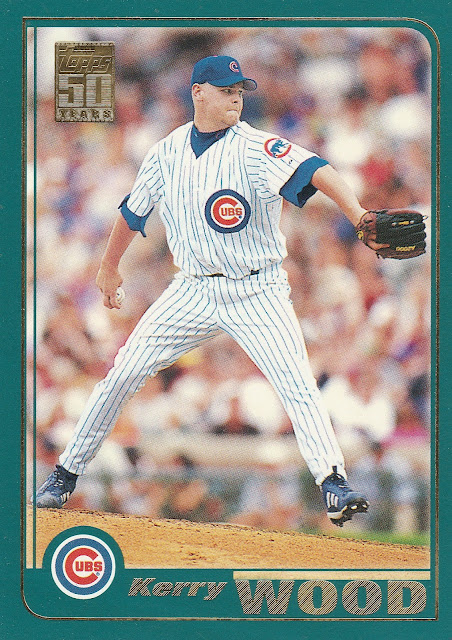

Wood's magical rookie season was curtailed by "elbow soreness" that kept him out of the rotation for the final month of the season. He'd return to make a start against Atlanta in the NLDS, taking the loss after allowing a single run over 5 innings. In Spring Training of 1999, Wood tore his UCL, nearly ending his career. A season of rehab and recovery was needed to get him back on the mound and he was able to rebound to have several excellent seasons in the Cubs' starting rotation.
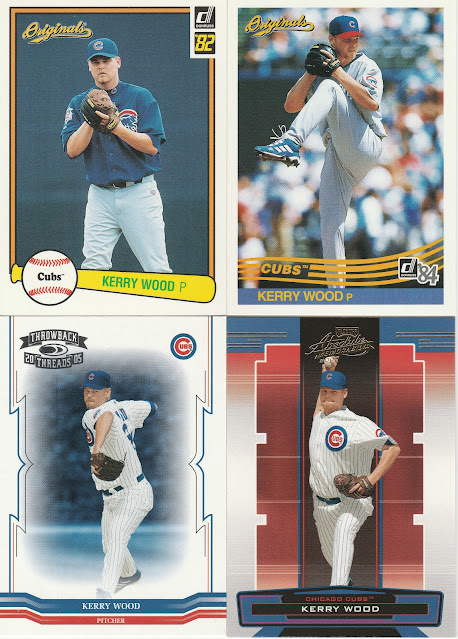

From 2001 - 2003, Wood averaged 200 innings pitched with 700 Strikeouts and an ERA+ of 122. He pitched a gem similar to his rookie season masterpiece (which we'll get to in a bit), when he tossed a 1 hit, 14K shutout against the Brewers in May of 2001. Along with Mark Prior, Wood formed a fearsome 1-2 punch at the top of the Cubs' Rotation and helped propel the team to within one game of the World Series. Wood was the starter of Game 7 of the 2003 NLCS against the Marlins, and even hit a home run to try to help his own cause, but the curse of the Billy Goat was still lurking in the shadows of the Friendly Confines. The Cubs would lose an ugly 9-6 game to the Marlins, and the following season the injury bug would bite Wood again. He would miss nearly 2 months of the 2004 campaign with a strained triceps muscle. 2005 ended prematurely with an injury in August, and 2006 and 2007 were nearly lost completely due to knee injuries and then a torn rotator cuff. 

Wood made the decision to shift from the rotation to the bullpen, and in 2008, he made a big splash, saving 34 games for the Cubs and striking out 84 batters in 64.1 innings. 
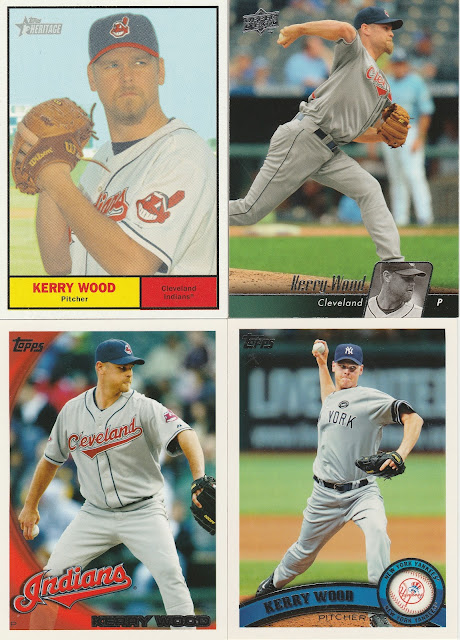

Following the 2008 season,  the Cubs opted not to sign Wood and he tested the free agent waters, landing in Cleveland. He would serve as the closer again, saving 20 games and sporting a league average ERA+ of exactly 100. He was traded at the 2010 trading deadline to the Yankees, where he pitched in middle relief setting up Mariano Rivera. He was his old electric self again with New York, recording a 0.69 ERA over 24 appearances. He allowed just 2 runs over 26 innings, striking out 31 batters down the stretch. In the Post-Season he allowed 2 more runs, 1 to the Twins and 1 to the Rangers, but overall pitched very well.


Wood returned to the North Side in 2011, and pitched the final two years of his career in the Cubs' bullpen. He's 3rd All-Time in strikeouts for the Cubs, even though he's 28th in innings pitched. 


Of course his signature moment came in his rookie season. Wood fanned 20 Astros in just his 5th career start. There are many tributes written about this game, but here are a few of my favorite tidbits:

-Out of 122 pitches thrown, only 7 were hit into fair territory. 
-Only 3 of those made it out of the infield.
-The lone hit he surrendered was an infield single that kicked off the glove of 3B Kevin Orie. Arguably it could have been ruled an error.
-The very first pitch of the game was a wild fastball that bounced off the mask of home plate umpire Jerry Meals.
-Houston's Shane Reynolds actually pitched a great game himself, striking out 10 and allowing just one earned run over 8 innings.

It has been argued that this was the greatest game ever pitched - even though he allowed a hit and also hit Craig Biggio (then again, who hasn't hit Biggio?). Bill James developed a formula to grade starting pitchers which is widely used and called the Game Score. 

Kerry Wood's game score for this outing was 105, the highest score of any pitched game before or since. 

Compare that to Clemens in 1986, his 20K game had a game score of 96.
Clemens in 1996, his 20K shutout had a game score of 97. 
Don Larsen's Perfect Game in the 1956 World Series? His Game Score was 94.
Sandy Koufax threw a perfect game in Sept of 1965 with 14 Ks - that game score was 101. 


Monday, January 3, 2022

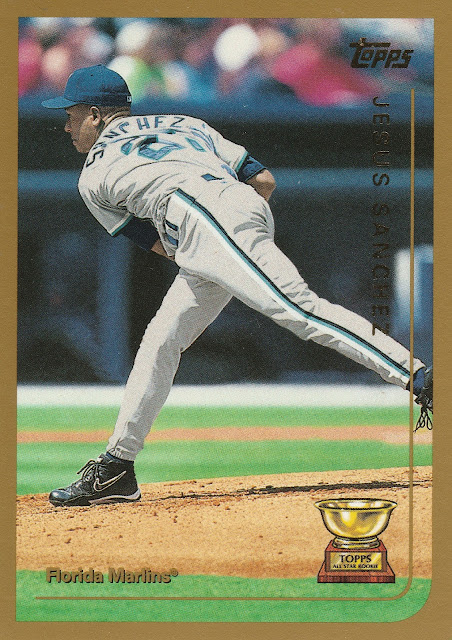
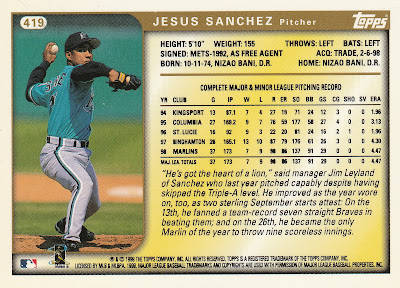
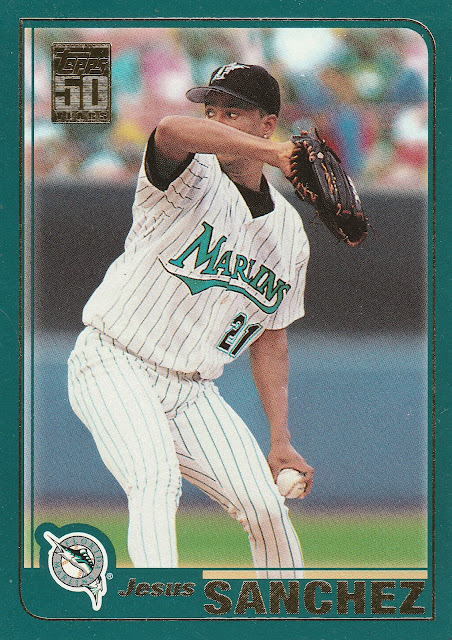
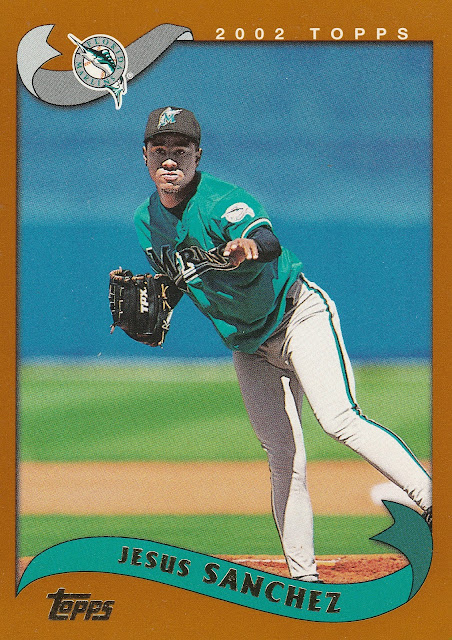
1998 Topps All-Star Rookie Left Handed Pitcher Jesús Sánchez

 Jesús Sánchez, Pitcher for the Florida Marlins, should not be confused with Jesús Sánchez, outfielder for the Miami Marlins. For one thing, Jesús Sánchez was born in the Dominican Republic. Jesús Sánchez, on the other was born in the Dominican Republic. Wait. Jesús Sánchez bats left handed, and Jesús Sánchez bats.... left handed. Hmm. Let's get more technical here. When Jesús Sánchez was born, Jesús Sánchez had just completed his 4th season of professional ball for the Binghampton Mets. Ah, now I get it. Jesús Sánchez, our Jesús Sánchez for this post, was a member of the 1998 Topps All-Star Rookie squad, while Jesús Sánchez was a literal rookie of life itself in 1998, completing his first year of being!


Jesús Sánchez was signed by the Mets as a 17 year old free agent out of the Dominican Republic in 1992, beginning a steady climb through the organization as a lefty with control and endurance. In his debut season of organized ball he finished 3 of his 12 starts. His 1.96 ERA was the lowest for any Mets' pitcher in the entire org that year. He made the jump from AA Binghampton all the way to the Marlins' rotation in one off-season. He joined the defending World Series champs and made 29 starts for manager Jim Leyland, who referred to him as having "the heart of a lion." While his season stats were not eye-popping, the fact that he was just 23 and hadn't pitched above AA previously made his season noteworthy. He saved his best start of the season for his last, scattering 5 hits and 2 walks over 9 shutout innings. The Marlins didn't score, either, and he ended up with a no-decision for his troubles.


By 2001, Sánchez had started 71 games for the Marlins over 3 seasons, but hadn't really found the consistency expected of a Major League starter. Some of it could be attributed to the way he was used - in 1999 he appeared in 59 games as a pitcher, and pinch ran 13 times. Fun fact - Sánchez was a long-distance runner in high school. He was used primarily out of the bullpen in 1999, but started 10 games. By 2000, he was once again in the rotation full time, and tossed a pair of complete game shutouts, but still ended up losing more games than he won. Sánchez had a great pickoff move, nabbing dozens of would-be base stealers in his career, setting a team record with 12 in 1998 alone. 


His pitch mix evolved over the years, with his change-up becoming his best weapon to complement his fastball. He didn't pitch with high velocity, and the transition from the minors to the majors would reflect the difficulty of bringing a less than blistering heater to the big leagues. Strikeout rates decreased, while walk rates, hits/9, and home run rates all increased.  Sánchez spent a good chunk of 2001 in AAA, not returning to the big leagues until late June. By the end of the year, he'd be traded to the Cubs, who viewed him a possible 5th starter / swing man in the bullpen. He'd spent parts of the next three seasons as a AAAA pitcher, shuttling between the big leagues and AAA for Chicago, Colorado, and Cincinnati. He then moved on to pitching in the Dominican Winter Leagues, the Mexican League, spent a year in China with the CBPL where he pitched a sub 3.00 ERA for the first time since 1996, and then returned to the U.S. to pitch in the independent Atlantic League for a pair of seasons, retiring in  2012. Sánchez today is the pitching coach for the Cleveland Guardians' Dominican Summer League team located in Boca Chica, D.R. which is located a few provinces east of his hometown of Nizao. 

Check this out - Sánchez finishes up a then-Marlins record of 7 consecutive strikeouts by tossing an "immaculate inning" - 9 pitches, 9 Strikes, 3 strikeouts!  He gets Greg Maddux with that nasty changeup.


Monday, April 5, 2021

1998 Topps All-Star Rookie Second Baseman Miguel Cairo


There are players in Major League history with more eye-popping stats than infielder Miguel Cairo, but very few of them were unanimous selections for the Topps All-Star Rookie team. Cairo was playing his first full MLB season at the age of 24 in 1998. He was already playing for his 4th MLB franchise, but it was because lots of teams wanted him! The expansion Tampa Bay Devil Rays needed talented players to fill out their roster - and Cairo fit the bill at second base.


His rookie season included 138 hits (26 doubles and 5 Triples) and 19 stolen bases in 150 games. He was the 8th pick in the Expansion draft, plucked from the Cubs organization. 


Cairo signed with the Los Angeles Dodgers as a minor league free agent when he was just 16 years old out of Venezuela. He made a big impression after a great year in High A Bakersfield in 1994 - he stole a career best 44 bases while hitting .291 in 155 games. From then on he was an intriguing target for various teams looking to improve their org's speed and/or defense. Seattle picked him up in a trade with the Dodgers after the 1995 season, then flipped him to Toronto less than a month later. He had a strong season in AAA for the Jays, and made his MLB debut in April of that year. He then came to the Cubs in time for the 1997 season, and he spent another year mostly in AAA, now in Iowa. He had 159 hits for the AAA team, and once again showed decent speed with 40 steals. The Devil Rays felt he was ready to take the next step and handed him the starting 2B job for 1998.


His most prolific seasons came as Tampa's starting second baseman, where he hit .275/.319/.356. He wasn't a power hitter, is what I'm saying. But he did pile up the singles and was a talented defender. He'd end up back in the Cubs organization in 2001 after the Devil Rays wanted to give Brent Abernathy a shot as the everyday 2nd baseman. Cairo was released in November by the Devil Rays, then picked up by Oakland, and was traded late in Spring training to the Cubs. The Cubs provided Cairo with the opportunity to re-invent himself from a light hitting second baseman into a light hitting utility infielder. This would be a key development for Cairo, as his versatility would allow him to prove his usefulness to many more teams for many more years. 

After a season with Chicago (split between AAA and the big league club), Cairo caught the eye of the Cardinals' Tony LaRussa. The Cubs placed Cairo on Waivers and the Cardinals snapped him up in time for the 2001 post season run. Cairo would pick up a hit and a stolen base against the eventual World Series Champion Diamondbacks in the 2001 NLDS. The following year, Cairo would play all over the diamond, appearing at every position except pitcher, center field, and catcher. He filled the Super Utility role that was a vintage LaRussa strategy. He would give anyone and everyone a day off when called upon, and was a valuable double switch option in the National League. 

In the 2002 NLDS, Cairo reached base in all 5 plate appearances. He'd add 5 more hits in the NLCS, but the Cardinals fell just short, losing to the Giants


Cairo had a great season with the Yankees in 2004, again playing all over the infield. He appeared in a career high 122 games, and topped 100 hits for the first time since his days as an everyday player in Tampa. He would go on to play for the Mets, then back to the Yankees, then the Cardinals again, then Seattle and Philadelphia before finally settling for a 3 year stint in Cincinnati. His time with Philly included his only World Series experience, though he was on the roster he did not get a plate appearance. In all, Cairo played in 17 MLB seasons, and collected over 1,000 career hits and scored over 500 career runs. 


This year Cairo has re-united with Tony LaRussa to serve as the bench coach for the Chicago White Sox.

Do you have any Miguel Cairo memories? I'd love to read them in the comments below. 

Thanks for reading! 

Monday, March 29, 2021

1998 Topps All-Star Rookie Third Baseman Bobby Smith


Bobby Smith, you say? Oh, he just made the Topps All-Star Rookie squad because he got the "Expansion Team Boost" you say. Oh, he was the only 3B who qualified, you say. Well guess what? Not only did he outplay Aramis Ramírez and future Hall of Famer Adrian Beltré, but he was top 5 among all rookies in homers and RBI. No need to make excuses for success! Bobby Smith was the best choice for Topps All-Star Rookie 3B in 1998, and I'm here to tell you all about it.


The Devil Rays picked Smith in the expansion draft from the Braves, which worked out great for Smith. He certainly would be waiting a long time for a chance to play behind Chipper Jones and the deep farm system that Atlanta boasted. In Tampa, he'd have a fair chance to be seen along with a host of other promising youngsters. His rookie season included the Devil Rays first walk off homer, which was a stunning end to a 14 inning marathon. Smith's homer was his 4th hit of the game, his first big league home run, and you can watch it right here:


Not too shabby.


Smith was an 11th round pick by Atlanta, following a great prep career in Oakland. He was the Oakland school district's Player of the Year in 1992, and had a scholarship offer from Cal-Berkeley. He opted to play professionally with the Braves, making his way up the organizational ladder. He displayed a little power, a little speed, and lot of versatility. In the minors, he was already moving around the diamond - he played in the outfield as well as shortstop, but his primary position was the hot corner. 


The Devil Rays had picked up Wade Boggs as a free agent before their first MLB game, and Bobby Smith was looked at as his heir apparent. Smith's rookie year was his most productive. Over the next few years, a pattern would emerge - Smith would hit well in AAA, then struggle in the big leagues. Whether it can be chalked up to a poor hitting environment in Tropicana Field, limited at bats to develop a groove, or just hitting his talent ceiling, Smith was unable to put it all together at the big league level. 

Smith still found jobs throughout organized pro ball, though his final MLB game came in 2002. He played another 5 seasons in the high minors for the Brewers, Yankees, White Sox and his hometown Oakland A's. After he retired from playing, Smith went on to a career in coaching, serving as a hitting couch in Arizona's minor league system under Delino DeShields, Sr.

Do you have any Bobby Smith memories? I'd love to read them in the comments below. 

Thanks for reading! 

Monday, March 22, 2021

1998 Topps All-Star Rookie Outfielder Magglio Ordóñez


The unlikely path that lay before Magglio Ordóñez was that of a 15 year MLB veteran. He was a late bloomer who became a smash hit in two AL Central cities. Magglio joined Mark Kotsay and Ben Grieve in the Topps All-Star Rookie outfield for the 1998 season after being left unprotected in the Rule V Draft the year before. Ordóñez had solid if not spectacular numbers in his rookie season, including 14 homers and 9 stolen bases. 


  Ordóñez was signed as an international free agent by the White Sox out of Caracas, Venezuela - the same hometown as former White Sox great Chico Carrasquel. He would spend 5 mostly uneventful seasons in the minor leagues before having a breakout campaign for AAA Nashville. He was the 1997 MVP of the American Association, thanks to a meaty .329 average and an OPS of .840. He did consistently rise in the minor league ranks each after after 1994, and showed glimpses of the power he'd later display at the big league level. 


Once he made it to the big leagues, Ordóñez was hitting his prime baseball years. With the White Sox, he made it to 4 All-Star games, and clubbed 30+ homers and 110+ RBI in four straight seasons starting in 1999. He earned the first of 3 career Silver Slugger awards in 2000, when he hit .315/.371/.546 with 32 homers, 126 RBI, 102 runs scored and led the AL in sacrifice hits. Things were going great for Ordóñez until a collision with an infielder on a pop up in short right field in 2004, which led to 2 surgeries on his knee. He'd play in just 52 games that season. Following that tough luck season, Ordóñez became a free agent and signed with the rival AL Central doormat, the Detroit Tigers.


Magglio's arrival in the motor city coincided with the team's renaissance from an afterthought to a juggernaut. During his first season in Detroit, he was still rehabbing and recovering from the knee injury that decimated his 2004 campaign. He'd play in 82 games in 2005, and crept back above .300 with a .302 average. This came with a bitter aftertaste - the White Sox would win the 2005 World Series without his bat in the lineup. But 2006 would be a different story. Ordóñez played his first full season since 2003, and helped the Tigers make a deep playoff run of their own, including some heroics in the 2006 ALCS. In game 4 of the series, Ordóñez hit a pair of homers - one to tie the game in the 6th inning and the next to walk off as a winner in the ninth. The Tigers would fall in the World Series to the Cardinals, with Ordóñez hitting just 2-19 with 4 Ks in the five game series. Then in 2007, he had one of the more remarkable offensive seasons in recent memory. He won the AL batting title, for starters, with a .363 average. He had 54 doubles, taking advantage of Comerica Park's spacious outfield alleys, also leading the league. Combined with his 28 homers, he managed to hit the most extra base hits in a season in MLB history without hitting a Triple. It would prove to be his 6th and final All-Star nod, and his 3rd and final Silver Slugger award. 


For his career, Ordóñez slashed .309/.369/.502 for an OPS of .871 and an OPS+ of 125. His 294 career homers trail only Miguel Cabrera and Andres Galarraga for the most by a Venezuelan born player in MLB history. 

Do you have any Magglio memories? I'd love to read them in the comments below. 

Thanks for reading!

Monday, March 15, 2021

1998 Topps All-Star Rookie Catcher A.J. Hinch


A.J. Hinch had all the trappings of a future star - he was a high school superstar, an Olympian, and a college standout. combine that with a quick run through the minors and you get a player ripe for Topps All-Star Rookie status. Of course, it didn't hurt that he was the only rookie catcher to play over 100 games in 1998.


The Oakland A's in 1998 were still looking for their next franchise catcher. Long-time catcher Terry Steinbach, a holdover from the great A's teams of the late 80s, left the team to play for his hometown Twins in 1997. Without him, the A's split their catching duties between 29 year old Brent Mayne, 28 year old switch hitter George Williams, and Izzy Molina (no relation). Williams actually had a pretty good season, with an OPS+ of 111 and an OBP of .397. Of course, Moneyball was still a few seasons away, so the A's were looking for power from the catching position. A.J. Hinch was poised to be the man for the job after a hot season in the minors, in which he hit 24 homers across two levels. 

For the big league club in 1998, Hinch struggled to adjust to major league stuff. He did have 9 homers and added 10 doubles, but slugged just .341 for the season. The big issue, which had not been hinted at in his amateur or minor league career, were the strikeouts. Hinch whiffed 89 times in that first year, good for a K rate of 22.8%. He displayed some decent skills behind the plate, throwing out 35 base stealers and committing just 9 errors in 120 games. 


Hinch came of age in Oklahoma, winning the 1992 Gatorade High School Player of the Year. He had starred on the Junior Team USA squad in 1991 and 1992, and he would join the big boys for Team USA in the 1996 Olympics, where he shared in a Bronze medal finish. He was drafted out of high school by the White Sox, but opted instead to retain amateur status with Team USA and his college of choice, Stanford. He stayed in school all 4 years, despite being drafted again following his Junior year, when was named the PAC-10 player of the Year. He would repeat the feat as a Senior, before being drafted a third time, now by the Oakland A's in the 3rd round of the June MLB draft. 


His rookie season would be his best in terms of games played and several offensive categories. In 2000, Hinch was sent back to Triple-A to try to right the ship after a rough 1999. He was part of the 3 team deal in the 2001 off-season that sent Johnny Damon to Oakland and Ben Grieve to Tampa Bay. Hinch landed in Kansas City, where he would serve as Brent Mayne's backup - the same Brent Mayne he succeeded in Oakland back in 1998. Hinch would bounce around the league for a couple years as a backup in Detroit and Philadelphia, playing a majority of his games in Triple-A Scranton Wilkes-Barre. He retired following the 2005 season, but had already started making plans for his next steps as early as 2003 when he attended the Winter Meetings and met with several General Managers. 

After his retirement, he served with the Diamondbacks as a minor league director of operations, then as the team's director of player development. In 2009, he was given the opportunity to be the team's manager. This learning experience would lead to a scouting gig and assistant general Manager role with the Padres, before the now controversial tenure as manager of the Houston Astros. Taking over for Bo Porter in 2014, Hinch inherited a team that was expected to lose, but more importantly, expected to learn how to win. The team exceeded expectations and made it to the post season for the first time in a decade with a Wild Card berth. The Astros remained competitive in the next few years while gaining experience. The good news is that they did learn to win, the bad news is how they won. The Astros won the 2017 World Series, but later were discovered to have done so with the benefit of an elaborate system for intercepting and relaying the opponent's pitches. For his part, Hinch did express regret and was the first to publicly apologize for the scandal. He listed as his biggest regret that he did not do more to curb the sign stealing when he first became aware of it. 

Hinch has been given another chance to show his integrity - following the retirement of Ron Gardenhire, Hinch was hired to be the manager of the Detroit Tigers for the 2021 season. 

Do you have any A.J. Hinch memories? I'd love to read them in the comments below. Uh... please be civil!

Thanks for reading!

Monday, November 2, 2020

1998 Topps All-Star Rookie Outfielder Ben Grieve


Many profiles of our next Topps All-Star Rookie want to know "What happened to Ben Grieve?" If you follow the trajectory of many phenoms / "can't miss" prospects, his story is probably a familiar one. Grieve had an MLB lineage (his father was a first round pick, too), to go along with a stellar prep career that had the scouts ready to fall all over themselves. Grieve backed up the hype in his rookie season with the A's - he set a franchise record for hits by a rookie, and made the MLB All-Star team en route to Rookie of the Year honors in the AL. Of course, that made him an ideal candidate for the Topps All-Star Rookie squad as well.


To give some perspective about how highly the A's thought of Grieve, he had more plate appearances that season than Rickey Henderson. Grieve's 41 doubles led the A's, as did his 168 base hits. Just 22 years old, Grieve was ready to take his place in Oakland A's history. 


The Oakland A's selected Grieve #2 Overall out of high school in Arlington, TX. He grew up with his father Tom Grieve as a 9 year veteran MLB pitcher and later coach and GM. Ben's older brother Tim was also a talented pitcher, and Ben even got the chance to face off against him in the minor leagues. The MLB connection included getting hitting instruction from the then Texas Rangers hitting coach Tom Robson while Ben was in high school. 


As prospects go, few were hotter than Grieve - he was the 1997 Minor League Player of the Year, have forced his way onto the MLB roster to finish the season. He slugged .610 with 24 homers in double A, then surpassed that with a SLG north of .700 in a handful of games in AAA Edmonton. He had already made an impression in 1996, hitting .356 for the season in Modesto. There was little doubt that Grieve was on his way to star status.


Despite the fact that Grieve's 1998 season was his only All-Star Appearance, his entire A's career was a success. Grieve follow up his Rookie of the Year campaign with a career high 28 homers. In 2000 he once again reached 40 doubles, this time with 27 homers, making it the highest slugging of his MLB career to date. He also topped 100 RBI for the first time, finishing the year with 104. That season marked his first appearance in post season play, where he struggled with a 2-17 with 7 strikeouts performance in the ALDS against the Yankees. Over the first 3 full seasons in the big leagues, Grieve was averaging 35 doubles, 25 homers, and over 90 RBI. 


Before the 2001 season began, Grieve was traded to Tampa in a wild three team deal that sent Johnny Damon to Oakland, Angel Berroa and Roberto Hernandez to Kansas City, along with several other players flipping between Oakland and KC. Grieve was the lone player coming to Tampa Bay, and they certainly thought they were getting a steal. It's about this time when people started the "what happened to Ben Grieve" narratives, with his first season with Rays just 11 homers and a 100 point drop in his slugging percentage. After the trade, Grieve had gone from second banana behind Jason Giambi to top dog in Tampa. He was hitting 5th in the order after an older Fred McGriff and Greg Vaughn. He was making less contact in Tampa (certainly the roof in St. Pete was less inviting than California sun), setting a career high with 159 strikeouts. The positives? He still rattled off a pair of 30 double seasons, and his walk rate had improved considerably. Maybe the opposition was willing (and able) to pitch around Grieve now that he was the main focus of the lineup? 2003 added injury to insult, as a blood clot in his shoulder required surgery. He would play in just 55 games that year, his last in Tampa. 


He was entering a free agent season after the injury, and was left with fewer options than a former ROY would normally expect. He landed in Milwaukee, where he was used in platoon situations for 108 games. He was on the move again the next year, taking a brief tour of the NL Central division. While the Pirates signed him initially, he would end up playing for the Cubs for a handful of games in 2004 and 2005. He moved to the south side after that, playing minor league ball for the White Sox for two more seasons. 


Do you have any Ben Grieve memories? I'd love to read them in the comments below. 

Thanks for reading!

Monday, October 12, 2020

1998 Topps All-Star Rookie Outfielder Mark Kotsay


In College, Mark Kotsay was the Big Man on Campus, starring for the Cal State Fullerton Titans in the 1995 College World Series. In 1998 with the Marlins, he looked like he might be a fish out of water. Young and unproven, Kotsay was given the tall order of taking over Right Field in place of Gary Sheffield. He finished the season with more games played than any other Marlin, and was near the top of the list in most of the team's offensive leaderboards. His 20 outfield assists were the most in the National League. You better believe that was enough to make Mark a member of the 1998 Topps All-Star Rookie team.


Kotsay found success at every level of play - in 1994 he played in the Cape Cod league following his freshman year at baseball powerhouse Cal State Fullerton. 1995 saw him set a record with a .517 average in the 1995 College World Series. His team would win their 3rd straight CWS, and he walked away with the Golden Spikes award. In 1996, he was selected by the Marlins as the #9 Overall pick in the June draft, played on Team USA in the 1996 Summer Olympic Games, and made his pro debut for the Kane County Cougars. By 1997, he had made it all the way up to the big leagues for a two week cup of coffee in July. The Marlins organization had big plans for Kotsay - little did he know that the team would win it all in 1997 - then blow it all up for the next season, totally re-making the outfield from the season before.


Kotsay would play 3 full seasons for the Marlins, playing a combo of Centerfield, Right, and 1st base. He didn't have the power numbers he displayed in college, but he definitely still had the contact skills. Kotsay was used near the top of the lineup and he piled up the hits. In the field, he continued to show off a cannon for an arm, leading the NL in assists in his rookie year and again in 1999. He would be traded to San Diego just before the 2001 season began. 


The Padres made Kotsay their everyday Centerfielder, and he continued to display line drive power to the gaps and excellent contact numbers. His outfield assists dwindled down to just 4 in his first season in San Diego, but that was mostly due to the word getting around that trying to take the extra base against him would usually end in embarrassment for the runner. From 2002 through 2004 he would again lead the league in assists as a Centerfielder, surpassing double digits each year. 2002 would also prove to be one of his best offensive seasons, hitting .292 with 17 homers and a 122 OPS+. Following the 2003 season, Kotsay was on the move again, as the Oakland A's traded Terrance Long and Ramon Hernandez to make him their leadoff man and centerfielder. 


Kotsay responded with a career high 190 hits, which was the most by a lefty in Oakland in more than 40 years. He also set a career high batting average, hitting .314 despite playing half of his games with the huge foul territory in Oakland, known to suppress those stats. One reason he was so successful in Oakland was his ability to limit strikeouts. In 2005 he struck out at a rate of once per 11.4 ABs, which was the 2nd best K rate in the American League. He'd get his first taste of post season play in 2006, hitting a home run against the Twins in the ALDS, and adding 4 more hits in the ALCS in a losing effort against the Tigers. The injury bug bit him in 2007, playing in just 56 games and a career low .214 average over that span. 


Kotsay was on the move again after that lost season, traded to Atlanta in January. He'd have a rare highlight for Atlanta in August of 2008, going 5-5 and hitting for the cycle. With Atlanta uncharacteristically out of post season contention, Kotsay was dealt again mid-season, going to the Red Sox to help their playoff push. Kotsay was happy to join Boston, as he listed playing in a World Series as his few remaining goals. He was quoted as saying after the trade "the respect of your peers is what you play the game for, and nothing else." He was eager for another shot at a championship with a talented team. He provided depth in the outfield and a valuable bat in the post season, hitting .300 in the ALDS and adding 7 more hits in the ALCS, but the Red Sox were bounced out by the Rays. He would be used as a reserve in 2009 by the Red Sox, then was dealt at the trade deadline again to Chicago. With the White Sox, he would spend more time as a DH than at any time in his career, and was no longer the everyday player he once was. His reputation was that of a "grinder / gamer" but at this point his goal was to provide leadership and defense when called upon. He'd get another post season shot in 2011 with Milwaukee reaching the LCS again, but falling just shy of the World Series.

He'd finish out his career back in San Diego, closer to his wife and kids in Southern California. He had been not so subtly hinting at a reunion for the past few years with the Padres, stating in an interview that he would call the team himself and inquire about an opening in the offseason. The veteran leadership would segue perfectly into coaching. He would retire in 2014, then return in 2015 as the Padres new hitting coach. He would move on to Oakland in 2015 as a bench coach, and recently has been one of the top names for managerial jobs in Boston, San Francisco, and Pittsburgh recently. Another spot opened up today on the South Side, could he be in line again for the role?

For his MLB career, Kotsay had 1,784 hits, scored 790 runs and drove in 720 more. He had 123 outfield assists, and was widely regarded as one of the better outfield defenders in the league by his peers. He was named to the Omaha (College World Series) Hall of Fame in 2014, and was named College Baseball's Player of the Decade for the 1990s. 

Do you have any Mark Kotsay memories? I'd love to read them in the comments below. 

Thanks for reading!


Monday, October 5, 2020

1998 Topps All-Star Rookie Short Stop Mike Caruso


The White Sox made a big trade with the Giants at the trade deadline in 1997, with 9 players changing uniforms. The big names at the time all moved out West - the Giants acquired Danny Darwin, who would finish his career in San Fran the following season at the age of 42. Wilson Alvarez, who became a free agent and signed up with the expansion Devil Rays, and Roberto Hernandez, who took the same path to free agency to Tampa. For a pair of rentals and a savvy veteran, the Giants sent 6 prospects to Chicago. It was dubbed the "White Flag" trade, with the Sox just 3.5 games behind Cleveland at the time. Fans felt that trading your ace and your closer in the middle of a pennant race was giving up, and they probably are not wrong. 

Mike Caruso was the player to make the most of it all - he turned a vacancy at short (Ozzie Guillen left for free agency) into a Topps All-Star Rookie Cup!


The trade makes more sense when Caruso made the team out of Spring Training in 1998. His previous highest level was single A, but the Sox didn't have a better answer at the position. The team needed a boost to their prospect pool, and Caruso was diving off the high dive with a cannonball. He swiped 22 bases and hit .305 his rookie year. That was good enough for 3rd in the ROY balloting, and he was the answer to several trivia questions - the youngest ChiSox player on Opening Day since 1959, the first rookie to hit .300 or better for the team since Minnie Miñoso, and made many onlookers ready to compare him to a "young Ozzie Guillen."  


Caruso was born in Queens, NY, but attended Marjory Stoneman Douglas High School in Parkland, FL (yes, the same high school that later was the site of an infamous shooting). He was a 2nd round draft pick of the Giants, and immediately made an impact in his first pro season. Playing for Single A Bellingham, he made the All-Star squad, stealing 24 bases and hitting .292. Baseball America had him in the top 50 prospects (#34) the following year. He started his second year hot - A .333 average before the trade to Chicago. He hit just .227 in 28 games for Winston-Salem after that, but his contact and speed tools were very advanced. With Ozzie Guillen departing following the 1997 season, the SS position was wide open.


So... what happened? He hit over .300 his rookie season, plays a primo position, and still is just 22 years old. It turned out that 1999 would be his final full season in the big leagues. His average dropped to .250 and he was caught stealing more times than he was successful. The fact was that at 22, his defense wasn't fully polished either - he had 35 errors his rookie season, and 24 in 1999. He would be supplanted at short by veteran Jose Valentin, and would be sent down to AAA to work on the finer points of middle infield defense.


He would play several years in the minors for the Sox, Rays, Royals, and Reds. He would even get one more crack at the majors, going 2-20 with the Royals towards the end of the 2002 season. He was out of baseball completely for two years after that. Caruso then made a comeback attempt in the Independent leagues and played for various teams throughout the independent minor league circuits until 2009. Here's a great article from the Lancaster County Paper, which details the journey of Caruso from phenom to journeyman, written in 2008. "I didn't realize what I did until it was over."

Do you have any Mike Caruso memories? I'd love to read them in the comments below. 

Thanks for reading!

Monday, July 27, 2020

1998 Topps All-Star Rookie First Baseman Todd Helton


Moving ahead to the 1998 Topps All-Star Rookie Roster and we start with a great one. Todd Helton is a Hall of Fame caliber player, and his value as a hitter was evident from the very beginning. His 97 RBI as a rookie was the 2nd most in a quarter-century. Crow all you like about the "Coors-Effect" but know that few hitters had the success that Todd Helton did in the 2000s. Helton was definitely the easy pick for Topps All-Star Rookie at first base. He finished 2nd in the NL Rookie of the Year balloting, leading all NL rookies in hits, average, runs, RBI, Homers, Slugging, OBP, multi-hit games, extra base hits and total bases. 


Helton not only led the league's rookie leaderboards, but also proved to be a team leader in the clubhouse from the start of his career. He was voted by his teammates to be the team's player representative during his rookie season, putting his University of Tennessee education to work!


Helton was ready to shine from an early age - as a college Freshman, Helton made the Team USA roster. He was drafted out of high school by the Padres, but opted to attend Tennessee as a baseball and football player. His first two years, he was the Vols backup QB behind Heath Shuler, then was slotted behind Jerry Colquitt (and ahead of a punk kid named Peyton). A knee injury at QB ended his football career, and he focused his attention squarely on baseball. He was the 1995 National Collegiate Player of the Year (Dick Howser Trophy winner), providing value as a hitter and as a pitcher. He set a Tennessee school record for saves in 1995, and over the course of his collegiate career had a 2.89 ERA in 193 innings pitched. At the plate, he hit .370 for his career for the Vols, and was the school record holder in homers and RBI by the time he was drafted.


Helton was the #8 Overall pick in the 1995 draft, and immediately made his way to the Single A Asheville Tourists. He hit just .254 over 201 at bats and had just 1 homer while striking out more than he walked. Things would turn around quickly, as he blasted AA pitching in 1996. He hit .336 across AA and AAA that year, and walked 62 times while striking out just 49. The following year, He was hitting .352 in AAA for the first 99 games before forcing his way onto the big league roster. His MLB debut on August 2, 1997 found him in Left Field, where he hit his first career homer, and went 2-4 against the Pirates. 


He would hit for the cycle in his 2nd full MLB season, and nearly duplicated the effort 4 other times that year but ultimately fell short. Nevertheless, his stats improved across the board from an already impressive rookie campaign, including an 80 point jump in his OPS. He eclipsed 100 RBI and 100 runs for the first time in his career, which he would repeat each year for the next 4 years. 


During his prime (1999 - 2006), Helton averaged a stat line of .336/.437/.603 with 100 walks, 116 runs, 111 RBI and 32 homers per season. 2000 was his career year - he led the NL in hits, doubles (59!), RBI, batting average, OBP, Slugging, (OPS obviously) and Total Bases. It was his first of 5 straight All-Star appearances, and he also brought home the Silver Slugger award. That 7 year prime included 4 Silver Sluggers and 3 Gold Gloves. Helton had 6 straight seasons of 30 or more homers and was an absolute on base machine. His batting title in 2000 would be his only one, though he was less 1/100th of a point away from a 2nd one in 2003, just behind Albert Pujols. The year 2000 was also his highest finish in NL MVP voting, ending up in 5th place. This could be called the "Reverse Coors Effect" as MVP voters were quick to discount a Rockie's numbers against the rest of the NL. It should also be noted that Pujols and Barry Bonds dominated the MVP discussion for much of Helton's prime years, leaving little room for him to make inroads on the ballot. 


By the end of his career in 2013, Helton was the undisputed "Greatest Rockie of All-Time," leading the franchise in nearly every significant offensive category. For his career he amassed over 2,500 hits, 369 homers, over 1,400 runs, 1,400 RBI, and 1,335 walks. His 592 doubles rank 19th all-time in MLB history, and his career WAR is just below the average Hall of Fame first basemen. He was the first player in MLB history to record 35 or more doubles in 10 straight seasons. His career OPS+ of 133 does take into account his home field advantage and still places him well above the league during his career. 

Does Todd Helton get your Hall of Fame vote? 

Any specific Todd Helton memories you'd like to share? I'd love to read them in the comments below. Thanks for reading!