Showing posts with label Colorado Rockies. Show all posts

Monday, February 28, 2022

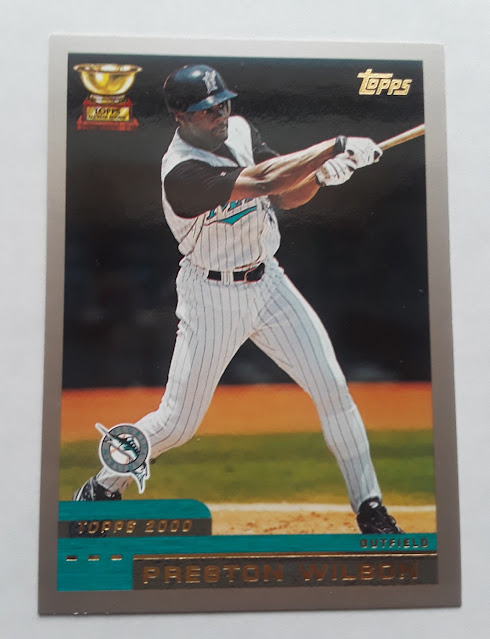
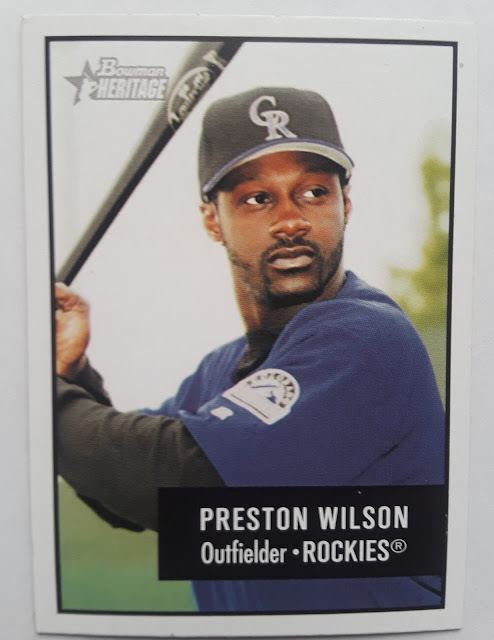
1999 Topps All-Star Rookie Outfielder Preston Wilson


Preston Wilson arrived in the big leagues after a very long journey that took him from the first round of the 1992 MLB Draft, to 4 top-100 prospect listings, to a winter spent playing baseball in Australia. After a 5 year minor league sojourn, Wilson had arrived in Queens, only to be traded away after just 8 games for the Mets. Wilson was big time prospect coming to Florida in exchange for the Marlins' brand new catcher Mike Piazza. 
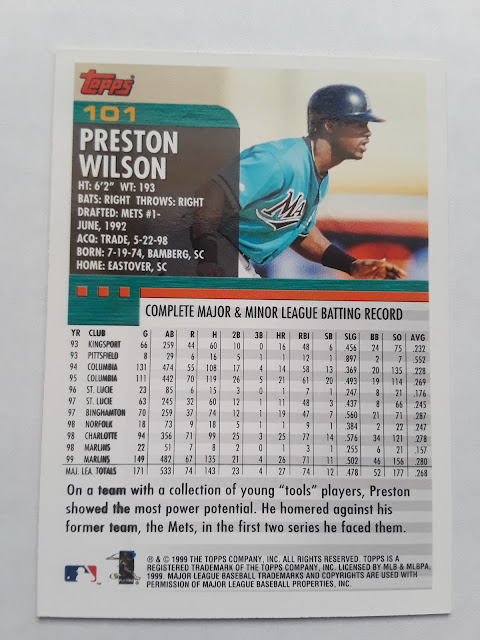

His first full season came in 1999, and he was able to show power and a little speed for an exciting and young rebuilding Marlins team. He'd finish 2nd in the NL Rookie of the Year voting and had a strong season, with a 119 OPS+ and hit 26 homers to go with 11 stolen bases. He was a great choice to join the 1999 Topps All-Star Rookie team.
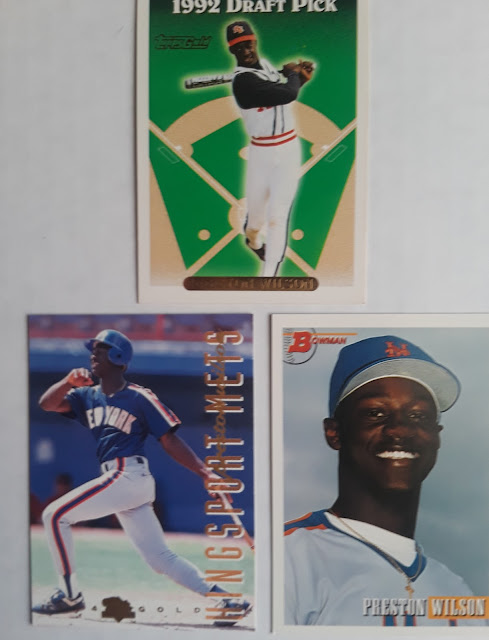

Wilson was the 9th Overall selection in the 1992 MLB draft, picked by his adopted father Mookie's former team, the New York Mets. To get the potentially awkward subject out of the way, Mookie Wilson's brother Richard was Preston's biological father, but it was Mookie that became Preston's mother Rosa's husband and raised Preston as his own son. So Mookie is technically Preston's uncle, but was also his father as far as Preston was concerned, and officially adopted him. Families are complicated, but it is clear that Preston was well loved and well raised by his parents. Preston was just 17 when he was drafted, and started his pro career with the Kingsport Mets in 1993. Before joining the Mets, he was the 1992 High School player of the year, and hit well for the 1992 18U USA National team. 

Wilson had no trouble launching the ball out of the park, hitting 17 homers in his first pro season, then at least 20 a year after that. In 1996, he played in just 23 games because of injuries to his wrist and shoulder. This had little to no impact the following season, as he hit 30 homers across 2 levels in the Mets organization, and then traveled down under for the Australian Winter League. I couldn't find any stats for his time with the Newcastle Hunter Eagles, but by the Spring of 1998, Wilson was poised to make his long awaited big league debut. He played in just 18 games for AAA Norfolk Tides before being called up in May 1998. His debut consisted of a 3 for 4 game with a stolen base and a run batted in. Each base hit, he was able to briefly visit with his dad, Mookie, who was the Mets' first base coach at the time.
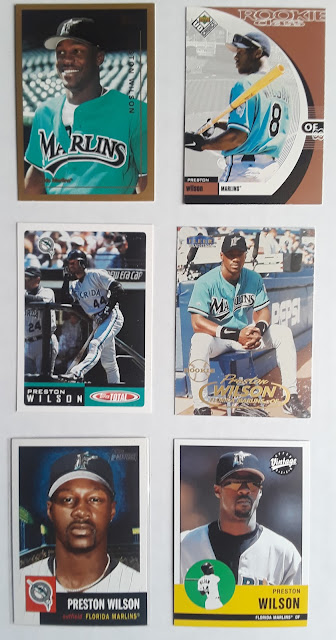

Wilson's trade to the Marlins included a demotion back to AAA, where he nearly hit 30 homers again, showing he was more than ready for a shot at the big leagues. Wilson would have an even better sophomore season, when he joined the 30-30 club in 2000. He was known for big power, but his swing also was conducive to strikeouts. In 2000, Wilson struck out 187 times, which was the most in the Majors, and nearly broke the long time record that Bobby Bonds held. Over his 4 full seasons with the Marlins, Wilson averaged 26 homers and 82 RBI per year. 

Wilson was traded to Colorado prior to the 2003 season, and the Rocky Mountain air was kind to Preston. 2003 would include career highs for Wilson across several offensive categories, and he led the National League with 141 RBI. 2003 was also Preston's lone all-star season. Wilson went 1 for 2 in the Midsummer Classic.
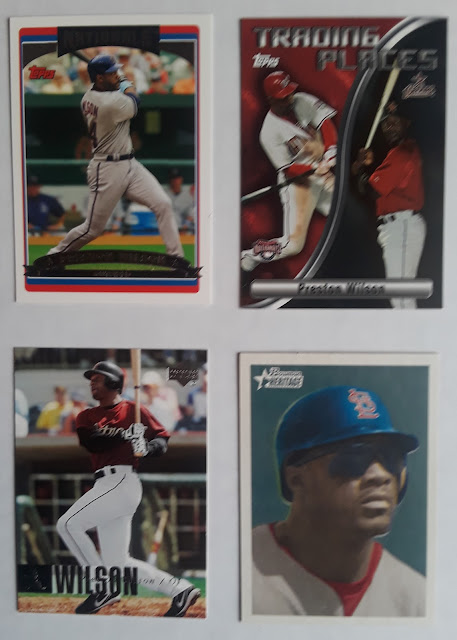

So, once a player has been a Topps All-Star Rookie, led the league in a few different offensive categories, made an All-Star team . . . what's left to check off? A World Series win, of course! Wilson started 2004 off slowly in Colorado, and was traded to the newly minted Nationals in Washington. He ended up playing what would amount to roughly one season with the Nats before being traded mid season to Houston, just in time to make a run at the post season. The Astros fell short, but the 2006 season would give Preston another chance to play the role of 2nd half star. Wilson was released at the deadline and picked up by the Cardinals, and he solidified the team's outfield rotation, providing a little power (9 homers in 33 games) and a little good old fashioned veteran leadership. Along with a strong cast of characters, the Cardinals would prevail in the World Series against the Detroit Tigers. Wilson appeared in all 5 games and picked up a pair of hits, scored a run, and drove in another. 


Following the 2006 championship, Wilson returned to St. Louis for an encore, but injuries limited his effectiveness and he played in just 25 games. Wilson worked hard to get back, and even played for the Independent League Long Island Ducks for 48 games in 2009 before deciding to retire. After his playing career, the charismatic and outspoken Wilson became a regular on Houston Astros and Florida Marlins broadcasts, and has dropped in as an MLB Network analyst from time to time as well. 

Wilson was recently interviewed for a Sports Illustrated article about declining participation of African-Americans in Major League Baseball, and his experiences and insights bring an important story into focus. You can read the article here -  and there's quite a bit to unpack inside. Wilson is also active on Twitter, his handle is @PrestonWilson44

Monday, July 27, 2020

1998 Topps All-Star Rookie First Baseman Todd Helton


Moving ahead to the 1998 Topps All-Star Rookie Roster and we start with a great one. Todd Helton is a Hall of Fame caliber player, and his value as a hitter was evident from the very beginning. His 97 RBI as a rookie was the 2nd most in a quarter-century. Crow all you like about the "Coors-Effect" but know that few hitters had the success that Todd Helton did in the 2000s. Helton was definitely the easy pick for Topps All-Star Rookie at first base. He finished 2nd in the NL Rookie of the Year balloting, leading all NL rookies in hits, average, runs, RBI, Homers, Slugging, OBP, multi-hit games, extra base hits and total bases. 


Helton not only led the league's rookie leaderboards, but also proved to be a team leader in the clubhouse from the start of his career. He was voted by his teammates to be the team's player representative during his rookie season, putting his University of Tennessee education to work!


Helton was ready to shine from an early age - as a college Freshman, Helton made the Team USA roster. He was drafted out of high school by the Padres, but opted to attend Tennessee as a baseball and football player. His first two years, he was the Vols backup QB behind Heath Shuler, then was slotted behind Jerry Colquitt (and ahead of a punk kid named Peyton). A knee injury at QB ended his football career, and he focused his attention squarely on baseball. He was the 1995 National Collegiate Player of the Year (Dick Howser Trophy winner), providing value as a hitter and as a pitcher. He set a Tennessee school record for saves in 1995, and over the course of his collegiate career had a 2.89 ERA in 193 innings pitched. At the plate, he hit .370 for his career for the Vols, and was the school record holder in homers and RBI by the time he was drafted.


Helton was the #8 Overall pick in the 1995 draft, and immediately made his way to the Single A Asheville Tourists. He hit just .254 over 201 at bats and had just 1 homer while striking out more than he walked. Things would turn around quickly, as he blasted AA pitching in 1996. He hit .336 across AA and AAA that year, and walked 62 times while striking out just 49. The following year, He was hitting .352 in AAA for the first 99 games before forcing his way onto the big league roster. His MLB debut on August 2, 1997 found him in Left Field, where he hit his first career homer, and went 2-4 against the Pirates. 


He would hit for the cycle in his 2nd full MLB season, and nearly duplicated the effort 4 other times that year but ultimately fell short. Nevertheless, his stats improved across the board from an already impressive rookie campaign, including an 80 point jump in his OPS. He eclipsed 100 RBI and 100 runs for the first time in his career, which he would repeat each year for the next 4 years. 


During his prime (1999 - 2006), Helton averaged a stat line of .336/.437/.603 with 100 walks, 116 runs, 111 RBI and 32 homers per season. 2000 was his career year - he led the NL in hits, doubles (59!), RBI, batting average, OBP, Slugging, (OPS obviously) and Total Bases. It was his first of 5 straight All-Star appearances, and he also brought home the Silver Slugger award. That 7 year prime included 4 Silver Sluggers and 3 Gold Gloves. Helton had 6 straight seasons of 30 or more homers and was an absolute on base machine. His batting title in 2000 would be his only one, though he was less 1/100th of a point away from a 2nd one in 2003, just behind Albert Pujols. The year 2000 was also his highest finish in NL MVP voting, ending up in 5th place. This could be called the "Reverse Coors Effect" as MVP voters were quick to discount a Rockie's numbers against the rest of the NL. It should also be noted that Pujols and Barry Bonds dominated the MVP discussion for much of Helton's prime years, leaving little room for him to make inroads on the ballot. 


By the end of his career in 2013, Helton was the undisputed "Greatest Rockie of All-Time," leading the franchise in nearly every significant offensive category. For his career he amassed over 2,500 hits, 369 homers, over 1,400 runs, 1,400 RBI, and 1,335 walks. His 592 doubles rank 19th all-time in MLB history, and his career WAR is just below the average Hall of Fame first basemen. He was the first player in MLB history to record 35 or more doubles in 10 straight seasons. His career OPS+ of 133 does take into account his home field advantage and still places him well above the league during his career. 

Does Todd Helton get your Hall of Fame vote? 

Any specific Todd Helton memories you'd like to share? I'd love to read them in the comments below. Thanks for reading!

Monday, March 23, 2020

1996 Topps All-Star Rookie Outfielder Todd Hollandsworth


Todd Hollandsworth was the NL Rookie of the Year in 1996, joining the ever growing list of Dodger phenoms to break into the big leagues. With similar tools to 1994 RoY Raul Mondesi, Hollandsworth flashed power, speed, and a strong outfield arm. He spent a good part of 1995 recovering from various nagging injuries, in 1996 it was his turn to fill in for the regular centerfielder, Brett Butler.


Todd hit 12 homers, stole 21 bases and had a 113 OPS+ while playing all three outfield positions. There is quite a bit of copy written bout Todd as a "gamer" aka a player who "plays the game the right way," and Brett Butler was even quoted as saying that Todd was never thinking "How cool do I look?" in a Clint Eastwood-esque get-off-my-lawn.


Todd had a big year in 1994 for Albuquerque, paving the way for his big league debut. He bashed 19 homers, drove in 91 runs, and stole 15 bases. It was his third season in a row with double digits in homers and steals, and he finally managed to get his strikeouts under 100 for the season. He was always a doubles machine, and had 31 for the Dukes in '94, the highest total of his minor league career.


Hollandsworth was the Dodgers' 3rd round selection in 1991, having lost picks in rounds 1 and 2 as compensation for adding Darryl Strawberry and Kevin Gross. They would add a 3rd rounder though as compensation for losing Kirk Gibson to Kansas City. He was born in Dayton, OH, and went to High School in Bellevue, Washington. As a Senior he hit .368 with a pair of homers, and was named "Athlete of the Year" by the Seattle Times and was a member of the Washington All-State Team. In addition to baseball, Hollandsworth also played for the Newport High Football squad (he rushed for over 1,000 yards) and their basketball team.


Following his Dodgers tenure, Hollandsworth spent time with 7 different teams- Colorado, Texas, Florida, Atlanta, the Cubs, and in his final MLB season, he played for both Ohio franchises. Hollandsworth didn't become the toolsy superstar hinted at by his rookie year, but he was a solid 4th outfielder for 12 MLB seasons. His best seasons were 2000, split between LA and the Rockies, and 2002, which was split between the Rockies and Rangers. The following season, Hollandsworth became a World Series Champion as a member of the Florida Marlins.

After his playing career, Hollandsworth has been a broadcaster for several teams, currently a member of the Marlins tv broadcast team.

Let's hear your Hollandsworth stories! Thanks for reading!

Tuesday, January 21, 2020

Break Out the Canadian Tuxedos!


Really a great day! I'm a big fan of Larry Walker, and finding out that he's been elected to the Baseball Hall of Fame in his 10th and final year of eligibility is just awesome. Walker himself was humble in the hours leading up to the announcement, thanking fans and his many advocates for their kind words and support. 


Young Larry was hoping to be a Goalie in the NHL, but baseball called to him instead. Growing up in Canada, baseball was an afterthought to many. The harsh, long winters limited opportunities and interest in the sport for many. Walker would later recall that before joining the Expos' minor league system, he'd never seen anyone throw a forkball, or slider, or even a decent curveball. He was a dead red fastball hitter, but lacked plate discipline and struggled mightily to hit anything else. Working first with Ken Brett, then Ralph Rowe, Walker became a great hitter through a tireless work ethic. He would return every year to the Florida Instructional League, even taking residence in the area to continue to fine tune his swing and approach at the plate.


What Walker didn't have to learn on the job was athleticism. He was rangy in right field and dangerous on the bases. Over his career he'd steal 230 bases and win 7 Gold Gloves.

His career in Montreal ended following the 1994 season. He led the NL in doubles that season, and hit a then career-high .322 with a .382 OBP. He had a perfect mix of power and speed, hitting 99 homers and stealing 98 bases with the Expos over 6 seasons, earning 2 Gold Gloves and appearing in his first All-Star game.


Walker would really take off in Colorado. His first full season in Colorado he was the NL leader in Outfield Assists, and finished 7th in the MVP voting. People will point to Colorado as an extreme hitter's park, and note that Walker's numbers started going up right when he arrived in the Rockies. I would agree that Coors Field can inflate numbers, but Walker was just hitting his prime (1995 was his age 28 season) and he hit very well on the road as well.


Walker had ridiculous numbers in Colorado, ran away with the MVP award in 1997 with a triple slash of .366/.452/.720. He slugged .720! He was the first player to slug over .700 and steal 30 bases in a season. He led the NL with 49 Homers, and 409 Total bases. He won another Gold Glove, a Silver Slugger, and made his 2nd All-Star team. He'd win the NL batting title 3 of the next 4 seasons. In 1999, he was the Triple Slash Triple Crown winner, leading the league in batting average, OBP, and Slugging. Over his 10 seasons with Colorado, he slugged .610.


He would finally play in a World Series with the Cardinals in 2004. Now away from Coors, he still posted an OPS+ of 134 in his final 2 seasons. His career Road OPS is higher than Roberto Clemente,  Ken Griffey, Jr. along with many others he will be joining in the Hall.


Congratulations to Larry Walker, the 2nd Canadian player to be inducted into the Hall of Fame!

Monday, January 20, 2020

1995 Topps All-Star Rookie Catcher Charles Johnson

 Image courtesy Gavin from Baseball Card Breakdown- used with permission.

Charles Johnson famously did not sign with Topps to appear on their cards, in solidarity with other 1991 Team USA players like Jason Varitek. Even so, Charles Johnson was still the obvious choice to be the 1995 Topps All-Star Rookie Catcher. He was just the 4th rookie to win a Gold Glove as a catcher, along with all-time greats like Johnny Bench and Carlton Fisk, and phenom Sandy Alomar, Jr. Those three were also Topps All-Star Rookies, just sayin'. 
Image courtesy Gavin from Baseball Card Breakdown- used with permission.

The fact that he didn't sign meant that he wasn't in the 1996 Topps Set, but that didn't stop me from tracking down a custom "card that never was." It was no surprise to me that Gavin had put one together, and he graciously allowed me to share it in this blog post. If you're a regular reader of my blog, but haven't read Gavin's, (first of all, really?) you're gonna love it


Charles Johnson was drafted in the first round in 1989 by the Montréal Expos, but opted to attend the University of Miami instead. after appearing with Team USA and playing for the Hurricanes, the Florida Marlins made him their 1st Round selection in 1992. Johnson spent 1993 with the Kane County Cougars. He hit .275 with 19 homers and 94 RBI. He would also hit well in 1994 with the Portland (Maine) Sea Dogs, blasting 28 homers for the AA squad. The hitting was a bonus, he was drafted for his defense and ability to call a game behind the plate, so any hitting would be icing on the cake.


His first Marlins tenure included stellar defense, and hitting when it meant the most. He would win a Gold Glove in each of his first four major league campaigns, the longest streak to start a career at catcher, again, since Johnny Bench, who won a whopping 10 consecutive Gold Gloves. Johnson would also come through big in the 1997 World Series, leading the Marlins with 10 hits while hitting for a .357 average over the 7 game series. His defense during the regular season was superlative - he caught 123 games in 1997 and had zero errors.


Johnson was part of the 1997 championship and the 1998 Marlins fire sale as well. The Marlins sent Johnson and Bobby Bonilla, Jim Eisenreich, and Gary Sheffield to the Dodgers in a deal for Mike Piazza. Mike would be flipped soon after to the Mets as well. Johnson finished the 1998 season in LA, winning his fourth Gold Glove, the first Dodger Catcher to win one since 1966. He hit just .217 down the stretch for the Dodgers, but he did have 12 homers.


After the 1998 season, Johnson was traded twice, where he briefly became Mike Piazza's teammate in New York, then moved on to Baltimore in exchange for Armando Benitez. In Baltimore, Johnson caught 135 games his first season, finishing in the top 5 in putouts, caught stealing, assists, and first in double plays turned by a catcher. Now in the AL, Johnson's Gold Glove streak came to an end with Ivan Rodriguez as a competitor.  He would add major offense in 2000, hitting a career high 31 homers, 94 RBI and a .304 average.


Most of that offense came following a July trade to the Chicago White Sox. during his time on Southside, Johnson had a OPS+ of 135 and slugged .607. The Sox were in the playoff hunt, and despite losing in the first round to Seattle, Johnson did his part, hitting .333 and reaching base at a .455 clip over the 3 games. Johnson would have his first taste of free agency following the 2000 season.


So of course, Johnson came home from the Southside to South Beach. In his second tour with the Marlins, Johnson made his second All-Star appearance, and caught his 3rd No-hitter. He's caught half of the Marlins' 6 no-hitters all-time. Johnson's streak of catching 100+ games would come to an end in 2001, when he would play in just 83 games for the Marlins in a down year. He would be traded to the Rockies (with Preston Wilson, one of the players that came to Florida from the Mets in the Piazza trade) following the 2002 season. Johnson would just miss the second Marlins' title, but also their 2nd fire sale.


Johnson would have a pair of decent seasons for the Rockies, though he didn't appear to have quite the "Coors-effect" bump that some other Colorado transplants would have. He hit 33 homers over the two seasons, and he would finish out his MLB career with a brief return to Florida, this time for the Tampa Bay Rays. He remains a mainstay in Miami, both as a University of Miami Alum, and as a Florida/Miami Marlin original. He's been on the record as a supporter of the team even through the tough re-building period that began with the Derek Jeter ownership.

For his career, he ranked 2nd only to Ivan Rodriguez in throwing out potential base stealers. Only Jason Varitek and Carlos Ruiz have caught more no-hitters in their careers.

Let's hear your Charles Johnson stories!

Monday, November 25, 2019

1995 Topps All-Star Rookie First Baseman John Mabry


Though he was an outfielder coming up to the big leagues, John Mabry was named the Topps All-Star Rookie First Baseman for the 1995 season. This versatility would become a trademark of Mabry's career - playing all outfield positions, both corner infield positions, and even 2 MLB appearances on the pitching rubber. He would finish 4th in the NL Rookie of the Year balloting.


Mabry hit over .300 for his rookie season, which would be a career high mark. The lanky lefty did not provide much on the bases, but apart from that he filled up the stat sheet with doubles and a very strong throwing arm.


Mabry was drafted by the Cardinals in the 6th Round in the 1991 draft, coming out of West Chester University of Pennsylvania. He was born in Wilmington, Delaware and attended Bohemia Manor High School in Chesapeake City, MD. Mabry's outfield arm was considered among the strongest in the Cardinals' system, and his swing was compared to David Justice early on by Joe Torre. Mabry jumped up the minor league ranks quickly, having already played 3 years of college ball. He flashed some power in 1993 and 1994, and earned a call up at the end of that season.


Mabry would play for many different MLB teams in his career, but the Cardinals were always home. He had three different stints in St. Louis, and his post-playing days have also been spent in the St. Louis area. His most prolific MLB season came in his sophomore season. In 1996, he was the Cardinals' primary first baseman, and led the team in base hits. He was 4th in the NL in fielding pct among first baseman, and played 13 errorless games in the outfield. He even hit for the cycle against the Rockies in May of that season. The arrival of Mark McGwire in 1998 allowed Mabry to return to his original position in the outfield. He would go on to become a super utility guy and pinch hitting specialist.


In addition to Saint Louis, Mabry played for Seattle, Philadelphia, San Diego, Oakland, the Cubs, and the Rockies. He would finish his career with the 4th most hits in MLB history for Delaware-born players. He still ranks 3rd all-time in Doubles from Delaware, behind Delino Deshields and Paul Goldschmidt. Mabry would join Mike Matheny's coaching staff in St. Louis, and was the team's hitting coach throughout Matheny's tenure.

Got any fun John Mabry stories?  I'd love to hear 'em!

Monday, April 22, 2019

Laser, Focused - 1993 Topps All-Star Rookie Third Baseman Mike Lansing


I learned something new today! Mike Lansing was drafted by the Baltimore Orioles in the 9th Round of the 1989 draft, but opted to return to college at Wichita State for another year. Here comes the crazy part - in 1990, Lansing was drafted by the Miami Miracle in the 6th Round of the 1990 MLB draft. What? Was the Miami Miracle just a name being used by the Marlins before they started with their official MLB games? Nope. The Miracle were an independent Minor League team. Major league baseball's rules allowed minor league clubs to participate in the June amateur draft, for some reason. In 1990, it was the Erie Sailors of the NY-Penn League and the Miracle, both Class-A teams making selections out from under the noses of the MLB clubs. The Miracle actually made 16 selections in the 1990 Draft and signed 15 players- the best known was Mike Lansing.


In his 2nd season in Miami, Lansing stole 29 bases and hit close to .300. As the Miracle were winding down their operations (they later relocated to Ft. Myers and are the Twins' high A affiliate now) in 1991, they sold off as many of their players as they could. Lansing was the biggest prize, a slick fielding and speedy middle infield prospect with a little bit of pop in his bat. The Expos jumped at the chance to add Lansing, and he spent 1992 with AA Harrisburg.


Lansing would have a fantastic rookie campaign in 1993, hitting .287 and stealing 23 bases. He played all over the infield, Topps gave him the nod as the All-Star Rookie squad's 3rd Baseman. He had a slow first half in 1994, but starting in June of that year, Lansing tapped into his potential and started to spray the ball all over the field. Each season would bring a different milestone - career high in steals in 1995, career highs in runs scored (99) and hits (185) in '96. Then in his final season in Montreal, he put it all together.


Lansing smashed career highs of 45 doubles, 20 homers, and drove in 70 runs for the Expos, while hitting .281. Lansing was the right mold of player to help out in Colorado, and certainly the thought was that playing at altitude would only improve on those career numbers. The Rockies gave up Jake Westbrook and a pair of other minor league prospects to get him.


While he didn't hit 20 homers again in Colorado, he did have his share of highlights, including the very first Rockies hit at Coors Field.


A serious back injury in 1999 ended what was a promising start - he was hitting .310 after his first 35 games.


In 2000, Lansing would come back with a strong season, and even hit for the cycle:


He was traded again mid-season in 2000 to the Boston Red Sox, his name being the biggest of the seven player group with three Rockies heading to Beantown and two pairs of Sox coming back in the deal. He'd play a full season in Boston in 2001, a year with Cleveland's AAA team in 2002, and retire following another back injury. Originally from Casper, Wyoming, Lansing is still active in the Colorado area often providing interviews for the local Rockies coverage.