Showing posts with label I Love the 80s. Show all posts

Sunday, March 20, 2022

I Love the 80s - 1982 Milwaukee Brewers

    This is a series of posts on a 1980's Frankenset. Each page features a different team, with 9 of my personal favorite cards from that year's team. You might find players repeated, you'll definitely see brands repeated, but hopefully you'll agree that there are some interesting selections from the 1980s!

In 1981, The Brewers were 2nd half champs in the AL East, which bought them a ticket to the ALDS against the New York Yankees. It was a close and tightly contested series, but the Yankees prevailed in 5 games. It was a great season for the Brewers all the same, as they reached the post season for the first time in their franchise history. Rollie Fingers was the AL Cy Young Winner, and the league MVP, the first American League Relief pitcher to win MVP honors.

The Brewers had quite the encore planned for 1982. A Brewer would win MVP again, this time it was Robin Yount, and the team would once again win the AL East. It was a close pennant race all season, and it would come down to one game against the rival Baltimore Orioles. After beating Baltimore and taking all 5 games to outlast the formidable California Angels, the Brewers took the St. Louis Cardinals to the limit as well. Game 7 would ultimately tip in the Cardinals' favor, but the Brewers proved to be a tough test and a worthy opponent.


The Cards:

Fleer # 146 Paul Molitor - The knock on Molitor early in his Hall of Fame career was his inability to stay on the field. Injuries limited him to just 64 games in an already strike shortened 1981 season, but he proved his durability in the Brewers' pennant winning 1982 campaign. Piling up base hits at the top of the Brewers' lineup, Molitor had the most plate appearances and most at bats in the league. More importantly, he led the AL in runs scored with 136, which was the highest run total in the American League since 1949! Molitor also hit .355 in the 1982 World Series in a losing effort. He would go on to win the WS MVP in 1993 as a member of the Toronto Blue Jays. Molitor was a 7 time All-Star and finished his career with 3,319 hits which ranks #10 All-Time.

Fleer # 141 Rollie Fingers - Acquiring Fingers before the start of the 1981 season (along with fellow HOFer Ted Simmons), turned the Brewers into a contender nearly overnight. He demonstrated exactly what they were trading for when he posted an absurd 333 ERA+ (100 is league average), tallying 28 saves in 47 appearances. He allowed just 9 runs all season, for a 1.04 ERA and cruised to a Cy Young and a league MVP award. His final save of the regular season came in the team's final game, when he struck out Lou Whitaker to pinch the Brewers post season ticket. The 7 time All-Star won 3 World Series with the Oakland A's in the mid 70s, and helped the Brewers get very very close to two more. After his playing days, he allowed his name to be attached to arguably the worst sports card repack product ever assembled. But what a moustache!

Donruss # 510 Robin Yount - Had to get a card of Yount on this page, This one was my favorite of the options available. Yount of course was the 1982 AL MVP, leading the league in hits, doubles, slugging pct, OPS+ and total bases. He was the first SS to lead the AL in slugging, and along with Cal Ripken helped re-define the position from the offensive side of the plate. Yount's offensive outburst continued in the post season, hitting over .400 in the World Series, but it wouldn't be enough to beat the Cardinals in the end. Yount would win another MVP in 1989, and finished his career with over 3,100 hits. In some ways he was an underappreciated superstar, making just 3 All-Star teams in his 20 year career. He excelled both at SS and in CF, playing roughly half of his career at either position. 

Topps # 542 Ned Yost - Better known in recent years for his time as a manager, Yost was a 3rd string catcher for the Brewers behind Simmons and Charlie Moore. He would have his most productive season with Texas in 1984, playing in 80 games. He would hit just .182/.201/.273 that season in 242 plate appearances, which resulted in the the Rangers granting him his release in advance of the 1985 season. Yost moved into the coaching ranks as a bullpen coach in Atlanta during their 1990s dynasty and worked his way up to becoming the Milwaukee Brewers manager in the early to mid 2000s. He would move to Kansas City where he presided over the team's resurgence as an AL Central power and led the team to back-to-back World Series appearances and a Championship in 2015. Yost retired following the 2019 season. 

Fleer # 150 Charlie Moore - Moore brought creativity and flair to Male Pattern Baldness as the everyday Catcher for the Brewers for a several years, and in 1981 as the primary backup catcher to Hall of Famer Ted Simmons. Moore had several seasons with above average offensive production while providing some excitement behind the plate - leading the league in passed balls in 1977. To make room for Simmons, Moore moved from behind the plate to Right Field for 1982 and 1983. Moore also had sneaky speed for a catcher; he had double digit steal totals twice, and for his career hit more Triples than Home runs.

Topps # 93 Larry Hisle - Larry seems to be saying, "Get your own helmet, this ones mine!" Hisle was a two sport star in high school, and opted for baseball despite a scholarship offer from The Ohio State University. He still attended the school in the off-season, while climbing through the minor league systems of several teams. Injuries would ultimately de-rail a promising career, highlighted by a 1977 campaign that saw Hisle lead the AL in runs batted in. He'd follow that up in 1978 with a 30+ homer and 100+ RBI season with his first season in Milwaukee. Hisle would tear his rotator cuff in 1979, which severely limited his productivity in the field and at the plate. Hisle would go on to serve as the Blue Jays hitting coach in 1992 and 1993 for a pair of World Series rings. Blue Jays batters finished 1-2-3 in the AL batting race in 1993.

Fleer # 146 Rickey Keeton - Keeton appeared in 22 big league games in 1980 and 81 for the Brewers, winning 3 games and losing 2. In College, he pitched in the College World Series and earned a win in his first start. He moved quickly through the minors as a 3rd round pick in 1978 by the Brewers, winning 29 games in two full seasons. After being traded by the Brewers, he pitched for several more seasons in the high minors for the Astros and Royals. Following his playing career, he became a coach and was the pitching coach for several minor league teams in the 1990s. He returned home to Cincinnati and serves as a youth pitching instructor for a baseball academy. 

Fleer # 145 Roy Howell - A first round pick by the Rangers, Howell became an All-Star as a member of the Toronto Blue Jays in 1978. He almost didn't make it to the big leagues, being shot(!) twice (!!) in two weeks (!!!) by strangers in two different off-season hunting accidents (no, really, read his SABR bio). A starter in Toronto, Howell was a Free Agent following the 1980 season, and opted for a reserve role with an up and coming Milwaukee team. Howell filled in at both corner infield positions, RF, and DH as needed for the Brewers, and turned up in the 1981 ALDS against the Yankees with a pair of singles and a pair of walks in 7 plate appearances. He'd go hitless in the 1982 World Series but did score a run, the first run of Game 2, which the Brewers ultimately lost. After his playing days, Howell spent time working in the insurance industry before returning to baseball as a coach in the Padres system. He was a hitting coach as recently as 2020 with the Tacoma Rainiers.

Topps # 280 Ben Oglivie - Oglivie was already a long time MLB veteran when he came to the Brewers in 1978, and had his best seasons in Milwaukee. The 3 time All-Star led the AL in homers with 41 in 1980, while hitting .304/.362/.563 as the Brew-Crew's middle of the order thunder. Born in Panama, he was the first foreign-born MLB HR king. For his career he posted a 118 OPS+, well above league average at the plate, even though his last few seasons were marred by nagging injuries and limited production. After his final MLB season, Oglivie spent two years in Japan with the Osaka Kinetsu Buffaloes, joining forces with his former Brewers teammate Dick Davis. He slashed .306/.375/.539 in Japan and hit 46 homers over the two seasons. 


Sunday, March 6, 2022

I Love the 80s - 1982 California Angels

   This is a series of posts on a 1980's Frankenset. Each page features a different team, with 9 of my personal favorite cards from that year's team. You might find players repeated, you'll definitely see brands repeated, but hopefully you'll agree that there are some interesting selections from the 1980s!

The 1981 California Angels picked up where the 1980 version left off, with a slow start. Angels manager and "close, personal friend of Angels' owner Gene Autry" Jim Fregosi was let go. Replacing the Angels legend was Gene Mauch, who had a track record of successful winning ballclubs. The strike killed any momentum the team may have found under new leadership, and they finished a distant 5th place in the AL West.


The Angels' ownership group has never been shy about spending to acquire talent. While injuries limited the team in 1980 and a disappointing 1981 saw the team struggle to meet expectations, a new year meant another chance to make a run at a championship. 1982 very could have been that year, with the Angels going after one of the biggest free agents in recent memory, and locked up Reggie Jackson. They also added veteran Bob Boone, and traded for Doug DeCinces to fill in the infield. The result was another Division win for the Angels, and a playoff run that fell just short of the World Series.


The Cards

Fleer #451 Don Baylor - The 1979 AL MVP was up to his old tricks again in 1981 and 1982, serving as the Angels' everyday DH and providing a punch in the middle of the lineup. Baylor hit 26 homers and ended up gathering a handful of MVP votes again in 1982, helping to lead the Angels to the post-season. Baylor was a post-season magnet, reaching the playoffs 7 times with five different teams. His lone World Series win came as a late season waiver pickup for the 1987 Minnesota Twins. Baylor was an aggressive base runner in his prime before an injury riddled 1980 season sapped his speed. Baylor finished his career with over 2100 hits, and over 330 homers.

Fleer #459 Ken Forsch - An All-Star for the Angels in 1981, Forsch led the AL in shutouts that season with 4. His claim to fame includes his brother Bob - the pair are the only siblings to both throw no-hitters in their MLB career. Forsch had 114-113 career record, which included 6 straight seasons with 10 or more victories. 

Topps #134 Dan Ford - Ford paired up with Baylor in 1979 as a formidable 1-2 punch in the heart of the Angels' lineup. Originally coming up with the Twins, Ford was consistent hitter and talented fielder, but it was his distinctive style that earned him the nickname "Disco Dan." Ford came to the Angels a year ahead of Twins teammate Rod Carew, and would depart prior to the 1982 season in a trade with the Orioles. Ford would rise to the occasion more than once with Baltimore, but most notably he hit a homer in Game 3 of the 1983 World Series off Phillies' great Steve Carlton. 

Topps #702 Steve Renko - Renko had many talents, he was drafted by the Raiders to play football, and started his pro baseball career as a two-way player, pitching and playing first base. He switched to pitching full time in the minors, and made his MLB debut as a member of the expansion Montreal Expos in 1969. Renko became the team's first ace, and he played the role of savvy veteran for the 1981 and 1982 Angels. He was known as a fast starter, often racking up victories and strikeouts in the first half the season. In 1982, he was 7-1 with 2.66 ERA in the first half. 

Topps #47T Reggie Jackson - The straw the stirs the drink switched from a Manhattan to a nice Napa Valley Sauvignon. Reggie returned to Southern California in 1982, after a successful run as a World Series hero in New York. The script was a simple one, join the Angels and make them a winner. In his 5 seasons with the Angels, the team won a pair of AL West crowns. He led the AL in homers in 1982 and won a Silver Slugger with a 147 OPS+. Jackson is MLB's all-time strikeout leader, but he more than makes up for that with 563 career homers. 

Topps #465 Butch Hobson - Hobson came to the Angels with Rick Burleson prior to the 1981 season. Hobson had a pair of very promising seasons in Boston, sandwiched between a not so promising one. His 1981 season with the Angels left much to be desired as he hit just .235/.321/.326 while leading the AL in errors among third basemen. His breakout season in 1977 came as member of Boston's "Crunch Bunch"  - hitting 30 homers and driving in 112 runs. Hobson became a manager following his playing career, including a stint as the Red Sox skipper in the 90s. Hobson won a pair of Atlantic League titles in the 00s.

Donruss #587 Juan Beniquez - Beniquez signed with the Angels as a free agent before the 1981 season and provided defense and the occasional timely hit. He won a Gold Glove in 1977 in center field, and known mostly for his defensive prowess. Something clicked in California, and the lifetime .257 hitter had 3 seasons hitting above .300 with the Angels and then another in Baltimore. His career year came in 1984 when he hit .336 and an OPS+ of 128 in 110 games. 

Topps #503 Rod Carew - 18X All-Star. 7X Batting Champ. 1967 Rookie of the Year. 1977 AL MVP. Rod Carew was a legit all-time great, who was a magician with the bat and a fearless baserunner. He stole home 7 times in 1969 alone. 3,053 career hits in his 19 seasons. In 1982, Carew hit .319/.396/.403 with an OPS+ of 121, helping the Angels to their second division title in 4 years. 

Topps #252 Fred Lynn - The 1975 ROY and MVP was finding life on the West Coast a little rougher than Boston. The truth was that he was still a great hitter, but balls that would clear the fence in Boston wouldn't in Anaheim. In 1982, for instance, Lynn hit just 21 homers, but hit .299/.374/.517 with an OPS+ of 143. His rough 1981 season (his first in California) likely makes people think he was a flop, but it turns out that Lynn had decent numbers throughout his Angels career. He captured a little of that Boston magic in the 1982 ALCS, when he hit a blistering .611/.650/.889 with 11 hits in the 5 game series. 


Sunday, January 23, 2022

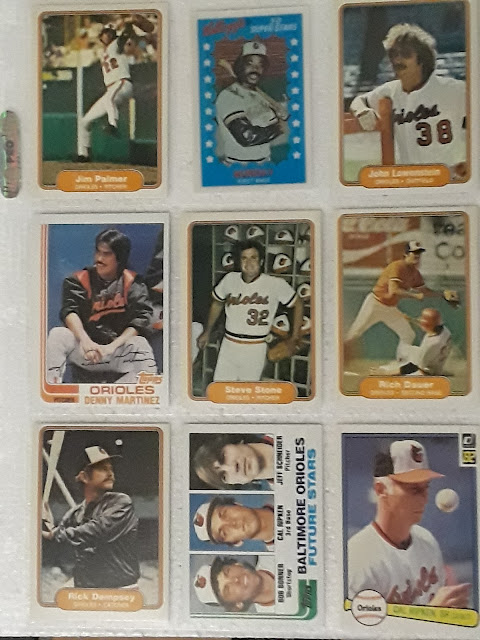
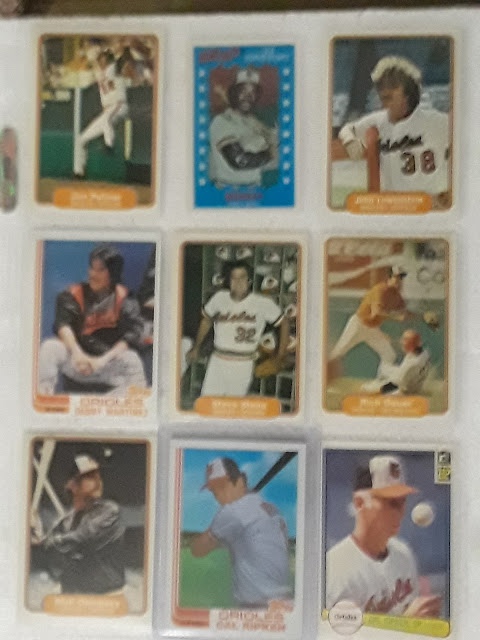
I love the 80s - 1982 Baltimore Orioles

 This is a series of posts on a 1980's Frankenset. Each page features a different team, with 9 of my personal favorite cards from that year's team. You might find players repeated, you'll definitely see brands repeated, but hopefully you'll agree that there are some interesting selections from the 1980s!

The Orioles came about as close as you can come to the post season without making it in 1981. The strike started with the Orioles trailing the Yankees for first place in the AL East by just 2 games. It was poor timing for Baltimore, as they had been ahead of the pack in late May. In the second half of the season, they finished ahead of the Yankees in the overall standings, but the Yankees played in October instead because the strike determined that the winner of each half would play in the playoffs, regardless of the overall records. 


In 1982, Baltimore again would play the role of the bridesmaid, finishing just a game behind the AL east champion Milwaukee, taking the Brewers to task until the final game of the season. Despite momentum favoring the Orioles who had bludgeoned the Brew Crew in the first three games of the 4 game series to tie up the standings, it was the Brewers that made the statement. Facing Hall of Fame hurler Jim Palmer, the Brewers piled up the runs, taking the final game of the season and the pennant with a 10-2 victory. Among many other highlights for the Orioles in 1982, their young prospect Cal Ripken sat out the 2nd game of a doubleheader on May 29th, then came back to the starting lineup on the 30th and would stay there until September of 1998. 


The Cards
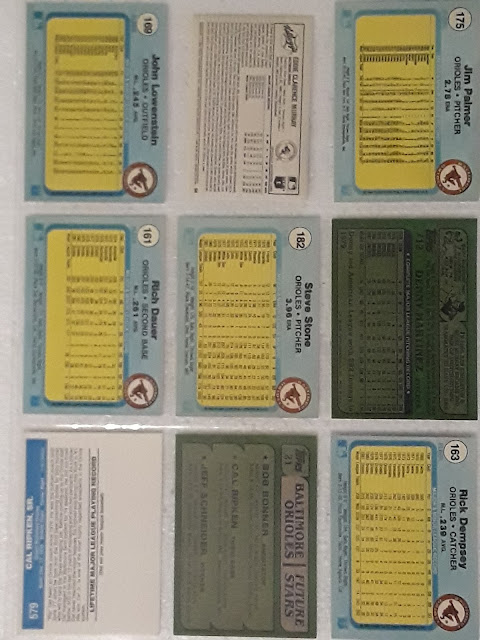
Fleer #175 Jim Palmer - In 1981, Palmer had a disappointing season, finishing with a 7-8 record and looked nothing like the ace of the Orioles' staff as he had been for the last decade plus. He would rebound in 1982 with a 15-5 mark and leading the AL in WHIP. He was once again in elite company, posting an ERA+ of 129 for the year, which helped him finish 2nd in the Cy Young voting. He'd been the Cy Young winner 3 times in his career, as well as a 20 game winner 8 times. He won a game in the World Series in 1966, 1970, and in 1983, with his team taking the whole enchilada each time. He was a first ballot Hall of Famer in 1990 with over 92% of the vote.

Kellogg's 3-D Super Stars #64 Eddie Murray - Steady Eddie was feeling the 2nd Place thing quite strongly in the early 80s. 1981 started a strong of 5 straight top 5 MVP finishes, but not once resulting in winning the award. In '81, Murray led the AL in Homers and RBI and had an OPS+ of 156. In fact his OPS+ was 156 again in 1982, and 83. In '84. he led the AL with a 157 OPS+, while also leading the AL in Walks (and Intentional Walks) and OBP. He was durable and dependable, with 27-33 homers and over 100 RBI as a near lock every season. He'd finish with over 3,200 hits and 504 Homers in his career, and is Major League Baseball's All-Time Leader in Sacrifice Flies. The 8 time All Star was a tremendous defender at 1st base, and was also a first ballot Hall of Famer like his teammate Jim Palmer.

Fleer #169 John Lowenstein - Lowenstein was known for his dry, witty banter with reporters and though he didn't make the National Baseball Hall of Fame, his 1982 Fleer Card shows he's a first ballot Style Hall of Fame member. 1982 was actually one of his best MLB seasons, coming towards the end of his 16 year career. He hit a career high 24 homers and 66 RBI while playing in a platoon with Gary Roenicke. The Lefty hitting Lowenstein got the lion's share of plate appearances and made the most of them. He was used as a utility man for a good portion of his career, which began in Cleveland. It was there that he generated some ironic attention when he publicly declared his disdain for "fan clubs." Some kindred spirits formed the Lowenstein Apathy Club, which involved sending the sardonic super-utility man letter signed in invisible ink that expressed their disinterest in his batting average and baserunning. Some expert-level smart-alecks even designed banners for home games that said "Hey Steiner" followed by 20 feet of blank white cloth. 

Topps #712 Denny Martinez - "El Presidente" was a fan-favorite and a very solid rotation option for nearly 25 years. In 1981, he led the AL in victories, and was the clear-cut heir apparent to the role of staff ace in Baltimore. He followed it up with another fine season with a 16-12 record. Early in his career, Martinez was a big time innings eater. His 18 complete games in 1979 led the AL, and in 2021 it would have been more than everyone in both leagues combined. He struggled with alcohol addiction in the mid eighties, but learned to control his addiction and reinvented himself on the mound. He would have a magical season in 1991 for the Expos, when he tossed a perfect game and led the NL in ERA and shutouts. His 245 career wins are the 2nd most by any Latino pitcher in MLB history, trailing only the legendary folk hero Bartolo Colon. Martinez was the first player born in Nicaragua to appear in a major league game, and he remains the most prolific major league player from that country. He has more complete games than Roger Clemens and Greg Maddux, and his 30 career shutouts ranks respectably high among his peers.

Fleer #182 Steve Stone - The 1980 Cy Young Winner was out of baseball by 1982, and it was all thanks to his dominant curveball. Stone was a solid starting pitcher at the back end of the rotation for 4 teams in the 1970s - the Giants, White Sox, Cubs, and finally the Orioles all saw flashes of brilliance, but Stone put it all together in 1980 with a 25-7 record. He won 14 straight decisions at one point, and it was all thanks to his decision that spring training to go all in with his curveball. The fallout from his career high 250 innings pitched was severe elbow tendonitis that limited him to just 12 starts in 1981. He was retired from the baseball diamond by the time his Fleer card was in packs. Stone was done playing but far from done with the game. He became the broadcast partner of Chicago legend Harry Caray, and has been a mainstay with the Cubs and the White Sox on both radio and television broadcasts since 1983.

Fleer #161 Rich Dauer - A self proclaimed "tough out but easy out," Dauer was a light hitting middle infielder with a great glove. Primarily used at second base, Dauer had a streak of 86 games without an error in 1978. The streak included another record of 425 straight chances without committing an error. He was especially tough to strike out, but was a career .257/.310/.343 triple slash hitter, which translated to a below league average hitter for his career. He was actually a hitting star in College with USC, where he helped lead his team to College World Series wins in 1973 and 1974. He didn't have a ton of hitting highlights in the big leagues, but did hit a homer in game 7 of the 1979 World Series, which would be the Orioles' only run in a losing effort.

Fleer #163 Rick Dempsey - Dempsey was also known as defensive wizard just like Dauer. His skills behind the plate gave him the opportunity to play regularly for the Orioles in the 1983 World Series, and he responded with 4 doubles and a homer to earn MVP honors. Dempsey would play for another World Series winner in 1988 as a backup to Mike Scioscia in Los Angeles. His career OPS+ of 87 wouldn't impress many, but his 2 world championship rings certainly makes him the envy of all his peers. 

Topps #21 Bob Bonner / Cal Ripken, Jr. / Jeff Schneider - 
Bobby Bonner was a great fielder at short, but unfortunately for him the prototype of the new "Slugging Shortstop" was coming up right next to him. The Orioles had its share of all-glove no hit guys on the team with Dauer and Dempsey. Bonner and Ripken were both up for the same spot to take over for long time Orioles Short Stop Mark Belanger, who was also famously fielding rich and power poor. Bonner couldn't keep up with Ripken's bat and ended up finding a different calling - he became a missionary and trains other missionaries and ministers in Zambia. 

Jeff Schneider saved one game for the Orioles in 1981, by giving up a walk and double but still managing to get the final out for a 6-5 squeaker of a win. That off-season, he was the throw-in player in a deal with the Angels for Dan Ford. Ford hit a clutch homer in the 1983 World Series for the O's, so Baltimore fans can thank Jeff Schneider for his small contribution there! Schneider was called up in the same transaction that resulted in Cal Ripken's call-up as well, so it's fitting to see him alongside Ripken on this card.

Cal Ripken played a bunch of games for Baltimore, most of them in a row. People think that's pretty neat.

Donruss #579 Cal Ripken, Sr. - You may have noticed in recent posts that 1982 Donruss was not one of my favorites. I will say that what I love about that set is the inclusion of coaches (not just managers! individual coaches). It didn't hurt that Cal Jr. was the #1 prospect in game. Even though they didn't know he'd be the AL Rookie of the Year, they had a pretty good hunch that he'd be in the conversation. Ripken Sr. was a baseball lifer, long-time coach in the Orioles organization, and would even become the manager for a brief period in 1987 and 88. The elder Ripken was a catching prospect, but a shoulder injury that did not heal properly ended his playing career early on. He became a coach and scout for the Orioles in 1961, though he still played sparingly when teams in the org needed a catcher. He had a tough and competitive personality, and his ethos as a coach influenced generations of Orioles players from Jim Palmer and Eddie Murray to his sons Billy and Cal, Jr. to many many others.  


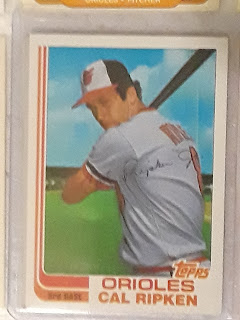
ok  ok here's the card I didn't put in the 9 pocket sleeve


that's what it would have looked like if I wanted to give myself a heart attack thinking about this card just chilling in a binder all loosey goosey - I couldn't even take a decent picture of it!

Note - my ancient laptop, which I've used with my scanner to post in this blog for the last 5 years or so, has finally bought the farm. I decided to do this post using my phone's camera instead of my scanner, probably will not post again until I can find a more permanent solution.

Sunday, January 16, 2022

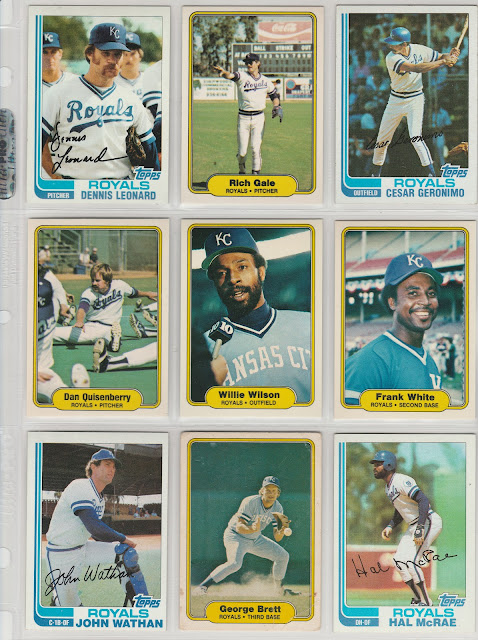
I love the 80s - 1982 Kansas City Royals

 This is a series of posts on a 1980's Frankenset. Each page features a different team, with 9 of my personal favorite cards from that year's team. You might find players repeated, you'll definitely see brands repeated, but hopefully you'll agree that there are some interesting selections from the 1980s!

I'd never suggest that the 1981 Baseball Strike was a good thing, but there were teams that took advantage of the break to change their fortunes. The Kansas City Royals had a miserable 1st half of 1981, falling 10 games under .500 and slipping to 5th place in the standings. The second half was another story. The Royals finished the second half in first place, securing a spot in the post season. They were bounced quickly by the Oakland A's in 3 straight games, but the Royals showed the fight that made them major players from the mid 70s through the mid 80s.


1982 was in many ways a more successful season than '81 for the Royals, with one big difference. This time, they would miss the post season altogether, though they finished with a 90 - 72 record. DH Hal McRae set a franchise record with his AL-Best 133 RBI, Dan Quisenberry paced all closers with 35 saves, and the franchise took a step towards securing a brighter future by drafting pitcher Bret Saberhagen. They missed the postseason in 1982, but were poised to return again soon.


The Cards:

Topps #495 Dennis Leonard - Leonard was the Royals' Ace in the late 70s. He was a 3 time 20 game winner, leading the AL in Starts and Innings Pitched in 1981. He was the only AL pitcher to exceed 200 innings pitched that season, given the time lost to the strike. He was also 3rd in Strikeouts and had a pair of shutouts, both of which came during a stretch of 7 starts in 26 days following the strike. The heavy workload and a pair of broken fingers made for a less than stellar 1982, in which his ERA ballooned about 5.00 for the first time in his career. The following season, the injury bug struck again and he'd essentially be out of baseball until 1986. He tore his patella tendon in a 1983 start, missed all of 1984, and would only make a pair of starts in 1985 for the Royals. Leonard continued his rehab, and returned to the team to make 30 starts at the age of 35. He retired as the Royals' All-Time Leader in Games Started, Innings Pitched, Complete Games, and Shutouts.

Fleer #408 Rich Gale - Gale was a 1978 Topps All-Star Rookie, but didn't get a trophy on his card as Topps decided to leave out the Cup from 1979 through 1986. That season, Gale won 14 games and finished 4th in AL Rookie of the Year voting. He started a pair of games in the 1980 World Series, with a no-decision and a loss. He and Leonard were an effective one-two punch in the late 70s for the Royals, but Gale had a rough time in 1981. He would be traded to San Francisco that off season, and by 1985, found himself pitching in Japan. He was on the mound for his team (the Hanshin Tigers) in their 1st ever Japan Series clincher. Gale is probably known more readily today for his work as a pitching coach, both in the big leagues and for a handful of teams in the minors.

Topps #693 Cesar Geronimo - Geronimo came to the Royals in 1981 as a role player after spending nearly a decade in Cincinnati as the primary Center Fielder for the "Big Red Machine." Geronimo was a 4 time Gold Glove winner in Cincy, and was closing out his career as a 4th outfielder for the Royals in the early 80s. His Gold Gloves weren't mirages or based on the success of his team. He passed the "eye test" in Center Field, sure, but also had favorable rankings in some of the new-school metrics as well. He was annually at or near the top of the leaderboard in Total Zone Runs and Range Factor. Geronimo joined the Reds from the Astros in the same trade that sent Hall Of Famer Joe Morgan to Cincinnati. Following his playing days, Geronimo co-founded a baseball academy in the Dominican Republic that focuses on teaching its students about life skills, English as a 2nd Language, and fiscal responsibility along with the standard fare of baseball training. He helped to establish a similar Academy in Japan for the Hiroshima Carp, that focused more specifically on baseball, as the students also attended a separate school. 

Fleer #422 Dan Quisenberry - The Early 80s were the peak years for the Royals' closer. Dan Quisenberry was the AL Saves leader 5 times, and Royals' Managers loved to give opposing offenses a Pop "Quiz." He was known for his unorthodox submarine-style delivery to the plate, and for writing poetry off the field. For a detailed and engrossing biographical essay, check out this link from the SABR Bio Project He appeared in all 6 World Series games in 1980, and had 4 appearances in the 1985 World Series, including a victory in Game 6. He's the Royals' All-Time Leader in ERA, and is 2nd in team history in Saves. Quisenberry, like his former Manager Dick Howser, passed away from brain cancer. 
 
Fleer #427 Willie Wilson - If you look up "triple" in the dictionary, there should be a picture of Willie Wilson there to help illustrate the concept. Wilson led the AL in Triples 5 times, and finished his career with 147. That's 56th overall in MLB history, but 3rd overall if you're looking at players whose photo is in color, behind just Roberto Clemente and Stan Musial. His 1980 season was historic. In addition to his 15 triples, he totaled 230 hits and scored 133 runs. Those figures all were best in the AL. He was 2nd in Stolen Bases with 79. He'd go on to win a batting title in 1982. He did all this while playing an elite Left field. Similar to Cesar Geronimo, Wilson was a regular visitor atop the league leaderboard in range factor and total zone runs. Wilson is the Royals' All-time leader in stolen bases, with 612. 

Fleer #426 Frank White - The late 70s and early 80s were a who's-who of the greatest Royals of all time and I don't mean Prince Charles. Frank White was the Royals' second baseman throughout their decade plus run of contending for the AL West title, starting in 1973 until his retirement in 1990. White was a defensive dynamo, racking up 8 Gold Gloves. The 5 time All-Star wasn't a slugger like Brett or a burner on the bases like Wilson, but he was a steady presence up the middle of the diamond for nearly 2 decades. His 2,006 hits are 2nd all-time in Royals history. 1982 was probably his best offensive season overall, hitting .298 with 11 homers and 10 stolen bases and a 114 OPS+. He terrorized the Yankees in 1980, earning ALCS MVP honors by hitting .545 in the series including a homer and stolen base. It was his defense that made him an all-time great. Reggie Jackson quipped of White "he's saved as many runs as I've driven in."

Topps #429 John Wathan - John Wathan was a rare breed - a catcher would could steal a base! In 1982, Wathan had a career high 36 steals, almost unheard-of for a backstop, and set a major league record for the position. Wathan was also able to hit for average, including a .305 mark in 1980, when he even garnered a few MVP votes. Following his 9 year playing career, Wathan was a coach and then Manager for the Royals and Angels. Since 2008, he's held the role of 'special assistant to the Director of Player Development' for the Royals. He's a baseball lifer, having worked as a scout, roving instructor, coach and a really fast catcher!

Fleer #405 George Brett - I won't share that infamous George Brett Story, or that other infamous George Brett Story - but suffice it to say, Brett is famous and infamous. He's Mr. Royal, leading pretty much every offensive category in team history, as well as being the leader of the team's first rise to prominence in the 70s and 80s. Brett's 3,000th hit is a bit of a funny story - he was picked off first base after getting it. But what was impressive to me is that it was his 4th hit of that game. That's on-brand for George Brett, going a bit above and beyond. Brett was a triples machine in his own right - when Wilson wasn't the league leader, Brett was leading the league in the late 70s / early 80s, including 20 triples in 1979. His 1980 season was even better, as the AL MVP led the league in all three triple slash categories, going .390/.454/.664 and an OPS+ of 203. Brett won 3 batting titles, in 3 different decades - 1976, 1980, and 1990. The 13 time All-Star was of course a first ballot Hall of Famer, joining the Cooperstown club with fellow 1975 Topps rookie Robin Yount in 1999.

Topps #625 Hal McRae - McRae moved from outfield in Cincy to become a slugging DH in the American League, providing much needed balance to the Royals' offensive attack in the 1970s. McRae was a key member of the Royals through the 1986 season, and later became manager of the team, known for his fiery demeanor and will to win. While his homer totals don't appear eye popping, McRae was still the premier DH for the majority of his career. His Career OPS+ of 123 shows how he was a step above the rest of the league at the plate. McRae finished his career with over 2,000 hits and over 1,000 RBI. 

Sunday, January 9, 2022

I Love the 80s - 1982 Philadelphia Phillies

 This is a series of posts on a 1980's Frankenset. Each page features a different team, with 9 of my personal favorite cards from that year's team. You might find players repeated, you'll definitely see brands repeated, but hopefully you'll agree that there are some interesting selections from the 1980s!

1981 saw the Phillies attempt to repeat as National League and World Champions. A strong 2nd half vaulted the team into the playoffs, where they came up just short losing the 5th and final game of the NLDS to the Montreal Expos. During the year, Pete Rose passed Stan Musial as the National League's all time hits leader, and Steve Carlton recorded his 3,000th career strikeout. The individual accolades were nice, but the team had higher aspirations.


With the window to win starting to close for the veterans like Rose and Carlton, the team would make a few moves to try to make another championship run in 1982. They cut ties with 33 year old Bob Boone, turning to Ozzie Virgil Jr and Bo Diaz to be the new every(other)day catchers, traded for starting pitcher Mike Krukow to solidify the rotation, and decided to turn to veteran SS Ivan DeJesus to bolster the middle infield. None of these moves would prove fruitful in the long run, with the last trade suffering mightily in hindsight as the return for that investment in DeJesus was future Hall of Fame Second Baseman Ryne Sandberg and veteran Larry Bowa, who provided roughly the same production as DeJesus in 1982. Still a strong presence in the NL East, the Phillies would stay close all season but ultimately finish in 2nd place. 


 The Cards:

Donruss #42 Steve Carlton - In 1982, Carlton was his usual superlative-laden self, winning the Cy Young Award (his 4th), on the back of a league leading 6 shutouts. He was also the NL's best with 23 victories, the last Phillie to win 20 games in the 20th Century, and led the NL in strikeouts for the 4th time. If you're more new school than old-school, you may be pleasantly surprised to know that not only were the counting stats good (Leading all NL pitchers in batters faced, innings pitched, complete games, and Games started), he also led the NL in FIP! Carlton was a no-doubt Hall of Fame case, pairing the 4 Cy Young awards with 2 World Championships. He was a 10 time All-Star, and is one of just 4 players in MLB history to surpass 4,000 career Strikeouts. 

Fleer #251 Tug McGraw - McGraw was another of the Phillies 35+ year old veteran stars in the early 80s. Arguably his finest season came in 1980 as the 35 year old closer for the Phightin' Phils. He finished the regular season with a 1.46 ERA and an ERA+ of 260. He notched 20 saves, but finished another 28 games for the Phillies, striking out 75 batters. He was a member of the 1969 Miracle Mets (but did not pitch in the World Series), and an integral part of the 1980 World Champion Phillies. The 2 time All-Star was a solid to spectacular relief arm for nearly 20 seasons in the big leagues. He struck out nearly twice as many batters as he walked over more than 1,500 innings pitched. McGraw was best known for his signature pitch, a devastating screwball.

Topps #781 Pete Rose - Few players can lay claim to establishing a team's identity the way that Pete Rose did for the Phillies. They were a very good team in the mid to late 70s, but were often on the losing end of battles with in-state rivals the Pittsburgh Pirates as well as Rose's former team, the Big Red Machine Cincinnati Reds. When Rose left Cincy for Philly in free agency, the fortunes of both teams flipped. As mentioned above, Rose became the all time leader in hits in the National League in 1981, but more importantly, his style of play and leadership helped get the Phillies over the hump against their NL East rivals and win the 1980 World Series. The team hadn't been to the World Series in 30 years, and hadn't won a world series game since 1915! Rose changed that culture in Philadelphia.

Donruss #606 Lonnie Smith - Lonnie Smith is possibly the most underrated player of the 1980s. In the Phillies championship season, Smith led the team in Stolen Bases, but also sported an OPS+ of 130, finishing 3rd in Rookie of the Year voting. Used sparingly in 1980 and due to the strike-shortened 1981 season, his first full season would be 1982. He was traded to Saint Louis, where Smith would finally get the chance to play everyday. He was an All-Star and amassed 6.2 WAR, placing 2nd in the NL MVP race. He hit .307 with 68 Steals and scored a league leading 120 runs for the wild run and gun Cardinal offense that won the 1982 World Series. He'd win 3 World Series championships in the 1980s, for three different teams- the Phils in 1980, the Cardinals in 1982, and the Royals in 1985 - playing key roles on defense, at the plate, and on the bases. The last season of the decade was his best- leading the NL with 8.9 WAR, certainly an MVP worthy season. However, he compiled that season for the lowly Braves, finishing well out of contention and out of sight, out of mind for MVP voters.  Time would catch up to Lonnie and his 1990s career paled in comparison to his 1980s numbers. He'd retire with a 118 OPS+, and a triple slash of .288/.370/.420. It amounted to a solid MLB career that doesn't get talked about that often.

Fleer #258 Mike Schmidt - Not too often do you see Schmidt sporting a full beard - nearly mistook him for Bill Walton! The Hall of Fame Third Baseman was right in the middle of his prime career years, the reigning NL MVP from 1980 and 1981. His 1982 season may have seen a slight dip in batting average, but he led the league (again) in OBP and Slugging. He was also right in the middle of a run of 9 consecutive Gold Gloves (he'd add one more before his career was over), and 5 straight Silver Slugger awards. In all, he'd be a 10 time All-Star, 10 Gold Gloves, 6 Silver Sluggers, 3 MVPs (80,81, and 86) and is generally regarded as one of the best third basemen of all time. He was the NL HR king 8 times, and his 548 career homers still ranks 16th, even after the steroid era saw 13 more members join the 500 HR Club. 

Topps #581 Ron Reed - Reed's career in many ways is reminiscent of Dennis Eckersley in miniature. Reed started his career in the Braves rotation and was pretty good. He was an All-Star in 1968 as a rookie, and followed it up with an 18-10 record in 1969. Reed transition from the rotation to the bullpen in 1976 for the Phillies, and became a mainstay in their relief corps until after his 40th birthday. Reed was essentially the team's closer in 1982, saving 14 games and sported a 2.66 ERA over 57 appearances. For his career he started 236 games and finished 300 as a reliever. He faced over 10,000 batters and still had a better than league average ERA+ of 108. Fun fact about Ron Reed - before playing baseball, he played for the Detroit Pistons for 2 seasons, averaging 8 points and 6.4 rebounds a game.

Donruss #441 Gary Matthews - "Sarge" came to the Phillies after the 1980 World Championship season from Atlanta in exchange for the legendary Bob Walk. Matthews was known for a blend of power and speed and was extremely durable. He played all 162 games for the Phillies in 1982, and would go on to show his skills at their peak in the 1983 NLCS. His three homers against the Dodgers powered the "Wheeze Kids" to the 1983 World Series, earning him MVP honors in the process. Matthews was the 1973 Rookie of the Year and was an All-Star in 1979 with Atlanta. He'd go on to have a magical season with the Cubs in 1984, leading the NL in walks and OBP, scoring 101 runs to mark his career high. Matthews finished his career with 2,011 hits, 234 homers, and scored 1,083 runs.

Fleer #260 Manny Trillo -You have to be pumped when you can wear a "World Champions" patch on your jacket. Trillo was the Phils All-Star/Gold Glove/Silver Slugger winning second baseman in the early 80s, earning each accolade at least once between 1979 and 1982. Timely hitting in the 1980 NLCS made him the MVP of the Series. He hit .381 with 4 RBI for the Phils against Houston. He won all 3 of his Gold Gloves with the Phillies, but he was highly regarded for his defense throughout his career. He was best known for his rifle throwing arm, somewhat rare for a second baseman. His defensive prowess was so tantalizing that it was the subject of a controversy in Oakland during the team's three-peat in the mid 70s. In 1974, A's Owner Charlie Finley wanted Manny to be on the active roster so badly he tried to coerce infielder Mike Andrews to sign a statement saying he was injured to make room for Trillo on the roster. The move was met with a near team-wide mutiny, and it took a ruling from MLB Commissioner Bowie Kuhn to re-instate Andrews and restore peace in the locker room. Trillo was then traded after the 1974 series to the Cubs in exchange for Billy Williams. 

Donruss #189 Sparky Lyle - Best known for his seasons in Yankee pinstripes. Lyle was a 16 year veteran pitching for elite teams in both leagues. He was a late season acquisition of the Phillies in 1980, and was not eligible for the post-season. His 14 innings of work down the stretch included a pair of saves and a miniscule 1.98 ERA. He's known as the first AL reliever to win a Cy Young award (1977), and one of the first to enter the game with a signature song playing to announce his arrival on the mound. (The same music used by High School graduations all over the country as well as Macho Man Randy Savage, "Pomp and Circumstance") Lyle credits Red Sox great Ted Williams with the advice that made him a big leaguer. Williams told him he'd never make it to the show without a slider. After perfecting the pitch in the minor leagues, Lyle would debut with Boston during the 1967 Impossible Dream Season. Lyle is quoted as saying "when Ted Williams told you something, you tried it."


Sunday, January 2, 2022

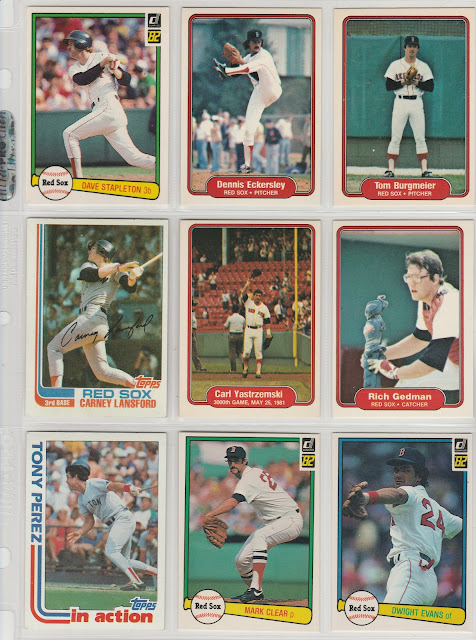
I love The 80s - 1982 Boston Red Sox

 This is a series of posts on a 1980's Frankenset. Each page features a different team, with 9 of my personal favorite cards from that year's team. You might find players repeated, you'll definitely see brands repeated, but hopefully you'll agree that there are some interesting selections from the 1980s!

In 1981, which was more red? The Boston baseball team's faces, or their stockings? The season began without two of the biggest stars for the 70s teams, namely Carlton Fisk and Fred Lynn. The deadline for major league teams to tender contracts to their players was December 20th, 1980. The contracts for Fisk and Lynn were not mailed until the 22nd, effectively making them free agents. While the team was appealing the decision, Lynn was traded to the Angels (technically the teams made a separate trade the same day of Lynn's free agent signing, the trade is unofficially viewed as partial compensation for losing Lynn), but Fisk was another story altogether. The team tried to re-sign him, but the catcher found greener pastures in Chicago with the White Sox. Fisk would add the extra twist of the knife Opening Day 1981 by hitting the game winning homer against his old team in his first visit to Fenway. The rest of the 1981 season was not much better - even though the Red Sox finished 10 games above .500, they still managed to end up in 5th place in the AL East.


In 1982, The Red Sox surprised a lot of people by starting very hot, at one point winning 13 of 14 games during a stretch of April ball. After surging into first place, they remained atop the Eastern Division until July. There were a handful of feel-good stories as well, like the homecoming of sorts for Worcester, MA kid Mark Fidrych. "The Bird" signed a free agent deal in February with the Red Sox, but his big league career was over. Ted Williams returned to the field in the Red Sox first ever "Old-Timers" game, making a highlight in the outfield with a shoestring catch. Some might have quipped that he should have been playing alongside Ted in that game, but 42 year old Carl Yastrzemski was having an excellent season, reminding fans of the player they had cheered for two decades in the shadow of the Green Monster. As Yaz was putting the finishing touches on his career, Wade Boggs was just getting his going. While still trying to find a permanent position, Boggs forced his way into the lineup by hitting .349 over 106 games all over the Boston infield, settling at third. The good vibes weren't enough to win a pennant, however, and the Sox finished third behind the Orioles and the Division winning Brewers.


The Cards:
Donruss #208 Dave Stapleton - Runner-up for the 1980 Rookie of the Year award behind Joe Charbonneau of Cleveland, Dave Stapleton was a versatile infielder, sharing time with Yaz at first base and with Jerry Remy at second. By 1982, he'd spell Yaz and Tony Perez at first base more often than not, because of his defensive chops. And yes, Stapleton was regularly used as a late inning defensive replacement during the 1986 season. OK, yes, he replaced Buckner in Game 5. But not Game 6. . .   

Fleer #292 Dennis Eckersley - Eckersley recorded his 100th Career Win in 1982, which might not seem like that big of a deal, but it would in hindsight frame the first of two halves of his Hall of Fame career nicely. Eck was still a starter in 1982, going a not-that-lucky 13-13 for the Red Sox. He'd go on to many years of success as a bullpen arm, notably in Oakland with a World Series victory in 1989. He'd finish his career with 197 wins and 390 saves. He was the first pitcher to have both a 20 Win season and a 50 Save season.

Fleer #288 Tom Burgmeier - Born in St. Paul, MN, Tom Burgmeier was an early target for Twins' scouting Director Jim Rantz. It would take a long journey through the Houston minor league system and a few seasons with the Royals before the Twins could add him to their bullpen, and by the time he reached his prime in 1980, he was off to Boston to make his lone All-Star appearance as the Red Sox Closer. After 745 major league appearances, Burgmeier became a pitching coach, serving in that capacity for several organizations over a couple decades starting in 1991 with the Royals.  

Topps #91 Carney Lansford - Lansford arrived in Boston as part of the Fred Lynn trade, and did a lot to take the sting away from losing the former MVP. Moving from California's pitcher friendly Anaheim Stadium to Fenway prompted a significant spike in his batting average. Lansford won a batting title in 1981, but still wasn't a good enough hitter to keep his job as the Red Sox everyday 3rd baseman. Lansford would be traded to Oakland following the 1982 season, and very nearly won a 2nd batting title in 1989. He had an identical .336 batting average in 1981 and 1989, but fell just short of Kirby Puckett's .339. Lansford did beat Boggs by 6 points, so he's got that going for him, which is nice.

Fleer #633 Carl Yastrzemski - As mentioned above, Yaz was playing in his age 42 season in 1982. It was his 22nd major league season, all with Boston. You've heard the stats before, but just as a refresher, he was the Triple Crown winner in 1967, leading the AL in HR, RBI and Average. He was also the MVP that year, and led the AL in Slugging and OBP as well. Oh, and hits, and runs scored. And Total Bases. And he won a Gold Glove that year. And he stole 10 bases, too. He only ground into 5 double plays all season that year. My favorite Yaz tidbit though is from 1965. When Satchel Paige returned to pitch one final MLB game for the Kansas City A's, only Yaz was able to get a hit off the ageless wonder. Paige, supposedly 59 years old at the time, pitched 3 innings and it was the double by Yaz in the first as the only blemish on his scoresheet. 

Fleer #294 Rich Gedman - Another Worcester, MA guy (like Mark Fidrych), Rich Gedman was the 1981 runner up for the Rookie of the Year behind the Yankees' Dave Righetti. Gedman split catching duties with Gary Allenson in 1982, playing an even 92 games each. Gedman had more hits with his bat to ball skills, while Allenson's patience at the plate netted him more walks. Gedman's calling card was throwing out runners trying to steal. He led the AL in caught stealing three straight seasons from 1984 through the championship run in 1986. Following his breakout 1984 season when he hit 24 homers, he earned the reputation of "feared hitter" not unlike his teammate Jim Rice. Gedman drew intentional walks 24 times in his two All-Star seasons, almost twice as many as Rice over the same period. Gedman was set to be a top free agent following the 1986 World Series, but strangely found no takers. (The world would later learn this was a direct result of collusion by the owners, who all agreed not to offer big free agent contracts that offseason). Gedman would re-sign with the Red Sox, but missed the first month of the season and all of Spring Training, which resulted in a career worst .205 average in 52 games. He was most closely comparable to the career of Salvador Perez by age 26, but after the lost season of 1987, he never regained his potent bat or his regular gig behind the plate for the Red Sox. 

Topps #256 Tony Pérez - "Big Doggie" was several years removed from his Big Red Machine years with Cincinnati, and in 1982 managed just 6 homers for the Red Sox. While he was no longer the same hitter he was in years prior, he was still a highly respected and highly coveted bench bat. He would go on to play several more seasons first with Philadelphia then back again to Cincinnati, never far from Pete Rose, just in case he needed someone to drive him in from second base. His is often mentioned as a comp for other power hitters of his era still waiting to get into Cooperstown like Dave Parker, Dwight Evans, and until recently Harold Baines. Pérez was elected to the Hall of Fame by the BBWAA in 2000.

Donruss #452 Mark Clear - Another player acquired for Fred Lynn, Mark Clear notched 9 saves and won 8 games for the Red Sox in his first season in Boston. In 1982, he was an AL All-Star selection, and had a career high 14 victories, all coming in relief. Originally signed by the Phillies to be a starter, poor mechanics led to back problems and an early release from his contract. Clear cleaned up his delivery (thanks to his uncle, who was the Angels' bullpen coach) and rehabbed with a back brace before signing a minor league deal with California. Once converted to relief work, he thrived. He was an All-Star his rookie season with the Angels, and was well on his way to a solid MLB career. 

Donruss #109 Dwight Evans - Somehow Evans managed to fly under the radar again in 1982. Despite hitting 32 homers and driving in 98 runs and leading the league with a .402 OBP finished a distant 7th in the MVP balloting (let's be fair, though, the right guy won (Robin Yount)). Evans is the Rodney Dangerfield of the Red Sox. Did you know that he's 2nd all-time in games played by a Red Sox player, trailing only Yaz? Evans also has 8 Gold Glove awards, easily the most by a Red Sox outfielder, and trailing only the best of the best in MLB history- Mays, Griffey Jr., Clemente, and Kaline. He hit more homers in the 1980s (256) than any other AL player.


Sunday, April 4, 2021

I Love The 80s - 1982 Los Angeles Dodgers

This is a series of posts on a 1980's Frankenset. Each page features a different team, with 9 of my personal favorite cards from that year's team. You might find players repeated, you'll definitely see brands repeated, but hopefully you'll agree that there are some interesting selections from the 1980s!

In 1981, the Dodgers climbed to the top of the NL West and then toppled Houston, Montreal, and finally the Yankees to win the World Series in six games. Southern California was enthralled in "Fernandomania" - the Rookie left hander threw a shutout on Opening Day and never looked back. The entire starting rotation had winning records, and each had at least 1 shutout on the season.


The following season was very good, just not as good as 1981. They would finish in 2nd place in the NL West, just 1 game behind the division winners. The rotation was a little top heavy in 82, but still excellent. The team also ranked 4th in the NL in Runs Scored. making for a balanced and formidable roster. Manager Tommy Lasorda was in just his 5th season as the team's skipper, but had already led the team to 3 NL pennants, and narrowly missed in 1980 (after a 1 game playoff) and was just one game short in 1982. 


The Cards

Topps #642 Mike Scioscia - 1982 saw growing pains for Scioscia, who was now the primary catcher after supplanting Steve Yeager. It was Scioscia's worst offensive season, slashing .219/.302/.296 for an OPS+ of just 80. But the season provided great experience for the young backstop as he learned the finer points of the game and the demanding position of catcher. He tore his rotator cuff and missed most of the 1983 season, but came back to spend the rest of his playing career as the Dodgers #1 catcher. The 2 time All-Star also had a long and productive managerial career with the Angels, including a 2002 World Series win.

Fleer #25 Rick Sutcliffe - The 1982 squad definitely missed the arm of Rick Sutcliffe, who was traded to Cleveland the prior December. Sutcliffe won the AL ERA title in 1982, and had a 14-8 record. Despite winning the NL Rookie of the Year award in 1979, Sutcliffe and manager Tommy Lasorda famously did not get along well. during the 1980 and 81 seasons, Sutcliffe's role on the team diminished and ultimately led to his trade. He was one of the better starting pitchers of the 1980s, including winning the NL Cy Young in 1984, and finishing his career with 171 victories. The 3 time All-Star had the reputation of being a very good hitting pitcher, thanks in no small part to his home run in Game 1 of the 1984 NLCS. 

Topps #410 Ron Cey - It would be his final season in Los Angeles in 1982, but Cey was not resting on his laurels. In '81, the season concluded with Cey and the Dodgers as World Champions. Cey was the Co-MVP for the World Series. Cey still showed he had excellent range at 3rd base, even at age 34 in 1982. He ranked in the top 5 in most defensive categories in the NL that season. Cey was a 6 time All-star, making the NL squad every year from 1974 through 1979. 

Topps #375 Dusty Baker - A baseball lifer, Baker has been part of more than a few of the game's biggest moments for the last 5 decades. Baker was on the receiving end of the world's first official "high five" from Glenn Burke. He was in the on deck circle when Hank Aaron hit home run #715.  He was MVP of the 1977 NLCS, and had a good case for repeating as NLCS MVP again in 1978, going 4-5 in the deciding victory. Later, as a Manager, he'd lead the Giants to a World Series appearance (facing his old teammate Mike Scioscia), then Managed the Cubs during the infamous "Steve Bartman" incident. Baker returned to coaching in 2020 and despite a regular season record below .500, led the Astros all the way to the ALCS. 

Fleer #27 Fernando Valenzuela -  His rookie season of 1981 was a tough act to follow, but Valenzuela had a terrific sophomore season with the Dodgers. Already the established ace of the rotation, Valenzuela won 19 games, and appeared in the 2nd of what would become 6 straight All-Star games. His 8 shutouts in 1981 were a rookie record, one that will be very tough to beat now. Valenzuela would miss the post season in 1988, but was a maintstay in the Dodgers rotation throughout the 80s. He performed very well in the post season, with a career ERA of 1.98 over 63 and 2/3 innings. Valenzuela could hit as well, with 10 career homers and a .200 average, quite good for the limited at bats for a pitcher. 

Donruss #84 Steve Garvey - The 1982 season was a "last hurrah" for several key members of the Dodgers of the 1970s. That included Steve Garvey, who would sign as a free agent with the Padres following that year. Garvey was the modern "Iron Horse," having played in the most consecutive games among active players. The streak was also marked with excellent offensive production - Garvey was a career .301 hitter with the Dodgers over his first 14 MLB seasons. The well rounded Garvey was the 1974 NL MVP, was a 4 time Gold Glove winner and a 10 time All-Star. He was named MVP of the All-Star Game twice. He is often the subject of discussion as one of the best players that are not inducted in the Hall of Fame.

Topps #545 Reggie Smith - Reggie formed a powerful nucleus of hitters along with Garvey, Cey, and Baker. In 1977, all 4 players hit at least 30 homers, the first time in MLB history that 4 teammates all reached that milestone in the same season. By 1982, Smith was a 17 year veteran in his final MLB season. Smith spent 1982 with Giants, and had a bounceback from a disappointing 1981 campaign in which he hit just .200 for the Dodgers in 41 games. Smith's career began in Boston, where he teamed with Yaz and the rest of the "Impossible Dreamers" for the 1967 team that captured the AL pennant in dramatic fashion. He was the AL Rookie of the Year runner-up, and hit a pair of homers in the '67 World Series against the Cardinals. The 4th World Series appearance for Reggie was the charm, making just a pair of plate appearances in the series, but sharing in the success of the 1981 Dodgers. Reggie is criminally underrated, finishing his career with a 137 OPS+, as well as displaying excellent defense throughout his 17 MLB seasons. His counting stat totals place him squarely in the Hall of "Very Good," over 2,000 hits, 314 homers, over 1,100 runs scored and over 1,000 career RBI.

Fleer #29 Steve Yeager - Yeager had the Catching job in 1981, lost it to Mike Scioscia, then won it back in 1983 when Scioscia tore his rotator cuff. A career .228 hitter, Yeager provided power and defense behind the plate. His offensive improved in the post season, where he hit .254 and slugged .449, which was nearly 100 points higher than his career regular season slugging mark. In World Series play, he slashed .298/.323/.579 over 4 trips to the fall classic.  His 2 homers in the 1981 World Series helped him to a share of the MVP award with Ron Cey. He had an excellent arm as well, twice leading the NL in caught stealing pct. Fun fact - his cousin is the famous test pilot Chuck Yeager, who was the first person to have broken the sound barrier in flight. 

Topps #338 Dave Lopes - Davey left the Dodgers following the 1981 World Series win, traded just before the season began in 1982 to Oakland. His 1981 season was a rough one, playing in just 58 games and hitting a career low .206. A late addition to the 1984 Cubs roster, and a deadline acquisition of the Astros in 1986, Lopes played in the NLCS six times in his career, and five times in the World Series (4 of those coming with the Dodgers, of course). Lopes was known as a speed threat, leading the NL in stolen bases in 1975 and 76, as well as compiling 556 steals over his 16 year career. Along with Garvey, Cey, and Bill Russell, Lopes formed the longest lasting intact infield in MLB history. The group appeared together in same lineup and same infield for roughly 10 straight seasons.

What is your favorite card of a Dodgers Player from 1982? Doesn't have to be one of these...

Thanks for reading!

Sunday, March 28, 2021

I Love The 80s - 1982 Chicago White Sox

  This is a series of posts on a 1980's Frankenset. Each page features a different team, with 9 of my personal favorite cards from that year's team. You might find players repeated, you'll definitely see brands repeated, but hopefully you'll agree that there are some interesting selections from the 1980s!

The White Sox finished the strike shortened 1981 season in 3rd place in the AL west, thanks to a fast start. They finished the first half of the season 9 games above .500, then had a tough stretch to close the season. While the ownership change that year meant the end of the Bill Veeck era, the White Sox would forge ahead with a bigger wallet even if it meant losing a few style points. Veeck had signed Ron LeFlore and Ed Farmer to seven figure deals on his way out the door, and new owners Jerry  Reinsdorf and Eddie Einhorn wasted little time adding Catching great Carlton Fisk.


1982 would see another 3rd place finish, but improved their overall winning percentage by nearly 30 points. They struggled in June and July (just a 23-31 record for those two months), and were absolutely owned by the Kansas City Royals in the season series, losing 10 of 13 games. If not for that, the team was in good position to make it back to the postseason for the first time since 1959. They would make that next step in 1983, winning 99 games and finishing 1st in the AL West.


The Cards:

Topps #237 Rusty Kuntz - Now known mostly for his role as a first base coach with the Royals, Kuntz was a valuable reserve outfielder for parts of 7 big league seasons. He had a grand total of just 104 major league hits, and his most memorable plate appearance was an out. That out was a sacrifice pop up not far beyond the infield dirt in Game 5 of the 1984 World Series. Kirk Gibson was stationed at third base when Kuntz hit the bat into short right field, into the glove of Padres' second baseman Alan Wiggins. Noticing that his back was fully turned away from the infield, Gibson alertly sprinted home, giving the Tigers the run that would prove to be the game winner. For more on Kuntz, I recommend checking out his SABR biography, written by Mike McClary.

Fleer #343 Carlton Fisk - The undisputed field general of the White Sox was Carlton Fisk, now in his second full season on the South Side. Fisk was 34 years old in 1982, but still managed 17 stolen bases, while throwing out 44 would-be base stealers from behind the plate. 1982 was Fisk's 9th All-Star season, in his 11th full season in the big leagues. Fisk was named the best baseball player ever to come from Vermont (he was born there), and the best baseball player ever to come from New Hampshire (he grew up there and played high school ball there) in 1999 by two different publications. 

Donruss #291 Chet Lemon -  Lemon was traded to the Tigers before the 1982 season began, but the White Sox already had Ron LeFlore and Rudy May (correction: Law) playing in center field, so Lemon was deemed expendable. It turned out that Lemon was just developing into a star at the time of the trade, adding power to the speed and defense that he had displayed in his 7 seasons in Chicago. Lemon was a 2 time All-Star and had led the AL in doubles in 1979 leading up to the trade. Though he missed out on the White Sox 1983 run to the ALCS, he more than made up for it the following year in Detroit, helping the Tigers win the World Series following another All-Star season.

Fleer #335 Bill Almon - Perhaps better remembered for his early days in San Diego as the SS that Ozzie Smith replaced, Almon had a solid 2 year stint with the White Sox in 1981 and 82. He hit a career high .301 in 1981, and added another season with 10 doubles and 10 steals in 1982. Almon's best season came the following year in 1983 with Oakland. The erstwhile shortstop was converted to a utility role, which allowed him to play in a career high 143 games. He had 29 doubles and 26 stolen bases for the A's that year, also career bests. 

Topps Traded #54T Steve Kemp - Kemp was traded to the White Sox from the Tigers for Chet Lemon. Both teams were looking to change the shape of their outfield, with the Sox looking to add some power in the corners, and the Tigers hoping to have their Center Fielder for years to come. Kemp responded in 1982 with a great slash line .286/.381/.428 which was good for an OPS+ of 122. Kemp hit 19 homers, scored a career high 91 runs, and drove in 89 of his own. It turned out that Lemon would have a longer career, spending 9 seasons in Detroit. Kemp was a free agent following the 1982 season and signed with the Yankees, where he would spend a couple seasons before being traded to Pirates with Tim Foli for Jay Buhner(!), Dale Berra, and Al Pulido. 

Donruss #369 Jim Essian - With Carlton Fisk behind the plate, it was either a very easy or very tough job to be his back up. Essian made the most of it, hitting .308 in just 27 games. He'd bounce around in the next three seasons, playing for Seattle, Cleveland, and Oakland. His best year came in 1977 as the primary catcher with the White Sox, with career highs in nearly every offensive category, including 10 homers, 50 runs scored, and 44 RBI. Essian briefly served as Manager of the crosstown Chicago Cubs in 1991, and was also the manager of the Greek National team in the 2010 European Championship.

Topps #461 Richard Dotson - Dotson was one of several young arms for the early 80s White Sox, and was among the most successful. In 1981, he led the AL with 4 shutouts, and had another outstanding campaign in 1982 with a 3.86 ERA. He put it all together in 1983, when he finished 4th in the AL Cy Young race. Dotson won 22 games in 1983, anchoring the rotation that won the AL West for Tony LaRussa's White Sox. His father was 4 time All-Star pitcher Turk Farrell, though Dotson did not learn this until long after Farrell's passing in 1977. 

Donruss #568 Harold Baines - The 23 year old Baines was enjoying a breakout Sophomore season in 1982 following a stellar rookie campaign. He led the White Sox position players with 3.4 WAR, and topped 100 RBI for the first time. His career would be marked by consistent production, either as a corner outfielder, or as a DH. He led the AL in slugging in 1984, thanks to 28 doubles, 10 Triples, and 29 homers. His lone Silver Slugger award came in 1989 when he split time between the White Sox and the Texas Rangers. The White Sox tried to lessen the sting of trading him away by retiring his number- little did they know he'd still be playing more than a decade later, retiring in 2001 after two seasons back in Chicago, his third stint playing for the team. 

Topps #328 Ed Farmer - "Farmio" was the voice of the White Sox on radio for years, but made his reputation on the mound. It was a long road with many twists and turns that led Farmer to the 1980 All-Star game. He saved 30 games for the White Sox that season, which was then a franchise record. The kidney disease that would be the cause of his death in 2020 was an inherited trait that necessitated a donation from his brother in 1991. The same issue caused the death of his mother when she was just 37 years old, and Farmer was a long time organ donor advocate. He served on the Board of Directors of the Polycystic Kidney Disease Research Foundation.

What is your favorite card of a Chicago White Sox Player from 1982? Doesn't have to be one of these...

Thanks for reading!

Sunday, March 21, 2021

I Love the 80s - 1982 San Francisco Giants

 This is a series of posts on a 1980's Frankenset. Each page features a different team, with 9 of my personal favorite cards from that year's team. You might find players repeated, you'll definitely see brands repeated, but hopefully you'll agree that there are some interesting selections from the 1980s!

The 1981 Giants were a veteran club that struggled to make up ground on the NL West frontrunners - they finished 5th in the first half, 3rd in the 2nd half, good for (you guessed it) the 4th best record overall in the division. They were led by Frank Robinson - who was MVP in both leagues as a player, and by virtue of his first managerial gig in the senior circuit, he became the 1st African American manager hired in both leagues as well. 


In 1982, Robinson would see his team improve across the board by completely overhauling the starting rotation, as well as getting quite a bit younger at several key positions. They finished 1982 with a record of 87-75. While this was only good for a 3rd place finish, they also were able to hang their hats on playing the role of spoiler. In the season's final weekend, the Giants were just one game out of first place. The rival Dodgers came to town and a Jerry Reuss shutout in the opener pushed the Giants out of the picture. The Giants would get their revenge the following day, knocking the Dodgers out of playoff contention. The weekend was capped by a home run from 38 year old Joe Morgan, who remarked after the game "I wanted this one for the Giants and the fans." Morgan would depart as a free agent following that final at bat and helped the 1983 Phillies go all the way to the World Series. The Giants would continue to get younger - and nearly landed a generational talent in the draft. Their 2nd round pick in 1982 was Barry Bonds. They ended up losing him the same way they lost the chance to sign Hank Aaron so many years ago, by not offering the best contract. Bonds asked for $75,000; the General Manager at the time wouldn't budge past $70,000. That led Barry to stick to his guns and opt to attend College rather than sign for less than he was worth. 


The Cards:

Fleer #384 Vida Blue - Blue was the headliner of a Giants' rotation in 1981 that was built on experience. Blue was still just 31 years old, but it would be his last season in San Francisco. He came to the Giants in 1978 in a Spring Training trade that sent 7 players and cash to the Oakland A's. He was coming off a season in which he lost an AL leading 19 games, however that can be attributed to the dismantling of the A's dynasty around him rather than any particular shortcomings on the mound. He was an All Star despite the tough luck losses, then followed it up with a stellar season again his first time pitching in the National League. He would make the 5th All-Star squad in his career, pitching to an 18-10 record with a 2.79 ERA. He'd finish 3rd in the NL Cy Young race. In 1981, he made just 18 starts in the strike shortened campaign, but again he pitched quite well. His ERA+ of 140 was his best in nearly a decade, buoyed by a 2.45 ERA. It would be his 6th and final All-Star nod. In 1982, he signed with Kansas City before returning to the Giants for the 1985 and 1986 seasons. While he won both Cy Young and MVP honors in 1971, he was largely overlooked by the Hall of Fame voters, falling off the ballot after 5 years of eligibility. His career matches up favorably with former teammate Catfish Hunter, as well as hall of famers Hal Newhouser and Don Drysdale. 

Topps #777 Tom Griffin - The eldest of the 3 30+ year old starting pitchers of the 1981 staff, Griffin moved into the rotation after several seasons as bullpen arm and spot starter. His 22 starts were the most since 1974, when he had one of his best years for Houston. He was an instant success in 1969 with the Astros, leading the NL in strikeouts per 9 innings. He cracked the 200K mark as a rookie that year. He had a reputation for owning the inner portion of the plate. He led the NL in 1980 (as a reliever) and 1981 in batters hit by pitch. Griffin also had a decent career swinging the bat, hitting 10 homers over his 14 MLB seasons, just five of those spent as a full-time starting pitcher.

Donruss #398 Darrell Evans - Evans was underrated as a 3rd baseman. He led the NL in errors in 1975, however he also led the NL in range factor six times in the 1970s, as well as finishing in the top five in Assists as a 3rd Baseman seven times in his career. He never won a Gold Glove for his efforts, not surprising given that Mike Schmidt was the annual Gold Glove Winner at the position from 1976 until 1984. My own memories of Evans center on his later seasons in Detroit, hitting 40 homers at the age of 38 to lead the AL in 1985 was quite a feat. Before he became an "aging slugger," Evans made a career out of working counts, drawing walks, and punishing mistakes. Evans led the NL in walks in 1973 and 1974, and that was in the same lineup as Hank Aaron - typically pitchers did not want guys on base for Hank to hammer home. Evans never really hit for average, which might explain the lack of All-Star appearances (just 2), as well as the lukewarm response to his Hall of Fame ballot appearance in 1995. If not for Mike Schmidt being a once in a generation talent, who knows what Evans' career would like compared to everyone else?

Fleer #387 Jack Clark - In 1981, Clark was the youngest regular in the Giants' lineup at 25 years old. He was already a two time All Star for the Giants, playing in the mid summer classic in 1978 and 1979. Clark was a masher and had some speed in his younger days. He had double digit steals three straight years from 77 to 79. In his later years, he developed similar skills to Evans, hitting 25+ homers and drawing 100+ walks every year from 1987 through 1990. His 1987 season in particular was stunning - he led the NL with 136 walks and was the league leader in OBP, SLG, OPS, and OPS+. The Cardinals really missed his bat in the 1987 World Series, injuries kept him from playing and may have been a deciding factor in the tightly contested seven game series. Clark was a classic case of a  career with a very high but very short peak. His overall counting stats (340 Homers, 1800+ hits, 1100 runs and 1100 RBI) don't scream "Hall of fame" career, however his OBP, SLG, and OPS+ stats rank favorably among his peers. 

Donruss #186 Fred Breining - Breining had a short but efficient MLB career. He was a stopper in the bullpen, a spot starter, a full time member of the Giants' 1983 rotation, a reliever again, and then out of MLB baseball all in a five year stretch. As a bullpen arm in 1981, Breining made just 1 start, but appeared in 45 games for the Giants, finishing 15 of them. He wasn't the closer, however, getting just one save. The following year, he'd make 9 starts, 2 of them complete games, while also finishing 16 games out of the bullpen. He had the least amount of success as a full time starter, going 11-12 with a 3.82 ERA over 32 starts. 1983 as a starter was actually the lowest WHIP of his career, but also the only time his ERA+ fell below league average. He appeared in 4 games in relief for Montreal in 1984 before injuring his shoulder fielding a bunt. 

Donruss #377 Al Holland - Holland was the set up man for the Giants from 1980 through 1982, a role at which he excelled to the tune of a 19-11 record with a 2.56 ERA. He picked up 19 saves as well over those seasons, which prepared him for the closer role in Philadelphia. He saved 25+ games in 1983 and 84 for the Phillies, and was an All-Star in 84. He appeared in 2 games in the NLCS and 2 more in the 1983 World Series, giving up 0 runs in relief. He was the 1983 Rolaids Relief Pitcher of the year. He is also a College baseball Hall of Famer, thanks to his stellar career for North Carolina A&T, leading the NCAA in ERA in 1975 with a 0.26 mark. 

Fleer #394 Jerry Martin - Not to be confused with Jerry Remy or Billy Martin, Jerry Martin was a journeyman outfield who played 72 games for the Giants in 1981, primarily as the team's Center Fielder. The year before he posted career highs in homers (23) and RBI (73) for the Cubs. He was not particularly speedy on the bases, never cracking double digit steals in a season. Martin was known to have a pretty good arm in the outfield, and came up through the Phillies' system as a top prospect. He was the MVP of the Western Carolinas league in 1972. Over the course of his 11 MLB seasons, he played for 5 different teams. He later spent 20 years as a coach in the minors, primarily with the Phillies and the Tigers.

Topps #171 Future Stars Bob Brenly / Chili Davis / Bob Tufts - 
Bob Brenly was an All-Star in 1984 and played 9 seasons with the Giants (and half a season with the Blue Jays) as a Catcher and corner infielder. Following his playing days he became a coach and Manager. He was the Manager of the 2001 Arizona Diamondbacks, winning the World Series in his first year in the role. 

Bob Tufts appeared in 27 career MLB games as a relief pitcher, and was traded with Vida Blue to the Royals following the 1981 season. Tufts' claim to fame was being a graduate of Princeton University, the first MLB player from that school since Dave Sisler. Tufts would go back to school and earn an MBA from Columbia University and became a Wall Street broker.

Chili Davis had the best MLB career of the bunch, first as an outfielder in San Francisco and with the Angels, then as a DH for many teams. He played for 3 World Series winning teams - the 1991 Twins, and the 1998 and 1999 Yankees. Davis had 350 career homers and over 2,350 hits, both the most by any player born in Jamaica. He also has the lowest career MLB ERA, having pitched a pair of scoreless innings in 1993 for the Angels. Following his playing career, Davis has become a highly sought after hitting coach, currently serving in that role for the New York Mets. 


Donruss #524 Johnnie LeMaster - LeMaster was the Giants' Shortstop on again and off again from 1978 until he was traded early in the 1985 season. One fun bit of trivia - his first MLB at bat was an inside the park home run off Don Sutton. His final career homer in 1985 was also of the inside the park variety. LeMaster was a decent fielder with a cannon arm, but was not the best hitter in MLB history, he had a career OPS+ of 60 (100 is league average) with a career batting average of .222. He was not so kindly nicknamed "Johnnie Disaster" by the Candlestick Park faithful and once wore a jersey with the name "BOO" on the back as a sarcastic nod to the fans that gave him a hard time. 

What is your favorite card of a San Francisco Giant from 1982? Doesn't have to be one of these...

Thanks for reading!