Showing posts with label New York Yankees. Show all posts

Monday, March 7, 2022

1999 Topps All-Star Rookie Outfielder Carlos Beltrán


Ok cats and kittens, let's talk Carlos Beltrán. The folks at Topps love a good overnight sensation story, and Beltrán was ready to deliver it. He skipped AAA and jumped to the big leagues to stay in 1999, shocking many by winning the AL Rookie of the Year award. So of course he was also headlining the 1999 Topps All-Star Rookie Squad.


A 2nd Round pick in 1995 out of Puerto Rico, Beltrán was well-known in Kansas City circles, but not considered a major league prospect in his first few pro seasons. He had a great glove, and was even named KC's best defensive minor league player in 1997. In 1998, he forced his way into the Royals' future plans by making a meteoric rise through the system. Still just 21 years old, he was promoted mid season to AA Wichita, where he hit .352/.427/.687 in 47 games. He was also stealing bases and playing elite defense in Center field. The surprising totals earned him a September call-up. He had started the year as the 93rd ranked prospect in baseball and found himself as the 14th by the time spring training rolled around in 1999. He made the Opening Day roster and began making his mark in the big leagues from there.


The early 00s Royals were probably one of the most exciting cellar dwellers in baseball. The outfield alone consisted of Beltrán, Johnny Damon, and Jermaine Dye. Well, at least for a little while. The Royals weren't major players in free agency, and at the time really struggled to re-sign their talented youngsters. Damon was traded in 2001 before the season started, then by mid season Dye was off to Oakland to join him. Beltrán stuck around a bit longer, through some fairly lean years. His talent was enough to keep fans interested and invested in the Royals, where he could be counted on for 20+ homers, 30+ steals, and Gold Glove worthy defense for parts of 7 seasons. He was a legit 5-tool player, and coming up on his prime (and free agent) years, which meant it was only a matter of time before he was traded.


In 2004,  the Astros spent big in the offseason to add Roger Clemens and Andy Pettitte to their starting rotation. They already had future hall of famers Craig Biggio and Jeff Bagwell in their lineup, but there was one position that had been a glaring weakness for some time. The Astros needed a center fielder. When the team pulled off a three-team deal in June, they finally found the man they'd been missing. Houston execs gushed about Beltrán, and they got exactly the player they were hoping for. In 90 regular season games, he belted 23 homers, stole 28 bases, and had a 135 OPS+ to go with 4.5 WAR. That was just an appetizer for the post-season. In the NLDS against Atlanta, he went 10-22 with 4 homers and 9 RBI. He scored 9 runs and stole a pair of bases. He played equally well in the NLCS, hitting 4 more homers, scoring 12 times in the 7 game series and producing a WPA (win probability added) of .82 for the series, which trailed only the great Albert Pujols. The Astros were eliminated in that final game, but for that brief time, Beltrán made his value clear.  


Now a free agent and just entering his prime at age 28, Beltrán made his way to New York to try to make a legacy for himself and the Mets. Things didn't go quite as he planned, though hindsight shows that he was even better in New York (129 OPS+) than he was in Kansas City (111 OPS+). He was undone again by the Cardinals in the post season of 2006, losing in 7 games in the NLCS. Beltrán had the the final at bat in the series, and was locked up by an Adam Wainwright curve ball, which some Mets fans still hold against him. All told, he spent 7 seasons in Queens. Despite 5 All-Star Appearances and 3 Gold Gloves, Beltrán was often blasted by the New York media for the team's inability to win titles. He was well respected by his teammates and coaches, but just like his time in KC, as his contract came to a close, the writing was on the wall that a move would be made.


Just shy of the trading deadline in 2011, the Mets sent Beltrán to San Francisco in exchange for pitcher Zack Wheeler. Beltrán hit well for his new team down the stretch, slashing .323/.369/.551 with 7 homers, but the Giants finished 2nd in the NL West and missed the playoffs. A free agent again, Beltrán attempted the old fashioned "If you can't beat 'em, join 'em" strategy and signed with the St. Louis Cardinals. He had a pair of All-Star campaigns, as well as more post season glory. In the 2012 NLDS, he hit .444 with a pair of homers. He tormented the Dodgers the following year in the NLCS with 6 hits including the Game 1 walk off winner. 

He returned to New York in 2014, now as an elder statesman and reserve outfielder. He'd reach the post season in 2015 for a cameo appearance (1-4), then again with the Rangers in 2016 as a DH. The only thing left for Beltrán, with all his personal success in the post season and in his career, was to find a way to bring home a championship for his team.


In 2017, he'd get his chance. He was a well-loved and well-respected icon among his teammates, and they even jokingly held a funeral for his outfielder's glove in July, as Beltrán had become at that point more of a player/coach and pinch hitter. He was always a student of the game and like his coach Alex Cora, extremely adept at reading opponent's signs and tendencies.

R.I.P. Beltrán's legacy?

Now at this point, we have only the various accounts of other teammates, coaches and opposing players to guide what Beltrán did as part of the 2017 Astros' sign stealing scandal. What seems most damning is that his name was only one singled out among the players in the official report of the investigation. What his exact role and level of involvement was, we might never really know. Certainly he was working to help his team win by any means necessary and certainly crossed a line. His coach Alex Cora would say as much - but also wanted to make it crystal clear when he said that this wasn't a two man operation. Cora shared responsibility for the scandal with the whole team, didn't say he was any less guilty, but also didn't think what happened with Beltrán after the investigation was totally "fair."

Beltrán was hired to manage the Mets shortly before the news of the sign stealing scandal was released. he would resign his position before ever taking the field as manager, and hasn't returned to baseball since. He did just get hired by the Yankees of all teams to be an analyst for their broadcasts in 2022 (if MLB has any broadcasts is still up in the air at the moment). 

So, tally it all up - a Rookie of the Year, 2X Silver Slugger, 3X Gold Glove winner, 9X All-Star, and "World Series Champion" with some legit career numbers. His post-season career was quite impressive, earning him the nickname Señor Octubre. Out of all the people involved with the scandal, so far he seems to have been negatively impacted the most. It didn't hurt Marwin Gonzalez, George Springer, A.J. Hinch, or Alex Cora in the long term- it remains to be seen how Carlos Correa and Jose Altuve fare with their next contracts, but chances are they'll get paid well too.  

Maybe we'll get to hear more from Beltrán in the future about his role in all of this. He's scheduled to appear on the 2023 Hall of Fame Ballot, so one way or another we're bound to hear plenty of other people talk about it. 

Monday, January 10, 2022

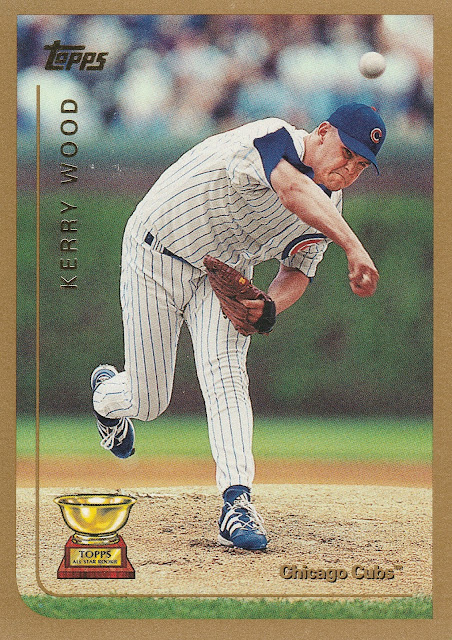
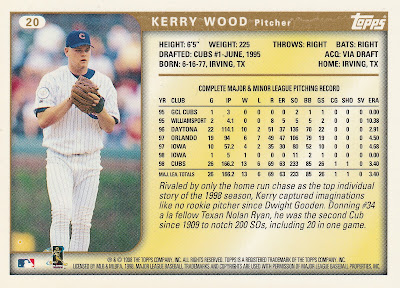
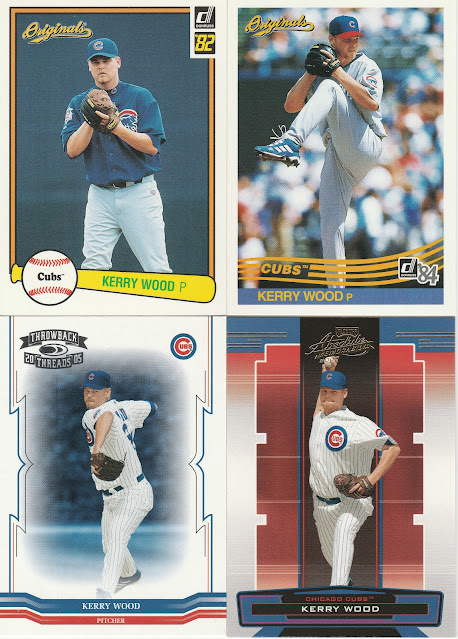
1998 Topps All-Star Rookie Right Handed Pitcher Kerry Wood


If you see this from the batter's box, you are in for a long day. Kerry Wood in 1998 was the NL Rookie of the Year, so of course he was Topps' first choice for right handed pitcher on their All-Star Rookie Squad. That season, Wood piled up the strikeouts (the most by a Chicago Cub since Hall of Famer Fergie Jenkins in the 1970s), and won 13 games. He had one Complete Game,  which was a shutout, but we'll talk about that game in a bit.


Topps went as far as to say that Kerry's rookie campaign was comparable to Dwight Gooden's phenomenal debut season, and the story of Kerry's season was second only to his teammate Sammy Sosa's chase with Mark McGwire to un-seat Roger Maris as the single season Home Run King. He led the NL in H/9 and K/9, but his electric stuff could be a little tough to harness at times. His 85 walks ranked in the top ten in the NL that year as well as hitting 11 batters and uncorking 6 wild pitches. Sometimes a little wildness can go a long way towards baffling the opposing batters.


The Cubs made Kerry a first round pick in 1995, selecting him out of high school in Grand Prairie, TX. Wood would start to show signs of the pitcher he'd grown into as a senior, when he fanned 152 batters in a little over 80 innings. He had a 0.77 ERA and was a perfect 14-0. His first full professional season came at the age of 19 for the High-A Daytona Cubs. He went 10-2 with a 2.91 ERA, striking out 136 batters in 114.1 innings pitched. The Cubs were willing to take the good with the bad, as the walks piled up alongside the Ks throughout his minor league career. In 1997 with the Orlando Rays and Iowa Cubs, he allowed a combined 131 walks in 151.2 innings. Despite the wildness, Wood returned in 1998 with a mission to make the big league roster. He would make just one start at AAA, striking out 11 of the 17 batters he faced before being called up to the Cubs.


Wood's magical rookie season was curtailed by "elbow soreness" that kept him out of the rotation for the final month of the season. He'd return to make a start against Atlanta in the NLDS, taking the loss after allowing a single run over 5 innings. In Spring Training of 1999, Wood tore his UCL, nearly ending his career. A season of rehab and recovery was needed to get him back on the mound and he was able to rebound to have several excellent seasons in the Cubs' starting rotation.


From 2001 - 2003, Wood averaged 200 innings pitched with 700 Strikeouts and an ERA+ of 122. He pitched a gem similar to his rookie season masterpiece (which we'll get to in a bit), when he tossed a 1 hit, 14K shutout against the Brewers in May of 2001. Along with Mark Prior, Wood formed a fearsome 1-2 punch at the top of the Cubs' Rotation and helped propel the team to within one game of the World Series. Wood was the starter of Game 7 of the 2003 NLCS against the Marlins, and even hit a home run to try to help his own cause, but the curse of the Billy Goat was still lurking in the shadows of the Friendly Confines. The Cubs would lose an ugly 9-6 game to the Marlins, and the following season the injury bug would bite Wood again. He would miss nearly 2 months of the 2004 campaign with a strained triceps muscle. 2005 ended prematurely with an injury in August, and 2006 and 2007 were nearly lost completely due to knee injuries and then a torn rotator cuff. 

Wood made the decision to shift from the rotation to the bullpen, and in 2008, he made a big splash, saving 34 games for the Cubs and striking out 84 batters in 64.1 innings. 


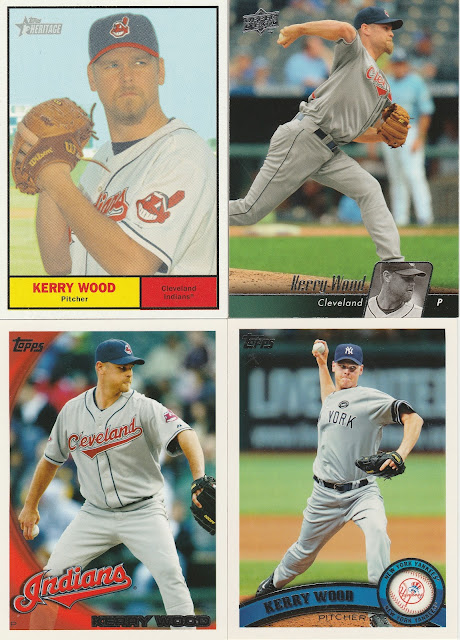
Following the 2008 season,  the Cubs opted not to sign Wood and he tested the free agent waters, landing in Cleveland. He would serve as the closer again, saving 20 games and sporting a league average ERA+ of exactly 100. He was traded at the 2010 trading deadline to the Yankees, where he pitched in middle relief setting up Mariano Rivera. He was his old electric self again with New York, recording a 0.69 ERA over 24 appearances. He allowed just 2 runs over 26 innings, striking out 31 batters down the stretch. In the Post-Season he allowed 2 more runs, 1 to the Twins and 1 to the Rangers, but overall pitched very well.


Wood returned to the North Side in 2011, and pitched the final two years of his career in the Cubs' bullpen. He's 3rd All-Time in strikeouts for the Cubs, even though he's 28th in innings pitched. 


Of course his signature moment came in his rookie season. Wood fanned 20 Astros in just his 5th career start. There are many tributes written about this game, but here are a few of my favorite tidbits:

-Out of 122 pitches thrown, only 7 were hit into fair territory. 
-Only 3 of those made it out of the infield.
-The lone hit he surrendered was an infield single that kicked off the glove of 3B Kevin Orie. Arguably it could have been ruled an error.
-The very first pitch of the game was a wild fastball that bounced off the mask of home plate umpire Jerry Meals.
-Houston's Shane Reynolds actually pitched a great game himself, striking out 10 and allowing just one earned run over 8 innings.

It has been argued that this was the greatest game ever pitched - even though he allowed a hit and also hit Craig Biggio (then again, who hasn't hit Biggio?). Bill James developed a formula to grade starting pitchers which is widely used and called the Game Score. 

Kerry Wood's game score for this outing was 105, the highest score of any pitched game before or since. 

Compare that to Clemens in 1986, his 20K game had a game score of 96.
Clemens in 1996, his 20K shutout had a game score of 97. 
Don Larsen's Perfect Game in the 1956 World Series? His Game Score was 94.
Sandy Koufax threw a perfect game in Sept of 1965 with 14 Ks - that game score was 101. 


Monday, April 5, 2021

1998 Topps All-Star Rookie Second Baseman Miguel Cairo


There are players in Major League history with more eye-popping stats than infielder Miguel Cairo, but very few of them were unanimous selections for the Topps All-Star Rookie team. Cairo was playing his first full MLB season at the age of 24 in 1998. He was already playing for his 4th MLB franchise, but it was because lots of teams wanted him! The expansion Tampa Bay Devil Rays needed talented players to fill out their roster - and Cairo fit the bill at second base.


His rookie season included 138 hits (26 doubles and 5 Triples) and 19 stolen bases in 150 games. He was the 8th pick in the Expansion draft, plucked from the Cubs organization. 


Cairo signed with the Los Angeles Dodgers as a minor league free agent when he was just 16 years old out of Venezuela. He made a big impression after a great year in High A Bakersfield in 1994 - he stole a career best 44 bases while hitting .291 in 155 games. From then on he was an intriguing target for various teams looking to improve their org's speed and/or defense. Seattle picked him up in a trade with the Dodgers after the 1995 season, then flipped him to Toronto less than a month later. He had a strong season in AAA for the Jays, and made his MLB debut in April of that year. He then came to the Cubs in time for the 1997 season, and he spent another year mostly in AAA, now in Iowa. He had 159 hits for the AAA team, and once again showed decent speed with 40 steals. The Devil Rays felt he was ready to take the next step and handed him the starting 2B job for 1998.


His most prolific seasons came as Tampa's starting second baseman, where he hit .275/.319/.356. He wasn't a power hitter, is what I'm saying. But he did pile up the singles and was a talented defender. He'd end up back in the Cubs organization in 2001 after the Devil Rays wanted to give Brent Abernathy a shot as the everyday 2nd baseman. Cairo was released in November by the Devil Rays, then picked up by Oakland, and was traded late in Spring training to the Cubs. The Cubs provided Cairo with the opportunity to re-invent himself from a light hitting second baseman into a light hitting utility infielder. This would be a key development for Cairo, as his versatility would allow him to prove his usefulness to many more teams for many more years. 

After a season with Chicago (split between AAA and the big league club), Cairo caught the eye of the Cardinals' Tony LaRussa. The Cubs placed Cairo on Waivers and the Cardinals snapped him up in time for the 2001 post season run. Cairo would pick up a hit and a stolen base against the eventual World Series Champion Diamondbacks in the 2001 NLDS. The following year, Cairo would play all over the diamond, appearing at every position except pitcher, center field, and catcher. He filled the Super Utility role that was a vintage LaRussa strategy. He would give anyone and everyone a day off when called upon, and was a valuable double switch option in the National League. 

In the 2002 NLDS, Cairo reached base in all 5 plate appearances. He'd add 5 more hits in the NLCS, but the Cardinals fell just short, losing to the Giants


Cairo had a great season with the Yankees in 2004, again playing all over the infield. He appeared in a career high 122 games, and topped 100 hits for the first time since his days as an everyday player in Tampa. He would go on to play for the Mets, then back to the Yankees, then the Cardinals again, then Seattle and Philadelphia before finally settling for a 3 year stint in Cincinnati. His time with Philly included his only World Series experience, though he was on the roster he did not get a plate appearance. In all, Cairo played in 17 MLB seasons, and collected over 1,000 career hits and scored over 500 career runs. 


This year Cairo has re-united with Tony LaRussa to serve as the bench coach for the Chicago White Sox.

Do you have any Miguel Cairo memories? I'd love to read them in the comments below. 

Thanks for reading! 

Sunday, October 11, 2020

I Love the 80s - 1982 New York Yankees

This is a series of posts on a 1980's Frankenset. Each page features a different team, with 9 of my personal favorite cards from that year's team. You might find players repeated, you'll definitely see brands repeated, but hopefully you'll agree that there are some interesting selections from the 1980s!

George Steinbrenner found a way to alienate just about everybody with his drive to win championships. The fact that he wanted to win was understandable-  the way he went about it drove the people that were tasked with winning those championships to the edge. In 1981, the team had a pair of future Hall of Fame superstars. One was in the final year of a historic contract, the other had barely seen the ink dry on his. Intentionally or not, Steinbrenner spent the summer of 1981 driving these two stars apart. He effusively praised the newly signed Dave Winfield, while slamming the proven post-season hero Reggie Jackson throughout the regular season. When the team, loaded with talent on offense and on the mound, made their way to another fall classic, victory was in the grasp of Steinbrenner again. However, Winfield's bat had gone cold, and Jackson was inexplicably left out of the lineup for 3 of the 6 contests. 

Steinbrenner's tactic then was lambast them both, driving Reggie out of New York and making Dave Winfield miserable just one year into his ten year deal.


1982 was the end of the "Reggie" era, and Mr. October took the postseason with him. 1981 would be the only World Series appearance of the decade for the Bronx Bombers. The decline of the 1982 team can be traced to Steinbrenner as well - he was more than willing to admit it. The team had three different managers, five pitching coaches, and four hitting coaches. They made a whirlwind of transactions throughout the season, making it difficult for the team to establish any kind of rhythm. The team was no doubt talented, with many of the same veterans forming the core of the prior AL championship roster. They finished 1982 with a losing record, the franchise's first since 1973- which as it happens was the year Steinbrenner first took ownership of the team. Their 9 game losing streak during the season has not been topped again by a Yankee team. One bright spot for the team saw the debut of 21 year old Don Mattingly, who would become the team's captain for the next decade plus. 


The Cards:
Fleer #53 Aurelio Rodriguez - The 1976 Gold Glove winner at third base was certainly known more for his defense than his hitting prowess, but the original A-Rod put on quite the display in the 1981 World Series. His .417 average (5/12) was better than most of the Yankee lineup. During the regular season he was a seldom used utility player, though he did hit a career best .346 when called upon. In the 70s he was a regular at third for the Tigers, and had it not been for playing the same position as Brooks Robinson, he might have had a few more trophies to display. He was regularly among the top ranked 3rd baseman in Range Factor, putouts, assists, double plays turned, and defensive WAR. After his MLB career, he returned to Mexico, where he continued his career as a player then manager. He was elected to Mexico's Baseball Hall of Fame in 1995, and the Latino Baseball Hall of Fame in 2012.

Topps #553 Dave Winfield - In 1982, Winfield hit a career high 37 homers, won his 3rd Gold Glove, his 2nd Silver Slugger, and was named to the All-Star team for the 6th straight season. And yet, the season was viewed by Steinbrenner as a failure. Winfield had been playing with a chip on his shoulder after being christened as "Mr. May" by the Yankees owner, but the abuse had yet to reach its apex. Winfield would continue to perform well on the field throughout the 80s, but the team as a whole was not able to make progress towards the ultimate goal of another World Series win. Winfield of course was just as hungry for it as anyone else-- maybe even more so given that he had only made one post season appearance in his career, and it went about as poorly as it possibly could have. Although he never finished higher than 3rd in the MVP balloting, Winfield was a complete player and a star for his entire big league career. He had over 3,000 hits, over 1,800 RBI, and combined 465 homers with 223 stolen bases. He would reach the World Series again before his career ended, winning it all with the Toronto Blue Jays. His 2 run double in the top of the 11th inning of game 6 proved to be the series clincher, making the long journey that much sweeter. 

Fleer #30 Bobby Brown - One of the first of a flurry of trades made by the Yankees in 1982 involved sending Bobby Brown along with three others to Seattle for Shane Rawley. Brown had a rough 1981, playing in just 31 games for the Yankees, and hitting just .226. But speed never slumps, and in Seattle he would crack the league leaderboard with 28 stolen bases. This was doubly impressive given that Brown was used as the team's fourth outfielder. He came to the Yankees from Toronto, and in 1979 was the International League MVP. His best MLB season came the following year, when he hit 14 homers and stole 27 bases. He was also part of the 1984 NL champion Padres squad, and was asked to fill in for the injured Kevin McReynolds. Brown had just 1 hit in 15 at bats in the World Series, then hit just .115 for the Padres in 1985, his final MLB season. He started an ice cream shop in Atlantic City with Jerry Mumphrey after he retired. 

Topps #301 Reggie Jackson -  There was very little action in New York for Reggie Jackson in 1982, as the team failed to extend his contract. George Steinbrenner told Reggie he was too old, so it was not a difficult decision to return to California, now with the Angels. Jackson immediately elevated the team's status as a post season contender. He led the AL in homers, out pacing his former teammate Winfield by a pair of round trippers. He also led the league in strikeouts for 5th time, but that was not concerning to Reggie, he was more focused on the bigger picture. He helped the Angels to a division title (the second in their franchise history), and would keep the team in contention for the next 4 years. He wasn't exactly joining a rag tag bunch of losers, but "The straw the stirs the drink" was the missing piece for a division championship. He joined 1979 MVP Don Baylor, 1977 MVP Rod Carew, 1975 MVP Fred Lynn and the criminally underrated foursome of Brian Downing, Bob Boone, Doug DeCinces, and Bobby Grich. The 82 Angels were a very good team!

Donruss #199 Rick Cerone - Rick was the prototypical journeyman/backup/platoon catcher, playing for 8 different teams in his career. New York was his most frequent stop, as a favorite of Steinbrenner in particular, despite blurting out a hearty F-bomb directed at George following a post season defeat in 1981. Cerone was the primary catcher for the Yankees that year, and again in 1982 prior to the trade for Butch Wynegar from Minnesota. He had his best season in 1980, when he hit 14 homers, drove in 85 runs and finished 7th in the AL MVP balloting. He was a first round pick in 1975 by Cleveland, and made his MLB debut that same year. For his career, he had 998 hits and 59 homers. He founded the independent Newark Bears baseball team in 1998, and sold them in 2003. 

Topps #569 Willie Randolph - Even though the Yankees had a rough stretch in terms of championship teams in the 1980s, where oh where would they have been without Willie Randolph? Willie was the unsung, unspoken leader of the team. Sure, Reggie was the big personality in the late 70s when Randolph was acquired from the Pirates, and Dave Winfield was the big name free agent after Reggie left, and Don Mattingly was the official team Captain after that. But Randolph was the real igniter of their offense, the stalwart of their defense, and the team's best base runner (well, in the years without Rickey Henderson anyway). In 1982, Randolph was the team leader in hits, runs, stolen bases, and games played. That would be a theme throughout his tenure in pinstripes. While he only had one season in which he led the league in anything (walks in 1980), he was a regular top ten finisher in OBP, walks, runs, and stolen bases. He was a six time All Star, which is probably low, and had 4 seasons in the top 10 in defensive WAR. 

Donruss #387 Yogi Berra - Donruss was hard at work to get some big names in its set that Fleer and Topps did not. That meant pulling from the coaching ranks. Yogi Berra had been coaching even before his playing career officially ended in the 1960s. When Billy Martin had him re-join the Yankees as a bench coach in 1976, I'm sure he could have never guessed that he'd see such a tumultuous revolving door of skippers until his own hiring and firing in 1984 and 1985. He'd seen the whole carousel revolve from Billy Martin through Gene Michael, Bob Lemon and back again. Berra's messy divorce from the Yankees in 1985 kept one of the greatest baseball minds away from his rightful home for nearly 15 years. Joe Torre was able to convince Berra to return in 1999 to the delight of the Yankee faithful. He remained a constant presence and a near-infinite source of wisdom and wise cracks until his passing in 2015. Berra, of course, was one of the greatest players of all-time - he captained 10 World Series winning clubs, won 3 MVP awards and was an 18 time All-Star. 

Topps #505 Graig Nettles -  Nettles was 37 in 1982, and appeared to be in the declining phase of his career. He would play one more season in New York before being traded to San Diego just prior to the start of the 1984 season. He had a resurgence in sunny So-Cal, helping the Padres to their first World Series appearance. Nettles of course was a key contributor to the Yankees' success in the 70s, winning a pair of Gold Gloves at third base while providing better than league average production for a position that still rarely included offensive prowess. Even pushing 40 years old, Nettles could still play well at the hot corner - he was in the top 5 in range factor, assists, and fielding percent every season from 1975 to 1985. 

Donruss #409 Tommy John - Is there a more famous baseball player than Tommy John that is eligible but missing from the Hall of Fame? Of course stats should count first and foremost when evaluating the candidacy of a player, but whose name comes up more often during your average MLB broadcast - Tommy John, or Robin Roberts? Eppa Rixey? Burleigh Grimes? Early Wynn? These are all Hall of Fame pitchers (and they happen to have had among the 10 most similar careers to Tommy's). Tommy John's willingness to do something no one had ever attempted before, undergo a risky procedure followed by a painful and arduous rehabilitation for the chance to pitch again . . . that has to count for something. How many careers today have been extended thanks to "Tommy John"? In 2014, nearly a third of all active MLB Pitchers have had Tommy John surgery. Heck, I think Dr. Frank Jobe should be in the Hall of Fame too - he devised the procedure (and also did a reconstruction of Orel Hershiser's shoulder in another unique and previously un-tested operation.). But Tommy John did the work of pitching for 14 seasons after being given a 100-1 shot at every pitching professionally again. By 1982 he was 7 years removed from the procedure. He was in the middle of his sixth season with double digit victories of those 7 when the Yankees traded him to the Angels. The waiver deadline deal gave California a veteran "ace" for the playoff push. He pitched well in game 1 of the ALCS, but got knocked around in game 4. The Angels would drop the decisive game 5 the following day despite a good start and a lead heading into the 7th inning. Tommy John finished his 21 year career with 288 victories and over 2,200 strikeouts.

What is your favorite card of a Yankee from 1982? Doesn't have to be one of these...

Thanks for reading!

Monday, July 6, 2020

1997 Topps All-Star Rookie Outfielder Andruw Jones


Andruw Jones was a once-in-a-generation talent - power, speed, and defense, Andruw could do it all. Jones was another player who could be pencilled in to the 1997 Topps All-Star Rookie Team before he even took the field that season. His 2 homers in the 1996 World Series at the tender age of 19 announced that he was something special. His rookie year could almost be called a disappointment, though he hit 18 homers and stole 20 bases while playing a stellar center field.


"The most graceful center fielder since Joe DiMaggio." That was Braves' manager Bobby Cox, who played with Mickey Mantle at the tail-end of the hall of famer's career. Cox knew a thing or two about talented center field play. Ultimately, the decline of Jones was a lot like that of Mantle, though it seems like it was for different reasons. In 1997, Jones put together a solid rookie campaign, filling up the stat sheet across the board. 


Jones was an international free agent signed by the Braves out of Curacao when he was just 16 years old. While the island was still a bit of a mystery to MLB scouts, Andruw was nearly a household name. He was an international sensation at age 11, playing in a tournament in Japan. At 13, the legend goes, he was launching 400 foot homers and was getting invites to play with adult leagues in Curacao. By 15, he was considered the best baseball player on the island.

His minor league career was equally impressive and showed his precociousness. He dominated at each level, and was the 1995 and 1996 Minor League Player of the Year according to Baseball America. In 1995 he was the MVP of Southern Atlantic League, where he hit 25 homers, drove in 100 runs, stole 56 bases, and of course was a revelation in center field. 1996 was not much different; he hit .339 and scored 115 runs before being called up to the Braves for 31 games at the end of the season. He remained on the post season roster as well, hitting a homer in Game 7 of the NLCS, then two more in the World Series - his first two World Series At bats.. He was the youngest player to homer in the World Series since Mickey Mantle. . .   Jones was ready for super stardom.


As Jones matured with Atlanta, his skills also became sharper. He would become arguably the greatest defensive center fielder of all time while patrolling Turner Field. Barry Bonds (Willie Mays' god son) was quoted as saying Jones "plays center field like no one I've ever seen in my life time." He would win 10 consecutive Gold Gloves in the National League. His peak years (1998-2006), Jones averaged .270/.347/.513 with 35 homers, 99 runs scored, 104 RBI, and double digit stolen bases. He was a 5-time All-Star in that stretch, and won a Silver Slugger in 2005, thanks to his league leading 51 homers and 128 RBI. 


His final season in Atlanta was perhaps a bad omen of things to come. He still hit for power with 26 homers and 94 RBI, but his batting average had plummeted to .222 and he had a career low with an OPS+ of 87. He still won a Gold Glove in CF, leading the NL in putouts, but he seemed to have lost a step or two in some of the advanced (if flawed) defensive metrics like Total Zone Runs and Range Factor. As Jones got older, his body type changed as he worked on hitting for power at the expense of speed. The charitable verdict on Jones is that he was overweight, the cynic may try to link his decline to the alleged use of performance enhancing drugs. From what little research I could do for this post, I didn't see a smoking gun for PEDs, just some circumstantial evidence of the obvious physical transformation that can be seen on his baseball cards. I don't put much stock in the steroids theory, but it seems like his decline was abrupt and tragic for a ballplayer with such a meteoric rise.


Jones signed a big free agent contract with the Dodgers, that didn't really pan out. His 2008 season included a long layoff following surgery to repair torn cartilage in his knee, and an abysmal 75 games in which he hit just .158 with 3 homers in 209 at bats. His free swinging ways, which had been a quirky and acceptable vice in his younger days was now responsible for derailing his production at every turn. 


Keep in mind that Andruw was still just 32 years old when he made the Rangers' roster as the 25th man. He was a non-roster invitee but showed enough in Spring Training to find a spot on the roster. He was intended to be a 4th outfielder, but instead found most of his at bats as a DH. He hit 17 homers, but hit just .214 for the season. One bright spot in his game was that he had managed to develop some latent on base skills, walking at a career high rate of 13.6%.  His OBP ended up more than 100 points higher than his batting average. He would end up playing just one season in Texas before moving on.


In 2010, Jones would play on the South Side, getting a Walk off homer (seen here, maybe?) in April against the Mariners, which led to his 400th career homer in July. he came into White Sox camp 30 pounds slimmer than the year before, which certainly made a difference. He surpassed 100 games played in a season for the first time since 2007. Jones played in the OF again, but wasn't the fielder we once was. His walk rate was again a career high, at 13.7%, and even stole 9 bases, which was the most he'd stolen in a season since 2001. His "Power/Speed" number was again in double digits, and he had an OPS+ of 120, once again proving his undeniable baseball talent.


Jones would sign on with the Yankees, hoping to build on his success in Chicago and perhaps get back to the post season. His first year as a bench player went quite well - he had a 126 OPS+, his highest since his last All-Star season in 2006. He got on base via the walk, hit for a little power (13 homers), and filled in admirably in the corner outfield when called upon. 


His Final MLB season did not go nearly as well, though he hit 14 homers and drove in 34. His rate stats had all declined, and he was striking out at a higher rate than he had in several years. He was left off the post season roster in 2012, and was looking for another chance in 2013. He represented the Netherlands in the World Baseball Classic and was looking to showcase his skills, hitting .333/.447/.370 in the tournament. He would sign with the Rakuten Golden Eagles in the Japanese Pacific League, was instrumental as the team's DH. The team won the league championship in 2013, thanks in no small part to Jones' 26 homers and 94 RBI. He played again with the Eagles in 2014, and tried another comeback with Atlanta in the Spring of 2015. He did not make the cut, and was out of pro ball at the age of 38. 


Do you think Andruw Jones is a Hall Of Famer? The best Center Fielder of all-time? Any specific Jones memories you'd like to share? I'd love to read them in the comments below. Thanks for reading!

Sunday, May 10, 2020

I Love the 80s - 1981 New York Yankees

This is a series of posts on a 1980's Frankenset. Each page features a different team, with 9 of my personal favorite cards from that year's team. You might find players repeated, you'll definitely see brands repeated, but hopefully you'll agree that there are some interesting selections from the 1980s!


In 1980 , The Yankees won the AL East with a record of 103-59. They ran into a buzz saw in the ALCS and were swept by the Kansas City Royals. To be fair, game one of that series was the only one that wasn't close. The following season, they would once again win the AL East (in the 1st half) to earn a playoff berth. This time, the Yankees would beat 2nd half champion Milwaukee in the Division series, then took care of Billy Martin's Oakland A's in the ALCS. They would fall short of the ultimate goal, however, when the Dodgers would beat them out for the World Series.


1981 was the end of the Reggie Jackson era in New York. During his time with the Yankees, they would win the AL East in 4 out of 5 seasons, go to 3 World Series, and win 2 of them. Of course, Jackson alone was not enough to secure that success, his tenure was the high watermark for the franchise in the 70s and 80s.

The Cards:
Donruss #231 Luis Tiant - "El Tiante" won 229 games over his 19 year career, and spent 2 years as a Yankee. In 1979, he compiled a 13-8 record with a 3.91 ERA. He was a 20 game winner 4 times, and twice led the league in ERA. Tiant's 1980 season Saw his ERA climb to a career high, but he made 25 starts for the Division champs.

Fleer Star Stickers #118 Rich Gossage - It was with New York that Gossage solidified his Hall of Fame resume, as the team's closer on both the 1978 and 1981 World Series teams. He was already a perennial All-Star, defining the role of the late inning reliever in the 70s and 80s. He was the AL Saves leader in 1980, and in 1981 he had a 0.77 ERA during the regular season. In the 81 ALDS, he saved all 3 Yankee victories. Over his career, he closed out 8 World Series games, notching 2 saves. 

Topps #400 Reggie Jackson - As the straw that stirs the drink, Reggie made the biggest splash in the post season. He has 10 career homers in the World Series, including a streak of 4 homers in 4 swings starting with his final at bat in game 5 of the 1977 World Series. Jackson is the All-Time MLB leader in Strikeouts, but also was on 5 World Series winners, which is certainly a fair trade off.

Fleer #86 Ron Davis - Davis was an unlikely All-Star in 1981, as a middle reliever for the Yankees. In his first full season of 1979, he racked up 14 victories out of the bullpen. He would be traded to the Twins and served as their closer for several seasons. He even pitched in the Senior Professional League, also as the closer for Sun City. 

Topps (Traded) #855 Dave Winfield - The biggest free agent available heading into the 1981 season was Dave Winfield, so that 's who George Steinbrenner was going to sign. There was some concern that Winfield and Jackson would clash, but the pair both had productive seasons that secured the 1st half championship. Winfield was the team leader in hits , doubles, and RBI. Over 9 seasons with New York, he'd have over 1300 hits, 205 homers, and more than 800 RBI. 

Fleer #87 Graig Nettles - While Reggie Jackson gets a fair share of credit for the success of the late 70s Yankees dynasty, one could make a case for Graig Nettles as well. In 1977, it was Nettles that was the team leader in Wins Above Replacement. He was a Gold Glove 3rd baseman in 1977 and 1978. In 1981, he would be the hero of the ALCS, hitting .500 with 9 RBI in 3 games. 

Kellogg's 3-D Super Stars #3 Reggie Jackson - The 1977 and 78 seasons get a lot of attention in Reggie's illustrious career, but his best season as a Yankee was probably his 1980 campaign. He was the runner up for the MVP award and led the AL in homers. He hit a career high .300 and had a stratospheric OPS+ of 172.

Topps #550 Tommy John - Tommy John finished 4th in the Cy Young balloting in 1980, sporting a 22-9 record and league leading 6 shutouts. He was a Dodgers ace before he came to the Yankees, and an Angels Ace after that. Of course, before he came to New York, he had an experimental surgery done to repair a torn ligament in his elbow. He made a painful and difficult recovery and resumed his career where so many pitchers before him had been forced into an early retirement. He had 3 20 Win seasons and 3 All-Star appearances post surgery, and ranks 26th All-Time in Career Wins. 

Donruss #351 Yogi Berra - With the volatility of the Yankees' manager position, having Yogi appear on a card as a bench coach could have been a smart bet for the next Yankees' skipper. Steinbrenner would make a change mid way through the 1981 season, firing Gene Michaels and re-hiring Bob Lemon, who was a previous Billy Martin replacement. Berra would have to wait until 1986 to get his shot again. He won the AL pennant in 1964 and the NL pennant in 1973 with the Mets. As a player, of course, Berra was a 3 time MVP, 14 time All-Star, and 10X World Series Champ. Not too shabby.

Friday, May 8, 2020

Free Stuff Friday #14 - Yankee Can Deal Company


It's another Free Stuff Friday, where I post some cards for you to claim, Here's 2007 Topps in all its glory, none of these are the red back variations. Just basic base.


here are the parallels - If you were unfamiliar, "The Pike" is the nickname for Ketel Marte.


Some Inserts!


Hockey! (I will be adding some basketball and/or football next week for Free Stuff Friday #15, stay tuned for that!)


For mini collections, how about some Yankees? The blue card in the middle is apparently from a box set, the rest are not. I assume I acquired all of these one at a time from repacks, but who knows?

Claim a card, claim all the cards!

If we haven't traded before (or in more than a year)  please reach out to me directly with your mailing address. I have several stacks of claimed cards with no address to send them to.

Monday, May 4, 2020

1996 Topps All-Star Rookie First Baseman Tony Clark

Tony the Tiger? He's Gr-r-r-r-reat!

Tony Clark was a prototypical Topps All-Star Rookie Candidate. The Switch hitting slugger was a mid season call-up and made major contributions to his team's offense. Clark also had a great story of making it to the show after possibly having his career derailed before it began. Over just 100 games for the Tigers, Tony crushed 27 home runs, to lead the team.


Tony the Tiger had a mixture of those impressive stats and impressive moments. He had a 2 HR game in September of 1996 - the first blast cleared the roof in Right Field at Tiger Stadium, which was often the benchmark used to measure whether new Tigers sluggers were legit or not. Clark slugged .503 in his rookie season, finishing 3rd in the AL Rookie of the Year voting.


Drafted by the Tigers in the 1st Round in 1990, Clark was a 2-sport star in high school in San Diego. Clark broke a single-season scoring record set by Basketball Hall of Famer Bill Walton. His senior season he averaged nearly 44 points per game. His pro contract with the Tigers allowed him to play College Basketball and baseball in the summers. At San Diego State University, Clark suffered a back injury falling on a teammate's foot during practice that ended his 1991 baseball season before it began. He would return the following season, but played in just 26 games. He did play well when he was on the field, slashing .306/.372/.588 for low-A Niagra Falls. After another season with just 36 games played, fans may have begun to wonder if  Clark was going to be a bust. He decided to leave San Diego State to focus solely on Baseball. 1994 would be a make or break year for Tony, so he chose making it by way of breaking it - he crushed 23 homers and drove in 99 runs over AA and AAA. He spent most of 1995 in AAA Toledo, where he would again slug the ball hard, and he earned a late season call-up to join the Tigers.


Clark's best MLB seasons came during his time in Detroit. He averaged 31 homers and 98 RBI each year from 1996 through 1999. Injuries would bite him again in 2000, playing in just 60 games, but once again he would bounce back to make his lone All-Star appearance in 2001. He hit 156 homers and had over 500 RBI in his time with the Tigers, and became just the 13th Switch Hitter to rack up 30+ homers in a season in MLB history. His OPS+ during his Tiger tenure was a strong 121.


Clark's career following his time in the motor city was a series of bright starts followed by injury woes and then more comebacks. He hit home runs in his first game played with Boston, the Mets, and the Yankees. At each of those stops along the way, Clark would struggle repeat his Tiger success. Clark was no longer being utilized as an everyday player. It may have just taken time for him to adjust to the new role. After joining the Diamondbacks in 2005,  Clark would surprise everyone by hitting 30 homers, and doing it in just 349 at bats. He had career highs in batting average, slugging, and OPS at age 35. Young players looked to Clark for advice and he was nominated to be the team's player representative for the MLBPA. 


Clark's experience as a player rep got his foot in the door with the MLBPA following his playing career. In 2013, after spending time as the deputy executive director. Clark was promoted to head the union, and has been the Executive Director ever since. Clark is still highly respected by players, rookies and veterans alike think of him as the go to guy for any questions they have about the baseball life, both on the field and as union members.

Clark retired from playing in 2009, with 251 career homers, the 13th highest total among all Switch Hitters. He hit homers from both sides of the plate in the same game 10 times, which ranks favorably compared to the great power hitting switch hitters like Mantle, Murray, Teixeira, and ... uh, Nick Swisher? He also has a unique claim to fame - hitting home runs in Japan in 2004, in Puerto Rico in 2003, and all Continental U.S. time zones in between, he has the All-Time record for most time zones homered in during MLB games.

What are some of your Tony Clark memories? 

Wednesday, April 1, 2020

Phil Niekro's in his 80s, so here's Phil Niekro in the 80s


Happy Birthday to Philip Henry Niekro, 81 years young today. Since he's in his 80s, I thought I would take some time to appreciate his work in the 1980s, his 3rd decade in the Major Leagues, where he would reach some important milestones and accolades.


Score released the only Phil Niekro card of 1988 to show his full career stats. Score instantly gained a reputation for their card backs, not only because of its full color photo (which Upper Deck would make mainstream the following year), but the clever and informative text below the career totals. In the case of Niekro, the career was left to speak for itself, and it had plenty to say!


1980 - 15-18, 3.63 ERA;  League Leader in Games Started, Losses, Homers Allowed. Gold Glove Winner. Roberto Clemente Award.

In 1980, Niekro had already pitched with Atlanta for 16 seasons, winning 218 games and appearing in a total of 608. Despite leading the NL in losses, this could still be considered a "good" Phil Niekro season. He earned a Gold Glove for his defense, and gave his team 38 starts and a pair of relief appearances.


Niekro was the winner of the Roberto Clemente award in 1980 as well, becoming the first pitcher to win the honor, given to a player who exemplifies sportsmanship and community involvement. In his case, it was in recognition his work with the Atlanta ALS (Lou Gehrig's Disease) Foundation.


1981 - 7-7, 3.10 ERA, 116 ERA+

In 1981, the league endured a player's strike that split the season into two halves. Niekro appeared in just 22 games, the lowest total since his rookie year of 1964. After allowing the most homers in the league in 1980, he found some kind of magic with his knuckler to drop his HR rate to just .4 HR/9 innings. He allowed just 6 long balls over his 139 innings pitched.


1982 - 17-4, 3.61 ERA; NL All-Star, Gold Glove award. 5th Place finish, NL Cy Young voting.

At first glance, 1982 may have been Niekro's best season of the 80s. He won 17 games for the Braves in the midst of a pennant race, made the All-Star team, and won his 4th Gold Glove award. The Cy Young voting of course loved his league leading .810 winning percentage for a contending team. He did have the lowest walk rate of his 80s seasons, issuing just 2.8 free passes per 9 innings. He would once again vault above 200 innings pitched, and started 35 games for Atlanta, despite missing the first two weeks of the season with a rib injury.


1983 - 11-10, 3.74 ERA; Gold Glove Award

1983 was a season of challenges and disappointments for Phil, his final full season in Atlanta. He had another solid season in terms of durability, however his walk rate spiked, leading to an ERA+ of 98, the first time his season rate fell below league average since 1966, the year before he became a full-time starter. The team had moved on from Manager Bobby Cox to hire Joe Torre. Niekro had been on record as early as 1977 as being interested in the manager position, likely as a Player/manager to start. Instead, the season would conclude with a much less encouraging exchange with the front office, with Atlanta's top brass suggesting that Niekro hang up his spikes. Niekro likened the falling out to a divorce, pointing out that with the exception of his wife and children, everything he had was bought and paid for with Braves paychecks. Team Owner Ted Turner, a long time fan of Niekro tried to extend an olive branch with a roster spot, but Niekro had made up his mind to move on.


1984 - 16-8, 3.09 ERA, 123 ERA+; AL All-Star

Now in a new uniform for the first time since the Braves moved from Milwaukee to Atlanta, Niekro would take his talents to the Big Apple and would try his luck tossing knuckleballs for George Steinbrenner. He would arguably have the best season of the decade in his first season with the Yankees. He posted the lowest ERA and highest ERA+ despite switching to a league that had a DH and learning how to retire a new crop of hitters. He reached 3,000 career strikeouts in July, and was named to his 5th and final All-Star squad. This was thanks to his fast start to the season, going 11-4 with a 1.19 ERA leading up to the break, including a 4-0 April.


1985 - 16-12 4.09 ERA; League Leader, Walks allowed

Niekro once again topped 200 innings pitched for the Yankees, and had a personal high-water mark for Strikeout rate in the 1980s, exceeding 6 Ks/9. Perhaps the most impressive start as a Yankee was his last. Coming into the season, Niekro needed 16 victories to reach 300 for his career. He had 15 with about a month to go in the season. A late trade reunited Phil with his brother Joe, who were gaining on the Perry brothers in a heated sibling rivalry for the most combined career wins by brothers. Coming into his final start of the year and sitting on 299 victories, he and his brother were more concerned for the health of their father, who was staying in a hospital in Wheeling, West Virginia. Niekro Sr was a Coal Miner, and had taught the signature knuckler to both Niekro brothers as children. Steinbrenner had arranged for the game to be broadcast by phone to the hospital, and Niekro's father was able to listen in as his son became the oldest 300 game winner, and oldest to throw a 9 inning shutout. His brother Joe was the first to greet Phil on the mound, who had eschewed the knuckleball for the majority of the start, to let Phil know that his dad had been listening in. Phil was able to present his dad with the game ball the next day.


1986 - 11-11, 4.32 ERA

Now at age 47, Niekro was released by the Yankees after Spring Training, but quickly snapped up by Cleveland. Niekro was happy to continue to chase down the Perrys with his brother Joe, who was still in pinstripes. They would combine for 20 wins in 1986, still 4 wins shy of the record. Phil had another season just below league average with a 98 ERA+, but finished with over 200 innings for the 19th time in his career.


1987 - 7-13, 6.30 ERA  (With CLE, TOR, and ATL)

Niekro's final season in the majors was a mixed blessing. In June, Niekro defeated Detroit to earn the 530 career victory for the Niekro family, passing Jim and Gaylord Perry for the most all-time. With the team out of the playoff race and holding several aging veterans, Cleveland would trade away Niekro for a pair of young players to the surging Toronto Blue Jays. Niekro was excited for what might be his final chance to play in a World Series. Unfortunately, his 3 starts with the Blue Jays resulted in 2 losses. His final start in Toronto ended in the first inning, after which he would be released. Niekro only had one goal left in mind - to finish his career with his original team. The final home game of the season would set the stage for Niekro to make one more appearance with the Braves. He signed a contract for $1, and made the start with a starting lineup that included Jeff Blauser at Short Stop, who was -2 years old when Niekro pitched his first game. That game, also against the Giants, featured Hank Aaron, Eddie Mathews, Felipe Alou, Rico Carty for the Braves - Willie Mays, Willie McCovey, Matty Alou for the Giants. His only batter faced in that contest was Jim Davenport, against whom he induced a ground ball out. In his final game, Niekro was crusing through the first three innings until he ran into trouble in the fourth. Braves skipper Chuck Tanner pulled Niekro while the team was still leading, wanting to keep Niekro from being the pitcher of record in a loss. Chuck Cary came in to relieve Niekro with the bases loaded and promptly gave up a Grand Slam. Niekro was on the hook for 5 of the 6 runs allowed in the inning.


Niekro being born on April Fool's Day feels fitting for a pitcher who was the master of fooling hitters with his signature pitch. Cleveland teammate Tom Candiotti also threw the inscrutable pitch, and said that talking about knuckleballs with "Knucksie" was like talking about lightbulbs with Thomas Edison.