Showing posts with label Montreal Expos. Show all posts

Sunday, November 1, 2020

I Love the 80s - 1982 Montreal Expos

This is a series of posts on a 1980's Frankenset. Each page features a different team, with 9 of my personal favorite cards from that year's team. You might find players repeated, you'll definitely see brands repeated, but hopefully you'll agree that there are some interesting selections from the 1980s!

The Expos clinched their first ever Playoff berth in 1981, despite the team's manager Dick Williams being fired in September by the front office with the team just a game and a half behind the Cardinals in the standings. They would lose 3 of the first 5 games under new skipper Jim Fanning, but squeaked out a narrow half game lead over the Cardinals by the end of the second half. They would go on to beat the defending champion Philadelphia Phillies in the Divisional round, but fell in 5 games to the Dodgers in the NLCS. The franchise would not return to the post season until after the team moved to Washington, D.C.


Despite missing the playoffs in 1982, the Expos were still a very good team, led by a trio of Hall of Famers. Carter, Dawson, and Raines were joined by fellow Expos Al Oliver and ace pitcher Steve Rogers in the All-Star Game. It was hosted for the first time outside of the United States and the only time in Montreal. Rogers pitched well and recorded the win. Ultimately the team finished third in the standings, behind the Cardinals and Phillies in the NL East. Despite the talented trio and more young players on the way, the team never finished higher than 3rd for the rest of the 80s. 


The Cards:

Donruss #114 Gary Carter - By 1982, "The Kid" was a veteran and a team leader. He was just about midway through a run of 10 consecutive All-Star appearances, and took home his 3rd straight Gold Glove and 2nd Silver Slugger award. He paced the Expos with 29 homers, and led the NL in WAR with 8.6 for the season. His final season in Montreal, 1984, he led the NL in RBI, won his 2nd All-Star MVP award, and posted a career high 175 hits. He'd go on to post season glory following a trade to the Mets, winning the World Series in 1986. Carter was elected to the Hall of Fame in his 6th year of eligibility. His 2,056 games caught ranks 4th All-Time in MLB history.

O-Pee-Chee #379 Andre Dawson - I had to break out the OPC for the Canadian teams! Andre, just like Gary, was celebrating 1982 with his 3rd Gold Glove and had appeared in his 2nd of 8 All-Star games. Dawson had the 2nd Highest WAR in the NL just behind Carter, with 7.9 wins above replacement. He played a sterling center field, including 7 outfield assists that year. He led the NL twice in that category from Center Field. He was the 1977 Rookie of the Year in the NL, thanks to displaying skills at all phases of the game. Before injuries sapped his speed, Dawson would average more than 30 steals and nearly 25 homers a year in his prime. He showed his worth again in his first year in Chicago, winning the MVP in the NL by virtue of leading the league in Homers (49) and RBI (137). He was elected to the Hall of Fame in his 9th year of eligibility, with voters citing his lower career totals compared to his healthier peers as a stumbling block. His speed, power, and grace on the field would not be denied!

Topps #3 Tim Raines - While Rickey was dominating the AL on the bases and leading off year after year, it was Tim Raines showing many of the same skills in Montreal. In 1981, Raines had a triple slash of .304/.391/.438 and stole 71 bases in just 88 games (remember, this was a strike shortened season, and Raines was a mid-year call-up!)! Just like his HOF brothers-in-arms, Raines was embarking on a string of numerous All-Star appearances in 1982. It would be his 2nd of 7 straight mid-summer classics. He led the NL in runs scored twice, won a batting title (and OBP title) in 1986, and was the top base stealer in the NL for 4 straight years starting in his rookie campaign. He'd steal at least 10 bases every year for 15 consecutive seasons. He ranks 5th All-Time in the category, with 808 career steals. Raines would have to wait the maximum period of 10 years on the HOF ballot before his induction - he never finished higher than 5th in MVP balloting, didn't have post season success in his prime (though he was a key piece of the 1996 and 98 Yankees teams), and didn't hit for power or reach the 3,000 hit milestone. His final year of eligibility included a successful campaign on behalf of OBP, stolen base %, and the value of a player who rarely got himself out. 

Topps #131 Stan Bahnsen - The 1968 AL Rookie of the year was coming to the end of long and winding road in the big leagues, which included a 20 win season followed by a 20 loss season, and 5 different franchises. 1981 would be his last of 5 seasons in Montreal. He came to the team mid way through 1977 from Oakland, and spent the rest of the year as a member of the starting rotation. He converted to the bullpen in 1978, and had several successful years in that role for the Expos. In 1981, Bahnsen would make his first post season appearance after 15 MLB seasons. He faced 5 batters and retired 4 of them in relief in the NLDS against the Phillies. Like many pitchers to have his staying power, Bahnsen learned how to pitch rather than just throw, as evidenced by the evolution of his nicknames. When he arrived in Yankee pinstripes, he was called "Bahnsen Burner" for his high 90s fastball. Towards the end of his career, he became known as "Stanley Struggle" for getting himself into and then out of jams through wits and guile. He went on to pitch in the Senior League, then in the Netherlands (the first former MLB player to do so).

Fleer #196 Brad Mills - One of the more iconic cards in the 1982 Fleer set, Mills is blowing a big bubble in the dugout. Mills was a rarely used utility infielder for the Expos, playing in 106 total games from 1980 through 1983, giving him plenty of time to work on his chewing gum skills. 1980 was the same year that Mills started professional baseball, going from single A up to the big league club that year. He would play in AAA for several seasons after his last MLB game in 1983. Following an injury that ended his playing career, Mills became a coach and then manager. He led the PCL Colorado Springs Sky Sox to a pennant in 1995, and later managed the Houston Astros for 2 and a half seasons. He's been a close confidant and bench coach in recent years of Cleveland skipper Terry Francona, though Mills sat out during the 2020 season to limit his exposure to the Coronavirus.

Donruss #650 Felipe Alou - Alou joined the Expos organization briefly as a player in 1973, then as a batting coach following his playing career in 1976. Alou would work his way up the ranks with the Expos, and stuck with the franchise even though he was offered a chance to manage the San Francisco Giants in 1985. He would get his chance in Montreal in 1992, and would be the skipper for arguably the best team in Franchise history in 1994. Though the strike ended the season prematurely, the Expos had their lone 1st place finish in Montreal that year. The strike eliminated the chance for the team to play in the post season, and they would not make it back under Alou, who remained the manager until 2001. He retired but was given another shot in San Francisco and led the Giants to a 100 win season in his first year with the club. After his final year as manager in 2003, he continued to work with the club as an instructor and as special assistant to the general manager. 

Topps Traded #7T Tim Blackwell -  Sporting one of the best moustaches of the 1980s, Tim Blackwell was a talented reserve catcher for several teams. He also had a brief period of time as the primary receiver for the Chicago Cubs, posting career highs across the board in 1980. He was drafted in 1970 by the Red Sox, and worked his way into a solid and dependable reserve role while learning the finer points of the game. This would come in handy in his next career choice, managing several minor league teams across all levels. He led the 1991 Columbia Mets and the 1993 Saint Paul Saints to league titles, and finished in 1st place 2 other times. 1982 was his first year in Montreal, and backing up Gary Carter meant not much playing time. He did manage to strikeout against Nolan Ryan in 1983, allowing Ryan to tie Walter Johnson's then record. Ryan would start his own record with the next batter, striking out Brad Mills for #3,509.

O-Pee-Chee #191 Tim Wallach - Like many Montreal Expos, Wallach was under the radar for much of his career. A first round pick in 1979 out of Cal State Fullerton, Wallach played 13 seasons for the Expos, amassing over 1,600 hits and driving in over 900 runs for the team north of the border. He wasn't totally ignored, however, winning 3 gold gloves and appearing on 5 All-Star rosters in his Expos career. His best season was 1987, when he finished 4th in the MVP race behind his former teammate Andre Dawson. That year he led the NL in Doubles while hitting a career high .298 and driving 123 runs. His output may have been directly tied to Dawson's absence in the heart of the Expos order, but he rose to the challenge. He would return to California to close out his career in Dodger blue and a brief stop with the Angels sandwiched between two stints in Chavez Ravine. His 2,054 games played at 3rd base ranks 11th All-Time at the position. He became a coach after his playing career ended and has followed Don Mattingly from the Dodgers to the Marlins as a bench coach. He opted to leave the Marlins for the 2020 season to seek a job in baseball closer to his California home. His son Chad currently plays for the Marlins. 

Fleer #194 Bill Lee - "The Spaceman" was spotted in Canada following a 1979 trade. The crafty and kooky lefty was the team's most successful starter that year, going 16-10 with a 3.04 ERA, his most victories since his heyday with the Red Sox in 1973-74-75. Lee would convert to bullpen duty and showed promise in that role as well, with an excellent run in 1981, posting a 2.94 ERA over 88 innings for the post season bound Expos. His time in Montreal (and his MLB career) came to an abrupt end in 1982 after just 7 games. Lee walked out (in full uniform) in protest for the release of Rodney Scott on May 5, 1982. Scott was one of Lee's best friends on the team, and Lee felt that manager Jim Fanning was exercising a personal grudge against Scott rather than solely a baseball decision. Following his MLB playing career, Lee wrote his (first) autobiography, then continued to pitch semi-professionally for a variety of teams and leagues. At age 65 in 2012, he pitched a complete game for a team in San Rafael, CA.

What is your favorite card of a Montreal Expo from 1982? Doesn't have to be one of these...

Thanks for reading!


Monday, May 25, 2020

1997 Topps All-Star Rookie Second Baseman Wilton Guerrero


A person could spend a lot of time writing about what Wilton Guerrero was not. He was not his brother Vladimir, he was not a Rookie of the Year like Dodger rookies were the prior five years, he was not the second baseman of the future. BUT! Wilton Guerrero was a very talented baseball player who may have been rushed to the big leagues before he was ready. While he may not have become a super star like his brother, he will forever have one thing over him - Wilton was a Topps All-Star Rookie!


Guerrero was a great hitter, with great contact skills. He wasn't a power hitter, but with his speed, he didn't need to be. In 1997, he had 9 triples, which led the Dodgers and was 3rd best in the National League. He was just 22 years old when the Dodgers made him their everyday 2nd baseman. The LA Dodgers were no strangers to starting rookies, and promoting young talent from within. The Rookie of the Year award is named after Dodger great Jackie Robinson. But the issues with Wilton's game were known before his call up. He was still given free reign to learn the finer points of the game on the job. He would start the 1998 season back in Triple AAA Albuquerque.


Signed in 1991 as a free agent out of the Dominican Republic, Guerrero had raw speed in spades. He also could hit for average. As an 18 year old, he hit .294 with 20 stolen bases in just 60 games in single A Great Falls. Guerrero would continue a steady climb up the Dodgers ladder, winning a batting title in 1995 for the San Antonio Missions. In 1996 with AAA Albuquerque, Guerrero again hit well, with a .344 average and 12 Triples. 


His tenure in LA was marked by decent hitting and speed, but also a series of mistakes that caused other players and coaches to become frustrated with the player they had lauded as a future star. In 1997 he was suspended for 7 games after it was discovered that his bat was corked. Despite stealing at least 20 bases a season in the minors, he stole just 6 bases while being caught 5 times in his rookie year. He would be traded to Montreal early in 1998 to reunite with his brother Vladimir.


With the Expos, Guerrero was not expected to be the everyday anything - he was the every other day everything. He would play all over the infield and occasionally fill in as an outfielder. He continued to hit well, even with limited at bats. He had found his niche as a utility player. He also found that his brother was very competitive. Wilton's last 3 homers as an Expo came on the same day as a Vladimir home run. He continued to hit Triples, ranking top 10 in the league in 1998 and 1999.


Wilton would sign with the Reds as a free agent before the 2001 season, and again had a great season playing all over the field. In 60 games, Guerrero hit a career high .338. He was traded twice in the same day in 2002 - going from the Reds to the Marlins to the Expos, part of a series of deals by the Marlins that sent away Ryan Dempster, Cliff Floyd, and several others. Following his 2nd tour with the Expos, Guerrero played with the Royals in 2004. He had a pair of very good seasons in AAA as well, once again finding his legs, stealing 30 bases with the Reds AAA squad in 2003, and hit .326 in AAA Omaha before the Royals called him up in 2004.

Following his playing career, he co-founded the Guerrero Baseball Academy in the Dominican Republic with his brother, and he continues to run the school to help train the next generation of baseball talent. Wilton's son Wilton Jr. is still several years away, but you can see his hitting showcase here.

Do you have any Wilton Guerrero stories? I'd love to read them in the comments below. Thanks for reading!

Monday, April 20, 2020

1996 Topps All Star Rookie Second Baseman Tony Batista


To make the Topps All-Star Rookie roster, you don't need to play in every game, you just need to shine at the right time. For Tony Batista, it was a torrid second half that made him the perfect choice for the 1996 Topps All-Star Rookie Second Baseman. He played in just 74 games for the A's in 1996, but they came late in the season. He became the team's regular starting second sacker in July, hitting .298 with 6 homers and 25 RBI.


Batista was signed by Oakland as a minor league free agent out of the Dominican Republic in 1991, when he was just 17 years old. After playing in the Dominican Winter League, Batista made his way the United States and was ready to take on new challenges in Single A. His career was nearly ended early in his minor league days, when he suffered a fractured skull following a collision in the outfield. Upon his return to the lineup, Batista began to show the early signs of the power hitter he would become. in 1994, Batista was making big gains in High A Modesto. He would hit 17 homers and 26 doubles for the club. He would hit 18 more in AA the following season, and his power up the middle was enough to earn him a call to the big leagues. The A's had been relying upon Brent Gates and Rafael Bournigal at second, so a little offense would go a long way.


Unfortunately for Batista, the league figured out how to pitch to him. Batista would struggle early on in his sophomore season, hitting under .200 early on, which led to a demotion back to AAA. Still just 23 years old. Batista still had plenty of work to do and plenty to prove.


The Expansion Arizona Diamondbacks selected Batista with the 27th pick of the expansion draft, and he would expect to see regular playing time for Arizona in their inaugural season. It was over the offseason that year that Batista developed his unorthodox batting stance, which involved standing parallel to the pitcher's mound and facing the pitcher head on. He did fare well in his time in the desert, clubbing 5 homers in 44 games, but he would be traded to Toronto in exchange for pitching, the one thing that expansion teams can never get enough of.


Batista would have his best individual season of his career with Toronto in 2000. He had already hit 26 homers following his trade to the Jays in 1999, but he would tear the cover off the ball in 2000, hitting 41 homers (4th best in the AL) . He had career highs in Runs Scored, hits, doubles, homers, RBI and total bases. he was also named to his first All-Star game. By June of 2001, Batista had Team records for homers by a SS and homers by a 3B in a season. He was a fan favorite in Toronto, despite being a fairly one dimensional all or nothing hitter.


Inexplicably, the Blue Jays placed Batista on waivers. This may have been an attempt to send Batista to the minors to improve his batting average, but the plan backfired as he was promptly claimed by the Baltimore Orioles. Cal Ripken was playing in his final MLB season, and Batista provided a capable reserve. He would also see a fair amount of time as a DH and as the team's shortstop. The first game of 2002, with Ripken now retired, featured Batista as the team's primary 3rd baseman. He crushed a Grand Slam, the first time the O's had an Opening Day Grand Slam since another Baltimore legend, Eddie Murray, hit one in 1986. Here's a fun article on him from Baltimore, which includes his hitting drill of hitting popcorn kernels

He would sign with the Montreal Expos in their final season, and was one of the team's few bright spots. He was ostensibly replacing Vlad Guerrero's bat in the lineup, and he filled in admirably in terms of power numbers, but they couldn't expect him to fill Vladdy's shoes. He had 32 homers and 110 RBI over 157 games with the Expos.

While Batista was hitting for power, he never in his career hit for average, and was not one to take a walk. So it was not surprising that he was unable to find a taker following the 2004 season, and ended up playing for a season in Japan with the SoftBank Hawks.

The Minnesota Twins took a flier on him in 2006, but 50 games later, they were ready to move on. He would return to Expos franchise again in 2007, and served as a pinch hitter and bench player for the Nationals.


Disappointingly, none of the cards I have of Batista in the batter's box. Thankfully YouTube has my back - check out this clip of Batista at the plate while he was playing for the Blue Jays, diving away from a brushback, then responding with a homer on the next pitch.

Batista finished his career in the majors with over 1,100 hits, 221 homers and a .299 OBP.  What are some of your memories of Tony Batista?

Monday, March 2, 2020

1996 Topps All-Star Rookie Outfielder F.P. Santangelo


Frank-Paul Santangelo was somewhat a late bloomer in MLB terms, making his debut at the age of 27 and was a 28 year old for his rookie year. He found career highs in games played, hits, doubles. homers, RBI, and finished 4th in the Rookie of the year balloting in the NL.


Santangelo was drafted in the 20th round of the 1989 draft, and methodically made his way up the ladder through the Expos' minor league system. He spent two seasons in West Palm Beach in Single A, one year in AA, then 4 seasons at the Triple A level before breaking through. He was single minded about making the big leagues, and vowed not to join teammates from Ottawa on their off-day excursions to the big league city of Montreal. He wanted the first time he saw the city to be as a major league ball player.


Even though he was "slow" to make it to the majors (don't forget that many never make it), he was notoriously early to arrive to practice. His manager in Single A would also be his manager in the big leagues, MLB lifer Felipe Alou. It was Alou who recognized the competitive spirit that drove Santangelo to be the first player to arrive each morning, which earned him a spot in the lineup. His first game in the big leagues against the Marlins included a pair of hits, including a triple.


His first full season, Santangelo played six different positions for the Expos, but he was primarily a left fielder and center fielder. While he was never a major power threat in his career, the switch hitter did complete a rare feat in 1997. In a game against the Cubs that June, he homered from both sides of the plate in the same game. (well, maybe not rare for Mickey Mantle, Eddie Murray, Ken Caminiti, Carlos Beltran, Nick Swisher or Mark Teixeira - but rare for the rest of us!) Santangelo was candid about his own involvement in the Steroid Era, having been named on the Mitchell Report. He admitted to using HGH in an effort to recover from injuries on 2 separate occasions in 1997 and 2000, but stated that he was not involved beyond that.


Santangelo was just getting started, but was already on the wrong side of 30 when his Expos tenure came to an end. He would go on to play one season each for the Giants, Dodgers, A's, and then for the Yankees in the minors before retiring following the 2002 season. In 2001 with the A's, he had his first taste of post season baseball, getting a double in 4 plate appearances in the ALDS. He was never very high on the MLB leaderboards, but did have a knack for getting on base the hard way. In 4 of his 7 MLB seasons he ranked in the top 10 in HBP.

Following his playing career, Santangelo went into broadcasting and has been a part of the Nationals broadcasting booth for nearly a decade. His signature call comes from his manager Felipe Alou, who would flatly declare "There goes the no-hitter" whenever his team got their first base hit of the night.


Any fond memories of F.P. Santangelo? Let's hear 'em!

Tuesday, January 21, 2020

Break Out the Canadian Tuxedos!


Really a great day! I'm a big fan of Larry Walker, and finding out that he's been elected to the Baseball Hall of Fame in his 10th and final year of eligibility is just awesome. Walker himself was humble in the hours leading up to the announcement, thanking fans and his many advocates for their kind words and support. 


Young Larry was hoping to be a Goalie in the NHL, but baseball called to him instead. Growing up in Canada, baseball was an afterthought to many. The harsh, long winters limited opportunities and interest in the sport for many. Walker would later recall that before joining the Expos' minor league system, he'd never seen anyone throw a forkball, or slider, or even a decent curveball. He was a dead red fastball hitter, but lacked plate discipline and struggled mightily to hit anything else. Working first with Ken Brett, then Ralph Rowe, Walker became a great hitter through a tireless work ethic. He would return every year to the Florida Instructional League, even taking residence in the area to continue to fine tune his swing and approach at the plate.


What Walker didn't have to learn on the job was athleticism. He was rangy in right field and dangerous on the bases. Over his career he'd steal 230 bases and win 7 Gold Gloves.

His career in Montreal ended following the 1994 season. He led the NL in doubles that season, and hit a then career-high .322 with a .382 OBP. He had a perfect mix of power and speed, hitting 99 homers and stealing 98 bases with the Expos over 6 seasons, earning 2 Gold Gloves and appearing in his first All-Star game.


Walker would really take off in Colorado. His first full season in Colorado he was the NL leader in Outfield Assists, and finished 7th in the MVP voting. People will point to Colorado as an extreme hitter's park, and note that Walker's numbers started going up right when he arrived in the Rockies. I would agree that Coors Field can inflate numbers, but Walker was just hitting his prime (1995 was his age 28 season) and he hit very well on the road as well.


Walker had ridiculous numbers in Colorado, ran away with the MVP award in 1997 with a triple slash of .366/.452/.720. He slugged .720! He was the first player to slug over .700 and steal 30 bases in a season. He led the NL with 49 Homers, and 409 Total bases. He won another Gold Glove, a Silver Slugger, and made his 2nd All-Star team. He'd win the NL batting title 3 of the next 4 seasons. In 1999, he was the Triple Slash Triple Crown winner, leading the league in batting average, OBP, and Slugging. Over his 10 seasons with Colorado, he slugged .610.


He would finally play in a World Series with the Cardinals in 2004. Now away from Coors, he still posted an OPS+ of 134 in his final 2 seasons. His career Road OPS is higher than Roberto Clemente,  Ken Griffey, Jr. along with many others he will be joining in the Hall.


Congratulations to Larry Walker, the 2nd Canadian player to be inducted into the Hall of Fame!

Monday, January 6, 2020

1995 Topps All-Star Rookie Left Handed Pitcher Carlos Pérez


Carlos Pérez made his presence known with authority. He reached the majors with a three pitch mix, fastball, splitter, slider. He was throwing everything hard, and good luck trying to hit it. In 1995, rosters were expanded to 28 to start the season after the strike, and Pérez had his chance to show he belonged. His first major league win came in May against the Phillies, when he rattled off 5 electric innings and belted his first career home run off Mike Williams in a 13-1 shellacking. Pérez would have a solid first half of the season, going 7-2 with a 3.26 ERA.


Pérez was known as a hothead - not just on the mound, but off it as well. His after-delivery motions resembled the electric slide or otherwise he would mimic the strikeout call of the home plate umpire, drawing the ire of his fellow competitors. His quick start in 1995 made him Felipé Alou's choice as the Expos' representative on the NL All-Star team. This appearance, along with the 6 hit shutout he hurled in June, solidified his place on the Topps All-Star Rookie squad. His arrest in late September for sexual assault ended his rookie season, though the team did not officially discipline him, he would not pitch again that year. Topps did not mention it on his card, either...


In the minor leagues, Pérez was injured and/or suspended often. He spent parts of 4 seasons in Single A, and yet he was still a major league rookie at the age of 24. Counterbalancing his temper and his injury history was very good control, and some promising strikeout numbers along the way. After finishing 1993 in High A, he took just one season to climb all the way up to the big leagues. He led the Montréal minor league org with a 14-7 record in 1994 across AA and AAA, tossing a pair of shutouts for AA Harrisburg, and completing 3 more games for AAA Ottawa.


The 1995 season ended poorly for Pérez, with an 0-5 slump followed by the September arrest, but his 1996 season was over before it even began. Pérez felt tightness in his shoulder during a Spring Training appearance and was put on the shelf to rest. When the issue did not resolve itself, exploratory surgery revealed a tear in his shoulder joint, bringing a swift and painful end to his season.


Pérez returned in 1997 for the Expos and led the National League in Shutouts with 5. He topped 200 innings for the first time in his career, and had a career high 12 victories for an Expos team missing many of the stars of its earlier heyday. He would be the Expos' Opening Day Starter in 1998,  and was having another solid season when he was traded to the Dodgers at the deadline along with Mark Grudzielanek for a trio of prospects.


Down the stretch in 1998, Pérez pitched very well, with a 125 ERA+ for the Dodgers over 11 starts. He would toss 4 straight complete games during that run, which no other Dodgers pitcher had done since Orel Hershisher in 1988. He also finished the 1998 season facing the 5th most batters in the NL while not making a single error in the field over his 241 innings pitched. Following the 1998 season, Pérez had a series of rough outings and even spent some time at AAA Albuquerque to try to regain some of the old magic. He still had a low walk rate and was generally keeping the ball in the park, but his strikeouts decreased dramatically and he was giving up hits in bunches. The end of his Dodgers career was marred by frustration as well. He walked the bases loaded in the 4th inning of a start against the Pirates, and made mincemeat of a gatorade cooler in the dugout after being pulled from the game. He would be relegated to the bullpen, and pitched his final professional innings by early 2001, again in the minor leagues.


Carlos was the 3rd major leaguer of 6 Pérez brothers to pitch professionally. Older brothers Pascual and Mélido also had big league experience. Valerio, Dario, and Vladimir pitched in the minors. Following his pro career, Carlos pitched in the Winter Leagues and in the 2008 World Baseball Classic, representing the Dominican Republic.

Do you have any Carlos Pérez memories?

Tuesday, May 14, 2019

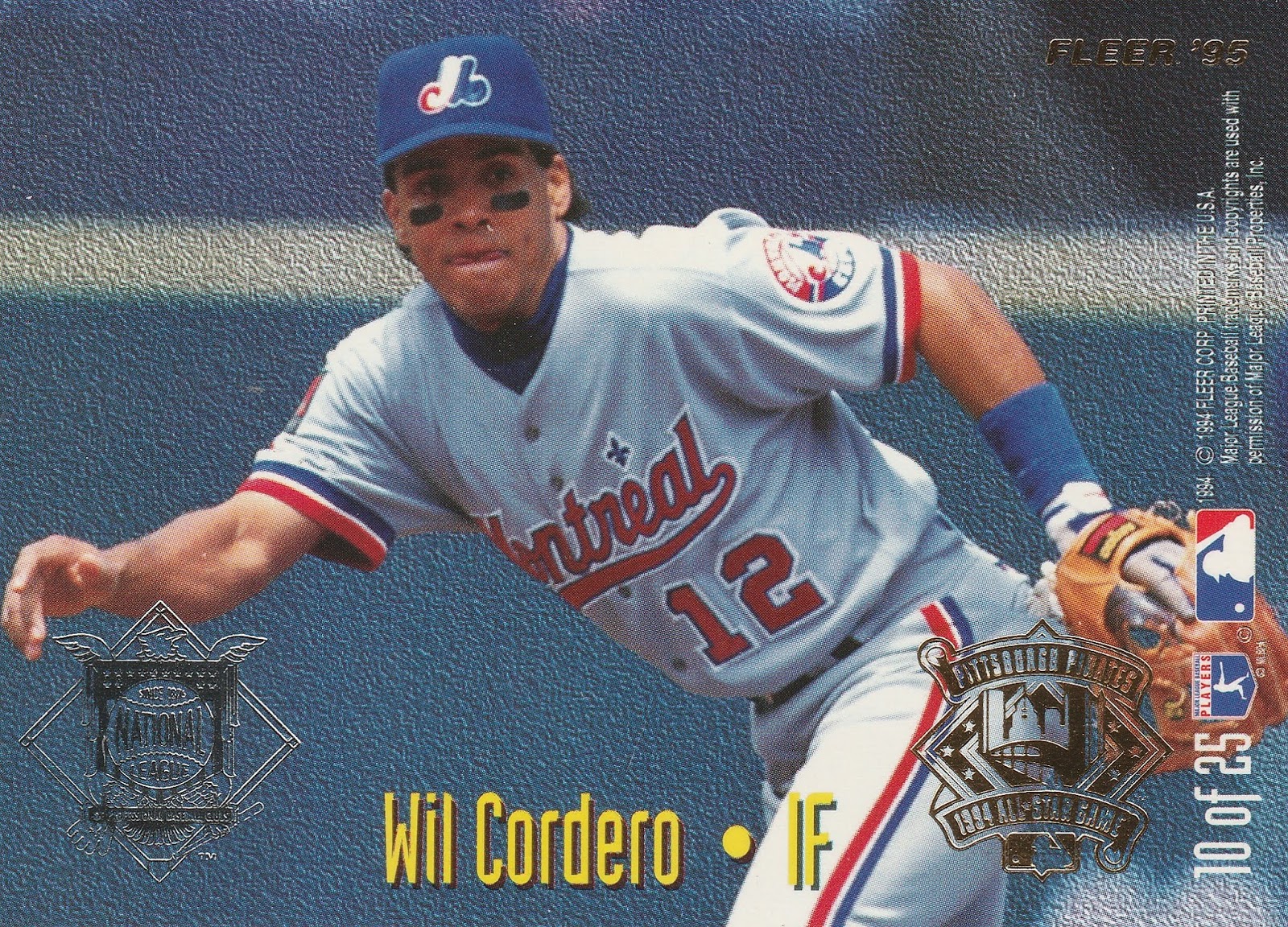
1993 Topps All-Star Rookie Short Stop - Wil Cordero


Wil Cordero had a decent rookie season, providing a little unexpected power (10 homers) to the Expos' middle infield. Along with teammate Mike Lansing, the future looked bright (Again! Still!) in Montreal. His fielding was still a work in progress (33 errors), but the Expos were content to allow Cordero to develop at the major league level. Instead of the dreaded "Sophomore Slump" Cordero would return in 1994 with arguably the best year of his major league career.


Cordero is from Mayaguez, Puerto Rico- the same city that produced Roberto Perez, Jose Vidro, Ozzie Virgil Jr., and Omar Olivares on the diamond and NBA player J.J. Barea. Cordero was signed by the Expos in 1988 just shy of his 17th birthday, and he made steady progress through the minors. In 1992, he was invited to major league camp in Spring Training, but an ill-timed slump and a pile of strike outs saw him returning to AAA Indianapolis for a second year. He would make his MLB debut in July, going 2 for 3 against the Dodgers, scoring 2 runs in a 4-3 victory. 


He'd play in 45 games for the Expos down the stretch in 1992, hitting .302 with minimal power (just 7 of his 38 hits went for extra bases.) He wasn't especially fast and his defense left a little to be desired, but he had the raw tools that a team operating on the strength of their next prospect crop would covet. He did show flashes of power in the minors (11 homers in '91) as well as being strikeout prone (122 Ks in  '90).


He put it all together in 1994 - making the All-Star team, and winning a Silver Slugger award as a Short Stop. He hit 15 homers for the Expos in the strike-shortened campaign.


The big season would make him an attractive trade chip, and he would be sent over to Boston in a trade for 4 players, the biggest name being pitcher Rheal Cormier. He'd play in Boston, Chicago, Cleveland, Pittsburgh, Florida, and back with the Expos again just in time for their move to Washington in 2005. He had a rough start was was released by the Nationals mid season. He'd finish 2005 playing for the Mets' AAA affiliate. He'd try again to make a comeback with the Mets in 2007, but was released prior to the start of the season.


Cordero played in 14 major league seasons, including the lone All-Star appearance in 1994, and two trips to the post season with Cleveland in 1999 and 2001. He hit .556 for Cleveland in the '99 ALDS including a home run in the ninth inning of a crazy game that ended with a score more like a football game, with Boston winning 23 to 7. The series went the distance, with Boston edging out Cleveland 3 games to 2.

Any fond Wil Cordero memories?

Monday, April 22, 2019

Laser, Focused - 1993 Topps All-Star Rookie Third Baseman Mike Lansing


I learned something new today! Mike Lansing was drafted by the Baltimore Orioles in the 9th Round of the 1989 draft, but opted to return to college at Wichita State for another year. Here comes the crazy part - in 1990, Lansing was drafted by the Miami Miracle in the 6th Round of the 1990 MLB draft. What? Was the Miami Miracle just a name being used by the Marlins before they started with their official MLB games? Nope. The Miracle were an independent Minor League team. Major league baseball's rules allowed minor league clubs to participate in the June amateur draft, for some reason. In 1990, it was the Erie Sailors of the NY-Penn League and the Miracle, both Class-A teams making selections out from under the noses of the MLB clubs. The Miracle actually made 16 selections in the 1990 Draft and signed 15 players- the best known was Mike Lansing.


In his 2nd season in Miami, Lansing stole 29 bases and hit close to .300. As the Miracle were winding down their operations (they later relocated to Ft. Myers and are the Twins' high A affiliate now) in 1991, they sold off as many of their players as they could. Lansing was the biggest prize, a slick fielding and speedy middle infield prospect with a little bit of pop in his bat. The Expos jumped at the chance to add Lansing, and he spent 1992 with AA Harrisburg.


Lansing would have a fantastic rookie campaign in 1993, hitting .287 and stealing 23 bases. He played all over the infield, Topps gave him the nod as the All-Star Rookie squad's 3rd Baseman. He had a slow first half in 1994, but starting in June of that year, Lansing tapped into his potential and started to spray the ball all over the field. Each season would bring a different milestone - career high in steals in 1995, career highs in runs scored (99) and hits (185) in '96. Then in his final season in Montreal, he put it all together.


Lansing smashed career highs of 45 doubles, 20 homers, and drove in 70 runs for the Expos, while hitting .281. Lansing was the right mold of player to help out in Colorado, and certainly the thought was that playing at altitude would only improve on those career numbers. The Rockies gave up Jake Westbrook and a pair of other minor league prospects to get him.


While he didn't hit 20 homers again in Colorado, he did have his share of highlights, including the very first Rockies hit at Coors Field.


A serious back injury in 1999 ended what was a promising start - he was hitting .310 after his first 35 games.


In 2000, Lansing would come back with a strong season, and even hit for the cycle:


He was traded again mid-season in 2000 to the Boston Red Sox, his name being the biggest of the seven player group with three Rockies heading to Beantown and two pairs of Sox coming back in the deal. He'd play a full season in Boston in 2001, a year with Cleveland's AAA team in 2002, and retire following another back injury. Originally from Casper, Wyoming, Lansing is still active in the Colorado area often providing interviews for the local Rockies coverage.

Wednesday, January 30, 2019

Blogging Burglary


I'll be the first to admit that when I'm in a collecting rut or a blogging rut, I go back and read through some of my favorite blogs for inspiration. This time I didn't go very far back in time - as soon as I read this post from Nick at the Dimeboxes Blog, I headed straight for COMC to do what all great artists do -- steal.


One of my favorite cards from the 1965 Topps/OPC set was the rookie card of Masanori Murakami. When I saw on Nick's blog that there was a Japanese insert set of Murakami cards from 1993, I had to get in on the action.


The subset included cards of Murakami in Japan with the NPB, as well as a few different cards in San Francisco.


As long as I was on the site, I figured I should stay a while and find some more bargains. I looked for some new additions to my "players at the bat rack" mini collection, and some 90s superstars. Hard to believe that Vlad Guerrero's son is going to be the #1 Prospect this season and quite possibly be even better than his dad was.


I do love horizontal heroes. I think I saw this Manny Ramirez card on Nick's blog at one point as well. Denard is a Player Collection guy for me, and the other two I just couldn't pass up.


I can't say that I actively collect the Expos, but all four of these guys are favorites of mine, and I try to never pass up the opportunity to pick up some more.


Some of the prospect guys I picked a few years back are still working their way towards the majors, and those that have made it have had some mixed levels of success. Nothing wrong with stealing a good idea!