Showing posts with label Andre Dawson. Show all posts

Sunday, November 1, 2020

I Love the 80s - 1982 Montreal Expos

This is a series of posts on a 1980's Frankenset. Each page features a different team, with 9 of my personal favorite cards from that year's team. You might find players repeated, you'll definitely see brands repeated, but hopefully you'll agree that there are some interesting selections from the 1980s!

The Expos clinched their first ever Playoff berth in 1981, despite the team's manager Dick Williams being fired in September by the front office with the team just a game and a half behind the Cardinals in the standings. They would lose 3 of the first 5 games under new skipper Jim Fanning, but squeaked out a narrow half game lead over the Cardinals by the end of the second half. They would go on to beat the defending champion Philadelphia Phillies in the Divisional round, but fell in 5 games to the Dodgers in the NLCS. The franchise would not return to the post season until after the team moved to Washington, D.C.


Despite missing the playoffs in 1982, the Expos were still a very good team, led by a trio of Hall of Famers. Carter, Dawson, and Raines were joined by fellow Expos Al Oliver and ace pitcher Steve Rogers in the All-Star Game. It was hosted for the first time outside of the United States and the only time in Montreal. Rogers pitched well and recorded the win. Ultimately the team finished third in the standings, behind the Cardinals and Phillies in the NL East. Despite the talented trio and more young players on the way, the team never finished higher than 3rd for the rest of the 80s. 


The Cards:

Donruss #114 Gary Carter - By 1982, "The Kid" was a veteran and a team leader. He was just about midway through a run of 10 consecutive All-Star appearances, and took home his 3rd straight Gold Glove and 2nd Silver Slugger award. He paced the Expos with 29 homers, and led the NL in WAR with 8.6 for the season. His final season in Montreal, 1984, he led the NL in RBI, won his 2nd All-Star MVP award, and posted a career high 175 hits. He'd go on to post season glory following a trade to the Mets, winning the World Series in 1986. Carter was elected to the Hall of Fame in his 6th year of eligibility. His 2,056 games caught ranks 4th All-Time in MLB history.

O-Pee-Chee #379 Andre Dawson - I had to break out the OPC for the Canadian teams! Andre, just like Gary, was celebrating 1982 with his 3rd Gold Glove and had appeared in his 2nd of 8 All-Star games. Dawson had the 2nd Highest WAR in the NL just behind Carter, with 7.9 wins above replacement. He played a sterling center field, including 7 outfield assists that year. He led the NL twice in that category from Center Field. He was the 1977 Rookie of the Year in the NL, thanks to displaying skills at all phases of the game. Before injuries sapped his speed, Dawson would average more than 30 steals and nearly 25 homers a year in his prime. He showed his worth again in his first year in Chicago, winning the MVP in the NL by virtue of leading the league in Homers (49) and RBI (137). He was elected to the Hall of Fame in his 9th year of eligibility, with voters citing his lower career totals compared to his healthier peers as a stumbling block. His speed, power, and grace on the field would not be denied!

Topps #3 Tim Raines - While Rickey was dominating the AL on the bases and leading off year after year, it was Tim Raines showing many of the same skills in Montreal. In 1981, Raines had a triple slash of .304/.391/.438 and stole 71 bases in just 88 games (remember, this was a strike shortened season, and Raines was a mid-year call-up!)! Just like his HOF brothers-in-arms, Raines was embarking on a string of numerous All-Star appearances in 1982. It would be his 2nd of 7 straight mid-summer classics. He led the NL in runs scored twice, won a batting title (and OBP title) in 1986, and was the top base stealer in the NL for 4 straight years starting in his rookie campaign. He'd steal at least 10 bases every year for 15 consecutive seasons. He ranks 5th All-Time in the category, with 808 career steals. Raines would have to wait the maximum period of 10 years on the HOF ballot before his induction - he never finished higher than 5th in MVP balloting, didn't have post season success in his prime (though he was a key piece of the 1996 and 98 Yankees teams), and didn't hit for power or reach the 3,000 hit milestone. His final year of eligibility included a successful campaign on behalf of OBP, stolen base %, and the value of a player who rarely got himself out. 

Topps #131 Stan Bahnsen - The 1968 AL Rookie of the year was coming to the end of long and winding road in the big leagues, which included a 20 win season followed by a 20 loss season, and 5 different franchises. 1981 would be his last of 5 seasons in Montreal. He came to the team mid way through 1977 from Oakland, and spent the rest of the year as a member of the starting rotation. He converted to the bullpen in 1978, and had several successful years in that role for the Expos. In 1981, Bahnsen would make his first post season appearance after 15 MLB seasons. He faced 5 batters and retired 4 of them in relief in the NLDS against the Phillies. Like many pitchers to have his staying power, Bahnsen learned how to pitch rather than just throw, as evidenced by the evolution of his nicknames. When he arrived in Yankee pinstripes, he was called "Bahnsen Burner" for his high 90s fastball. Towards the end of his career, he became known as "Stanley Struggle" for getting himself into and then out of jams through wits and guile. He went on to pitch in the Senior League, then in the Netherlands (the first former MLB player to do so).

Fleer #196 Brad Mills - One of the more iconic cards in the 1982 Fleer set, Mills is blowing a big bubble in the dugout. Mills was a rarely used utility infielder for the Expos, playing in 106 total games from 1980 through 1983, giving him plenty of time to work on his chewing gum skills. 1980 was the same year that Mills started professional baseball, going from single A up to the big league club that year. He would play in AAA for several seasons after his last MLB game in 1983. Following an injury that ended his playing career, Mills became a coach and then manager. He led the PCL Colorado Springs Sky Sox to a pennant in 1995, and later managed the Houston Astros for 2 and a half seasons. He's been a close confidant and bench coach in recent years of Cleveland skipper Terry Francona, though Mills sat out during the 2020 season to limit his exposure to the Coronavirus.

Donruss #650 Felipe Alou - Alou joined the Expos organization briefly as a player in 1973, then as a batting coach following his playing career in 1976. Alou would work his way up the ranks with the Expos, and stuck with the franchise even though he was offered a chance to manage the San Francisco Giants in 1985. He would get his chance in Montreal in 1992, and would be the skipper for arguably the best team in Franchise history in 1994. Though the strike ended the season prematurely, the Expos had their lone 1st place finish in Montreal that year. The strike eliminated the chance for the team to play in the post season, and they would not make it back under Alou, who remained the manager until 2001. He retired but was given another shot in San Francisco and led the Giants to a 100 win season in his first year with the club. After his final year as manager in 2003, he continued to work with the club as an instructor and as special assistant to the general manager. 

Topps Traded #7T Tim Blackwell -  Sporting one of the best moustaches of the 1980s, Tim Blackwell was a talented reserve catcher for several teams. He also had a brief period of time as the primary receiver for the Chicago Cubs, posting career highs across the board in 1980. He was drafted in 1970 by the Red Sox, and worked his way into a solid and dependable reserve role while learning the finer points of the game. This would come in handy in his next career choice, managing several minor league teams across all levels. He led the 1991 Columbia Mets and the 1993 Saint Paul Saints to league titles, and finished in 1st place 2 other times. 1982 was his first year in Montreal, and backing up Gary Carter meant not much playing time. He did manage to strikeout against Nolan Ryan in 1983, allowing Ryan to tie Walter Johnson's then record. Ryan would start his own record with the next batter, striking out Brad Mills for #3,509.

O-Pee-Chee #191 Tim Wallach - Like many Montreal Expos, Wallach was under the radar for much of his career. A first round pick in 1979 out of Cal State Fullerton, Wallach played 13 seasons for the Expos, amassing over 1,600 hits and driving in over 900 runs for the team north of the border. He wasn't totally ignored, however, winning 3 gold gloves and appearing on 5 All-Star rosters in his Expos career. His best season was 1987, when he finished 4th in the MVP race behind his former teammate Andre Dawson. That year he led the NL in Doubles while hitting a career high .298 and driving 123 runs. His output may have been directly tied to Dawson's absence in the heart of the Expos order, but he rose to the challenge. He would return to California to close out his career in Dodger blue and a brief stop with the Angels sandwiched between two stints in Chavez Ravine. His 2,054 games played at 3rd base ranks 11th All-Time at the position. He became a coach after his playing career ended and has followed Don Mattingly from the Dodgers to the Marlins as a bench coach. He opted to leave the Marlins for the 2020 season to seek a job in baseball closer to his California home. His son Chad currently plays for the Marlins. 

Fleer #194 Bill Lee - "The Spaceman" was spotted in Canada following a 1979 trade. The crafty and kooky lefty was the team's most successful starter that year, going 16-10 with a 3.04 ERA, his most victories since his heyday with the Red Sox in 1973-74-75. Lee would convert to bullpen duty and showed promise in that role as well, with an excellent run in 1981, posting a 2.94 ERA over 88 innings for the post season bound Expos. His time in Montreal (and his MLB career) came to an abrupt end in 1982 after just 7 games. Lee walked out (in full uniform) in protest for the release of Rodney Scott on May 5, 1982. Scott was one of Lee's best friends on the team, and Lee felt that manager Jim Fanning was exercising a personal grudge against Scott rather than solely a baseball decision. Following his MLB playing career, Lee wrote his (first) autobiography, then continued to pitch semi-professionally for a variety of teams and leagues. At age 65 in 2012, he pitched a complete game for a team in San Rafael, CA.

What is your favorite card of a Montreal Expo from 1982? Doesn't have to be one of these...

Thanks for reading!


Tuesday, August 13, 2019

1993 Topps Traded Set


Found a nice deal on a sealed 1993 Topps Traded Set, so today I am sharing some of the highlights with you! Mike Piazza was already an established star when this set was issued, even though he was still a rookie.


The 1993 Topps Set featured a 2nd player photo on the back, a flourish they hadn't tried in a long long time. But the pressure was on to keep up with Johnny Fleer and Joey Donruss and uh, Janey Upper Deck, so that means photos on both sides! I don't know if this a common issue with the traded set, or a symptom of being in a sealed box for so many years, but the ink on the backs looks a little runny to me.


Also - what's the deal? For the first time, the traded set was no longer in alphabetical order. Also ALSO, " IT - 132T ?" I? Weird.


Piazza was one of 6 Hall of Fame players in the set (with 2 or 3 more possibly to add later?). Boggs defected from Boston to the Yankees, where he would finally win a World Series, and get to ride a NYC Police horse after the clinching game. Andre Dawson went from the Cubs to Beantown, now towards the end of his magnificent career. Greg Maddux and Paul Molitor were thinking championship as well, and both would be rewarded by the end of their tenures with their new teams.


Now that Bowman has returned and the Prospect Machine was in full motion, finding quality rookies in the traded set was becoming more rare. The Team USA issue provided opportunities to add more young players to the set, and like Nomar in 1992, another Freshman made a splash in the new traded set.


The Team USA backs are a little different, so I figured I'd share those, too. Todd was quite the athlete!


The Twins representatives had nearly 20 seasons combined in the big leagues by the time the set came out - granted, they were all from Hall of Fame OF/1B/DH Dave Winfield. Todd Walker technically wasn't with the Twins organization yet, but he'd be drafted in the first round in 1994 by the Twins. David McCarty and Pat Meares were expected to take the reigns in the infield for Greg Gagne and Kent Hrbek. Meares ultimately did become the team's everyday SS, and McCarty had flashes of brilliance, but never really became the player to match the potential.


This group of guys might have a Hall of Famer or 3 in it, you can argue about which 3 they might be. Bonds had card #1T honors, all of these guys became key pieces of their team's success for the rest of the 1990s.


Lastly, here are a couple of my favorite photos from the set, and two guys that were appearing in familiar uniforms. The traded sets can be light on action and personality, but Boomer Wells listening to the national anthem and Erik Pappas sporting some gnarly hat hair. The Big Cat had a miserable 1993 in Saint Louis, playing in fewer than 100 games, and hitting just 10 homers. But Colorado would prove that he still had a few of those 9 lives remaining, and in fact would have the best years of his career. Kirk Gibson was returning to Detroit where he found his early post season success.

Tuesday, February 19, 2019

A Mad Dog, A Crime Dog, and Unlikely Champions - the 1987 Topps Traded Set


The most ubiquitous Topps design is the old woodgrain borders of 1987 Topps. The design was itself a riff on the 25 year old 1962 Design, proving yet again that there are no new ideas. But can you teach an old new tricks? The base set has been covered extensively, but maybe there are some lesser known gems in the traded set. Greg Maddux has his Topps debut here, en route to 18 Gold Gloves, 4 straight Cy Young awards, 8 All-Star games (that's it?), and 355 career victories. He also has a stat named after him, unofficial though it may be - A "Maddux" is a starting pitcher that tosses a complete game shutout, while throwing fewer than 100 pitches. He had 13 Madduxes himself, among his 35 career shutouts.


The other big name rookies in the set? Ellis Burks, who would go on to a great Red Sox career, and a MONSTER season in Coors Field for the Rockies. David Cone, shown here as a New York Met, who would find Maddux-like success in stops in Kansas City and with both the Mets and the Yankees, to name a few. Terry Steinbach is a Minnesota kid, who was in the middle of the Oakland Dynasty of the late 80s / early 90s. Matt Williams had an early run at Roger Maris' single season HR record in 1994, his quest was cut short by the work stoppage. He'd play in World Series with San Fran, Cleveland, and Arizona, winning it all in 2001.


In addition to Maddux, there were 4 more Hall of Fame players. Reggie Jackson came back to Oakland for one last tour with the A's (it's one of my favorite cards of the 80s). Steve Carlton was keeping his career rolling in Cleveland, Andre Dawson was playing an MVP season for the only team he and his agent could convince to sign him during the thick of collusion by MLB owners. The Oakland A's added a new secret weapon to their bullpen, Dennis Eckersley, who would become a lights out closer.


9 new Twins? Can you say championship?!?! The Twins added a Closer (Reardon), a great set-up man (Berenguer), a pair of starting pitchers (Niekro the vet, Straker the rookie), key bench players (Newman for defense/speed and Larkin for a lefty bat), and most importantly a new leadoff man / everyday left fielder, Danny Gladden. Gladden would be on both Twins World Series teams, and the argument can be made that the addition of his glove and bat was exactly what the Twins needed to make it over the top.


In the '87 series, he hit .290, drove in 7 runs, stole 2 bases, and hit a homer. In the 1991 Series, he scored the only run that would matter, the first run of Game Seven in the bottom of the 10th. He's a regular analyst on Twins radio broadcasts, always worth a listen for the stray Hrbek or Puckett story, and his fiery brand of harmless homerism.


There were several guys that were Rookies, but these were not their official rookie cards. LaValliere was around for several seasons already, but I include him as I always considered him as a Pirate. Benny Santiago and Fred McGriff are making their Topps Debuts, but both had 1986 cards with other manufacturers. Shane Mack was on the '84 Olympic team, so this is his first card in an MLB uniform, but he and Mark McGwire both had 1985 Topps rookie cards. Mack is a criminally underrated part of the Twins' second championship - I'll sing his praises when we get to the 1990 traded set.


Two cards that just look wrong, and two that make total sense to me!


Yikes! Harper is like "how could you?" Mitchell and Nelson both smell something is off. Greg Minton is way too into it, but he's no stranger to airbrushing disasters.

Tuesday, November 20, 2018

1977 Topps All-Star Rookie Team

Here they are - the Topps All-Star Rookie Team, selected "by the Youth of America" following the 1977 season and featured in the 1978 Topps set. 

I have completed the run of these up through 2018, specifically all regular issue cards that bear the All-Star Rookie Trophy.


Second Base - Bump Wills
Texas (A.L.) 1977 - '81, Chicago (N.L.) 1982

In his favor, Wills is the son of Dodger great Maury Wills. Counting against him? The nickname "Bump" was acquired because he was known to bump into things as a child. Wills shared his father's speed on the basepaths, stealing 30+ bases in 4 of his 6 MLB seasons. He swiped 28 as a rookie, to go along with some power as well, knocking out 9 homers and 28 doubles. He had a career high 155 hits and was 3rd in the Rookie of the Year voting. Wills had consistent numbers throughout his career. In 1978, he set the Rangers record for stolen bases in a season, which still stands today. In the field, Wills had the most assists and the most putouts in the AL in 1978. Wills is also known for his 1979 Topps card, which has two versions. One with his team listed as the Rangers, and the other (more common) that listed him as a Toronto Blue Jay. Apparently Sy Berger was tipped off in the 1978 off-season that a big trade had been made, sending Wills to the Jays. Berger alerted his staff and they printed Wills cards as a Blue Jay before learning that the deal fell through (if it was legit at all in the first place). Wills played his final MLB season in Chicago with the Cubs, and later played in Japan for two seasons with the Hankyu Braves. He finished with 196 career steals, and was the Rangers' all-time leader until Ian Kinsler (and later Elvis Andrus) came along.

Bump's Rookie Card is 1977 Topps #494 shared with Jim Gantner, Mike Champion, and Juan Bernhardt.


Designated Hitter - Eddie Murray
Hall of Famer
Rookie Card
Baltimore (A.L.) 1978 -'88, '96; Los Angeles (N.L.) 1989 - '91, '97; New York (N.L.) 1992 - '93; Cleveland (A.L.) 1994 - '96; Anaheim (A.L.) 1997. 

Steady Eddie played 20 MLB seasons, and he was terrifying to opposing pitchers the entire time. Murray's career high was 33 homers, and the only season he led the league was in the strike shortened 1981 season, but you could set your watch to Murray hitting 20-30 bombs every year. Murray was the 1977 Rookie of the Year, even though he played 110 games as a DH. He was such a dynamic hitter that it didn't matter he didn't spend much time in the field. He would swap positions with Lee May the following season, with May becoming the primary DH while Murray became the mainstay at First Base. His glove was not a liability, he would even win 3 Gold Gloves over his career.  Murray was the heart of the order for the Orioles in the World Series runs of 1979 and 1983. For his career, he hit 9 post-season homers, averaging 1 per series. In his lone championship winning series of 1983, he hit a pair of homers while slugging .550 in the 5 games. His best season arguably came the following year, when he led the AL in Walks,  OBP, and OPS+, crushing 33 homers and driving in 110. He won his 3rd straight Gold Glove, made the All-Star team and won the Silver Slugger for First Basemen. He was never named MVP, but he finished in the top five in six seasons.

He never had the big peak, but he had strong numbers consistently for longer than almost any player in history. His later career included a pair of good to great seasons in Cleveland, helping the team reach its first World Series berth since 1954.

Murray finished with 3,255 hits, 560 doubles, 504 homers, 1,910 Runs batted in, and played more games at first base than any player in major league history. He is also the All-time leader in Sacrifice Flies, which is pretty neat!


Outfield - Mitchell Page
Rookie Card
Oakland (A.L.) 1977 - '83, Pittsburgh (N.L.) 1984

Page was the runner up to Murray for the ROY, but you could argue that Page should have taken home the hardware. Page hit 21 homers, and stole 42 bases for the A's while hitting .307/.405/.521 and scoring 85 runs while playing in left field all season. He did lead the AL with 14 errors in LF, but had a respectable arm with 11 outfield assists. Page was not able to repeat his fine rookie season, however, and following a contract dispute with the stingy Charlie Finley in 1979 and injuries that limited his mobility, Page struggled to stay with the big league club. He played until 1984, but never surpassed 57 games played in any season in the 80s. He was a bit player in the film "Angels in the Outfield " playing the Angels' First Baseman. Page passed away unexpectedly in 2011, after years coaching in the minor leagues for several different teams.


Outfield - Andre Dawson
Hall of Famer
Montreal (N.L.) 1976 - '86; Chicago (N.L.) 1987 - '92; Boston (A.L.) 1993 - '94; Florida (N.L.) 1995 - '96. 


The Hawk was tremendous, and yet his career still has a hint of "what if?" due to balky knees that derailed a historic pace. The National League's 1977 Rookie of the Year, Dawson made an immediate impact in Montreal. The city already had a young star in Catcher Gary Carter, but the addition of Dawson gave the team a formidable 1-2 punch. Dawson was very fast - stealing 20+ bases annually. He was strong, also hitting 20+ homers each season early on. In 1979, he had 24 doubles, 12 triples, 25 homers, and 35 stolen bases. Through 1983 and his age 28 season, Dawson's stats were quite similar to Billy Williams and Dave Winfield at the same point in their careers. 253 of his 314 career steals came in his first 11 seasons. Despite the knee and leg issues (12 surgeries during his career), Dawson still managed to log serious innings in the field and played 130+ games a season through the first decade of his career. His MVP season in 1987 was a statement to the world that his will was greater than the pain. Playing for a struggling Cubs team on an allegedly blank contract because no one else would sign him, he hit a career high (and league leading) 49 homers and 137 RBI. 

Dawson would finish his career with a couple forgettable seasons for the Florida Marlins in his hometown, but the incredible speed and power would be remembered vividly when he was inducted into the Hall of Fame in 2010. He was just the 2nd player in MLB history to steal 300+ bases and hit 400+ homers. He was an 8-time All-Star and won 8 Gold Gloves.

Andre's Rookie Card is 1977 Topps #473, shared with Gene Richards, John Scott, and Denny Walling.


Right Handed Pitcher - Dave Rozema
Rookie Card
Detroit (A.L.) 1977 - '84, Texas (A.L.) 1985 - '86

Rozema had impeccable control - as a rookie in 1977 he led the AL with just 1.8 walks per 9 innings. His meat-and-potatoes stats of a 15-7 record, 3.09 ERA and 16 complete games landed him 4th in the ROY vote, and 9th in the Cy Young race. He would not reach those heights again, despite the scarcity of walks, he didn't strike many batters out either. He was moved to the bullpen in 1980, and the great control was definitely an asset. Control on the mound didn't translate to control off it- his famously landed on the disabled list in 1982 for failing to complete a "flying karate kick" aimed at Twins infielder John Castino during a benches-clearing brawl. Rozema tore ligaments in his knee, ending his 1982 season. He was an integral part of the 1984 Tigers' pitching staff, serving as a spot starter and bullpen stopper, but was not part of the playoff roster as the Tigers won the World Series. The following season, Rozema signed with Texas and pitched two more major league seasons. He would appear again in 1990 in the Senior Baseball League as well.


Third Base - Wayne Gross
Oakland (A.L.) 1976 - '83, '86; Baltimore (A.L.) 1984 - '85.

Wayne Gross was an All-Star as a rookie in 1977, filling in for an injured Vida Blue as the A's lone participant. The Lefty slugger hit 22 homers his rookie year for the A's, and finished with 121 in his MLB career. He hit a homer in the 1981 ALDS against Kansas City, though the A's would ultimately lose the next series against New York. Gross played as the semi-regular third baseman for the next few years until the team acquired Carney Lansford. He even pitched a couple innings in 1983 for Oakland. He would hit 22 homers again in 1984 in his first season in Baltimore, but it would be his final full season. Gross also appeared in "Angels in the Outfield" like Mitchell Page, appearing as a White Sox relief pitcher.

Wayne's rookie card is 1977 Topps #479, shared with Brian Asseltine, Sam Mejias, and Al Woods.


Outfield - Ruppert Jones
Kansas City (A.L.) 1976, Seattle (A.L.) 1977 - '79, New York (A.L.) 1980, San Diego (N.L.) 1981 - '83, Detroit (A.L.) 1984, California (A.L.) 1985 - '87.


The Expansion Seattle Mariners were lucky to have Ruppert Jones, who was a big hit right off the bat. He had his own fan club in Center Field, "Roop's Troops," and was the team's first All-Star. He hit 24 homers that season and drove in 79 runs. He was not a patient hitter, striking out 120 times to just 55 walks, but he was never boring! Like many of the players on this All-Star Rookie roster, Jones had to deal with many injuries in his career. In the off-season following 1977, he had surgery to remove cartilage from his knee, and had a tough time meeting the same standard in 1978 that had marked his first year in Seattle. He came back the following year healthy and spry - he had a career high 33 stolen bases, along with career bests in several more offensive categories.

He would make his second All-Star squad in 1982 with San Diego, with a fine season playing as the team's main Center Fielder. Jones was a member of the 1984 champion Tigers team, though he was mostly a reserve player by that time in his career. Jones had over 1,100 career hits and of not for a series of injuries, could have had many more.

Ruppert's rookie card was 1977 Topps #488, shared with Jack Clark, Dan Thomas, and Lee Mazzilli


Short Stop - Bob Bailor
Baltimore (A.L.) 1975 - '76, Toronto (A.L.) 1977 - '80, New York (N.L.) 1981 - '83, Los Angeles (N.L.) 1984 - '85.

The Expansion Toronto Blue Jays had a rough first season, but Bob Bailor set an expansion league record with a .310 average for the season. Bailor was the first player selected by the Blue Jays in the 1976 expansion draft. It was the best batting average for a rookie in 1977 as well. Bailor was known to be tough to strike out, fanning in just 5% of his MLB at bats. Bailor was a multi-talented fielder; he was used primarily as a Short Stop in 1977, but in his career he played all over the infield and outfield. He was a favorite of managers throughout his playing career. Despite not having the most impressive stats, he played a smart brand of ball, rarely making any kind of mental mistakes. He was a mentor to younger players, which was parlayed into several seasons as the manager of the Blue Jays' minor league team in Syracuse. He was a bench coach with the big league club in Toronto, often as Cito Gaston's right hand man. He said when the Blue Jays won their first championship in 1992 - "I've gone from walking in the snow to walking in champagne," referring to the snow-covered field in Toronto for their first ever home game.

Bob's rookie card is 1976 SSPC #386; his first Topps Card is 1977 #474.


First Base - Doug Ault
Texas (A.L.) 1976, Toronto (A.L.) 1977 - '78; 1980.

Just because they weren't very good it didn't mean that Topps was going to pass up promoting the two expansion franchises. Toronto's Doug Ault hit the first home run in Blue Jays' history, then hit another in the third inning of that first game. He had three hits in all in the Opener, making him an instant hero in Toronto. With Eddie Murray playing most of the season as a DH, it opened a spot on the Topps All-Star Rookie squad for Ault, the First First Baseman in Toronto history. Ault hit .245 with 11 homers in 1977, and would play just two more partial seasons, ending his U.S. playing career in 1980. He would spend a season playing in Japan for the Hanshin Tigers, and another season in Mexico before becoming a coach in the Toronto minor league system.

Doug's rookie card was 1977 Topps #477


Left Handed Pitcher - Jerry Garvin 
Rookie Card
Toronto (A.L.) 1977 - '82

The third Blue Jay on the Topps All-Star Rookie Team, Garvin was the first rookie to win 4 games in the month of April. He also allowed 33 home runs, the most in the AL in 1977.


Like several of the players on this team, Garvin's rookie season was his best. He was the Blue Jays' most used pitcher in the 1970s, and he was on the hill for a franchise record 61 games in 1980. Following some time on the DL and a strike shortened 1981, Garvin was removed from the 40 Man roster in 1982 to make room for another pitcher, and he would not return to MLB play again.


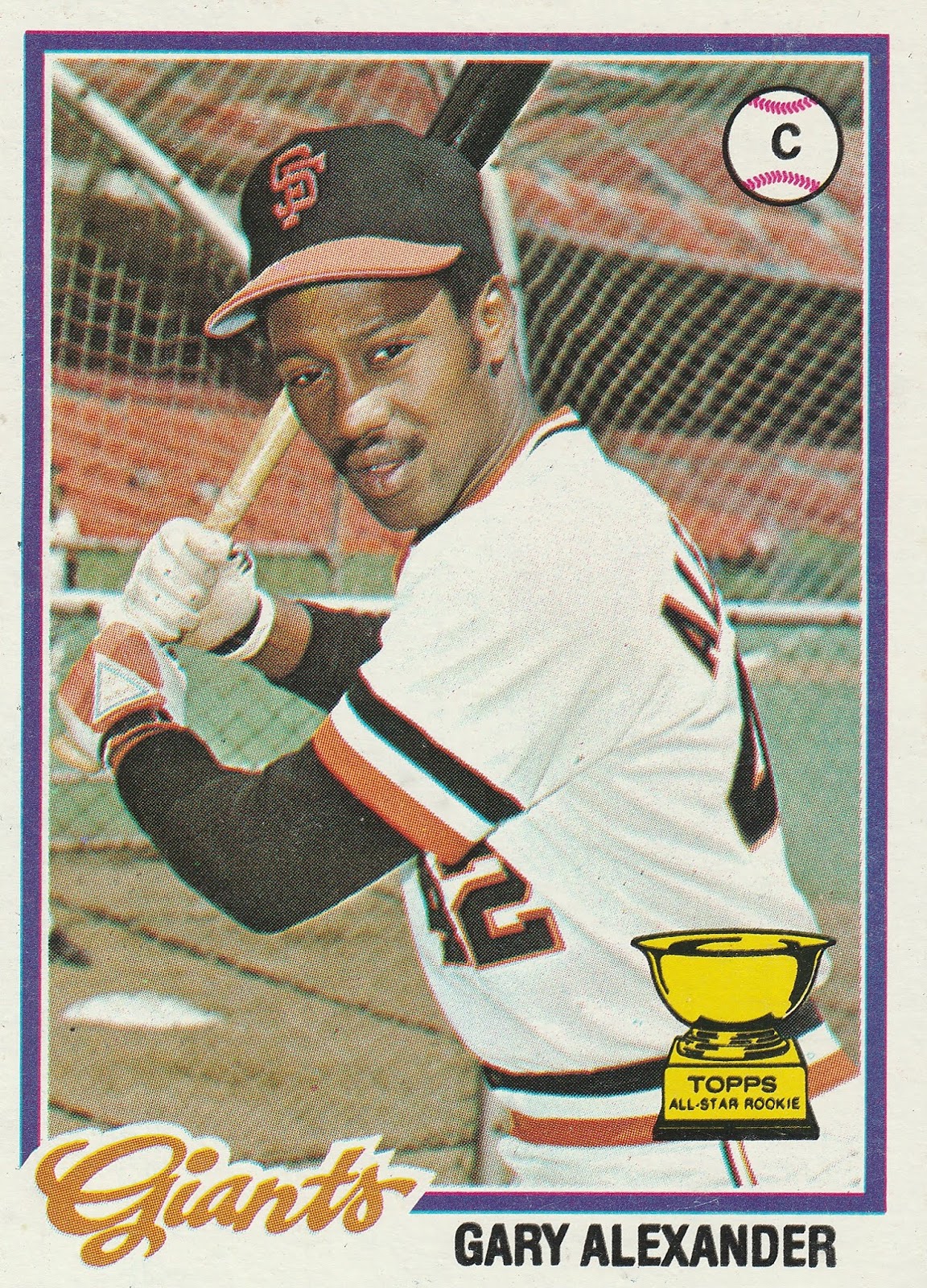
Catcher - Gary Alexander
San Francisco (N.L.) 1975 - '77, Oakland (A.L.) 1978, Cleveland (A.L.) 1978 - 1980, Pittsburgh (N.L.) 1981.

Alexander was not the Giants' primary catcher in 1977, appearing in just 55 games. His rookie season was sandwiched between catching John Montefusco's no-hitter in 1976, and a career high water mark in 1978, hitting 27 homers and 84 RBI. He did have a career high .303 average in 1977, and the other rookie catchers had similarly uninspiring stat lines. Alexander was the Texas League player of the year in 1975, so there was good reason to think he would have a strong career ahead of him. He would have another good season in 1979 with Cleveland, hitting 15 homers.

Gary's rookie card is 1977 Topps #476 shared with Dale Murphy, Rick Cerone and Kevin Palsey

Tuesday, July 17, 2018

Alas, All-Star!


The scan is a little off, but I think it will underscore the point I want to make about the All-Star game. Let me clarify, not the game itself, but the way it is represented on cardboard. Topps used to make a point of having a different design for the All-Stars, and we can look back 30 and 60 years to prove the point.


Red White and Blue dominate the design, with AL All-Stars getting a red background and Blue lettering. The NL All-Stars do the opposite, with a blue background and red letters. The photos are more conservative head shots rather than in-game action.


The backs have a relevant leaderboard with the All-Star somewhere in the top ten. Add in a little season highlight blurb, and you've got yourself a clean and classy tribute to the game's best.


Guess what? The '88 Topps set was no stranger to good ideas from past Topps sets. The base cards owed a bit of their look to 1967, with big bold colors for the team names. The All-Star Sub-set in '88 went back even further, with a nod to the 1950's.


The backs have a longer run on sentence / paragraph about the player, and then a breakdown of each player's performance by opponent, a grid that would resurface in 1989 with Topps' resurrection of Bowman.

The Topps Update All-Star cards of the last decade or so aren't terrible - I just think they could learn a bit from their past successes. It would be great for the cards to have a unique design (they could even be an insert, you know how Topps loves insert sets) compared to the base cards, and celebrate the event a little more than a logo. I do like the event specific photography, and I do like that the backs usually talk about what made the player an All-Star.

What do you think? Should the All-Stars get their own design?

Wednesday, May 25, 2016

I Love the 80s : 1981 Montreal Expos

It's gonna be sad to talk about the Expos during this series on 1980s cardboard - I really hope that the Expos can come back some day. In 1980, the Expos finished second in the NL East with a 90-72 record. They were led by a very fleet of foot outfield, a Hall of Fame Catcher in his prime, and a rotation that blended youth and experience. 
 In 1981, the Expos made the postseason and defeated the defending champion Phillies in the Divisional series, but lost to eventual 1981 World Series Champion Los Angeles Dodgers in a very hard fought NLCS. Here are my favorite cards of Expos in 1981. Quick story on Ron LeFlore - I realize that is a White Sox card, but I wanted to include another card with the Expos' home uniform, and this was one of the better examples.

The Cards:

Donruss # 89 Larry Parrish - Parrish was the regular 3rd Baseman for the Expos in 1980 and 1981, missing significant time after being hit by a pitch on his wrist.

Fleer #148 Ellis Valentine - Valentine's 22 homers in 1980 marked the third straight season of 20+ homers, and he was just 26 years old. He ended up being traded to the Mets during the first half of the 1981 season for pitching help.

Fleer Star Stickers #123 Andre Dawson -  The Hawk had a bit of a down year in 1980 compared to his 1978 Rookie of the Year campaign, but he still won his first silver slugger award and first Gold Glove. They would be the first of many for the Hall of Famer. 1981 would mark his first All-Star appearance.

O-Pee-Chee #6 Gary Carter - The Kid pretty much killed it in 1980 and 81. He won his first of 3 straight Gold Gloves behind the plate, finished 2nd the MVP balloting (his highest finish), and enjoyed a pair of All-Star appearances. The Hall of Famer was the on field leader of the team.

Topps Traded #816 Tim Raines - I decided to use this Topps card instead the O-P-C card with three Expos rookies on it.

O-Pee-Chee #244 Ellis Valentine - The modified facemask that Ellis wore on his helmet makes this one of my favorite cards of the decade.

Fleer #143 Steve Rogers - Rogers was the Expos Ace in 1980 and 1981, and was a life-long Montreal Expo. He led the National League in complete games in 1980 and finished 5th in the Cy Young voting. He would go on to lead the league in ERA in 1982, and finished his 13 year career in 1985.

Donruss # 538 Tim Raines -  Rock. His career was just getting started in 80/81 - playing in just 15 games for the Expos in 1980, but he was the Minor League Player of the Year. In 1981, he took over Left Field for the Expos and stole 71 bases in just 88 games. He would go on to steal at least 70 in his first 6 full seasons. He should be in the Hall of Fame, hopefully that will be fixed next year.

Donruss # 576 Ron LeFlore - It would be hard to imagine it, but Raines' stolen base totals were actually a drastic reduction from the totals of the 1980 Expos Left Fielder, Ron LeFlore. He stole 97 bases in 1980 for Montreal. He came to the majors with Detroit and then Tigers Manager Billy Martin gave the 26 year old a chance at redemption. LeFlore had a checkered past, but his talent on the field was never in doubt. LeFlore took the opportunity and despite a late start he ran with it. By the time he stole 97 bases for the Expos, he was already 32 years old. With the speedy Raines coming up and seemingly no place for LeFlore in the Expos Outfield, he was allowed to test free agency. He returned to the AL and played his final two seasons for the White Sox.

Tuesday, October 13, 2015

I Miss Youppi, Too.

 Maybe it was the pack of Bill and Ted movie cards I opened this weekend, but I'm feeling nostalgic. I think I'm going to spend a little time on the forgotten this week.
 I miss the Expos! I miss the awesome logo, and having two teams in Canada.
 Greats like Gary Carter behind the plate and Andre Dawson patrolling the outfield.
 Tim Raines deserves some more hall of fame votes, and so does Larry Walker. I always get a kick out of the J in "Pedro J. Martinez" - makes me think of Homer J. Simpson.
 Some of my favorite Expos cards - including Vlad!
One of my favorite cards of the 1980s - some awesome action, and the grin on Speier's portrait is just amazing.

I'd love to have the Expos back again, to travel to Montreal to watch them play a game... heck, I wouldn't even mind Youppi. Anyone have a Youppi card to send me? I miss the old son of a gun.