Showing posts with label New York Mets. Show all posts

Monday, March 21, 2022

1999 Topps All-Star Rookie First Baseman Brian Daubach


The path to the big leagues can be a long one - it was certainly the case for Brian Daubach, who was a rookie at the ripe old age of 27. It wasn't for lack of effort - in fact the slugger from Belleville, IL would become affectionately known as the charter member of the "Dirt Dogs," the role players that helped the early 2000s Red Sox finally overcome the Curse of the Bambino.


Daubach hit 21 homers in his first full season in the big leagues, while hitting a robust .294/.360/.562 slash line. He had a torrid month of August which included 7 homers and a .327 average. His slugging pct for the season would have ranked in the top 10 in the AL if he had enough plate appearances to qualify. Pair that with his long road to the big leagues, and it's a great story - worthy of a spot on Topps' All-Star Rookie Team. 


Drafted in the 17th Round by the Mets in 1990 out of high school. He would spend several seasons in the minors in the Mets' org with less than impressive totals - his highest slugging percentage in his first 6 seasons was .401, and his career season high in homers to that point was just 10. Then, his reputation took a hit during the player's strike in Spring Training of 1995. Daubach was placed on the Mets' replacement players' roster with other minor league Mets, playing in Spring Training games while the MLBPA was still on the picket line. As a result of crossing the line, Daubach was barred from ever joining the Players' Association. Heading into 1996, he'd even been told by a manager that he'd never be a major leaguer, and perhaps that was enough to motivate him to prove the critics wrong. He was just starting to see some progress (22 Homers in 1996) when he became a minor league free agent. He contemplated playing in Japan, but ultimately took an offer with the Florida Marlins. He slugged over .500 for the first time in his professional career, and the following season had his breakout with the Charlotte Knights, the Marlins' AAA affiliate. He led the International league in Extra base hits, and earned a call-up to play for the big league squad in September of 1998. 


The Red Sox were intrigued by his power potential that had blossomed at the right time. Daubach would hit 20 or more homers for the Red Sox in his first four seasons - a feat accomplished just 4 other times in team history. Ted Williams, Tony Conigliaro, Jim Rice, and Nomar Garciaparra being the others. He was rewarded with a $2.325 Million Dollar deal for 2002, where he would once again hit better than league average (111 OPS+) with another 20 homers for Boston. The Team would have the choice between bringing back Daubach to play first, or they could take a flier on a young player just cut loose by the Twins. The Sox chose Ortiz, so Daubach was on the move again.

Daubach spent a season in Chicago, where he'd play first base, DH, and both corner outfield positions. He hit just .230/.352/.388 in his lone South Side season, and was left looking for another gig that offseason. 2004 would bring him back to Boston, ostensibly as an insurance/injury replacement. He'd find his way into the lineup just 30 times that summer, but Red Sox fans were happy to have him all the same. He would return to the organization that drafted him in 2005, splitting time between the AAA Norfolk Tides and the Mets. He hit pretty well in Norfolk, with 16 homers and a .325 average. He would spend one more season in the minors, moving over to the Cardinals' AAA team in Memphis before retiring and getting into coaching. He is currently the hitting coach for the AAA Rochester Red Wings, and was the manager in Harrisburg when the Nationals drafted Bryce Harper. 


Monday, March 7, 2022

1999 Topps All-Star Rookie Outfielder Carlos Beltrán


Ok cats and kittens, let's talk Carlos Beltrán. The folks at Topps love a good overnight sensation story, and Beltrán was ready to deliver it. He skipped AAA and jumped to the big leagues to stay in 1999, shocking many by winning the AL Rookie of the Year award. So of course he was also headlining the 1999 Topps All-Star Rookie Squad.


A 2nd Round pick in 1995 out of Puerto Rico, Beltrán was well-known in Kansas City circles, but not considered a major league prospect in his first few pro seasons. He had a great glove, and was even named KC's best defensive minor league player in 1997. In 1998, he forced his way into the Royals' future plans by making a meteoric rise through the system. Still just 21 years old, he was promoted mid season to AA Wichita, where he hit .352/.427/.687 in 47 games. He was also stealing bases and playing elite defense in Center field. The surprising totals earned him a September call-up. He had started the year as the 93rd ranked prospect in baseball and found himself as the 14th by the time spring training rolled around in 1999. He made the Opening Day roster and began making his mark in the big leagues from there.


The early 00s Royals were probably one of the most exciting cellar dwellers in baseball. The outfield alone consisted of Beltrán, Johnny Damon, and Jermaine Dye. Well, at least for a little while. The Royals weren't major players in free agency, and at the time really struggled to re-sign their talented youngsters. Damon was traded in 2001 before the season started, then by mid season Dye was off to Oakland to join him. Beltrán stuck around a bit longer, through some fairly lean years. His talent was enough to keep fans interested and invested in the Royals, where he could be counted on for 20+ homers, 30+ steals, and Gold Glove worthy defense for parts of 7 seasons. He was a legit 5-tool player, and coming up on his prime (and free agent) years, which meant it was only a matter of time before he was traded.


In 2004,  the Astros spent big in the offseason to add Roger Clemens and Andy Pettitte to their starting rotation. They already had future hall of famers Craig Biggio and Jeff Bagwell in their lineup, but there was one position that had been a glaring weakness for some time. The Astros needed a center fielder. When the team pulled off a three-team deal in June, they finally found the man they'd been missing. Houston execs gushed about Beltrán, and they got exactly the player they were hoping for. In 90 regular season games, he belted 23 homers, stole 28 bases, and had a 135 OPS+ to go with 4.5 WAR. That was just an appetizer for the post-season. In the NLDS against Atlanta, he went 10-22 with 4 homers and 9 RBI. He scored 9 runs and stole a pair of bases. He played equally well in the NLCS, hitting 4 more homers, scoring 12 times in the 7 game series and producing a WPA (win probability added) of .82 for the series, which trailed only the great Albert Pujols. The Astros were eliminated in that final game, but for that brief time, Beltrán made his value clear.  


Now a free agent and just entering his prime at age 28, Beltrán made his way to New York to try to make a legacy for himself and the Mets. Things didn't go quite as he planned, though hindsight shows that he was even better in New York (129 OPS+) than he was in Kansas City (111 OPS+). He was undone again by the Cardinals in the post season of 2006, losing in 7 games in the NLCS. Beltrán had the the final at bat in the series, and was locked up by an Adam Wainwright curve ball, which some Mets fans still hold against him. All told, he spent 7 seasons in Queens. Despite 5 All-Star Appearances and 3 Gold Gloves, Beltrán was often blasted by the New York media for the team's inability to win titles. He was well respected by his teammates and coaches, but just like his time in KC, as his contract came to a close, the writing was on the wall that a move would be made.


Just shy of the trading deadline in 2011, the Mets sent Beltrán to San Francisco in exchange for pitcher Zack Wheeler. Beltrán hit well for his new team down the stretch, slashing .323/.369/.551 with 7 homers, but the Giants finished 2nd in the NL West and missed the playoffs. A free agent again, Beltrán attempted the old fashioned "If you can't beat 'em, join 'em" strategy and signed with the St. Louis Cardinals. He had a pair of All-Star campaigns, as well as more post season glory. In the 2012 NLDS, he hit .444 with a pair of homers. He tormented the Dodgers the following year in the NLCS with 6 hits including the Game 1 walk off winner. 

He returned to New York in 2014, now as an elder statesman and reserve outfielder. He'd reach the post season in 2015 for a cameo appearance (1-4), then again with the Rangers in 2016 as a DH. The only thing left for Beltrán, with all his personal success in the post season and in his career, was to find a way to bring home a championship for his team.


In 2017, he'd get his chance. He was a well-loved and well-respected icon among his teammates, and they even jokingly held a funeral for his outfielder's glove in July, as Beltrán had become at that point more of a player/coach and pinch hitter. He was always a student of the game and like his coach Alex Cora, extremely adept at reading opponent's signs and tendencies.

R.I.P. Beltrán's legacy?

Now at this point, we have only the various accounts of other teammates, coaches and opposing players to guide what Beltrán did as part of the 2017 Astros' sign stealing scandal. What seems most damning is that his name was only one singled out among the players in the official report of the investigation. What his exact role and level of involvement was, we might never really know. Certainly he was working to help his team win by any means necessary and certainly crossed a line. His coach Alex Cora would say as much - but also wanted to make it crystal clear when he said that this wasn't a two man operation. Cora shared responsibility for the scandal with the whole team, didn't say he was any less guilty, but also didn't think what happened with Beltrán after the investigation was totally "fair."

Beltrán was hired to manage the Mets shortly before the news of the sign stealing scandal was released. he would resign his position before ever taking the field as manager, and hasn't returned to baseball since. He did just get hired by the Yankees of all teams to be an analyst for their broadcasts in 2022 (if MLB has any broadcasts is still up in the air at the moment). 

So, tally it all up - a Rookie of the Year, 2X Silver Slugger, 3X Gold Glove winner, 9X All-Star, and "World Series Champion" with some legit career numbers. His post-season career was quite impressive, earning him the nickname Señor Octubre. Out of all the people involved with the scandal, so far he seems to have been negatively impacted the most. It didn't hurt Marwin Gonzalez, George Springer, A.J. Hinch, or Alex Cora in the long term- it remains to be seen how Carlos Correa and Jose Altuve fare with their next contracts, but chances are they'll get paid well too.  

Maybe we'll get to hear more from Beltrán in the future about his role in all of this. He's scheduled to appear on the 2023 Hall of Fame Ballot, so one way or another we're bound to hear plenty of other people talk about it. 

Monday, February 28, 2022

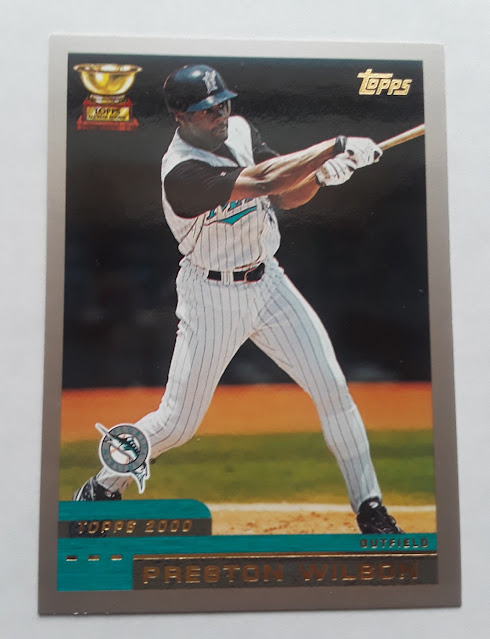
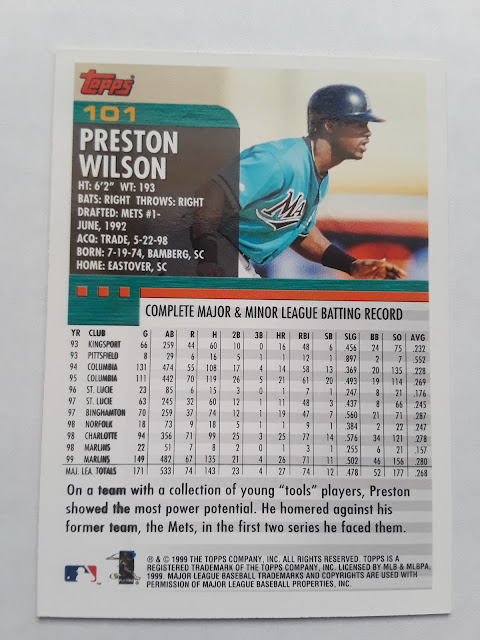
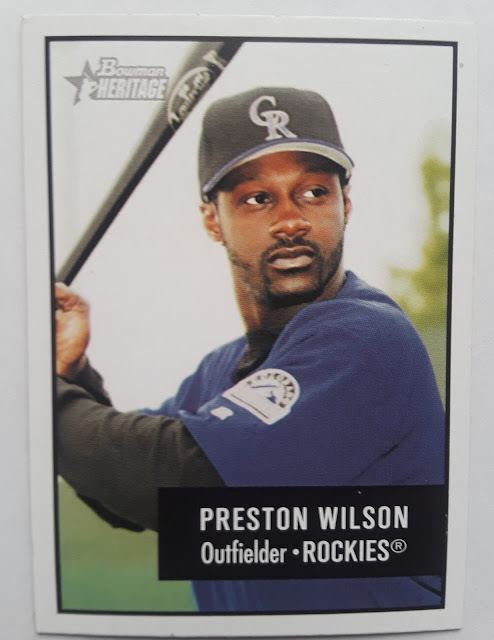
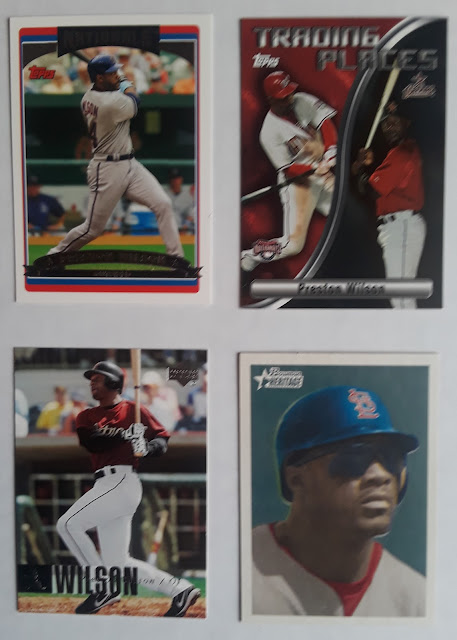
1999 Topps All-Star Rookie Outfielder Preston Wilson


Preston Wilson arrived in the big leagues after a very long journey that took him from the first round of the 1992 MLB Draft, to 4 top-100 prospect listings, to a winter spent playing baseball in Australia. After a 5 year minor league sojourn, Wilson had arrived in Queens, only to be traded away after just 8 games for the Mets. Wilson was big time prospect coming to Florida in exchange for the Marlins' brand new catcher Mike Piazza. 


His first full season came in 1999, and he was able to show power and a little speed for an exciting and young rebuilding Marlins team. He'd finish 2nd in the NL Rookie of the Year voting and had a strong season, with a 119 OPS+ and hit 26 homers to go with 11 stolen bases. He was a great choice to join the 1999 Topps All-Star Rookie team.


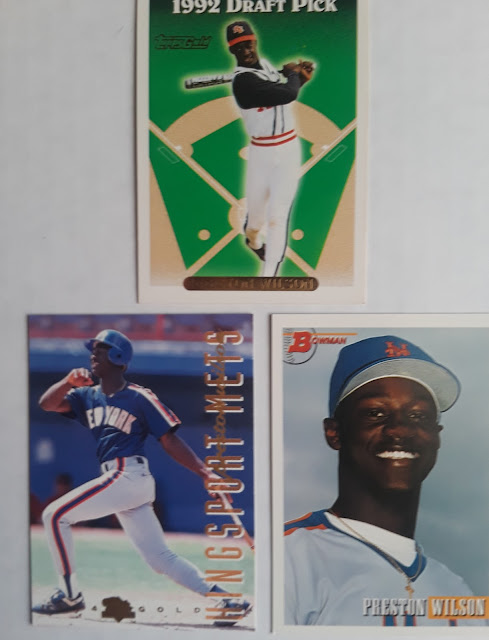
Wilson was the 9th Overall selection in the 1992 MLB draft, picked by his adopted father Mookie's former team, the New York Mets. To get the potentially awkward subject out of the way, Mookie Wilson's brother Richard was Preston's biological father, but it was Mookie that became Preston's mother Rosa's husband and raised Preston as his own son. So Mookie is technically Preston's uncle, but was also his father as far as Preston was concerned, and officially adopted him. Families are complicated, but it is clear that Preston was well loved and well raised by his parents. Preston was just 17 when he was drafted, and started his pro career with the Kingsport Mets in 1993. Before joining the Mets, he was the 1992 High School player of the year, and hit well for the 1992 18U USA National team. 

Wilson had no trouble launching the ball out of the park, hitting 17 homers in his first pro season, then at least 20 a year after that. In 1996, he played in just 23 games because of injuries to his wrist and shoulder. This had little to no impact the following season, as he hit 30 homers across 2 levels in the Mets organization, and then traveled down under for the Australian Winter League. I couldn't find any stats for his time with the Newcastle Hunter Eagles, but by the Spring of 1998, Wilson was poised to make his long awaited big league debut. He played in just 18 games for AAA Norfolk Tides before being called up in May 1998. His debut consisted of a 3 for 4 game with a stolen base and a run batted in. Each base hit, he was able to briefly visit with his dad, Mookie, who was the Mets' first base coach at the time.


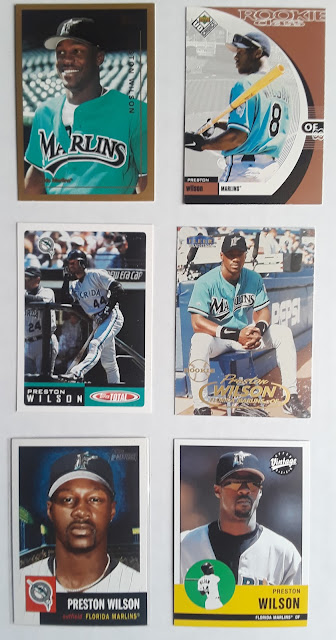
Wilson's trade to the Marlins included a demotion back to AAA, where he nearly hit 30 homers again, showing he was more than ready for a shot at the big leagues. Wilson would have an even better sophomore season, when he joined the 30-30 club in 2000. He was known for big power, but his swing also was conducive to strikeouts. In 2000, Wilson struck out 187 times, which was the most in the Majors, and nearly broke the long time record that Bobby Bonds held. Over his 4 full seasons with the Marlins, Wilson averaged 26 homers and 82 RBI per year. 


Wilson was traded to Colorado prior to the 2003 season, and the Rocky Mountain air was kind to Preston. 2003 would include career highs for Wilson across several offensive categories, and he led the National League with 141 RBI. 2003 was also Preston's lone all-star season. Wilson went 1 for 2 in the Midsummer Classic.


So, once a player has been a Topps All-Star Rookie, led the league in a few different offensive categories, made an All-Star team . . . what's left to check off? A World Series win, of course! Wilson started 2004 off slowly in Colorado, and was traded to the newly minted Nationals in Washington. He ended up playing what would amount to roughly one season with the Nats before being traded mid season to Houston, just in time to make a run at the post season. The Astros fell short, but the 2006 season would give Preston another chance to play the role of 2nd half star. Wilson was released at the deadline and picked up by the Cardinals, and he solidified the team's outfield rotation, providing a little power (9 homers in 33 games) and a little good old fashioned veteran leadership. Along with a strong cast of characters, the Cardinals would prevail in the World Series against the Detroit Tigers. Wilson appeared in all 5 games and picked up a pair of hits, scored a run, and drove in another. 


Following the 2006 championship, Wilson returned to St. Louis for an encore, but injuries limited his effectiveness and he played in just 25 games. Wilson worked hard to get back, and even played for the Independent League Long Island Ducks for 48 games in 2009 before deciding to retire. After his playing career, the charismatic and outspoken Wilson became a regular on Houston Astros and Florida Marlins broadcasts, and has dropped in as an MLB Network analyst from time to time as well. 

Wilson was recently interviewed for a Sports Illustrated article about declining participation of African-Americans in Major League Baseball, and his experiences and insights bring an important story into focus. You can read the article here -  and there's quite a bit to unpack inside. Wilson is also active on Twitter, his handle is @PrestonWilson44

Monday, April 5, 2021

1998 Topps All-Star Rookie Second Baseman Miguel Cairo


There are players in Major League history with more eye-popping stats than infielder Miguel Cairo, but very few of them were unanimous selections for the Topps All-Star Rookie team. Cairo was playing his first full MLB season at the age of 24 in 1998. He was already playing for his 4th MLB franchise, but it was because lots of teams wanted him! The expansion Tampa Bay Devil Rays needed talented players to fill out their roster - and Cairo fit the bill at second base.


His rookie season included 138 hits (26 doubles and 5 Triples) and 19 stolen bases in 150 games. He was the 8th pick in the Expansion draft, plucked from the Cubs organization. 


Cairo signed with the Los Angeles Dodgers as a minor league free agent when he was just 16 years old out of Venezuela. He made a big impression after a great year in High A Bakersfield in 1994 - he stole a career best 44 bases while hitting .291 in 155 games. From then on he was an intriguing target for various teams looking to improve their org's speed and/or defense. Seattle picked him up in a trade with the Dodgers after the 1995 season, then flipped him to Toronto less than a month later. He had a strong season in AAA for the Jays, and made his MLB debut in April of that year. He then came to the Cubs in time for the 1997 season, and he spent another year mostly in AAA, now in Iowa. He had 159 hits for the AAA team, and once again showed decent speed with 40 steals. The Devil Rays felt he was ready to take the next step and handed him the starting 2B job for 1998.


His most prolific seasons came as Tampa's starting second baseman, where he hit .275/.319/.356. He wasn't a power hitter, is what I'm saying. But he did pile up the singles and was a talented defender. He'd end up back in the Cubs organization in 2001 after the Devil Rays wanted to give Brent Abernathy a shot as the everyday 2nd baseman. Cairo was released in November by the Devil Rays, then picked up by Oakland, and was traded late in Spring training to the Cubs. The Cubs provided Cairo with the opportunity to re-invent himself from a light hitting second baseman into a light hitting utility infielder. This would be a key development for Cairo, as his versatility would allow him to prove his usefulness to many more teams for many more years. 

After a season with Chicago (split between AAA and the big league club), Cairo caught the eye of the Cardinals' Tony LaRussa. The Cubs placed Cairo on Waivers and the Cardinals snapped him up in time for the 2001 post season run. Cairo would pick up a hit and a stolen base against the eventual World Series Champion Diamondbacks in the 2001 NLDS. The following year, Cairo would play all over the diamond, appearing at every position except pitcher, center field, and catcher. He filled the Super Utility role that was a vintage LaRussa strategy. He would give anyone and everyone a day off when called upon, and was a valuable double switch option in the National League. 

In the 2002 NLDS, Cairo reached base in all 5 plate appearances. He'd add 5 more hits in the NLCS, but the Cardinals fell just short, losing to the Giants


Cairo had a great season with the Yankees in 2004, again playing all over the infield. He appeared in a career high 122 games, and topped 100 hits for the first time since his days as an everyday player in Tampa. He would go on to play for the Mets, then back to the Yankees, then the Cardinals again, then Seattle and Philadelphia before finally settling for a 3 year stint in Cincinnati. His time with Philly included his only World Series experience, though he was on the roster he did not get a plate appearance. In all, Cairo played in 17 MLB seasons, and collected over 1,000 career hits and scored over 500 career runs. 


This year Cairo has re-united with Tony LaRussa to serve as the bench coach for the Chicago White Sox.

Do you have any Miguel Cairo memories? I'd love to read them in the comments below. 

Thanks for reading! 

Sunday, June 7, 2020

I Love the 80s - 1982 New York Mets

This is a series of posts on a 1980's Frankenset. Each page features a different team, with 9 of my personal favorite cards from that year's team. You might find players repeated, you'll definitely see brands repeated, but hopefully you'll agree that there are some interesting selections from the 1980s!

The team in 1981 finished in 5th place, with manager Joe Torre wearing out his welcome. The narrative around the Mets is that they are always the runner-up in vying for the attention of New York fans. In 1982 this was no different, as articles would say the Mets were trying to "steal" New York from the Yankees. The big off season trade to acquire George Foster would not result in an instant change of their fortunes. 


In 1982, The Mets would do even worse, despite the key acquisition of Foster and the early quick start. The team's high water mark of 27-21, was followed by a deep dive. The team finished with 97 losses and a sixth place finish in the NL East. One of the more notable moments for the Mets in 1982 was a highlight shared with another team. It was in August that Joel Youngblood got a hit for the Mets, was traded to Montreal, then picked up another hit later that same day. That month, the Mets dropped 24 of 29 games, and the New York Times headline declared that the Mets "must start from scratch" in 1983. 


The Cards:
Topps #494 Hubie Brooks - Just one example of many, the season that Hubie Brooks had in 1982 was a far cry from his 1981 campaign, and well short of his career averages. After hitting .307 with a 116 OPS+ and finishing 3rd in the ROY vote, Brooks slashed just .249/.297/.317 in 1982. He actually had a pair of subpar seasons before blossoming into a star player in 1984. After being traded to Montreal, Brooks would make 2 All-Star teams and won a pair of silver slugger awards as the Expos' Short Stop. 

Topps #465 Lee Mazzilli - Mazzilli was drafted out of a Brooklyn high school by the Mets in 1973, was an All-Star in 1979, and made a circuitous route through the major leagues between 1982 and 1986 to make his way back onto to the Mets' 1986 World Series roster. He was traded to the Rangers in April of 1982 for Ron Darling and Walt Terrell, and would split that season between Texas and the Yankees. He then played for the Pirates for a few years before being released mid way through the 86 season. The Mets picked him up for the tail end of the year, and he ended up being a trusted pinch hitter. He had a pair of hits in the World Series in just 5 plate appearances.

Topps #143 Mookie Wilson - Mookie was more or less immune to the slump that plagued most of the Mets in 1982. He hit .279, just above his career average, while stealing 58 bases as the team's leadoff man. He tallied career highs in hits and RBI in addition to those steals. His speed was also on display in the post season, as he swiped 4 bags in 1986, 3 in the World Series, without being caught. He was also a standout in the field, leading the NL in putouts as a Center fielder in 1982. 

Fleer #536 Rusty Staub - Le Grand Orange was in rare form in 1981, hitting a career high .317 as a pinch hitter. In 1982, he like so many Mets had a backslide, hitting just .242. He actually hit more homers in 81 in a strike shortened season with nearly 100 fewer plate appearances than he did in 1982. Of course he would come back in 1983 with another fine season, now 39 years old and still providing value to the Mets as bench bat. The 6 time All-Star had over 2,700 base hits over his 23 year career.

Fleer #524 Pete Falcone -  Pete Falcone is featured here on one of the most iconic card collector's cards of the 80s. For a deep dive on this card, I recommend the Shlablotnik Report. Falcone was another hometown product from Brooklyn like Lee Mazzilli, though his path to Queens came via San Francisco and Saint Louis. He had a successful 1981 out of the bullpen for the Mets. 1982 was a rough season as a member of the starting rotation - going 8-10 with a 3.84 ERA. 

Fleer #539 Frank Taveras - The Mets everyday SS in 1981, Taveras was traded in the off-season to Montreal, where he played just 48 games. It was a far cry from 1979, when he played in a bewildering 164 games split between the Pirates and the Mets.  He was known mostly for his speed, having led the NL in steals in 1977, and swiping 300 bases in his career. For the Mets in 1981, he hit just .230. His first career home run came after 1,594 at bats, but he made the most if it- the blast was a grand slam. What might not surprise you - it was an inside-the-park homer. 

Topps #592 Craig Swan - Swan led the Mets' starting rotation in Wins and ERA in 1982 and was the team's only starting pitcher with an ERA+ above league average. He was the 1978 NL ERA champ, with a 2.43 mark. Pitching for the Mets during some of their most challenging seasons, Swan had just three campaigns in which he had more wins than losses. He was fairly stingy with the gopher ball, posting a 0.8 HR/9 mark for his career. In 1982, he connected for his own long tripper, the lone homer of his career. The homer was also notable in that he hit it off of Hall of Fame pitcher Fergie Jenkins. 

Topps #478 Ray Searage - Known more today for his role as a pitching coach, particularly in Pittsburgh, Searage was a 7 year MLB vet. He was used exclusively out of the bullpen in the big leagues, appearing in 254 big league games. Searage pitched in 26 games as a rookie with the Mets in 1981, and sported a 3.68 ERA. He also had a single plate appearance, and notched his first and only big league hit. He reached on an infield nubber to the pitcher, but as far as the boxscore is concerned, it was a line drive. He would spend 82 and 83 in Cleveland's minor league system, before returning to the bigs with Milwaukee. He would have a great stint with the White Sox in 1986, sporting a 0.62 ERA over 29 appearances.

Topps #432 Mike Scott - 1982 was not Mike Scott's year. He had a tough time as a starter, with a 5.21 ERA over 22 starts. In 15 relief appearances he did a little better, notching 3 saves and finishing 10 games. He would bounce back in a big way once he was traded to Houston. He was the NL Cy Young Winner in 1986, and won 20 games in 1989. Scott was also named MVP of the 1986 NLCS, despite the fact that the Astros were eliminated by the Mets. His 2 starts in the NLCS were both complete game victories over his former team, including a shutout in Game 1 out dueling Dwight Gooden. The game 6 win by the Mets in 16 innings saved them from having to face Scott again in Game 7. 

Monday, May 4, 2020

1996 Topps All-Star Rookie First Baseman Tony Clark

Tony the Tiger? He's Gr-r-r-r-reat!

Tony Clark was a prototypical Topps All-Star Rookie Candidate. The Switch hitting slugger was a mid season call-up and made major contributions to his team's offense. Clark also had a great story of making it to the show after possibly having his career derailed before it began. Over just 100 games for the Tigers, Tony crushed 27 home runs, to lead the team.


Tony the Tiger had a mixture of those impressive stats and impressive moments. He had a 2 HR game in September of 1996 - the first blast cleared the roof in Right Field at Tiger Stadium, which was often the benchmark used to measure whether new Tigers sluggers were legit or not. Clark slugged .503 in his rookie season, finishing 3rd in the AL Rookie of the Year voting.


Drafted by the Tigers in the 1st Round in 1990, Clark was a 2-sport star in high school in San Diego. Clark broke a single-season scoring record set by Basketball Hall of Famer Bill Walton. His senior season he averaged nearly 44 points per game. His pro contract with the Tigers allowed him to play College Basketball and baseball in the summers. At San Diego State University, Clark suffered a back injury falling on a teammate's foot during practice that ended his 1991 baseball season before it began. He would return the following season, but played in just 26 games. He did play well when he was on the field, slashing .306/.372/.588 for low-A Niagra Falls. After another season with just 36 games played, fans may have begun to wonder if  Clark was going to be a bust. He decided to leave San Diego State to focus solely on Baseball. 1994 would be a make or break year for Tony, so he chose making it by way of breaking it - he crushed 23 homers and drove in 99 runs over AA and AAA. He spent most of 1995 in AAA Toledo, where he would again slug the ball hard, and he earned a late season call-up to join the Tigers.


Clark's best MLB seasons came during his time in Detroit. He averaged 31 homers and 98 RBI each year from 1996 through 1999. Injuries would bite him again in 2000, playing in just 60 games, but once again he would bounce back to make his lone All-Star appearance in 2001. He hit 156 homers and had over 500 RBI in his time with the Tigers, and became just the 13th Switch Hitter to rack up 30+ homers in a season in MLB history. His OPS+ during his Tiger tenure was a strong 121.


Clark's career following his time in the motor city was a series of bright starts followed by injury woes and then more comebacks. He hit home runs in his first game played with Boston, the Mets, and the Yankees. At each of those stops along the way, Clark would struggle repeat his Tiger success. Clark was no longer being utilized as an everyday player. It may have just taken time for him to adjust to the new role. After joining the Diamondbacks in 2005,  Clark would surprise everyone by hitting 30 homers, and doing it in just 349 at bats. He had career highs in batting average, slugging, and OPS at age 35. Young players looked to Clark for advice and he was nominated to be the team's player representative for the MLBPA. 


Clark's experience as a player rep got his foot in the door with the MLBPA following his playing career. In 2013, after spending time as the deputy executive director. Clark was promoted to head the union, and has been the Executive Director ever since. Clark is still highly respected by players, rookies and veterans alike think of him as the go to guy for any questions they have about the baseball life, both on the field and as union members.

Clark retired from playing in 2009, with 251 career homers, the 13th highest total among all Switch Hitters. He hit homers from both sides of the plate in the same game 10 times, which ranks favorably compared to the great power hitting switch hitters like Mantle, Murray, Teixeira, and ... uh, Nick Swisher? He also has a unique claim to fame - hitting home runs in Japan in 2004, in Puerto Rico in 2003, and all Continental U.S. time zones in between, he has the All-Time record for most time zones homered in during MLB games.

What are some of your Tony Clark memories? 

Sunday, March 29, 2020

I love the 80s - 1981 New York Mets

This is a series of posts on a 1980's Frankenset. Each page features a different team, with 9 of my personal favorite cards from that year's team. You might find players repeated, you'll definitely see brands repeated, but hopefully you'll agree that there are some interesting selections from the 1980s!

In 1980, The Mets finished 5th in the NL East, narrowly avoiding 100 losses. The following season they would come out flat, again finishing in 5th place in the first half. They came sputtering out of the gate in the second half of the season following the strike, with a 24-28 record which was 4th best in the division. Manager Joe Torre would be let go following the '81 season, moving on quickly to become the Braves' new manager.


The team changed ownership in 1980, with Nelson Doubleday and Fred Wilpon leading a new group. They would install Frank Cashen as the new GM, who was the architect of the Orioles' 1960s dynasty. Their poor performance in 1979 also gave them the #1 Overall pick in the 1980 draft, and they selected Darryl Strawberry. In the 1981 draft they added Lenny Dykstra in the 13th round, and just missed Roger Clemens (he was picked by the Mets in the 12th Round, but he opted not to sign.). The motto for the team in 1980 was "The Magic Is Back!" but it unfortunately went missing in the second half. They flirted with the .500 mark but tumbled to their 4th straight losing season, 24 games out of first place. They did see the debuts of Hubie Brooks and Mookie Wilson as September call-ups.


Here are the cards:

Topps #377 Jerry Morales - Morales came to the Mets in an offseason trade, and spent 1980 as the regular centerfielder for a team waiting for their young phenom Mookie Wilson to develop. Morales was an All-Star with the Cubs in 1977, and was coming off a season in Detroit that was less than stellar. Though he had a career high in stolen bases and hit 14 homers for the Tigers, he only hit .211 and had an OPS+ of 65. For the Mets, Morales fared a little better, but was not intended to be a long term solution, and was released following the 1980 season. He would play a few more seasons for the Cubs as a 4th outfielder.

Donruss #276 Neil Allen - Allen was the Mets' closer in 1980, 81, and 82. He saved 22 games for the Mets in 1980, and fared even better in 81 and 82, lowering his ERA and striking out more batters each year. He was the key piece in the trade that netted the Mets Keith Hernandez from the Cardinals.

Fleer #325 Joe Torre - Joe Torre had been the Mets Manager since 1977, starting as a Player/Manager. He was widely regarded as a smart coach, but not a particularly successful one. When he was finally let go from his tenure with the Mets, he had endured 5 consecutive losing seasons. He would go on to more challenges in Atlanta and St. Louis, though he did start to have some success at the end of his Cardinals' run, which led to his being hired to take over that other New York team in 1996. Of course he found quite a bit of success with that team, and was named to the Hall of Fame as a manager in 2014.

Fleer #330 Doug Flynn - Flynn came to the Mets in the Tom Seaver trade, going from being a backup to Joe Morgan in Cincy, to getting the everyday job in New York. Flynn was a glove first middle infielder, in fact winning the 1980 Gold Glove for 2nd base. He was a member of the '76 Reds championship team, and just missed out on the 1986 Mets run, going to Texas in a trade that brought Jim Kern to New York.

Topps #259 Mets Future Stars Juan Berenguer, Hubie Brooks, and Mookie Wilson - The 1980 Mets team had several everyday starters that were 30+, and the lineup was cobbled together with aging players and inexperienced once. Juan Berenguer was 25, still primarily a starting pitcher. He appeared sparingly in the 1980 season, just 9 innings pitched in the big leagues. He was a key part of the 1984 Tigers team, though he did not pitch in the postseason. He was also a big part of the 87 Twins World Series team. Hubie Brooks had a cup of coffee with the Mets in September of 1980, and would become a fan favorite following his 3rd place finish in the 1981 ROY balloting. Brooks of course, would be part of the Gary Carter trade with the Expos.

Donruss #575 Mookie Wilson - Wilson was a very highly touted prospect for the Mets in 1980, like Brooks he was a September Call-up. Wilson quickly became the igniter of the Mets' offense as a lead-off man and base stealer. In 1981, Wilson stole 24 bases in the strike shortened season, then reeled off a pair of 50+ stolen base campaigns. His best offensive season in New York came in 1984 when he had 10 Triples and 10 homers to go with 46 steals. Wilson had big moments in the playoffs as well for the Mets in 86.

Topps #414 John Pacella - Topps had several good shots of Mets' pitchers in the 1981 set, but this one with Pacella's cap on the mound is my favorite. Pacella was a spot starter for the 1980 Mets, starting 15 games and appearing 17 more in relief. He was still getting his legs under him, and would spend 1981 and most of 82 in the Yankees' minor league system.

Donruss #36 Roy Lee Jackson - Jackson like Pacella had a dual role for the 1980 Mets, as he started 8 games but appeared in 24 games overall. He was traded to the Blue Jays following the 1980 season, where he would spend the bulk of his MLB career in the Toronto bullpen. He had a pair of strikeout crowns in college for the Tuskegee Institute and yet still went undrafted. The Mets signed him as a free agent following his college career.

Fleer #321 Steve Henderson - Henderson also came to the Mets with Doug Flynn in the Seaver trade, and was the trade chip that brought Dave Kingman over to the Mets from the Cubs. He had several good years in New York, making his MLB debut in 1977. His 1980 season featured his career high with 23 stolen bases. He was in the top ten in the NL with OBP and Triples. In his 12 MLB seasons, Henderson was a career .280 hitter.


Monday, March 16, 2020

1996 Topps All-Star Rookie Left handed Pitcher Billy Wagner


Billy the Kid is firing bullets for Houston here in 1996. Wagner had the reputation for wildness on his way to the big leagues, and was having trouble cracking the Astros' starting rotation. Houston Manager Terry Collins decided to try Wagner in the bullpen instead, and the rest is history!


Wagner's fastball was the stuff of legend. Despite measuring under 6' tall, he was able to generate impressive speed throwing with his less dominant hand. Wagner was born right handed, but broke his arm twice as a 7 year old, and started to throw left handed instead. He was clocked in the high 90s and averaged a little over 95 mph as a collegian. In 1996, his fastball was paired with a wicked slider. This led to 67 strikeouts in 51 innings. There was still concern about his control, as he walked 30 batters, but that would turn out to be his career high for free passes.


Wagner was the 12th Overall pick in the 1993, plucked out of Division III collegiate ball from Ferrum College in Virginia. Wagner probably could have been successful at any college, but was overlooked by the big name schools. In his Senior year of high school, he had eye-popping numbers at the plate and on the mound. He hit .451 and stole 23 bases, and pitched to a 7-1 record with a 1.52 ERA. He struck out 116 batters in just 46 innings pitched. The stat that mattered to scouts? His height, which was still just 5'5" as an 18 year old. At Ferrum, Wagner continued to blow away hitters, and set several NCAA records for strikeouts. He had a 19.1 K/9 his Sophomore season.  After his Junior year, he spent the summer in the Cape Cod League, finally attracting the attention of big league scouts.


Wagner was still a starter throughout his minor league career, though he never made a major league start. With the Quad Cities River Bandits, Wagner topped 200 strikeouts in just 153 innings pitched, but had just an 8-9 record. The one knock on his game was his control. This was ultimately solved in the big leagues, but for stretches of time the walks would haunt Wagner.


As a relief pitcher, Wagner was incredible. The fastball/slider combo was devastating, and throughout his career Wagner blew away the competition. With Houston, he had a 12.4 K/9, striking out 694 batters in 504 innings and a 2.53 ERA. 1999 was probably his most appreciated season, as he was named the NL Rolaids Relief Pitcher of the year. In 74 and 2/3 innings, Wagner had 124 strikeouts and just 24 walks. His 1.53 ERA and 1.65 FIP were both career bests, and he locked down 39 saves for Houston.


Well, this is hubris on my part, as I just assumed I had Wagner Phillies cards, but his two seasons in Philly line up perfectly with years in which very little cardboard made it into my collection. For Philly, Wagner added on 59 career saves and pitched to a 1.86 ERA. He moved on to the New York Mets, and continued his assault on the record books. Wagner saved 101 games and once again had more strikeouts than innings pitched.


After a rough year in Boston in which he appeared in just 15 games, Wagner had a great final season with Atlanta at the age of 38. He had a career high 7 wins and an impressive 1.43 ERA to go with another 37 saves.


Wagner was probably the best reliever not named Mariano Rivera in the late 90s and throughout the 2000s. He greatly improved his control issues from the minors, and was a dominant force throughout his career. It seems that because he wasn't Rivera or Trevor Hoffman, he's been overlooked by Hall of Fame voters. He didn't exactly light the world on fire in the post season, and that may have had some impact on his candidacy over the years, but his 11.9 career k/9 and 422 saves are worth more than voting results in the low double digits. This past year, his vote total jumped from 16% to nearly 32%, still well short of the needed 75%. His career 187 ERA+ would have been 3rd best all-time, but he only pitched 903 innings and the minimum for the leaderboard is 1,000 innings. He trails only Rivera and Craig Kimbrel (who also is short of the 1,000 inning minimum). For comparison, Trevor Hoffman's ERA+ was a still tremendous 141. Wagner also surpasses Hoffman in career WHIP.

What do you think? Is Wagner a Hall of Famer? Do you have any great Wagner memories?

Monday, January 27, 2020

1995 Topps Rookie All-Star Outfielder Shawn Green


Shawn Green showed that you didn't have to be muscle-bound to be a powerful hitter. Green was 6'4" and 190 pounds soaking wet for his rookie season, but he still slugged .509 in that first exposure to major league pitching. He set a team record for extra-base hits as a Rookie, thanks to 31 doubles, 4 Triples, and 15 homers. He was a perfect fit for the 1995 Topps All-Star Rookie Team, combining the prestige of a 1st Round Pick and a solid production line at the plate.


The MLB draft can be a real minefield for franchises hoping to turn their fortunes around,  prospects that seem like they can't miss, often do. Such was not the case for Shawn Green, who fulfilled the promise from his prep career. In 1990, Green was the star of the U.S. team in the World Junior Championships, hitting .482 with a tournament high 17 hits, and stole 8 bases over the 9 games. 


Green was named to the 1991 All-County Baseball team for Orange County, CA by the LA Times, along with Aaron Boone and several of the Los Angeles area's top prep stars. At the time, Shawn Green was the County's all time hit leader, and was known for his great skill for making contact. His low strikeout totals were almost Joe Mauer-esque - he only whiffed twice as a senior, and just 20 times over all 4 years in high school combined. Green had a batting cage built in at his home, and painstakingly developed his bat to ball skills.

The Blue Jays drafted Green 16th Overall in the 1991 MLB Draft, and as much as they liked his contact ability, they also believed he would develop power. At first it seemed that the bet would not pay off - In his first professional season, Green slugged just .345 over 114 games in High-A. He did steal 22 bases, however, and still displayed 4 out of 5 tools with his trademark high rate of contact to go with some excellent work in field with his glove and his arm. Patience would pay off quickly, as his age 21 season featured the complete package. He slashed .344/.410/.509 with 13 homers and 19 stolen bases. He won the International League's batting title and his sweet lefty swing was drawing frequent comparisons to fellow Blue Jay John Olerud. He was ready to be called up to the big leagues for the 1995 season.


Over his 7 years in Toronto, Green saw his playing time increase as he had to prove his ability against tough lefties. By 1998, Green was ready to blossom. He crushed 35 homers and topped 100 RBI for the first time in his career. In 1999 he made his first All-Star squad and led the AL in doubles and total bases. He also took home a Sliver Slugger and a Gold Glove for the year.


The Dodgers and Blue Jays made a deal with Shawn Green returning to Southern California in exchange for Raul Mondesi. His first season in Los Angeles featured some big highlights and some rough times. He homered in 5 straight games, hit the 2nd most doubles in Dodger history to date, and played all 162 games. In 2001, he found himself in the headlines for a game he did not play. Despite having played in 415 consecutive games, Green honored his Jewish faith and sat out during Yom Kippur, ending the streak but making a statement for younger Jewish fans (and truly, fans of all faiths) to possibly emulate. He would set a team record with 49 Home runs that still stands today. Green would return to the All-Star game in 2002. That season, Green would also have one of the greatest single game hitting performances in MLB history, hitting 4 homers and setting an MLB record with 19 Total Bases against the Milwaukee Brewers.


Over parts of 2 seasons in Arizona, Green had 33 homers and drove in 124 runs. Green would play in 273 games with the D'Backs, and his speed of his early years was nearly gone, he still played a full season in the outfield without committing an error.


Shawn Green finished his pro career playing for the New York Mets - and though his power numbers faded, but he continued hit for a decent average and reached the 2,000 hit mark in 2007. He is a member of Jewish Sports Halls of Fame in Northern California, Southern California, as well as the National and International Jewish Sports Halls of Fame. He had 4 seasons of more than 100 runs Scored and 100 RBI, and was just the 10th player in MLB history (at the time of the feat) to hit 35+ homers and 35+ stolen bases in a single season.

Let's hear your Shawn Green stories!