This is a series of posts on a 1980's Frankenset. Each page features a different team, with 9 of my personal favorite cards from that year's team. You might find players repeated, you'll definitely see brands repeated, but hopefully you'll agree that there are some interesting selections from the 1980s!
The Orioles came about as close as you can come to the post season without making it in 1981. The strike started with the Orioles trailing the Yankees for first place in the AL East by just 2 games. It was poor timing for Baltimore, as they had been ahead of the pack in late May. In the second half of the season, they finished ahead of the Yankees in the overall standings, but the Yankees played in October instead because the strike determined that the winner of each half would play in the playoffs, regardless of the overall records.
In 1982, Baltimore again would play the role of the bridesmaid, finishing just a game behind the AL east champion Milwaukee, taking the Brewers to task until the final game of the season. Despite momentum favoring the Orioles who had bludgeoned the Brew Crew in the first three games of the 4 game series to tie up the standings, it was the Brewers that made the statement. Facing Hall of Fame hurler Jim Palmer, the Brewers piled up the runs, taking the final game of the season and the pennant with a 10-2 victory. Among many other highlights for the Orioles in 1982, their young prospect Cal Ripken sat out the 2nd game of a doubleheader on May 29th, then came back to the starting lineup on the 30th and would stay there until September of 1998.
The Cards
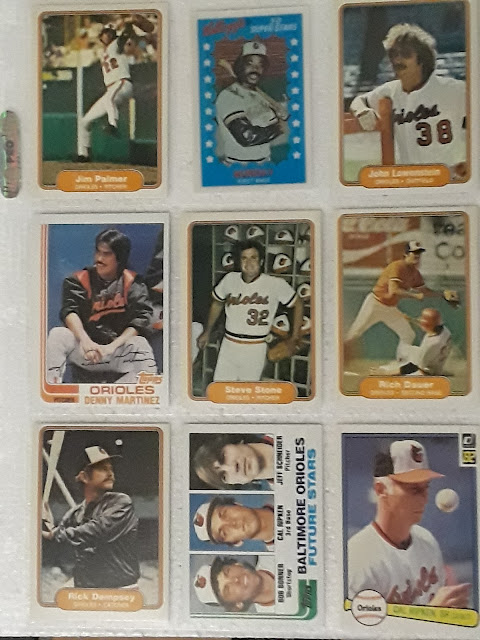
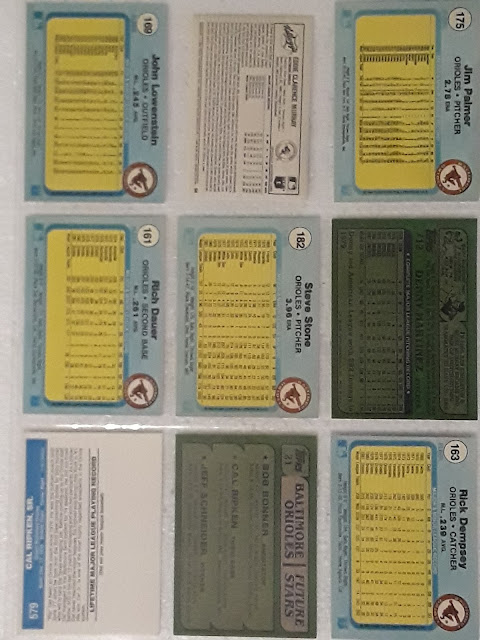
Fleer #175 Jim Palmer - In 1981, Palmer had a disappointing season, finishing with a 7-8 record and looked nothing like the ace of the Orioles' staff as he had been for the last decade plus. He would rebound in 1982 with a 15-5 mark and leading the AL in WHIP. He was once again in elite company, posting an ERA+ of 129 for the year, which helped him finish 2nd in the Cy Young voting. He'd been the Cy Young winner 3 times in his career, as well as a 20 game winner 8 times. He won a game in the World Series in 1966, 1970, and in 1983, with his team taking the whole enchilada each time. He was a first ballot Hall of Famer in 1990 with over 92% of the vote.
Kellogg's 3-D Super Stars #64 Eddie Murray - Steady Eddie was feeling the 2nd Place thing quite strongly in the early 80s. 1981 started a strong of 5 straight top 5 MVP finishes, but not once resulting in winning the award. In '81, Murray led the AL in Homers and RBI and had an OPS+ of 156. In fact his OPS+ was 156 again in 1982, and 83. In '84. he led the AL with a 157 OPS+, while also leading the AL in Walks (and Intentional Walks) and OBP. He was durable and dependable, with 27-33 homers and over 100 RBI as a near lock every season. He'd finish with over 3,200 hits and 504 Homers in his career, and is Major League Baseball's All-Time Leader in Sacrifice Flies. The 8 time All Star was a tremendous defender at 1st base, and was also a first ballot Hall of Famer like his teammate Jim Palmer.
Fleer #169 John Lowenstein - Lowenstein was known for his dry, witty banter with reporters and though he didn't make the National Baseball Hall of Fame, his 1982 Fleer Card shows he's a first ballot Style Hall of Fame member. 1982 was actually one of his best MLB seasons, coming towards the end of his 16 year career. He hit a career high 24 homers and 66 RBI while playing in a platoon with Gary Roenicke. The Lefty hitting Lowenstein got the lion's share of plate appearances and made the most of them. He was used as a utility man for a good portion of his career, which began in Cleveland. It was there that he generated some ironic attention when he publicly declared his disdain for "fan clubs." Some kindred spirits formed the Lowenstein Apathy Club, which involved sending the sardonic super-utility man letter signed in invisible ink that expressed their disinterest in his batting average and baserunning. Some expert-level smart-alecks even designed banners for home games that said "Hey Steiner" followed by 20 feet of blank white cloth.
Topps #712 Denny Martinez - "El Presidente" was a fan-favorite and a very solid rotation option for nearly 25 years. In 1981, he led the AL in victories, and was the clear-cut heir apparent to the role of staff ace in Baltimore. He followed it up with another fine season with a 16-12 record. Early in his career, Martinez was a big time innings eater. His 18 complete games in 1979 led the AL, and in 2021 it would have been more than everyone in both leagues combined. He struggled with alcohol addiction in the mid eighties, but learned to control his addiction and reinvented himself on the mound. He would have a magical season in 1991 for the Expos, when he tossed a perfect game and led the NL in ERA and shutouts. His 245 career wins are the 2nd most by any Latino pitcher in MLB history, trailing only the legendary folk hero Bartolo Colon. Martinez was the first player born in Nicaragua to appear in a major league game, and he remains the most prolific major league player from that country. He has more complete games than Roger Clemens and Greg Maddux, and his 30 career shutouts ranks respectably high among his peers.
Fleer #182 Steve Stone - The 1980 Cy Young Winner was out of baseball by 1982, and it was all thanks to his dominant curveball. Stone was a solid starting pitcher at the back end of the rotation for 4 teams in the 1970s - the Giants, White Sox, Cubs, and finally the Orioles all saw flashes of brilliance, but Stone put it all together in 1980 with a 25-7 record. He won 14 straight decisions at one point, and it was all thanks to his decision that spring training to go all in with his curveball. The fallout from his career high 250 innings pitched was severe elbow tendonitis that limited him to just 12 starts in 1981. He was retired from the baseball diamond by the time his Fleer card was in packs. Stone was done playing but far from done with the game. He became the broadcast partner of Chicago legend Harry Caray, and has been a mainstay with the Cubs and the White Sox on both radio and television broadcasts since 1983.
Fleer #161 Rich Dauer - A self proclaimed "tough out but easy out," Dauer was a light hitting middle infielder with a great glove. Primarily used at second base, Dauer had a streak of 86 games without an error in 1978. The streak included another record of 425 straight chances without committing an error. He was especially tough to strike out, but was a career .257/.310/.343 triple slash hitter, which translated to a below league average hitter for his career. He was actually a hitting star in College with USC, where he helped lead his team to College World Series wins in 1973 and 1974. He didn't have a ton of hitting highlights in the big leagues, but did hit a homer in game 7 of the 1979 World Series, which would be the Orioles' only run in a losing effort.
Fleer #163 Rick Dempsey - Dempsey was also known as defensive wizard just like Dauer. His skills behind the plate gave him the opportunity to play regularly for the Orioles in the 1983 World Series, and he responded with 4 doubles and a homer to earn MVP honors. Dempsey would play for another World Series winner in 1988 as a backup to Mike Scioscia in Los Angeles. His career OPS+ of 87 wouldn't impress many, but his 2 world championship rings certainly makes him the envy of all his peers.
Topps #21 Bob Bonner / Cal Ripken, Jr. / Jeff Schneider -
Bobby Bonner was a great fielder at short, but unfortunately for him the prototype of the new "Slugging Shortstop" was coming up right next to him. The Orioles had its share of all-glove no hit guys on the team with Dauer and Dempsey. Bonner and Ripken were both up for the same spot to take over for long time Orioles Short Stop Mark Belanger, who was also famously fielding rich and power poor. Bonner couldn't keep up with Ripken's bat and ended up finding a different calling - he became a missionary and trains other missionaries and ministers in Zambia.
Jeff Schneider saved one game for the Orioles in 1981, by giving up a walk and double but still managing to get the final out for a 6-5 squeaker of a win. That off-season, he was the throw-in player in a deal with the Angels for Dan Ford. Ford hit a clutch homer in the 1983 World Series for the O's, so Baltimore fans can thank Jeff Schneider for his small contribution there! Schneider was called up in the same transaction that resulted in Cal Ripken's call-up as well, so it's fitting to see him alongside Ripken on this card.
Cal Ripken played a bunch of games for Baltimore, most of them in a row. People think that's pretty neat.
Donruss #579 Cal Ripken, Sr. - You may have noticed in recent posts that 1982 Donruss was not one of my favorites. I will say that what I love about that set is the inclusion of coaches (not just managers! individual coaches). It didn't hurt that Cal Jr. was the #1 prospect in game. Even though they didn't know he'd be the AL Rookie of the Year, they had a pretty good hunch that he'd be in the conversation. Ripken Sr. was a baseball lifer, long-time coach in the Orioles organization, and would even become the manager for a brief period in 1987 and 88. The elder Ripken was a catching prospect, but a shoulder injury that did not heal properly ended his playing career early on. He became a coach and scout for the Orioles in 1961, though he still played sparingly when teams in the org needed a catcher. He had a tough and competitive personality, and his ethos as a coach influenced generations of Orioles players from Jim Palmer and Eddie Murray to his sons Billy and Cal, Jr. to many many others.
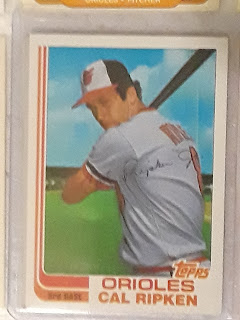
ok ok here's the card I didn't put in the 9 pocket sleeve
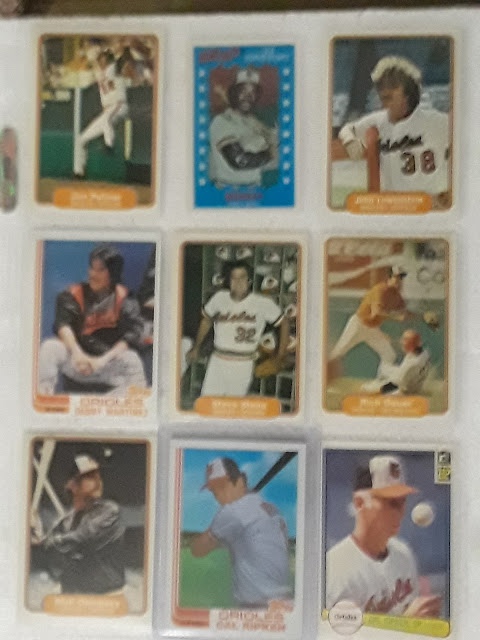
that's what it would have looked like if I wanted to give myself a heart attack thinking about this card just chilling in a binder all loosey goosey - I couldn't even take a decent picture of it!
Note - my ancient laptop, which I've used with my scanner to post in this blog for the last 5 years or so, has finally bought the farm. I decided to do this post using my phone's camera instead of my scanner, probably will not post again until I can find a more permanent solution.
To make the Topps All-Star Rookie roster, you don't need to play in every game, you just need to shine at the right time. For Tony Batista, it was a torrid second half that made him the perfect choice for the 1996 Topps All-Star Rookie Second Baseman. He played in just 74 games for the A's in 1996, but they came late in the season. He became the team's regular starting second sacker in July, hitting .298 with 6 homers and 25 RBI.
Batista was signed by Oakland as a minor league free agent out of the Dominican Republic in 1991, when he was just 17 years old. After playing in the Dominican Winter League, Batista made his way the United States and was ready to take on new challenges in Single A. His career was nearly ended early in his minor league days, when he suffered a fractured skull following a collision in the outfield. Upon his return to the lineup, Batista began to show the early signs of the power hitter he would become. in 1994, Batista was making big gains in High A Modesto. He would hit 17 homers and 26 doubles for the club. He would hit 18 more in AA the following season, and his power up the middle was enough to earn him a call to the big leagues. The A's had been relying upon Brent Gates and Rafael Bournigal at second, so a little offense would go a long way.
Unfortunately for Batista, the league figured out how to pitch to him. Batista would struggle early on in his sophomore season, hitting under .200 early on, which led to a demotion back to AAA. Still just 23 years old. Batista still had plenty of work to do and plenty to prove.
The Expansion Arizona Diamondbacks selected Batista with the 27th pick of the expansion draft, and he would expect to see regular playing time for Arizona in their inaugural season. It was over the offseason that year that Batista developed his unorthodox batting stance, which involved standing parallel to the pitcher's mound and facing the pitcher head on. He did fare well in his time in the desert, clubbing 5 homers in 44 games, but he would be traded to Toronto in exchange for pitching, the one thing that expansion teams can never get enough of.
Batista would have his best individual season of his career with Toronto in 2000. He had already hit 26 homers following his trade to the Jays in 1999, but he would tear the cover off the ball in 2000, hitting 41 homers (4th best in the AL) . He had career highs in Runs Scored, hits, doubles, homers, RBI and total bases. he was also named to his first All-Star game. By June of 2001, Batista had Team records for homers by a SS and homers by a 3B in a season. He was a fan favorite in Toronto, despite being a fairly one dimensional all or nothing hitter.
Inexplicably, the Blue Jays placed Batista on waivers. This may have been an attempt to send Batista to the minors to improve his batting average, but the plan backfired as he was promptly claimed by the Baltimore Orioles. Cal Ripken was playing in his final MLB season, and Batista provided a capable reserve. He would also see a fair amount of time as a DH and as the team's shortstop. The first game of 2002, with Ripken now retired, featured Batista as the team's primary 3rd baseman. He crushed a Grand Slam, the first time the O's had an Opening Day Grand Slam since another Baltimore legend, Eddie Murray, hit one in 1986. Here's a fun article on him from Baltimore, which includes his hitting drill of hitting popcorn kernels
He would sign with the Montreal Expos in their final season, and was one of the team's few bright spots. He was ostensibly replacing Vlad Guerrero's bat in the lineup, and he filled in admirably in terms of power numbers, but they couldn't expect him to fill Vladdy's shoes. He had 32 homers and 110 RBI over 157 games with the Expos.
While Batista was hitting for power, he never in his career hit for average, and was not one to take a walk. So it was not surprising that he was unable to find a taker following the 2004 season, and ended up playing for a season in Japan with the SoftBank Hawks.
The Minnesota Twins took a flier on him in 2006, but 50 games later, they were ready to move on. He would return to Expos franchise again in 2007, and served as a pinch hitter and bench player for the Nationals.
Disappointingly, none of the cards I have of Batista in the batter's box. Thankfully YouTube has my back - check out this clip of Batista at the plate while he was playing for the Blue Jays, diving away from a brushback, then responding with a homer on the next pitch.
Batista finished his career in the majors with over 1,100 hits, 221 homers and a .299 OBP. What are some of your memories of Tony Batista?
This is a series of posts on a 1980's Frankenset. Each page features a different team, with 9 of my personal favorite cards from that year's team. You might find players repeated, you'll definitely see brands repeated, but hopefully you'll agree that there are some interesting selections from the 1980s!
In 1980, The Orioles finished in 2nd place in the AL East though they did win 100 games. The following season they would once again play runner-up to the Yankees, with a 2nd place first half. They faded a bit in the second half of the season following the strike, with a 28-23 record which was 4th best in the division.
The Orioles had a legacy dating back to the mid 60s as a top AL East Contender. Staff Ace Jim Palmer was a direct line from those 60s teams, having debuted for Baltimore in 1965. Mark Belanger was along for the ride as well, the team's everyday shortstop since 1968. More recently, Al Bumbry and Eddie Murray joined the team in the 1970s. Murray would be a foundational cornerstone for the new dynasty that was just getting started in the 1980s.
The Cards: Drake's Big Hitters #6 Eddie Murray - The Switch Hitting Slugger Steady Eddie had a phenomenal 1980, just a couple years removed from his Rookie of the Year campaign. 1980 saw Murray achieve career highs with a .300 average, 100 runs scored, 32 homers, and 116 RBI. Topps #425 Al Bumbry - The 1973 Rookie of the Year had a great 1980 season as well. He led the team in stolen bases and a .392 OBP as the O's leadoff man. He scored 118 runs and had 205 base hits, making his lone All-Star apprearance. Even in the strike shortened 1981, Bumbry would steal 22 bags. He would retire in 1985 after one season with the Padres. Kellogg's 3-D Superstars #2 Jim Palmer - Palmer was nearing the end of his illustrious career in 1980, but still a very effective lefty righty starter. He was technically not the team's best starting pitcher that year, but the wealth of experience he brought to the starting staff was invaluable. He sported a 16-10 record with a 3.98 ERA. 1981 was a bit of a lost season, but he would bounce back in 1982, leading the AL in WHIP and winning percentage with a 15-5 record. Topps #210 Jim Palmer - The lefty righty with the golden arm was a 3 time Cy Young award winner, 3 time World Series champ, and 4 time Gold Glove winner. He won 20+ games in 8 seasons, and was elected to the Hall Of Fame in 1990, his first year of eligibility. He nearly became the first active player enshrined in Cooperstown when he attempted a comeback in 1991, but he wasn't named to the final roster and ultimately stayed retired. Donruss #591 Steve Stone - The team's ace in 1980 was Steve Stone. He won 25 games for the Orioles that season, no O's pitcher has matched it since then. Stone was part of the trade that sent Ron Santo to the South Side. The heavy workload in 1980 (250 innings pitched) took its toll on Stone's arm. 1981 would be his final season, though he would go on to a second career alongside play by play announcer Harry Caray with WGN. Fleer #180 Dennis Martinez - El Presidente was used both in the starting rotation and in relief for the Orioles in 1980, starting 12 games and appearing in 13 more out of the bullpen. The role was somewhat surprising given that he led the AL in complete games and innings pitched in 1979, and would lead the league in victories in 1981. Martinez was the first person from Nicaragua to play major league baseball, and his 245 MLB victories were the most by a Latin American pitcher at the time of his retirement, surpassed only by Bartolo Colon. Fleer Star Stickers #117 Eddie Murray - Eddie Murray would hit over 500 career homers and eclipse 3,000 career hits, joining an exclusive club with Willie Mays and Hank Aaron to reach both milestones during his playing days. Murray was never voted as the league's MVP, but he finished 2nd two times and was a top 10 finisher eight times. He is the All-Time MLB leader in intentional walks. Donruss #475 Tim Stoddard - The team's closer in 1980 with 26 saves, Stoddard appears to have been lost in a sandstorm on Tatooine, never to be seen again. But he would actually appear on major league rosters for another 9 seasons, though his 1980 campaign was probably his best year. Topps #615 Rick Dempsey - Orioles catcher Dempsey was a world series champion in 1983 and 1988, winning MVP honors for his .385/.467/.923 slash line in the 83 series. A career .233 hitter, Dempsey was best known for his excellent defensive skills behind the plate. He is one of just 29 MLB players (and just 3 catchers) to play in 4 different decades in the major leagues. He is the Orioles' all-time leader in games caught.
Charles Johnson famously did not sign with Topps to appear on their cards, in solidarity with other 1991 Team USA players like Jason Varitek. Even so, Charles Johnson was still the obvious choice to be the 1995 Topps All-Star Rookie Catcher. He was just the 4th rookie to win a Gold Glove as a catcher, along with all-time greats like Johnny Bench and Carlton Fisk, and phenom Sandy Alomar, Jr. Those three were also Topps All-Star Rookies, just sayin'.
Image courtesy Gavin from Baseball Card Breakdown- used with permission.
The fact that he didn't sign meant that he wasn't in the 1996 Topps Set, but that didn't stop me from tracking down a custom "card that never was." It was no surprise to me that Gavin had put one together, and he graciously allowed me to share it in this blog post. If you're a regular reader of my blog, but haven't read Gavin's, (first of all, really?) you're gonna love it.
Charles Johnson was drafted in the first round in 1989 by the Montréal Expos, but opted to attend the University of Miami instead. after appearing with Team USA and playing for the Hurricanes, the Florida Marlins made him their 1st Round selection in 1992. Johnson spent 1993 with the Kane County Cougars. He hit .275 with 19 homers and 94 RBI. He would also hit well in 1994 with the Portland (Maine) Sea Dogs, blasting 28 homers for the AA squad. The hitting was a bonus, he was drafted for his defense and ability to call a game behind the plate, so any hitting would be icing on the cake.
His first Marlins tenure included stellar defense, and hitting when it meant the most. He would win a Gold Glove in each of his first four major league campaigns, the longest streak to start a career at catcher, again, since Johnny Bench, who won a whopping 10 consecutive Gold Gloves. Johnson would also come through big in the 1997 World Series, leading the Marlins with 10 hits while hitting for a .357 average over the 7 game series. His defense during the regular season was superlative - he caught 123 games in 1997 and had zero errors.
Johnson was part of the 1997 championship and the 1998 Marlins fire sale as well. The Marlins sent Johnson and Bobby Bonilla, Jim Eisenreich, and Gary Sheffield to the Dodgers in a deal for Mike Piazza. Mike would be flipped soon after to the Mets as well. Johnson finished the 1998 season in LA, winning his fourth Gold Glove, the first Dodger Catcher to win one since 1966. He hit just .217 down the stretch for the Dodgers, but he did have 12 homers.
After the 1998 season, Johnson was traded twice, where he briefly became Mike Piazza's teammate in New York, then moved on to Baltimore in exchange for Armando Benitez. In Baltimore, Johnson caught 135 games his first season, finishing in the top 5 in putouts, caught stealing, assists, and first in double plays turned by a catcher. Now in the AL, Johnson's Gold Glove streak came to an end with Ivan Rodriguez as a competitor. He would add major offense in 2000, hitting a career high 31 homers, 94 RBI and a .304 average.
Most of that offense came following a July trade to the Chicago White Sox. during his time on Southside, Johnson had a OPS+ of 135 and slugged .607. The Sox were in the playoff hunt, and despite losing in the first round to Seattle, Johnson did his part, hitting .333 and reaching base at a .455 clip over the 3 games. Johnson would have his first taste of free agency following the 2000 season.
So of course, Johnson came home from the Southside to South Beach. In his second tour with the Marlins, Johnson made his second All-Star appearance, and caught his 3rd No-hitter. He's caught half of the Marlins' 6 no-hitters all-time. Johnson's streak of catching 100+ games would come to an end in 2001, when he would play in just 83 games for the Marlins in a down year. He would be traded to the Rockies (with Preston Wilson, one of the players that came to Florida from the Mets in the Piazza trade) following the 2002 season. Johnson would just miss the second Marlins' title, but also their 2nd fire sale.
Johnson would have a pair of decent seasons for the Rockies, though he didn't appear to have quite the "Coors-effect" bump that some other Colorado transplants would have. He hit 33 homers over the two seasons, and he would finish out his MLB career with a brief return to Florida, this time for the Tampa Bay Rays. He remains a mainstay in Miami, both as a University of Miami Alum, and as a Florida/Miami Marlin original. He's been on the record as a supporter of the team even through the tough re-building period that began with the Derek Jeter ownership.
For his career, he ranked 2nd only to Ivan Rodriguez in throwing out potential base stealers. Only Jason Varitek and Carlos Ruiz have caught more no-hitters in their careers.
Marty Cordova had a 9 year MLB career following a 6 year minor league climb. By the time Cordova made the major league roster in 1995, he had learned all the right moves to make him successful at the big league level. He was named the 1995 AL Rookie of the Year after hitting a career best 24 homers and stealing 20 bases.
Marty would set a record by hitting a homer in 5 straight games; hitting streaks would be a hallmark throughout his career. Cordova arrived in MN fully grown - debuting at the age of 25. I can vividly recall thinking that Cordova looked like the biggest and baddest dude on the team in those early days.
Cordova was a 10th round selection by the Twins in 1989, the same draft that netted 1991 AL Rookie of the Year Chuck Knoblauch, and Twins ace Scott Erickson. Cordova had already been drafted once before in 1987 by the Padres out of high school, but he opted for school at Orange Coast College in Costa Mesa, CA. Throughout the minor leagues, Cordova flashed considerable power, and shifted from SS to 3B to the outfield. He was the 1992 California League Player of the Year, thanks to 28 homers and 131 RBI to go along with 13 steals. He cleaned up his early defensive struggles as well, making just 2 errors in over 130 minor league games in 1993. Cordova was ranked a top 10 MLB prospect for 3 straight years, finishing #4 overall in 1994.
His rookie season was his high water mark for homers, but it could be argued that his 1996 season was even better. He would reach career highs in average, doubles, and RBI that year, filling in as the offensive leader of a team that lost Kirby Puckett to injury and Kent Hrbek to retirement. Cordova's 23 game hitting streak is still the 4th longest in Twins' history. With Cordova in the outfield and Knoblauch in the infield, the young Twins would show promise throughout the mid to late 90s, but inexperience would be the team's Achilles Heel. Cordova would be hampered by injuries to his back towards the end of his Twins tenure. He would be granted free agency following the 1999 season.
Cordova would sign with Boston in January of 2000, but was let go in Spring Training due to those nagging injuries. He would find a suitor quickly, though, as Toronto swooped in to sign Cordova to a one year deal. He would play in just 62 games for the Jays, hitting a career worst .340 slugging percentage. He was able to have a bounce back season with Cleveland in 2001, topping 20 homers for just the second time in his career. The comeback would earn him a 3 year deal with Baltimore, but he would again struggle with durability, missing the final season of his deal entirely, and playing in just 9 games in 2003. The most notorious injury, of course, was the tanning bed incident, in which Cordova suffered burns on his face when he fell asleep during a tanning session. Cordova would attempt another comeback in 2005 with Tampa, but opted to retire before the end of spring training.
For his career, Cordova drove in over 500 runs in 9 years, despite never hitting 25 homers in a season. His arm in the corner outfield, and his speed early in his career showed the promise of a very talented player.
The 1994 Topps All-Star squad picked a great catcher for their squad, even though he played about half a season his rookie year. In 80 games for the Braves, Lopez platooned with veteran receiver Charlie O'Brien. Lopez did get the lion's share of opportunities and did not waste them.
Javy was still learning on the job behind the plate - leading the NL with 10 passed balls and allowing 66 stolen bases, catching just 23% of the runners that tried to take an extra base. But his offense was already major league ready, crushing 13 homers in those 80 games.
Javy celebrated his 17th birthday in Ponce, Puerto Rico, then signed a contract with the Braves the next day in November 1987. He would spend 2 years in short season rookie ball, then start his steady ascent to the big leagues in 1990 with a full season at single A Burlington. By 1992, he was hitting in the mid .300s with power in AA. He would make his MLB debut in September of 1992, and after another season in the minors, his bat forced the Braves to call up the promising youngster.
His Braves tenure included 3 All-Star appearances, and prodigious power. He would become the Braves' all-time leader for homers by a catcher with 214 round trippers. He was an MVP candidate in 2003, when he hit .328/.378/.687 with 43 homers and 109 RBI. In the Braves' World Series winning 1995 season, Lopez came up big in the NLCS, hitting .357 with a homer against Cincinnati. His 1996 NLCS was even better, hitting .542/.600/1.000 (!) 13 hits, a pair of homers, and earning MVP honors.
Following his Braves career, Lopez moved to the AL East, and took on catching duties for the Baltimore Orioles in a chaotic time for the franchise. Lopez would cite the heavy involvement of Orioles team owner Peter Angelos as contributing to the disjointed atmosphere. In his 2.5 seasons in Baltimore, Lopez had 46 homers and a .293 batting average, actually slightly higher than his Braves career average. The team did not have the same success, however, and he was dealt to the Boston Red Sox in an August deal for a player to be named later. Lopez had a brief 18 game tenure in Boston and did not play in the post season. in 2007 Lopez tried to continue his career with the Rockies, but was released in March and retired.
Let's hear your favorite (or I guess least favorite if you didn't root for Atlanta or Baltimore) memories about Javy Lopez! Thanks for reading and I'd love to read your comments below.
The 1994 Topps Rookie All-Star squad returns for Labor Day with a player who exemplifies hard work. Chris Gomez played both 2nd and Short for the Tigers in 1994, and makes the Topps Roster as the team's SS.
Gomez was developed as a glove first middle infielder, but it was his unexpected power surge in 1994 that convinced Sparky Anderson to continue to pencil him into the lineup for the Tigers. The team of course had Alan Trammell and Lou Whitaker for the umpteenth season in the middle infield, as well as super utility man Tony Phillips to fill in, limiting Gomez to 84 games played.
The Tigers drafted Gomez in the third round of the 1992 draft out of Long Beach State. He originally attended Loyola Marymount after High School in Lakewood California. He was drafted out of high school by the Angels but opted to go to school for an education and to develop his skills. By his senior season, Gomez was an elite defender and capable with the bat, becoming an All-American selection at Short.
Gomez had the tall task of supplanting Alan Trammell as the everyday SS for the Tigers, and the early returns were promising. His defense was predictably solid, and he did hit 11 homers in 1995, but had just a .223 batting average. The Tigers had been spoiled for nearly 2 decades with a perennial All-Star at the position and would end up trading him to San Diego in 1996 in a trade including Brad Ausmus and Andujar Cedeño.
Gomez would play parts of 5 seasons with the Friars, including a big offensive year in 1998, when he hit a career best 32 doubles. He hit .364 for the 1998 World Series, including a triple. His superlative defense continued as well, leading the NL fielding pct and was second in double plays turned.
Following his Padres' run and a successful season as the Rays' shortstop, Gomez became a valuable utility player for several teams, playing all over the infield for Minnesota, Toronto, Baltimore, Cleveland, Pittsburgh and almost Philadelphia.
Interesting story - in December of 2004, Baltimore scooped up Chris Gomez from the free agent class just before the Rule V draft. The Orioles didn't have room on the major league roster at the moment as they were exploring trades to possibly net Tim Hudson from the A's. The O's placed Gomez temporarily on the AA Bowie BaySox roster. The Phillies swooped in and opted to use one of their minor league Rule V selections to pick Gomez, and Baltimore nearly lost their free agent to a technicality. The Phillies wanted Gomez as insurance for possibly losing Placido Polanco, but once the Phils reunited with him, they gave the O's a chance to buy back Gomez.
Any Chris Gomez memories to share? Maybe Cleveland fans that recall the playoff push in 2007? Or Padres fans from a decade before?
Well, well, well if it isn't Mr, Marlin himself! The Expansion Draft in 1992 netted several big names for the Marlins including their Inaugural Opening Day starter Charlie Hough, future Hall of Famer Trevor Hoffman, ace reliever Bryan Harvey, and their franchise centerpiece in their early days, Jeff Conine.
Racquetball Superstar!
Conine was a standout baseball player at UCLA, but as a relief pitcher. In fact, he only had one plate appearance in college (he was hit by a pitch), but his hitting prowess was an open secret. The Kansas City Royals' GM John Schuerholtz had the inside scoop from UCLA's pitching coach that the team's best hitter was actually in their bullpen. The Royals made Conine their 58th Round (!) pick in the 1987 MLB Draft.
Conine would put up decent numbers in 3 minor league campaigns including hitting .320 with 15 homers for the AA Memphis Chicks in 1990, earning him a September Call-up. In 1991 injuries limited him to just 51 games at AAA, and his career was in danger of ending before it began. He came back strong in 1992, blasting 20 homers in 112 games for AAA Omaha, again returning to the majors for 1992.
The expansion draft changed everything. Conine was about to hit his peak, the Marlins needed athletes all over the diamond. No longer waiting in the wings in KC, Conine would play in all 162 games for the Marlins in 1993. He rapped out 174 hits, 12 homers, and drove in 79 runs as a rookie, finishing 3rd in the NL Rookie of the Year voting.
Conine would make the All-Star Team in 1994 and 1995. He would be the All-Star MVP in the second game, hitting a solo homer in the 8th inning, which would prove to be the winning run. In 1996, he had career highs in hits, runs, doubles, homers, and total bases. While Conine put up good numbers in South Florida, the team would finish no higher than 3rd, and at least 16 games out of first place in the NL East through the 1996 season. Conine experienced a lot of losing seasons and growing pains in Florida, so winning it all in 1997 was a bittersweet victory. Bittersweet because Conine was a notable casualty of the Marlins' first fire sale.
After spending a season back in Kansas City, Conine would move on to the Baltimore Orioles as the team's DH/1B and fill in corner outfielder. He would be a bit better than league average over 6 seasons with the O's, with a heavenly 777 hits. In 2003, he'd wind up back with the Marlins just in time for another post-season run. Once again the Marlins won the Wild Card, and Conine turned up the volume in the NLCS, hitting .458 with a homer against the Cubs, and a .333 mark in the World Series, scoring 4 runs against the Bronx Bombers. His 2nd title in Florida cemented his place as a Marlins legend. He would play in the bigs until 2007, with short term stops in Philly, Cincy, and with the Mets for 21 games. He signed a 1-day contract with the Marlins in 2008 to officially retire with the team.
After his playing days, Conine competed in Triathalons, and more recently had been on the Marlins' broadcast team, until Derek Jeter purged the organization of many former Marlins in favor of a clean slate. His son Griffin was a 2nd round pick by the Blue Jays in the 2018 MLB draft, as Toronto continues to stockpile next generation talent.
In 1969, Humankind reached the Moon, just in time to see one of Reggie's homers pass by Apollo 11's window. Just 23 years old, Reggie Jackson had already starred in college at Arizona State in Football and Baseball, and had moved with the A's from Kansas City to Oakland. That year made his first All-Star appearance, led the AL in Runs Scored, Slugging, OPS, Intentional Walks, and for the second year in a row, strikeouts. The strikeouts didn't bother Reggie, especially with a career high 47 Homers to go with them. He once said that "the most important requirement in success is overcoming failure. You must learn to tolerate it, but never accept it."
It was Reggie Jackson and the players that formed the nucleus around him were the first Athletics team to reach the post season since the team was managed by Connie Mack in the 1930s. In 1972, it was Reggie's surprise steal of home in game 5 against the Detroit Tigers that vaulted them into the World Series and setting the stage for Oakland's dynasty. "Just as nature fills a vacuum, Reggie fills a spotlight." -- Bob Marshall
At the peak of the Oakland dynasty, Jackson was the centerpiece of a dynamic offense. In 1973, he was the MVP of the World Series, and MVP of the American League. He led the AL in Runs scored, Homers, RBI, Slugging and OPS. Playing against the legend Willie Mays and the New York Mets, Jackson would hit .310 in the seven game marathon. Facing elimination, Jackson drove in go ahead runs early and an insurance run later on in Game 6, and a back breaking homer in Game 7 to put the A's up for good.
As an Oakland Athletic, Reggie walked the walk as much as the talked the talk. As the team succeeded and he found great personal success, he displayed the kind of swagger and bravado that would make him a household name. The team was barely holding itself together with in-fighting and a young MC Hammer spying on the players and relaying gossip to owner Charlie O. Finley. No, really. Jackson and the rest of the team's stars would have to endure the antics of the team owner and the low-ball offers he'd extend for new contracts.
Jackson loved Oakland, with deep ties to his teammates and the community. Finley was not willing to pay the salary that Jackson would command in 1976 and beyond and the game's premier power hitter. Reggie was traded to Baltimore just before Opening Day, shocking the baseball world. His season with the Orioles was overlooked for a long time - Topps did not make a card with him in an Orioles unform until after his playing career - but the team would certainly take notice of his talents while he was there. Jackson would lead the team in homers, RBI, slugging, OPS... and stolen bases! He swiped 28 bags at an 80% success rate. He also had a personal best in homers - hitting one in 6 straight games during the 1976 season. The Orioles missed the playoffs - the only time that Jackson missed the playoffs from '71 through 1978. After the season, Jackson would be a free agent. "If I played in New York, they'd name a candy bar after me."
The Reggie Bar was apparently very tasty, if a little too similar to the Baby Ruth bar, but not nearly as sweet as the addition of Reggie Jackson's bat to the Yankees line-up. Not so sweet? his relationship with Billy Martin and Thurman Munson. The New York media had certainly picked a side early on, and drew a firm pinstripe in the sand after Reggie's interview with Robert Ward for Sport Magazine. Even before the magazine was released, the backlash was strong. It was in this interview that Jackson famously quipped "I'm the straw that stirs the drink." Despite the rocky relationship between Reggie and some parts of the Yankees clubhouse, the talent was clear, and winning breeds good team chemistry. It would be wrong to say that all was forgiven, but Reggie's 5 World Series Homers sure made the dugout atmosphere more relaxed. Jackson was of course the MVP of the 1977 World Series, and the team would repeat again in 1978 as Champions. His heroics would earn him the nickname "Mr. October." Jackson would continue to lead the team offensively into the 1980s.
My first exposure to Topps Traded cards was Reggie's bespectacled mug in a California Angels helmet. When Gene Autry heard that Jackson was willing to play out west again once he became a free agent, he made sure to make Reggie a big offer, giving the 35 year old a 5 year deal. Can you imagine a contract like that today? Reggie would help the Angels to 2 more playoff appearances, though he would not reach the World Series again in California. He would retire following one last season with Oakland in 1987.
The Hall of Famer retired with 563 homers, over 220 stolen bases, 1500 + runs, 1702 RBI, and over 2500 hits. He is the All-Time MLB leader in strikeouts, but he didn't mind the boos or taunts - "They don't boo nobodys."