Showing posts with label Kansas City Royals. Show all posts

Monday, March 7, 2022

1999 Topps All-Star Rookie Outfielder Carlos Beltrán


Ok cats and kittens, let's talk Carlos Beltrán. The folks at Topps love a good overnight sensation story, and Beltrán was ready to deliver it. He skipped AAA and jumped to the big leagues to stay in 1999, shocking many by winning the AL Rookie of the Year award. So of course he was also headlining the 1999 Topps All-Star Rookie Squad.


A 2nd Round pick in 1995 out of Puerto Rico, Beltrán was well-known in Kansas City circles, but not considered a major league prospect in his first few pro seasons. He had a great glove, and was even named KC's best defensive minor league player in 1997. In 1998, he forced his way into the Royals' future plans by making a meteoric rise through the system. Still just 21 years old, he was promoted mid season to AA Wichita, where he hit .352/.427/.687 in 47 games. He was also stealing bases and playing elite defense in Center field. The surprising totals earned him a September call-up. He had started the year as the 93rd ranked prospect in baseball and found himself as the 14th by the time spring training rolled around in 1999. He made the Opening Day roster and began making his mark in the big leagues from there.


The early 00s Royals were probably one of the most exciting cellar dwellers in baseball. The outfield alone consisted of Beltrán, Johnny Damon, and Jermaine Dye. Well, at least for a little while. The Royals weren't major players in free agency, and at the time really struggled to re-sign their talented youngsters. Damon was traded in 2001 before the season started, then by mid season Dye was off to Oakland to join him. Beltrán stuck around a bit longer, through some fairly lean years. His talent was enough to keep fans interested and invested in the Royals, where he could be counted on for 20+ homers, 30+ steals, and Gold Glove worthy defense for parts of 7 seasons. He was a legit 5-tool player, and coming up on his prime (and free agent) years, which meant it was only a matter of time before he was traded.


In 2004,  the Astros spent big in the offseason to add Roger Clemens and Andy Pettitte to their starting rotation. They already had future hall of famers Craig Biggio and Jeff Bagwell in their lineup, but there was one position that had been a glaring weakness for some time. The Astros needed a center fielder. When the team pulled off a three-team deal in June, they finally found the man they'd been missing. Houston execs gushed about Beltrán, and they got exactly the player they were hoping for. In 90 regular season games, he belted 23 homers, stole 28 bases, and had a 135 OPS+ to go with 4.5 WAR. That was just an appetizer for the post-season. In the NLDS against Atlanta, he went 10-22 with 4 homers and 9 RBI. He scored 9 runs and stole a pair of bases. He played equally well in the NLCS, hitting 4 more homers, scoring 12 times in the 7 game series and producing a WPA (win probability added) of .82 for the series, which trailed only the great Albert Pujols. The Astros were eliminated in that final game, but for that brief time, Beltrán made his value clear.  


Now a free agent and just entering his prime at age 28, Beltrán made his way to New York to try to make a legacy for himself and the Mets. Things didn't go quite as he planned, though hindsight shows that he was even better in New York (129 OPS+) than he was in Kansas City (111 OPS+). He was undone again by the Cardinals in the post season of 2006, losing in 7 games in the NLCS. Beltrán had the the final at bat in the series, and was locked up by an Adam Wainwright curve ball, which some Mets fans still hold against him. All told, he spent 7 seasons in Queens. Despite 5 All-Star Appearances and 3 Gold Gloves, Beltrán was often blasted by the New York media for the team's inability to win titles. He was well respected by his teammates and coaches, but just like his time in KC, as his contract came to a close, the writing was on the wall that a move would be made.


Just shy of the trading deadline in 2011, the Mets sent Beltrán to San Francisco in exchange for pitcher Zack Wheeler. Beltrán hit well for his new team down the stretch, slashing .323/.369/.551 with 7 homers, but the Giants finished 2nd in the NL West and missed the playoffs. A free agent again, Beltrán attempted the old fashioned "If you can't beat 'em, join 'em" strategy and signed with the St. Louis Cardinals. He had a pair of All-Star campaigns, as well as more post season glory. In the 2012 NLDS, he hit .444 with a pair of homers. He tormented the Dodgers the following year in the NLCS with 6 hits including the Game 1 walk off winner. 

He returned to New York in 2014, now as an elder statesman and reserve outfielder. He'd reach the post season in 2015 for a cameo appearance (1-4), then again with the Rangers in 2016 as a DH. The only thing left for Beltrán, with all his personal success in the post season and in his career, was to find a way to bring home a championship for his team.


In 2017, he'd get his chance. He was a well-loved and well-respected icon among his teammates, and they even jokingly held a funeral for his outfielder's glove in July, as Beltrán had become at that point more of a player/coach and pinch hitter. He was always a student of the game and like his coach Alex Cora, extremely adept at reading opponent's signs and tendencies.

R.I.P. Beltrán's legacy?

Now at this point, we have only the various accounts of other teammates, coaches and opposing players to guide what Beltrán did as part of the 2017 Astros' sign stealing scandal. What seems most damning is that his name was only one singled out among the players in the official report of the investigation. What his exact role and level of involvement was, we might never really know. Certainly he was working to help his team win by any means necessary and certainly crossed a line. His coach Alex Cora would say as much - but also wanted to make it crystal clear when he said that this wasn't a two man operation. Cora shared responsibility for the scandal with the whole team, didn't say he was any less guilty, but also didn't think what happened with Beltrán after the investigation was totally "fair."

Beltrán was hired to manage the Mets shortly before the news of the sign stealing scandal was released. he would resign his position before ever taking the field as manager, and hasn't returned to baseball since. He did just get hired by the Yankees of all teams to be an analyst for their broadcasts in 2022 (if MLB has any broadcasts is still up in the air at the moment). 

So, tally it all up - a Rookie of the Year, 2X Silver Slugger, 3X Gold Glove winner, 9X All-Star, and "World Series Champion" with some legit career numbers. His post-season career was quite impressive, earning him the nickname Señor Octubre. Out of all the people involved with the scandal, so far he seems to have been negatively impacted the most. It didn't hurt Marwin Gonzalez, George Springer, A.J. Hinch, or Alex Cora in the long term- it remains to be seen how Carlos Correa and Jose Altuve fare with their next contracts, but chances are they'll get paid well too.  

Maybe we'll get to hear more from Beltrán in the future about his role in all of this. He's scheduled to appear on the 2023 Hall of Fame Ballot, so one way or another we're bound to hear plenty of other people talk about it. 

Sunday, January 16, 2022

I love the 80s - 1982 Kansas City Royals

 This is a series of posts on a 1980's Frankenset. Each page features a different team, with 9 of my personal favorite cards from that year's team. You might find players repeated, you'll definitely see brands repeated, but hopefully you'll agree that there are some interesting selections from the 1980s!

I'd never suggest that the 1981 Baseball Strike was a good thing, but there were teams that took advantage of the break to change their fortunes. The Kansas City Royals had a miserable 1st half of 1981, falling 10 games under .500 and slipping to 5th place in the standings. The second half was another story. The Royals finished the second half in first place, securing a spot in the post season. They were bounced quickly by the Oakland A's in 3 straight games, but the Royals showed the fight that made them major players from the mid 70s through the mid 80s.
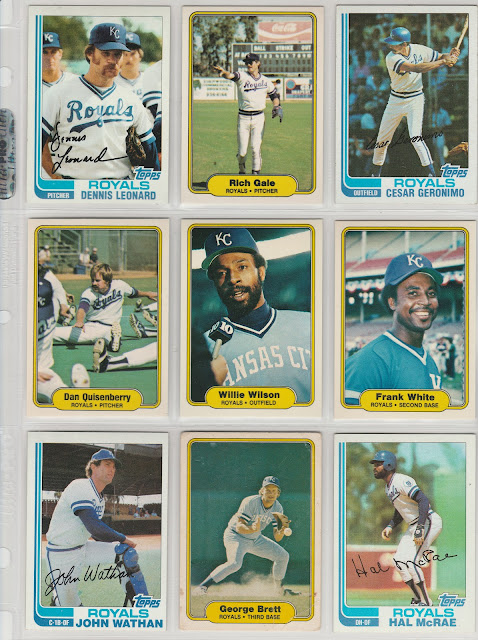

1982 was in many ways a more successful season than '81 for the Royals, with one big difference. This time, they would miss the post season altogether, though they finished with a 90 - 72 record. DH Hal McRae set a franchise record with his AL-Best 133 RBI, Dan Quisenberry paced all closers with 35 saves, and the franchise took a step towards securing a brighter future by drafting pitcher Bret Saberhagen. They missed the postseason in 1982, but were poised to return again soon.


The Cards:

Topps #495 Dennis Leonard - Leonard was the Royals' Ace in the late 70s. He was a 3 time 20 game winner, leading the AL in Starts and Innings Pitched in 1981. He was the only AL pitcher to exceed 200 innings pitched that season, given the time lost to the strike. He was also 3rd in Strikeouts and had a pair of shutouts, both of which came during a stretch of 7 starts in 26 days following the strike. The heavy workload and a pair of broken fingers made for a less than stellar 1982, in which his ERA ballooned about 5.00 for the first time in his career. The following season, the injury bug struck again and he'd essentially be out of baseball until 1986. He tore his patella tendon in a 1983 start, missed all of 1984, and would only make a pair of starts in 1985 for the Royals. Leonard continued his rehab, and returned to the team to make 30 starts at the age of 35. He retired as the Royals' All-Time Leader in Games Started, Innings Pitched, Complete Games, and Shutouts.

Fleer #408 Rich Gale - Gale was a 1978 Topps All-Star Rookie, but didn't get a trophy on his card as Topps decided to leave out the Cup from 1979 through 1986. That season, Gale won 14 games and finished 4th in AL Rookie of the Year voting. He started a pair of games in the 1980 World Series, with a no-decision and a loss. He and Leonard were an effective one-two punch in the late 70s for the Royals, but Gale had a rough time in 1981. He would be traded to San Francisco that off season, and by 1985, found himself pitching in Japan. He was on the mound for his team (the Hanshin Tigers) in their 1st ever Japan Series clincher. Gale is probably known more readily today for his work as a pitching coach, both in the big leagues and for a handful of teams in the minors.

Topps #693 Cesar Geronimo - Geronimo came to the Royals in 1981 as a role player after spending nearly a decade in Cincinnati as the primary Center Fielder for the "Big Red Machine." Geronimo was a 4 time Gold Glove winner in Cincy, and was closing out his career as a 4th outfielder for the Royals in the early 80s. His Gold Gloves weren't mirages or based on the success of his team. He passed the "eye test" in Center Field, sure, but also had favorable rankings in some of the new-school metrics as well. He was annually at or near the top of the leaderboard in Total Zone Runs and Range Factor. Geronimo joined the Reds from the Astros in the same trade that sent Hall Of Famer Joe Morgan to Cincinnati. Following his playing days, Geronimo co-founded a baseball academy in the Dominican Republic that focuses on teaching its students about life skills, English as a 2nd Language, and fiscal responsibility along with the standard fare of baseball training. He helped to establish a similar Academy in Japan for the Hiroshima Carp, that focused more specifically on baseball, as the students also attended a separate school. 

Fleer #422 Dan Quisenberry - The Early 80s were the peak years for the Royals' closer. Dan Quisenberry was the AL Saves leader 5 times, and Royals' Managers loved to give opposing offenses a Pop "Quiz." He was known for his unorthodox submarine-style delivery to the plate, and for writing poetry off the field. For a detailed and engrossing biographical essay, check out this link from the SABR Bio Project He appeared in all 6 World Series games in 1980, and had 4 appearances in the 1985 World Series, including a victory in Game 6. He's the Royals' All-Time Leader in ERA, and is 2nd in team history in Saves. Quisenberry, like his former Manager Dick Howser, passed away from brain cancer. 
 
Fleer #427 Willie Wilson - If you look up "triple" in the dictionary, there should be a picture of Willie Wilson there to help illustrate the concept. Wilson led the AL in Triples 5 times, and finished his career with 147. That's 56th overall in MLB history, but 3rd overall if you're looking at players whose photo is in color, behind just Roberto Clemente and Stan Musial. His 1980 season was historic. In addition to his 15 triples, he totaled 230 hits and scored 133 runs. Those figures all were best in the AL. He was 2nd in Stolen Bases with 79. He'd go on to win a batting title in 1982. He did all this while playing an elite Left field. Similar to Cesar Geronimo, Wilson was a regular visitor atop the league leaderboard in range factor and total zone runs. Wilson is the Royals' All-time leader in stolen bases, with 612. 

Fleer #426 Frank White - The late 70s and early 80s were a who's-who of the greatest Royals of all time and I don't mean Prince Charles. Frank White was the Royals' second baseman throughout their decade plus run of contending for the AL West title, starting in 1973 until his retirement in 1990. White was a defensive dynamo, racking up 8 Gold Gloves. The 5 time All-Star wasn't a slugger like Brett or a burner on the bases like Wilson, but he was a steady presence up the middle of the diamond for nearly 2 decades. His 2,006 hits are 2nd all-time in Royals history. 1982 was probably his best offensive season overall, hitting .298 with 11 homers and 10 stolen bases and a 114 OPS+. He terrorized the Yankees in 1980, earning ALCS MVP honors by hitting .545 in the series including a homer and stolen base. It was his defense that made him an all-time great. Reggie Jackson quipped of White "he's saved as many runs as I've driven in."

Topps #429 John Wathan - John Wathan was a rare breed - a catcher would could steal a base! In 1982, Wathan had a career high 36 steals, almost unheard-of for a backstop, and set a major league record for the position. Wathan was also able to hit for average, including a .305 mark in 1980, when he even garnered a few MVP votes. Following his 9 year playing career, Wathan was a coach and then Manager for the Royals and Angels. Since 2008, he's held the role of 'special assistant to the Director of Player Development' for the Royals. He's a baseball lifer, having worked as a scout, roving instructor, coach and a really fast catcher!

Fleer #405 George Brett - I won't share that infamous George Brett Story, or that other infamous George Brett Story - but suffice it to say, Brett is famous and infamous. He's Mr. Royal, leading pretty much every offensive category in team history, as well as being the leader of the team's first rise to prominence in the 70s and 80s. Brett's 3,000th hit is a bit of a funny story - he was picked off first base after getting it. But what was impressive to me is that it was his 4th hit of that game. That's on-brand for George Brett, going a bit above and beyond. Brett was a triples machine in his own right - when Wilson wasn't the league leader, Brett was leading the league in the late 70s / early 80s, including 20 triples in 1979. His 1980 season was even better, as the AL MVP led the league in all three triple slash categories, going .390/.454/.664 and an OPS+ of 203. Brett won 3 batting titles, in 3 different decades - 1976, 1980, and 1990. The 13 time All-Star was of course a first ballot Hall of Famer, joining the Cooperstown club with fellow 1975 Topps rookie Robin Yount in 1999.

Topps #625 Hal McRae - McRae moved from outfield in Cincy to become a slugging DH in the American League, providing much needed balance to the Royals' offensive attack in the 1970s. McRae was a key member of the Royals through the 1986 season, and later became manager of the team, known for his fiery demeanor and will to win. While his homer totals don't appear eye popping, McRae was still the premier DH for the majority of his career. His Career OPS+ of 123 shows how he was a step above the rest of the league at the plate. McRae finished his career with over 2,000 hits and over 1,000 RBI. 

Monday, March 15, 2021

1998 Topps All-Star Rookie Catcher A.J. Hinch


A.J. Hinch had all the trappings of a future star - he was a high school superstar, an Olympian, and a college standout. combine that with a quick run through the minors and you get a player ripe for Topps All-Star Rookie status. Of course, it didn't hurt that he was the only rookie catcher to play over 100 games in 1998.


The Oakland A's in 1998 were still looking for their next franchise catcher. Long-time catcher Terry Steinbach, a holdover from the great A's teams of the late 80s, left the team to play for his hometown Twins in 1997. Without him, the A's split their catching duties between 29 year old Brent Mayne, 28 year old switch hitter George Williams, and Izzy Molina (no relation). Williams actually had a pretty good season, with an OPS+ of 111 and an OBP of .397. Of course, Moneyball was still a few seasons away, so the A's were looking for power from the catching position. A.J. Hinch was poised to be the man for the job after a hot season in the minors, in which he hit 24 homers across two levels. 

For the big league club in 1998, Hinch struggled to adjust to major league stuff. He did have 9 homers and added 10 doubles, but slugged just .341 for the season. The big issue, which had not been hinted at in his amateur or minor league career, were the strikeouts. Hinch whiffed 89 times in that first year, good for a K rate of 22.8%. He displayed some decent skills behind the plate, throwing out 35 base stealers and committing just 9 errors in 120 games. 


Hinch came of age in Oklahoma, winning the 1992 Gatorade High School Player of the Year. He had starred on the Junior Team USA squad in 1991 and 1992, and he would join the big boys for Team USA in the 1996 Olympics, where he shared in a Bronze medal finish. He was drafted out of high school by the White Sox, but opted instead to retain amateur status with Team USA and his college of choice, Stanford. He stayed in school all 4 years, despite being drafted again following his Junior year, when was named the PAC-10 player of the Year. He would repeat the feat as a Senior, before being drafted a third time, now by the Oakland A's in the 3rd round of the June MLB draft. 


His rookie season would be his best in terms of games played and several offensive categories. In 2000, Hinch was sent back to Triple-A to try to right the ship after a rough 1999. He was part of the 3 team deal in the 2001 off-season that sent Johnny Damon to Oakland and Ben Grieve to Tampa Bay. Hinch landed in Kansas City, where he would serve as Brent Mayne's backup - the same Brent Mayne he succeeded in Oakland back in 1998. Hinch would bounce around the league for a couple years as a backup in Detroit and Philadelphia, playing a majority of his games in Triple-A Scranton Wilkes-Barre. He retired following the 2005 season, but had already started making plans for his next steps as early as 2003 when he attended the Winter Meetings and met with several General Managers. 

After his retirement, he served with the Diamondbacks as a minor league director of operations, then as the team's director of player development. In 2009, he was given the opportunity to be the team's manager. This learning experience would lead to a scouting gig and assistant general Manager role with the Padres, before the now controversial tenure as manager of the Houston Astros. Taking over for Bo Porter in 2014, Hinch inherited a team that was expected to lose, but more importantly, expected to learn how to win. The team exceeded expectations and made it to the post season for the first time in a decade with a Wild Card berth. The Astros remained competitive in the next few years while gaining experience. The good news is that they did learn to win, the bad news is how they won. The Astros won the 2017 World Series, but later were discovered to have done so with the benefit of an elaborate system for intercepting and relaying the opponent's pitches. For his part, Hinch did express regret and was the first to publicly apologize for the scandal. He listed as his biggest regret that he did not do more to curb the sign stealing when he first became aware of it. 

Hinch has been given another chance to show his integrity - following the retirement of Ron Gardenhire, Hinch was hired to be the manager of the Detroit Tigers for the 2021 season. 

Do you have any A.J. Hinch memories? I'd love to read them in the comments below. Uh... please be civil!

Thanks for reading!

Monday, June 8, 2020

1997 Topps All-Star Rookie Outfielder Jose Guillen


Jose Guillen  has one of the better All-Star Rookie cards of all time. Posing with the statue of the great Roberto Clemente, and poised to become the Pirates' right fielder of the future, Guillen beamed. He shared some of the same skills that made Clemente so good, in particular a throwing arm that dazzled and delighted fans. He was a Topps All-Star rookie at just the age of 20, with a long and productive MLB career ahead of him.


Guillen would have a decent season for the Pirates as their everyday Right Fielder in 1997. He hit 14 homers and drove in 70 runs. He was the 4th youngest player in the league but was still entrusted with the second most plate appearances on the Pirates' squad. While he had a great arm (9 assists as a rookie), he struggled a bit with the leather, ranking 2nd in errors among right fielders. He ranked below league average in rate stats, however was still learning the finer points of the game.


Guillen was signed in 1993 by the Pirates as a free agent out of the Dominican Republic. He would spent his minor league career in Single A clubs, with an MVP season in 1996 for the high A Lynchburg Hillcats. His final minor league season, he hit .322 with 21 homers and 24 stolen bases. The steals were somewhat of a mirage, as he never stole more than 5 bases in a season before or since. He followed up his 1997 season with a nearly identical 1998 season. He performed even better in the field, and led the NL in RF assists. Despite two seasons with 14 homers and nearly as many errors, Guillen was still considered a top prospect by many observers, who were more than willing to compare him to Roberto Clemente or Dave Winfield, who did have somewhat slow starts to their Hall of Fame careers. 


After leaving Pittsburgh, Guillen began a whirlwind tour of the big leagues, never stopping in one place for more than a couple seasons. He was either burning bridges or providing tantalizing potential at seemingly every stop along the way. Tampa picked him up in 1999 near the trade deadline, and he would muster just 15 homers over the next 2 and a half seasons before being released. The Arizona Diamondbacks gave him a chance, and after hitting .229 over 54 games, he was cut loose. The Rockies had him for just two days, and decided to go in  another direction before he hooked up with the Reds in Cincinnati to finish the 2002 season. He actually played his best baseball in Cincy, including a torrid first half in 2003, when he slashed .337/.385/.629 with a 165 OPS+. He found his power stroke, hitting 23 homers for the Reds before becoming a deadline deal to the Oakland A's. It was in Oakland the he had his only taste of post season play, hitting .455 in 4 games against Boston in the 2003 ALDS. 


He then signed a deal with AL West rivals the Angels, but butted heads with Mike Scioscia on numerous occasions. Even with a career high 104 RBI, he was on the move again after one season in Anaheim. Now in D.C., Guillen had a good season, followed by an atrocious one in which he hit just .216 with just 9 homers. The next year he was in Seattle, and managed to knock in 99 runs, but wore out his welcome there just as quickly. He then signed a 3 year deal with Kansas City, and nearly fulfilled the whole contract before being traded midway through the 2010 season to San Francisco. By that point he had publicly called his teammates babies and openly complained about K.C.'s losing culture. 


His final MLB stop was a stretch run in San Francisco for the Giants team that finally got over the hump and won a championship. Guillen missed the on field celebration, he had been left off the post season roster while being investigated for the alleged use of HGH. He hit .266 with 5 homers and 13 RBI for the Giants in the closing months of the 2010 season, and they would be the last games he would play in the league.

His Career MLB Totals

I'll leave you with a more positive note, here's video of Guillen's tremendous throwing arm taken from a game in 1998. 

Do you have any Jose Guillen Stories? I'd love to read them in the comments below. Thanks for reading!

Monday, April 13, 2020

1996 Topps All Star Rookie Outfielder Jermaine Dye


The Topps All-Star Rookie Team loves the guy who can shine in an unexpected role. Jermaine Dye got the opportunity to start in Atlanta in his rookie year due to an injury to Braves' star outfielder David Justice. Though he appeared in just 96 games for Atlanta, he came up big -- hitting a dozen homers and racking up 134 total bases. He also came to the big leagues ready to hit - his very first plate appearance was a home run! He was the first Brave to hit a homer in their first plate appearance since Chuck Tanner in 1955 (when the team was still in Milwaukee!)


Dye finished in 6th place in the NL Rookie of the year voting, thanks to his key role on a playoff team. Dye homered in the NLDS, though his post season as a whole left a little to be desired at the plate. He was just 22 years old, however, and would use that experience to his advantage.


Jermaine Dye was a 17th round selection by the Braves in the 1993 MLB Draft. He was a three sport (Baseball, Basketball, and Football) at Wood High School in Vacaville, CA. Dye had scholarship offers to play football for BYU, basketball for UNLV. But he grew up idolizing Chili Davis with the Giants, who he could watch often. His father drove the Bay Area Muni bus, and his route would take him past Candlestick Park every day. Jermaine and his sister would get a ride to the game from their dad, who was also Jermaine's primary hitting coach and mentor.  Dye grew to be 6'4" tall and promised power to all fields. Jermaine's primary position in High school and College, however, was as a dominant pitcher. After a season in college, the Braves drafted Dye, ultimately deciding that hitting would take him further than his arm alone. He did boast a cannon from the outfield, throwing out runners with ease.  Dye would jump a level every year, hitting at each stop along the way. His debut with the Braves may have come out of necessity with the injury to Justice, but Dye made the most of it.


Following that promising 1996 season, Dye was traded to the Royals for Michael Tucker and Keith Lockhart. The first couple years in Kansas City could be called disappointing - he was tagged with the label of being injury prone. It turned out that he was just snake-bitten and a victim of some bad luck. Once he was able to play a full season, Dye proved the detractors wrong. His tremendous 1999 led to an All-Star selection in 2000. He made the roster as a starter - the first Royal to be elected to the All-Star Game by the fans since Bo Jackson in 1989. He would also earn a Gold Glove for his solid defensive work in the outfield. His final two and a half seasons in Kansas City made him a rising star, hitting over 100 RBI and scoring over 100 runs in 2000 to go with a .321 batting average.


Dye would be traded mid-season in 2001 to the Oakland A's. He responded in his first full month back in the Bay Area where he grew up by being named the AL player of the month. He hit .330 with 7 homers, 32 RBI, and scored 22 runs in the month of August. The A's would make the playoffs in each of the next three seasons with Dye patrolling the outfield. The injury bug would bite him again in Oakland. He was not much of a base stealer, but Dye's running game was all but shut down at this point in his career due to various leg and knee injuries. Though the lost time made some critical of Jermaine's production in Oakland, he did play better than league average at the plate and in the field over his time in Oakland. He also hit .400 with a pair of doubles in the 2002 ALDS against the Twins, and contributed another homer in the 2003 ALDS despite only playing in 65 regular season games.


The best years of his pro career came in Chicago. He signed with the White Sox after the 2004 season and made an instant impact, as the team went all the way to the World Series. Dye was the World Series MVP, hitting .438 with a homer and 3 RBI in the Series sweep over Houston. Dye would follow that MVP performance with his best full Season in the bigs. He hit 44 homers and drove in 120 Runs with a career high 1.006 OPS. He won a Silver Slugger, made his 2nd All-Star team, and finished 5th in the league MVP voting. Over the 3 year stretch from '05 through '07, no AL outfielder hit more homers than Jermaine Dye. For his Chicago career, Dye crushed 164 home runs and slugged .525. His OPS+ over that span was a robust 121.


Though injuries delayed his emergence as a star and interrupted his career in Oakland, he still had a tremendous 14 year career that included over 1,750 career hits, 325 Homers, and over 1,000 RBI. He was not one to take a walk, with a walk rate of just 8.3% vs a k Rate of 18.1%. Despite those numbers he still had a Career OPS+ of 111, well above league average.

Let's hear your Jermaine Dye stories!

Monday, April 6, 2020

1996 Topps All-Star Rookie Third Baseman Joe Randa


Hitting over .300 with 20+ doubles and 10+ steals will get you most of the way towards a spot on the Topps All-Star Rookie roster. throw in some good defense and a successful minor league track record and you are nearly a lock!

 Joe Randa did all of that in his first full MLB season as the Kansas City Royals' primary 3rd baseman. George Brett had now been retired for a few years and long since moved over from 3rd to 1st (and DH), so a new hotshot at the hot corner was a welcome sight indeed. His .303 batting average in 1996 was best on the team among the regular starters.


Randa was drafted first by the Angels out of high school, but Volunteered to go to the University of Tennessee instead. After setting RBI records with the school, the Royals made him an 11th Round pick in 1991. He turned out to be more than ready for professional baseball, becoming the Northwest League Player of the Year, suiting up for the Eugene Emeralds. Throughout his minor league climb, Randa hit for average and flashed speed and power on occasion to go with solid defense at third.


His Royals career spanned 8 seasons, broken up by a pair of years with other organizations in the late 90s. Randa earned the nickname "The Joker" because he was often seen sporting a wry, mischievous grin.  Tony Muser's explanation was that it was just his resting face. Ok Tony. He did have plenty to smile about as a Royal however, including his two most productive MLB seasons in 1999 and 2000. In '99 Randa hit .314 and 16 homers, then followed it up by driving in over 100 runs for the only time in his career. Over 1,000 of his career hits came in a Royals uni. In 2004 he became just the 3rd player in Royals history to get 6 hits in a game. He also ended up scoring 6 runs in the contest.


His career also included a Grover Cleveland-esque non consecutive 2 year stint in Pittsburgh (1997 and 2006), and stops in Detroit, Cincinnati, and San Diego. He was very briefly an Arizona Diamondback (drafted in the expansion draft, then traded to the Tigers for Travis Fryman), and a New York Met (acquired on Dec 4th for Willie Blair, then traded to KC on Dec 10th for Juan LeBron - maybe the Mets confused him for Carlos Beltran just like Topps did?). His Reds tenure was also short lived, but memorable. He hit the first Opening Day walk-off homer in Reds history, and followed that with a 6 RBI encore in game 2 of the opening series in 2005. Between Cincy and San Diego that season, he belted a career high 17 homers. San Diego also provided him with his only playoff experience, hitting .364 in three games. His final stop in Pittsburgh saw his production and playing time decline, so he called it a career following the season. He retired with more base hits than games played, and over 700 career RBI.


Let's hear your Joe Randa stories! 


Monday, March 30, 2020

1996 Topps All-star Rookie Catcher Jason Kendall


Some might say that Jason Kendall had catching in his blood. That's because his father Fred Kendall was also a MLB catcher, with a 12 year career for several teams. Jason spent little time making a name for himself- earning a trip to the All-Star Game in his rookie year. He hit .300 and turned in stellar defense behind the plate, quickly creating a rapport with his pitching staff. Kendall finished 3rd in the NL Rookie of the Year balloting.


Right from the start, Kendall was a rock - Catching 130 games in his rookie season. He also was stingy with strikeouts, with just 30 Ks in 471 plate appearances. Few catchers in the league in 1996 combined his level of defense and hitting ability, let along first year players, so he was the obvious choice for the 1996 Topps All-Star Rookie Team.


Kendall grew up in Southern California (his dad played several seasons in San Diego) and attended high school in Torrance, CA. He was already a talented hitter -- He hit safely in 43 consecutive games from 1990 to 1992 which tied a National record.


The Pirates drafted Kendall in the 1st round - #23 overall. He worked his way quickly through the Pirates' minor league system, mixing great defense, hitting for average, and speed. Kendall stole 14 bases for AA Salem and then in AAA in 1995 hit .325/.414/.448 and stole 10 more bags. He was more than ready for the big leagues.


Kendall had a serious ankle injury in 1999 that could have derailed his career. He would would come back strong the following season, even hitting for the cycle in 2000. Over his Pirates tenure, he became their all-time leader in games caught, stole 140 bases, and slashed .306/.387/.418 over 9 seasons. 


Once Kendall was traded from the Pirates after the 2004 season, Kendall began a nomadic pilgrimage around the big leagues. He spent 2 and a half seasons with Oakland, half a year with the Cubs, 2 years with Milwaukee and a final year in Kansas City.  He made his first post season appearance of his career in 2006 with Oakland, facing off against the Twins. Kendall's rate stats fell off considerably at this time, at one point he had the lowest slugging percentage among all qualified MLB hitters, and in another season (2007) had the lowest OBP and 2nd lowest slugging in the league.


Despite those declining stats, Kendall still had a great reputation in the league as a tough competitor. His ability to block pitches in the dirt and call games made him an asset even as shoulder issues hurt his ability to throw out base stealers. He continued to pile up hits, too, and surpassed 2,000 career hits in 2009. At the time, he was just the 8th full time catcher to reach that milestone. He also holds a record for most stolen bases in a single season by a catcher in the modern era, when he swiped 26 bases in 1998. He was known for crowding the plate - he ranks 5th all-time in HBP.

Let's hear your Jason Kendall stories! Anyone read his book Throwback

Sunday, March 1, 2020

I love the 80s : 1981 Kansas City Royals

This is a series of posts on a 1980's Frankenset. Each page features a different team, with 9 of my personal favorite cards from that year's team. You might find players repeated, you'll definitely see brands repeated, but hopefully you'll agree that there are some interesting selections from the 1980s!

In 1980, The Royals won the American League pennant, ultimately falling short in the World Series 4 games to 2 against the Phillies. The following season they would falter a bit out of the gate, with a 5th place first half. They rebounded in the second half of the season following the strike, with a 30-23 record which was the best in the division. They would fall in the divisional series to Oakland, the first half winners of the AL West.


The Royals were a formidable opponent in the late 70s and early 80s. Future Hall of Famer George Brett led the offense both seasons, but had key contributions from Willie Aikens, Frank White, Hal McRae, and the speedy Willie Wilson. On the mound, Dennis Leonard anchored a talented starting rotation, and Dan Quisenberry locked down the late innings in relief. They mixed power and speed to go with great defense.


The Cards:

Fleer #29 Willie Wilson - Wilson was one of the best players in baseball in 1980, leading the AL in hits, runs, and triples. He hit .326 and stole 79 bases as the Royals leadoff hitter. He also reeled in a Gold Glove award. The only real knock on his hitting was a lack of home run power, but he was everything the Royals could hope for. He didn't really draw walks, either, with just 28 bases on balls in 1980 despite being the league leader in plate appearances.

Topps #401 A.L. Championship - Featured here is George Brett, who ran away with a batting title in 1980 with a .390 average, the highest in the AL since Ted Williams cracked .406 in 1941. The Royals swept the Yankees in the ALCS. Frank White earned MVP honors with 6 hits, 3 RBI, and 3 runs scored in the 3 game set. Dan Quisenberry had a save in game 2 and was the winning pitcher in the clinching game 3. Brett's 3 run shot in the 7th inning was the decisive blow to complete the sweep.

Donruss #223 Willie Wilson - Wilson's dominance of the league in 1980 was no isolated incident. He was the 1979 stolen base leader, and had a streak from 1978 thru 1982 with batting averages over .300. He led the AL in triples 5 times, and ranks 56th all time with 147 triples for his career.

Topps #218 Paul Splittorff - Despite over 160 career victories, Splittorff was never named to an All-Star team. He was a 20 game winner in 1973, and was still an effective and valuable part of the Royals' rotation in 1980 and 81. For 1980, he was 14-11 with an ERA just north of 4.00. By this point in his career, he would primarily pitch to contact and rely on the defense behind him. He struck out just 2.3 batters per 9 innings.

Donruss #491 George Brett - Brett was the 1980 AL MVP, thanks in no small part to his otherworldly .390 batting average, though he also led the league in OBP and slugging. His OPS+ was a ridiculous 203. In some ways, his 1980 season is a case of what could have been - he missed time due to injury, playing in just 117 games out of the 162 game schedule.

Topps #585 Amos Otis -  The Royals' everyday centerfielder had a great season in 1979, and again in 1982, but was limited by injury in 1980. He still played over 100 games in 1980, but hit just .251, more than 20 points below his eventual career average. Otis led the league in doubles twice, and stolen bases once, early in his career. He made 4 straight All-Star appearances in the 1970s and was a 3 time gold glove winner.

Fleer Star Stickers #102 Larry Gura -  The lefty Gura was 18-10 in 1980, making his lone all-star appearance. He would follow that up with another solid season in 1981, improving his ERA and WHIP. Gura had 6 of his 16 career shutouts in 1980 and 81. We was a winner in game 1 of the 1980 ALCS, and had a pair of quality starts in the World Series as well.

Fleer #46 John Wathan - It's a nice luxury to have a "back-up" catcher that can also play the corners in the infield and outfield. Essentially a utility man, Wathan still appeared in 126 games in 1980. He hit .305 and had an OPS of .783. Wathan also had sneaky speed for a catcher / corner guy, stealing 17 bags in 1980, 11 in 81, then 36(!) in 1982. He would be a reserve on the 1985 Royals championship team in his final MLB season.

Kellogg's 3-D Super Stars #34 Willie Wilson - Wilson may not have the star power recognition of George Brett, but for my money, Wilson was the best all-around player on those 80s Royals teams. Wilson won his batting title in 1982, and was the the pillar at the top of the lineup for both World Series teams in 1980 and 1985. Wilson finished his MLB career with over 2,200 hits, 1,100 runs scored, and 668 stolen bases.  To go with his Gold Glove in 1980, he also had a pair of Silver Slugger awards. 13 of his 41 career homers were inside-the-park homers. His 1982 batting title was the first in the AL by a switch hitter since Mickey Mantle.

Monday, September 30, 2019

1994 Topps All-Star Rookie Left Handed Pitcher Brian Anderson


The 6'1" lefty from Ohio made a big impression in 1994 for the Angels early on. Anderson hurled 8 shutout innings against the Yankees, earning the victory, one of three straight victories to start the season. He was just a year removed from pitching in college for Wright State. If not for a fractured thumb suffered in May, he may have had a much more  impressive rookie campaign. The player's strike ended his season while he was still regaining his early season form.


His swift rise to the majors, his first round pedigree, and his early season success was enough to land him a spot on the 1994 Topps All-Star Rookie team.


Anderson had a stellar college career-- in his junior and senior season he recorded more strikeouts than innings pitched. His final season in 1993 included 98 Ks and just 6 walks. He was a 3rd Team All-American in 1992, and was the Angels' first round selection (#3 Overall) in June of 1993. He set records at Wright State for single season Ks, victories, innings pitched, and complete games.


Anderson spent little time in the minor leagues, as a college pitcher with a track record of success, there was little left for him to prove, and the Angels were anxiously awaiting his arrival. He would only pitch in 4 minor league games in 1993 before his promotion the big leagues.


The quick promotion may have prevented Anderson from developing his craft. Rod Carew is probably reassuring Anderson that at least his doesn't have to pitch to him. In 1996, Anderson was traded to Cleveland for Jason Grimsley after a pair of frustrating but solid seasons at the back of the Angels rotation.


In 1997, Anderson would get his first taste of the post season, and it suited him well. Cleveland used Anderson out of the bullpen, and he made 6 appearances including a win in the ALCS and a save in the World Series. Following this, Anderson was still a pitcher looking for a home, and he was one of the more intriguing arms available in the expansion draft for the Rays and Diamondbacks.


Anderson was the first player selected by the Diamondbacks, and became the first pitcher to toss a shutout for the team. He topped 200 innings pitched in the team's inaugural season, and led the national league with a criminally stingy 1.0/9 inning walk rate. The flip side of that stat was the league leading 39 homers allowed. Undeterred, Anderson would again shine in the post season, going 7 strong innings against the Mets in losing effort in 1999, then again performed well in 2001, limiting damage in 4 appearances, winning a game in relief in the NLCS against Atlanta, and providing a day of rest inbetween the starts from Curt Schilling and Randy Johnson in the World Series.

He would return to Cleveland in 2003, and his defense let him down, allowing 27 UNearned runs in his 23 starts. The Royals acquired Anderson for the second half, seeing the better peripheral numbers and the rotten luck. He would go 5-1 down the stretch for the Royals, finished with career bests in victories, ERA, and complete games.

He would finish his career after a UCL injury in spring training for the Rays in 2008. He had been trying to recover from a pair of Tommy John surgeries. The relationship with the Rays would prove fruitful, along with a connection to longtime Reds' announcer Marty Brennaman and has led to his 2nd career, as the announcer for Rays TV.

Anderson finished with 10 Wins Above Replacement, and an 82-83 record in 13 MLB seasons. His 1.96 career walk rate per 9 innings is in the top 100 All-time.