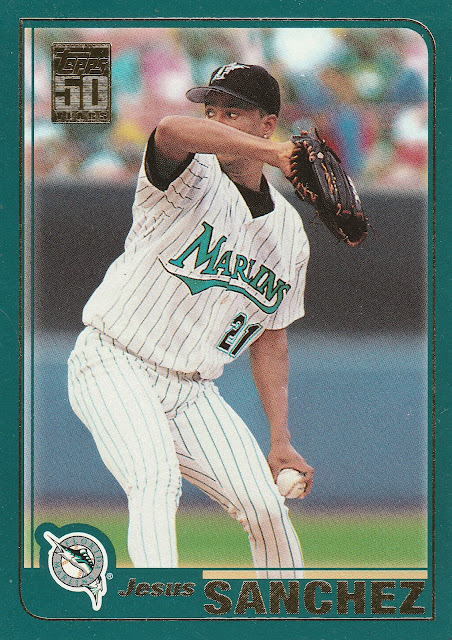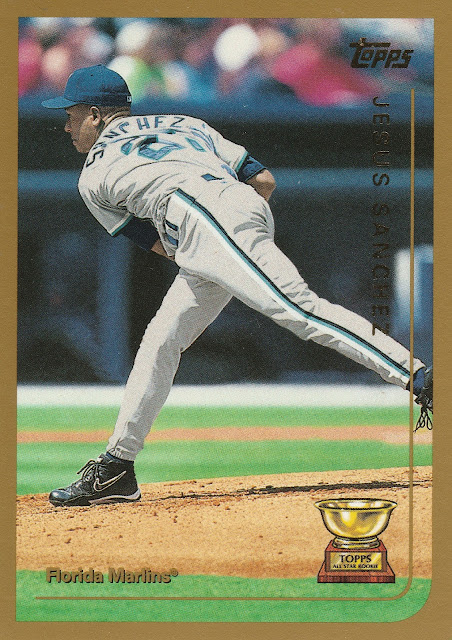
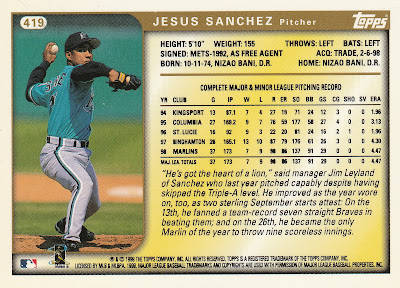
Jesús Sánchez, Pitcher for the Florida Marlins, should not be confused with Jesús Sánchez, outfielder for the Miami Marlins. For one thing, Jesús Sánchez was born in the Dominican Republic. Jesús Sánchez, on the other was born in the Dominican Republic. Wait. Jesús Sánchez bats left handed, and Jesús Sánchez bats.... left handed. Hmm. Let's get more technical here. When Jesús Sánchez was born, Jesús Sánchez had just completed his 4th season of professional ball for the Binghampton Mets. Ah, now I get it. Jesús Sánchez, our Jesús Sánchez for this post, was a member of the 1998 Topps All-Star Rookie squad, while Jesús Sánchez was a literal rookie of life itself in 1998, completing his first year of being!
Collected baseball cards from 1986-1995, and again from 2014 to Present. A simple blog to discuss the hobby.
Showing posts with label Topps All-Star Rookie. Show all posts
Monday, January 3, 2022
1998 Topps All-Star Rookie Left Handed Pitcher Jesús Sánchez
By 2001, Sánchez had started 71 games for the Marlins over 3 seasons, but hadn't really found the consistency expected of a Major League starter. Some of it could be attributed to the way he was used - in 1999 he appeared in 59 games as a pitcher, and pinch ran 13 times. Fun fact - Sánchez was a long-distance runner in high school. He was used primarily out of the bullpen in 1999, but started 10 games. By 2000, he was once again in the rotation full time, and tossed a pair of complete game shutouts, but still ended up losing more games than he won. Sánchez had a great pickoff move, nabbing dozens of would-be base stealers in his career, setting a team record with 12 in 1998 alone.
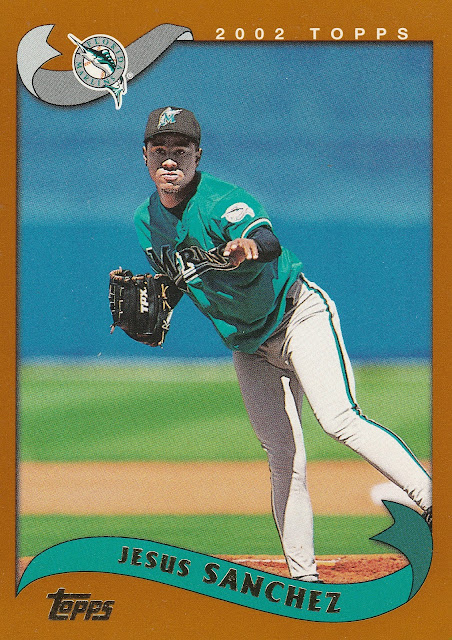
His pitch mix evolved over the years, with his change-up becoming his best weapon to complement his fastball. He didn't pitch with high velocity, and the transition from the minors to the majors would reflect the difficulty of bringing a less than blistering heater to the big leagues. Strikeout rates decreased, while walk rates, hits/9, and home run rates all increased. Sánchez spent a good chunk of 2001 in AAA, not returning to the big leagues until late June. By the end of the year, he'd be traded to the Cubs, who viewed him a possible 5th starter / swing man in the bullpen. He'd spent parts of the next three seasons as a AAAA pitcher, shuttling between the big leagues and AAA for Chicago, Colorado, and Cincinnati. He then moved on to pitching in the Dominican Winter Leagues, the Mexican League, spent a year in China with the CBPL where he pitched a sub 3.00 ERA for the first time since 1996, and then returned to the U.S. to pitch in the independent Atlantic League for a pair of seasons, retiring in 2012. Sánchez today is the pitching coach for the Cleveland Guardians' Dominican Summer League team located in Boca Chica, D.R. which is located a few provinces east of his hometown of Nizao.
Check this out - Sánchez finishes up a then-Marlins record of 7 consecutive strikeouts by tossing an "immaculate inning" - 9 pitches, 9 Strikes, 3 strikeouts! He gets Greg Maddux with that nasty changeup.
Monday, April 13, 2020
1996 Topps All Star Rookie Outfielder Jermaine Dye
The Topps All-Star Rookie Team loves the guy who can shine in an unexpected role. Jermaine Dye got the opportunity to start in Atlanta in his rookie year due to an injury to Braves' star outfielder David Justice. Though he appeared in just 96 games for Atlanta, he came up big -- hitting a dozen homers and racking up 134 total bases. He also came to the big leagues ready to hit - his very first plate appearance was a home run! He was the first Brave to hit a homer in their first plate appearance since Chuck Tanner in 1955 (when the team was still in Milwaukee!)
Dye finished in 6th place in the NL Rookie of the year voting, thanks to his key role on a playoff team. Dye homered in the NLDS, though his post season as a whole left a little to be desired at the plate. He was just 22 years old, however, and would use that experience to his advantage.
Jermaine Dye was a 17th round selection by the Braves in the 1993 MLB Draft. He was a three sport (Baseball, Basketball, and Football) at Wood High School in Vacaville, CA. Dye had scholarship offers to play football for BYU, basketball for UNLV. But he grew up idolizing Chili Davis with the Giants, who he could watch often. His father drove the Bay Area Muni bus, and his route would take him past Candlestick Park every day. Jermaine and his sister would get a ride to the game from their dad, who was also Jermaine's primary hitting coach and mentor. Dye grew to be 6'4" tall and promised power to all fields. Jermaine's primary position in High school and College, however, was as a dominant pitcher. After a season in college, the Braves drafted Dye, ultimately deciding that hitting would take him further than his arm alone. He did boast a cannon from the outfield, throwing out runners with ease. Dye would jump a level every year, hitting at each stop along the way. His debut with the Braves may have come out of necessity with the injury to Justice, but Dye made the most of it.
Following that promising 1996 season, Dye was traded to the Royals for Michael Tucker and Keith Lockhart. The first couple years in Kansas City could be called disappointing - he was tagged with the label of being injury prone. It turned out that he was just snake-bitten and a victim of some bad luck. Once he was able to play a full season, Dye proved the detractors wrong. His tremendous 1999 led to an All-Star selection in 2000. He made the roster as a starter - the first Royal to be elected to the All-Star Game by the fans since Bo Jackson in 1989. He would also earn a Gold Glove for his solid defensive work in the outfield. His final two and a half seasons in Kansas City made him a rising star, hitting over 100 RBI and scoring over 100 runs in 2000 to go with a .321 batting average.
Dye would be traded mid-season in 2001 to the Oakland A's. He responded in his first full month back in the Bay Area where he grew up by being named the AL player of the month. He hit .330 with 7 homers, 32 RBI, and scored 22 runs in the month of August. The A's would make the playoffs in each of the next three seasons with Dye patrolling the outfield. The injury bug would bite him again in Oakland. He was not much of a base stealer, but Dye's running game was all but shut down at this point in his career due to various leg and knee injuries. Though the lost time made some critical of Jermaine's production in Oakland, he did play better than league average at the plate and in the field over his time in Oakland. He also hit .400 with a pair of doubles in the 2002 ALDS against the Twins, and contributed another homer in the 2003 ALDS despite only playing in 65 regular season games.
The best years of his pro career came in Chicago. He signed with the White Sox after the 2004 season and made an instant impact, as the team went all the way to the World Series. Dye was the World Series MVP, hitting .438 with a homer and 3 RBI in the Series sweep over Houston. Dye would follow that MVP performance with his best full Season in the bigs. He hit 44 homers and drove in 120 Runs with a career high 1.006 OPS. He won a Silver Slugger, made his 2nd All-Star team, and finished 5th in the league MVP voting. Over the 3 year stretch from '05 through '07, no AL outfielder hit more homers than Jermaine Dye. For his Chicago career, Dye crushed 164 home runs and slugged .525. His OPS+ over that span was a robust 121.
Though injuries delayed his emergence as a star and interrupted his career in Oakland, he still had a tremendous 14 year career that included over 1,750 career hits, 325 Homers, and over 1,000 RBI. He was not one to take a walk, with a walk rate of just 8.3% vs a k Rate of 18.1%. Despite those numbers he still had a Career OPS+ of 111, well above league average.
Let's hear your Jermaine Dye stories!
Friday, April 10, 2020
Free Stuff Friday #10 - Loud Noises!
It's week #10 of free stuff Friday, so I thought I would try to kick it up a notch. Sorry, no extra Altuve or Trout rookies lying around from 2011. But feel free to claim one or claim them all with what I have here.
Inserts! Note that Max is an insert and a parellel - numbered to /50
Not sure quite this one got so Cardinals heavy, but sometimes these things happen! If the fine print is too fine, the Josh Hamilton is a factory set parallel.
Autographs!
Ya know what, how about a couple more.
Topps Heritage singles - I think I might actually try to build this base set, I'll save that post for another day...
Some hockey to dive into . . .
And some hockey inserts why not?
Mini Collection today is Topps' All-Star Rookie Cups. Sweet Lou is not a reprint, though he is off center.
Let me know your address if we haven't traded before (or in a long time).
I also want to hear your requests. Have I been neglecting your favorite team?
Labels:
2011 Topps,
Autographs,
free stuff,
Hockey,
Lou Pinella,
Topps All-Star Rookie
Monday, April 6, 2020
1996 Topps All-Star Rookie Third Baseman Joe Randa
Hitting over .300 with 20+ doubles and 10+ steals will get you most of the way towards a spot on the Topps All-Star Rookie roster. throw in some good defense and a successful minor league track record and you are nearly a lock!
Joe Randa did all of that in his first full MLB season as the Kansas City Royals' primary 3rd baseman. George Brett had now been retired for a few years and long since moved over from 3rd to 1st (and DH), so a new hotshot at the hot corner was a welcome sight indeed. His .303 batting average in 1996 was best on the team among the regular starters.
Randa was drafted first by the Angels out of high school, but Volunteered to go to the University of Tennessee instead. After setting RBI records with the school, the Royals made him an 11th Round pick in 1991. He turned out to be more than ready for professional baseball, becoming the Northwest League Player of the Year, suiting up for the Eugene Emeralds. Throughout his minor league climb, Randa hit for average and flashed speed and power on occasion to go with solid defense at third.
His Royals career spanned 8 seasons, broken up by a pair of years with other organizations in the late 90s. Randa earned the nickname "The Joker" because he was often seen sporting a wry, mischievous grin. Tony Muser's explanation was that it was just his resting face. Ok Tony. He did have plenty to smile about as a Royal however, including his two most productive MLB seasons in 1999 and 2000. In '99 Randa hit .314 and 16 homers, then followed it up by driving in over 100 runs for the only time in his career. Over 1,000 of his career hits came in a Royals uni. In 2004 he became just the 3rd player in Royals history to get 6 hits in a game. He also ended up scoring 6 runs in the contest.
His career also included a Grover Cleveland-esque non consecutive 2 year stint in Pittsburgh (1997 and 2006), and stops in Detroit, Cincinnati, and San Diego. He was very briefly an Arizona Diamondback (drafted in the expansion draft, then traded to the Tigers for Travis Fryman), and a New York Met (acquired on Dec 4th for Willie Blair, then traded to KC on Dec 10th for Juan LeBron - maybe the Mets confused him for Carlos Beltran just like Topps did?). His Reds tenure was also short lived, but memorable. He hit the first Opening Day walk-off homer in Reds history, and followed that with a 6 RBI encore in game 2 of the opening series in 2005. Between Cincy and San Diego that season, he belted a career high 17 homers. San Diego also provided him with his only playoff experience, hitting .364 in three games. His final stop in Pittsburgh saw his production and playing time decline, so he called it a career following the season. He retired with more base hits than games played, and over 700 career RBI.
Let's hear your Joe Randa stories!
Monday, March 30, 2020
1996 Topps All-star Rookie Catcher Jason Kendall
Some might say that Jason Kendall had catching in his blood. That's because his father Fred Kendall was also a MLB catcher, with a 12 year career for several teams. Jason spent little time making a name for himself- earning a trip to the All-Star Game in his rookie year. He hit .300 and turned in stellar defense behind the plate, quickly creating a rapport with his pitching staff. Kendall finished 3rd in the NL Rookie of the Year balloting.
Right from the start, Kendall was a rock - Catching 130 games in his rookie season. He also was stingy with strikeouts, with just 30 Ks in 471 plate appearances. Few catchers in the league in 1996 combined his level of defense and hitting ability, let along first year players, so he was the obvious choice for the 1996 Topps All-Star Rookie Team.
Kendall grew up in Southern California (his dad played several seasons in San Diego) and attended high school in Torrance, CA. He was already a talented hitter -- He hit safely in 43 consecutive games from 1990 to 1992 which tied a National record.
The Pirates drafted Kendall in the 1st round - #23 overall. He worked his way quickly through the Pirates' minor league system, mixing great defense, hitting for average, and speed. Kendall stole 14 bases for AA Salem and then in AAA in 1995 hit .325/.414/.448 and stole 10 more bags. He was more than ready for the big leagues.
Kendall had a serious ankle injury in 1999 that could have derailed his career. He would would come back strong the following season, even hitting for the cycle in 2000. Over his Pirates tenure, he became their all-time leader in games caught, stole 140 bases, and slashed .306/.387/.418 over 9 seasons.
Once Kendall was traded from the Pirates after the 2004 season, Kendall began a nomadic pilgrimage around the big leagues. He spent 2 and a half seasons with Oakland, half a year with the Cubs, 2 years with Milwaukee and a final year in Kansas City. He made his first post season appearance of his career in 2006 with Oakland, facing off against the Twins. Kendall's rate stats fell off considerably at this time, at one point he had the lowest slugging percentage among all qualified MLB hitters, and in another season (2007) had the lowest OBP and 2nd lowest slugging in the league.
Despite those declining stats, Kendall still had a great reputation in the league as a tough competitor. His ability to block pitches in the dirt and call games made him an asset even as shoulder issues hurt his ability to throw out base stealers. He continued to pile up hits, too, and surpassed 2,000 career hits in 2009. At the time, he was just the 8th full time catcher to reach that milestone. He also holds a record for most stolen bases in a single season by a catcher in the modern era, when he swiped 26 bases in 1998. He was known for crowding the plate - he ranks 5th all-time in HBP.
Let's hear your Jason Kendall stories! Anyone read his book Throwback?
Monday, March 16, 2020
1996 Topps All-Star Rookie Left handed Pitcher Billy Wagner
Billy the Kid is firing bullets for Houston here in 1996. Wagner had the reputation for wildness on his way to the big leagues, and was having trouble cracking the Astros' starting rotation. Houston Manager Terry Collins decided to try Wagner in the bullpen instead, and the rest is history!
Wagner's fastball was the stuff of legend. Despite measuring under 6' tall, he was able to generate impressive speed throwing with his less dominant hand. Wagner was born right handed, but broke his arm twice as a 7 year old, and started to throw left handed instead. He was clocked in the high 90s and averaged a little over 95 mph as a collegian. In 1996, his fastball was paired with a wicked slider. This led to 67 strikeouts in 51 innings. There was still concern about his control, as he walked 30 batters, but that would turn out to be his career high for free passes.
Wagner was the 12th Overall pick in the 1993, plucked out of Division III collegiate ball from Ferrum College in Virginia. Wagner probably could have been successful at any college, but was overlooked by the big name schools. In his Senior year of high school, he had eye-popping numbers at the plate and on the mound. He hit .451 and stole 23 bases, and pitched to a 7-1 record with a 1.52 ERA. He struck out 116 batters in just 46 innings pitched. The stat that mattered to scouts? His height, which was still just 5'5" as an 18 year old. At Ferrum, Wagner continued to blow away hitters, and set several NCAA records for strikeouts. He had a 19.1 K/9 his Sophomore season. After his Junior year, he spent the summer in the Cape Cod League, finally attracting the attention of big league scouts.
Wagner was still a starter throughout his minor league career, though he never made a major league start. With the Quad Cities River Bandits, Wagner topped 200 strikeouts in just 153 innings pitched, but had just an 8-9 record. The one knock on his game was his control. This was ultimately solved in the big leagues, but for stretches of time the walks would haunt Wagner.
As a relief pitcher, Wagner was incredible. The fastball/slider combo was devastating, and throughout his career Wagner blew away the competition. With Houston, he had a 12.4 K/9, striking out 694 batters in 504 innings and a 2.53 ERA. 1999 was probably his most appreciated season, as he was named the NL Rolaids Relief Pitcher of the year. In 74 and 2/3 innings, Wagner had 124 strikeouts and just 24 walks. His 1.53 ERA and 1.65 FIP were both career bests, and he locked down 39 saves for Houston.
Well, this is hubris on my part, as I just assumed I had Wagner Phillies cards, but his two seasons in Philly line up perfectly with years in which very little cardboard made it into my collection. For Philly, Wagner added on 59 career saves and pitched to a 1.86 ERA. He moved on to the New York Mets, and continued his assault on the record books. Wagner saved 101 games and once again had more strikeouts than innings pitched.
After a rough year in Boston in which he appeared in just 15 games, Wagner had a great final season with Atlanta at the age of 38. He had a career high 7 wins and an impressive 1.43 ERA to go with another 37 saves.
Wagner was probably the best reliever not named Mariano Rivera in the late 90s and throughout the 2000s. He greatly improved his control issues from the minors, and was a dominant force throughout his career. It seems that because he wasn't Rivera or Trevor Hoffman, he's been overlooked by Hall of Fame voters. He didn't exactly light the world on fire in the post season, and that may have had some impact on his candidacy over the years, but his 11.9 career k/9 and 422 saves are worth more than voting results in the low double digits. This past year, his vote total jumped from 16% to nearly 32%, still well short of the needed 75%. His career 187 ERA+ would have been 3rd best all-time, but he only pitched 903 innings and the minimum for the leaderboard is 1,000 innings. He trails only Rivera and Craig Kimbrel (who also is short of the 1,000 inning minimum). For comparison, Trevor Hoffman's ERA+ was a still tremendous 141. Wagner also surpasses Hoffman in career WHIP.
What do you think? Is Wagner a Hall of Famer? Do you have any great Wagner memories?
Monday, March 2, 2020
1996 Topps All-Star Rookie Outfielder F.P. Santangelo
Frank-Paul Santangelo was somewhat a late bloomer in MLB terms, making his debut at the age of 27 and was a 28 year old for his rookie year. He found career highs in games played, hits, doubles. homers, RBI, and finished 4th in the Rookie of the year balloting in the NL.
Santangelo was drafted in the 20th round of the 1989 draft, and methodically made his way up the ladder through the Expos' minor league system. He spent two seasons in West Palm Beach in Single A, one year in AA, then 4 seasons at the Triple A level before breaking through. He was single minded about making the big leagues, and vowed not to join teammates from Ottawa on their off-day excursions to the big league city of Montreal. He wanted the first time he saw the city to be as a major league ball player.
Even though he was "slow" to make it to the majors (don't forget that many never make it), he was notoriously early to arrive to practice. His manager in Single A would also be his manager in the big leagues, MLB lifer Felipe Alou. It was Alou who recognized the competitive spirit that drove Santangelo to be the first player to arrive each morning, which earned him a spot in the lineup. His first game in the big leagues against the Marlins included a pair of hits, including a triple.
His first full season, Santangelo played six different positions for the Expos, but he was primarily a left fielder and center fielder. While he was never a major power threat in his career, the switch hitter did complete a rare feat in 1997. In a game against the Cubs that June, he homered from both sides of the plate in the same game. (well, maybe not rare for Mickey Mantle, Eddie Murray, Ken Caminiti, Carlos Beltran, Nick Swisher or Mark Teixeira - but rare for the rest of us!) Santangelo was candid about his own involvement in the Steroid Era, having been named on the Mitchell Report. He admitted to using HGH in an effort to recover from injuries on 2 separate occasions in 1997 and 2000, but stated that he was not involved beyond that.
Santangelo was just getting started, but was already on the wrong side of 30 when his Expos tenure came to an end. He would go on to play one season each for the Giants, Dodgers, A's, and then for the Yankees in the minors before retiring following the 2002 season. In 2001 with the A's, he had his first taste of post season baseball, getting a double in 4 plate appearances in the ALDS. He was never very high on the MLB leaderboards, but did have a knack for getting on base the hard way. In 4 of his 7 MLB seasons he ranked in the top 10 in HBP.
Following his playing career, Santangelo went into broadcasting and has been a part of the Nationals broadcasting booth for nearly a decade. His signature call comes from his manager Felipe Alou, who would flatly declare "There goes the no-hitter" whenever his team got their first base hit of the night.
Any fond memories of F.P. Santangelo? Let's hear 'em!
Saturday, February 8, 2020
2020 Topps Series I First Impressions
Finally found some 2020 Topps Series 1 today at the card show - I purchased 2 Hobby packs and some assorted singles. Kyle Schwarber gets the nod as the first card from the first pack.
The backs are a slightly less fun, less colorful version of the 2019 backs. Like last year, design elements from the card front carry over to the back, and there is an attempt to retain team specific colors front to back. It was Lost Collector's tweet that I read this morning pointing this out first, but the other immediately noticeable difference this year is the gloss on the front of the card. These cards are treated on the surface with... something. My hope is that it doesn't have any long term effects on the card fronts, like causing the cards to bow or fade or ... I don't know what. They feel kind of creepy to sort.
To refresh your memory, here are the last four designs of the 2010s.
There are some good photo choices and decent framing of those photos in Series 1.
Rookies rule the world this time around, the best two in my 2 packs were hurlers Dylan Cease and Jesus Luzardo. Omar Narvaez is playing at Target Field, with a cameo from Jason Castro.
Ramon Laureano has a familiar photo - this was the same shot used on a Topps NOW card last year. The cool thing about that it is it makes identifying the play much easier. This was Topps NOW #119, from April 21, 2019. Laureano robbed Teoscar Hernandez of a homer, then flung the ball back to the infield. It could have been an error, but the expansive foul territory in Oakland allowed for the ball to stay in the ballpark again, and the A's turned a double play by gunning down Justin Smoak, who was trying to advance to second on the errant throw.
The insert from the packs were a Cleveland Best Teams of the 2010s card, and the Robin Yount above. The best card I found in either Hobby pack was the Pete Alonso Rookie Cup card. Browsing singles, I added the Ichiro and Aquino 1985 inserts. I think I'm collecting Aquino now, why not?
No Twins at all pulled, so I added this Turkey Red insert of Eddie Rosario. Rosie is not in the Series 1 base set, but you are all on notice now -- I am going all in on a ROSIE RAINBOW for 2020 Series 2. 2020 VISION -- ROSIE RAINBOW, ALL THE WAY!
For good karma, I will take this opportunity to remind you to send Tom your Vogelbachs, and send Jim your Kiké Hernandezes!

Ok, that's enough yelling for one day. The Rookie Cup is back again, and it is tiny! It's the same size as last year, but somehow the design makes it look even smaller to me. I actually bought these before I found packs, so I have a 2nd Pete Alonso, for anyone wanting to trade for one.
Yordan Alvarez has the Cup and is also designated as a rookie this year, because Topps decided to save him for 2020 instead of jamming him into update.
Overall, this year's set isn't really doing it for me. I'm going to buy some retail at Target if they ever show up, or possibly at the local Walgreens, which started stocking current year Topps cards for the first time ever in 2019. Maybe they will again this year, but I won't hold my breath. Maybe I just need to see some more to decide.
Have you found any packs yet? What are your first impressions?
Subscribe to:
Posts (Atom)