Showing posts with label Eddie Murray. Show all posts

Sunday, January 23, 2022

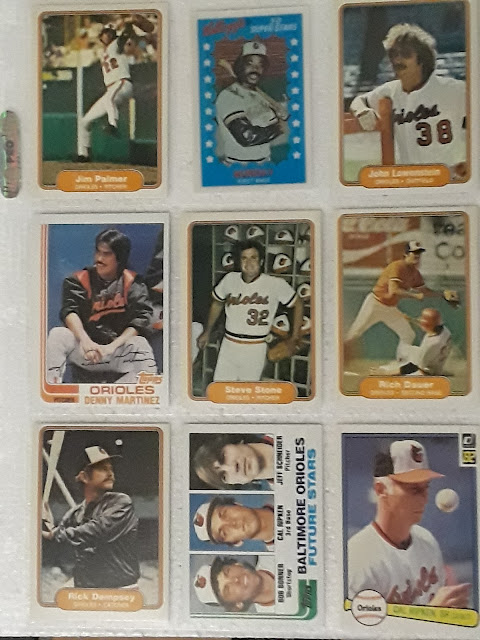
I love the 80s - 1982 Baltimore Orioles

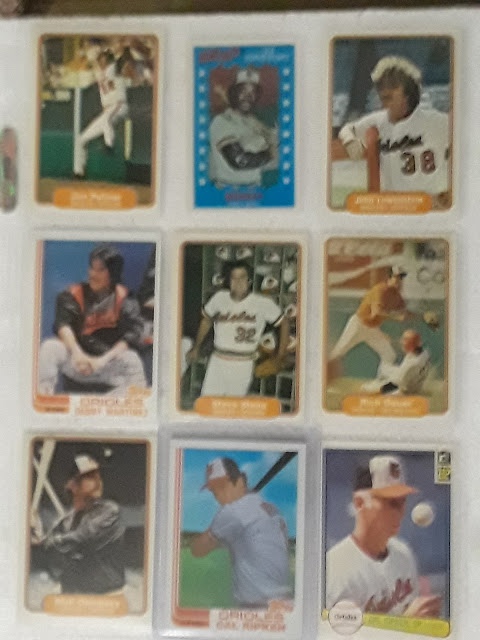
 This is a series of posts on a 1980's Frankenset. Each page features a different team, with 9 of my personal favorite cards from that year's team. You might find players repeated, you'll definitely see brands repeated, but hopefully you'll agree that there are some interesting selections from the 1980s!

The Orioles came about as close as you can come to the post season without making it in 1981. The strike started with the Orioles trailing the Yankees for first place in the AL East by just 2 games. It was poor timing for Baltimore, as they had been ahead of the pack in late May. In the second half of the season, they finished ahead of the Yankees in the overall standings, but the Yankees played in October instead because the strike determined that the winner of each half would play in the playoffs, regardless of the overall records. 


In 1982, Baltimore again would play the role of the bridesmaid, finishing just a game behind the AL east champion Milwaukee, taking the Brewers to task until the final game of the season. Despite momentum favoring the Orioles who had bludgeoned the Brew Crew in the first three games of the 4 game series to tie up the standings, it was the Brewers that made the statement. Facing Hall of Fame hurler Jim Palmer, the Brewers piled up the runs, taking the final game of the season and the pennant with a 10-2 victory. Among many other highlights for the Orioles in 1982, their young prospect Cal Ripken sat out the 2nd game of a doubleheader on May 29th, then came back to the starting lineup on the 30th and would stay there until September of 1998. 


The Cards
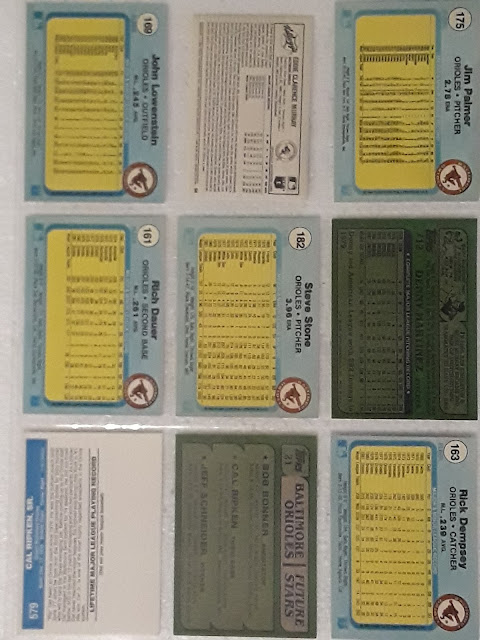
Fleer #175 Jim Palmer - In 1981, Palmer had a disappointing season, finishing with a 7-8 record and looked nothing like the ace of the Orioles' staff as he had been for the last decade plus. He would rebound in 1982 with a 15-5 mark and leading the AL in WHIP. He was once again in elite company, posting an ERA+ of 129 for the year, which helped him finish 2nd in the Cy Young voting. He'd been the Cy Young winner 3 times in his career, as well as a 20 game winner 8 times. He won a game in the World Series in 1966, 1970, and in 1983, with his team taking the whole enchilada each time. He was a first ballot Hall of Famer in 1990 with over 92% of the vote.

Kellogg's 3-D Super Stars #64 Eddie Murray - Steady Eddie was feeling the 2nd Place thing quite strongly in the early 80s. 1981 started a strong of 5 straight top 5 MVP finishes, but not once resulting in winning the award. In '81, Murray led the AL in Homers and RBI and had an OPS+ of 156. In fact his OPS+ was 156 again in 1982, and 83. In '84. he led the AL with a 157 OPS+, while also leading the AL in Walks (and Intentional Walks) and OBP. He was durable and dependable, with 27-33 homers and over 100 RBI as a near lock every season. He'd finish with over 3,200 hits and 504 Homers in his career, and is Major League Baseball's All-Time Leader in Sacrifice Flies. The 8 time All Star was a tremendous defender at 1st base, and was also a first ballot Hall of Famer like his teammate Jim Palmer.

Fleer #169 John Lowenstein - Lowenstein was known for his dry, witty banter with reporters and though he didn't make the National Baseball Hall of Fame, his 1982 Fleer Card shows he's a first ballot Style Hall of Fame member. 1982 was actually one of his best MLB seasons, coming towards the end of his 16 year career. He hit a career high 24 homers and 66 RBI while playing in a platoon with Gary Roenicke. The Lefty hitting Lowenstein got the lion's share of plate appearances and made the most of them. He was used as a utility man for a good portion of his career, which began in Cleveland. It was there that he generated some ironic attention when he publicly declared his disdain for "fan clubs." Some kindred spirits formed the Lowenstein Apathy Club, which involved sending the sardonic super-utility man letter signed in invisible ink that expressed their disinterest in his batting average and baserunning. Some expert-level smart-alecks even designed banners for home games that said "Hey Steiner" followed by 20 feet of blank white cloth. 

Topps #712 Denny Martinez - "El Presidente" was a fan-favorite and a very solid rotation option for nearly 25 years. In 1981, he led the AL in victories, and was the clear-cut heir apparent to the role of staff ace in Baltimore. He followed it up with another fine season with a 16-12 record. Early in his career, Martinez was a big time innings eater. His 18 complete games in 1979 led the AL, and in 2021 it would have been more than everyone in both leagues combined. He struggled with alcohol addiction in the mid eighties, but learned to control his addiction and reinvented himself on the mound. He would have a magical season in 1991 for the Expos, when he tossed a perfect game and led the NL in ERA and shutouts. His 245 career wins are the 2nd most by any Latino pitcher in MLB history, trailing only the legendary folk hero Bartolo Colon. Martinez was the first player born in Nicaragua to appear in a major league game, and he remains the most prolific major league player from that country. He has more complete games than Roger Clemens and Greg Maddux, and his 30 career shutouts ranks respectably high among his peers.

Fleer #182 Steve Stone - The 1980 Cy Young Winner was out of baseball by 1982, and it was all thanks to his dominant curveball. Stone was a solid starting pitcher at the back end of the rotation for 4 teams in the 1970s - the Giants, White Sox, Cubs, and finally the Orioles all saw flashes of brilliance, but Stone put it all together in 1980 with a 25-7 record. He won 14 straight decisions at one point, and it was all thanks to his decision that spring training to go all in with his curveball. The fallout from his career high 250 innings pitched was severe elbow tendonitis that limited him to just 12 starts in 1981. He was retired from the baseball diamond by the time his Fleer card was in packs. Stone was done playing but far from done with the game. He became the broadcast partner of Chicago legend Harry Caray, and has been a mainstay with the Cubs and the White Sox on both radio and television broadcasts since 1983.

Fleer #161 Rich Dauer - A self proclaimed "tough out but easy out," Dauer was a light hitting middle infielder with a great glove. Primarily used at second base, Dauer had a streak of 86 games without an error in 1978. The streak included another record of 425 straight chances without committing an error. He was especially tough to strike out, but was a career .257/.310/.343 triple slash hitter, which translated to a below league average hitter for his career. He was actually a hitting star in College with USC, where he helped lead his team to College World Series wins in 1973 and 1974. He didn't have a ton of hitting highlights in the big leagues, but did hit a homer in game 7 of the 1979 World Series, which would be the Orioles' only run in a losing effort.

Fleer #163 Rick Dempsey - Dempsey was also known as defensive wizard just like Dauer. His skills behind the plate gave him the opportunity to play regularly for the Orioles in the 1983 World Series, and he responded with 4 doubles and a homer to earn MVP honors. Dempsey would play for another World Series winner in 1988 as a backup to Mike Scioscia in Los Angeles. His career OPS+ of 87 wouldn't impress many, but his 2 world championship rings certainly makes him the envy of all his peers. 

Topps #21 Bob Bonner / Cal Ripken, Jr. / Jeff Schneider - 
Bobby Bonner was a great fielder at short, but unfortunately for him the prototype of the new "Slugging Shortstop" was coming up right next to him. The Orioles had its share of all-glove no hit guys on the team with Dauer and Dempsey. Bonner and Ripken were both up for the same spot to take over for long time Orioles Short Stop Mark Belanger, who was also famously fielding rich and power poor. Bonner couldn't keep up with Ripken's bat and ended up finding a different calling - he became a missionary and trains other missionaries and ministers in Zambia. 

Jeff Schneider saved one game for the Orioles in 1981, by giving up a walk and double but still managing to get the final out for a 6-5 squeaker of a win. That off-season, he was the throw-in player in a deal with the Angels for Dan Ford. Ford hit a clutch homer in the 1983 World Series for the O's, so Baltimore fans can thank Jeff Schneider for his small contribution there! Schneider was called up in the same transaction that resulted in Cal Ripken's call-up as well, so it's fitting to see him alongside Ripken on this card.

Cal Ripken played a bunch of games for Baltimore, most of them in a row. People think that's pretty neat.

Donruss #579 Cal Ripken, Sr. - You may have noticed in recent posts that 1982 Donruss was not one of my favorites. I will say that what I love about that set is the inclusion of coaches (not just managers! individual coaches). It didn't hurt that Cal Jr. was the #1 prospect in game. Even though they didn't know he'd be the AL Rookie of the Year, they had a pretty good hunch that he'd be in the conversation. Ripken Sr. was a baseball lifer, long-time coach in the Orioles organization, and would even become the manager for a brief period in 1987 and 88. The elder Ripken was a catching prospect, but a shoulder injury that did not heal properly ended his playing career early on. He became a coach and scout for the Orioles in 1961, though he still played sparingly when teams in the org needed a catcher. He had a tough and competitive personality, and his ethos as a coach influenced generations of Orioles players from Jim Palmer and Eddie Murray to his sons Billy and Cal, Jr. to many many others.  


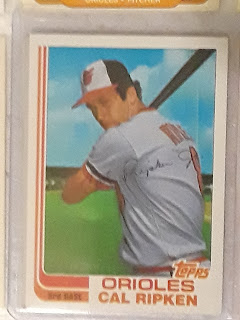
ok  ok here's the card I didn't put in the 9 pocket sleeve


that's what it would have looked like if I wanted to give myself a heart attack thinking about this card just chilling in a binder all loosey goosey - I couldn't even take a decent picture of it!

Note - my ancient laptop, which I've used with my scanner to post in this blog for the last 5 years or so, has finally bought the farm. I decided to do this post using my phone's camera instead of my scanner, probably will not post again until I can find a more permanent solution.

Wednesday, March 25, 2020

Let's Get Crackin'!


Julie from A Cracked Bat sent over an envelope recently with some very cool cards! This J.D. Durbin autograph is numbered to just 75 copies.


Julie had a few cards up for grabs recently, and I was happy to claim this Eddie Murray from Archives . . .


. . . and this 2020 Nelson Cruz insert from series 1. Julie also threw in the Durbin and a couple more extras!


Kennys! He was actually in minor league camp with the Tigers this spring, not sure what his fate will be now given the circumstances in which a season will or won't be played at this point. Maybe he'll get a chance to be a 1B / DH for Gardy at some point in 2020.


Last but not least was this neat patch card of Shannon Stewart - based on the design, I bet there is a bat relic version of this card as well! I miss these designs and products, even though Panini is still trying to get some portion of the market while they wait for a chance to once again have a license for MLB logos.

Thanks very much Julie! These are great!

Sunday, February 16, 2020

I Love the 80s : 1981 Baltimore Orioles

This is a series of posts on a 1980's Frankenset. Each page features a different team, with 9 of my personal favorite cards from that year's team. You might find players repeated, you'll definitely see brands repeated, but hopefully you'll agree that there are some interesting selections from the 1980s!

In 1980, The Orioles finished in 2nd place in the AL East though they did win 100 games. The following season they would once again play runner-up to the Yankees, with a 2nd place first half. They faded a bit in the second half of the season following the strike, with a 28-23 record which was 4th best in the division. 


The Orioles had a legacy dating back to the mid 60s as a top AL East Contender. Staff Ace Jim Palmer was a direct line from those 60s teams, having debuted for Baltimore in 1965. Mark Belanger was along for the ride as well, the team's everyday shortstop since 1968. More recently, Al Bumbry and Eddie Murray joined the team in the 1970s. Murray would be a foundational cornerstone for the new dynasty that was just getting started in the 1980s.


The Cards:
Drake's Big Hitters #6 Eddie Murray - The Switch Hitting Slugger Steady Eddie had a phenomenal 1980, just a couple years removed from his Rookie of the Year campaign. 1980 saw Murray achieve career highs with a .300 average, 100 runs scored, 32 homers, and 116 RBI. 

Topps #425 Al Bumbry -  The 1973 Rookie of the Year had a great 1980 season as well. He led the team in stolen bases and a .392 OBP as the O's leadoff man. He scored 118 runs and had 205 base hits, making his lone All-Star apprearance. Even in the strike shortened 1981, Bumbry would steal 22 bags. He would retire in 1985 after one season with the Padres. 

Kellogg's 3-D Superstars #2 Jim Palmer - Palmer was nearing the end of his illustrious career in 1980, but still a very effective lefty righty starter. He was technically not the team's best starting pitcher that year, but the wealth of experience he brought to the starting staff was invaluable. He sported a 16-10 record with a 3.98 ERA. 1981 was a bit of a lost season, but he would bounce back in 1982, leading the AL in WHIP and winning percentage with a 15-5 record. 

Topps #210 Jim Palmer - The lefty righty with the golden arm was a 3 time Cy Young award winner, 3 time World Series champ, and 4 time Gold Glove winner. He won 20+ games in 8 seasons, and was elected to the Hall Of Fame in 1990, his first year of eligibility. He nearly became the first active player enshrined in Cooperstown when he attempted a comeback in 1991, but he wasn't named to the final roster and ultimately stayed retired.

Donruss #591 Steve Stone - The team's ace in 1980 was Steve Stone. He won 25 games for the Orioles that season, no O's pitcher has matched it since then. Stone was part of the trade that sent Ron Santo to the South Side. The heavy workload in 1980 (250 innings pitched) took its toll on Stone's arm. 1981 would be his final season, though he would go on to a second career alongside play by play announcer Harry Caray with WGN.

Fleer #180 Dennis Martinez - El Presidente was used both in the starting rotation and in relief for the Orioles in 1980, starting 12 games and appearing in 13 more out of the bullpen. The role was somewhat surprising given that he led the AL in complete games and innings pitched in 1979, and would lead the league in victories in 1981. Martinez was the first person from Nicaragua to play major league baseball, and his 245 MLB victories were the most by a Latin American pitcher at the time of his retirement, surpassed only by Bartolo Colon.

Fleer Star Stickers #117 Eddie Murray - Eddie Murray would hit over 500 career homers and eclipse 3,000 career hits, joining an exclusive club with Willie Mays and Hank Aaron to reach both milestones during his playing days. Murray was never voted as the league's MVP, but he finished 2nd two times and was a top 10 finisher eight times. He is the All-Time MLB leader in intentional walks. 

Donruss #475 Tim Stoddard - The team's closer in 1980 with 26 saves, Stoddard appears to have been lost in a sandstorm on Tatooine, never to be seen again. But he would actually appear on major league rosters for another 9 seasons, though his 1980 campaign was probably his best year. 

Topps #615 Rick Dempsey - Orioles catcher Dempsey was a world series champion in 1983 and 1988, winning MVP honors for his .385/.467/.923 slash line in the 83 series. A career .233 hitter, Dempsey was best known for his excellent defensive skills behind the plate. He is one of just 29 MLB players (and just 3 catchers) to play in 4 different decades in the major leagues. He is the Orioles' all-time leader in games caught.   

Tuesday, July 30, 2019

1992 Topps Traded Set


The single solid color bricks that served as a calling card for Topps Traded Sets was gone for good in 1992. The longer, thinner boxes that started in 1990 were now the "standard" format, though Topps still had the brick version. Now both versions featured photo reproductions of the cards inside, featuring the big name free agents, rookies, and traded players.


Another change for trade was the back. For the first time since 1981, the traded set backs were the same color as the flagship set - no bright neon traded variation this time. Just like the regular set, a panoramic image of the player's new home was squeezed in whenever possible. There were 3 horizontal cards in the 1992 traded set, the rest are the more familiar portrait format.


Canada was stockpiling Hall of Fame players. Toronto grabbed a pair of Saint Paul, MN heroes, Jack Morris and Dave Winfield. The Expos reclaimed their prodigal son, Gary Carter was no longer the "The Kid," but still a fan favorite. Steady Eddie Murray would be one of several new faces in New York, hoping to power the Mets to the post season again.


The traded set rarely had the biggest of the big name rookies. 1992 would feature the future Rookie of the Year Pat Listach, Team USA standout Jason Varitek, 2-sport star Brian Jordan, and a very young Nomar Garciaparra. Nomar was just a college Freshman, earning his spot as the only walk-on for Team USA. It would be a few years before he'd return to the national spotlight with the Boston Red Sox.


Although 1992 was a big USA Olympic year, the baseball team was on the outside looking in. After losing to Cuba and Japan in the tournament, the US team missed out on all medals.


Canada would not field an Olympic baseball team, but they had the last laugh with the Blue Jays winning the first of two World Series championships. The "other" Canadian team was just showing early signs of the team they would become by the mid 90s.


The Minnesota Twins may have been overconfident following their 1991 World Series victory - they did little to improve their team following the season. They would replace Jack Morris with another 20 game winner, John Smiley. They also added veteran arm Bill Krueger. While the team actually had a better record in 1992, they would fall short of the post season behind the still dangerous Oakland A's.

I tossed in Taubensee and Valera as some of my favorite images from the set.


The Hot Stove may have been cool in the Midwest, but the fires were burning on the coasts. The big free agents flocked to New York, with the Yankees scoring Danny Tartabull and the Mets adding Bobby Bonilla. A pair of trades sent Gary Sheffield and Eric Davis out West. Davis would reunite with his childhood friend Darryl Strawberry, and Sheffield would team up with San Diego legend Tony Gwynn.


Some off-season moves don't work out the way they were planned...


And others work out even better than you had hoped!


Last but not least, here's Kevin Campbell. You may be asking... why? What? Why? Well, to tell you the truth, if I had made this post last week, I would have skipped right past this card. Over the weekend, the Twins were playing the Chicago White Sox and LaTroy Hawkins was doing the commentary alongside play-by-play man Dick Bremer. They were talking about pitch selection and Bremer asked about the 4-seam vs. the 2-seam fastball. According to Hawkins, he never threw a 4-seamer in his entire MLB career - and he owed it all to Kevin Campbell. During Spring Training in his rookie year, Hawkins was warming up in the bullpen and Campbell noticed some fastball command issues from the young righty. He showed Hawkins his grip for his 2-seam fastball and Hawkins found it to be much more comfortable than any pitch he'd thrown before. The rest of his 21 year major league career, that 2-seamer would be LaTroy's bread and butter. So there you go - Kevin Campbell!

Tuesday, March 5, 2019

Junior Senior - The 1989 Topps Traded Set


The 1989 Topps Traded Set has some of the more iconic cards in the Traded series of the 80s - and with the exception of the Ripken Rookie, the Ken Griffey, Jr Rookie is at the top of that list. I mean, it´s not even his most easily recognizable rookie card, but this was the card to chase from this set. He was already considered a candidate for all-time greatness, and he did not disappoint.


He wasn´t the only Hall of Fame player in the set - in fact, he wasn´t even the only Mariners Rookie Hall of Fame player! Rickey returns to Oakland, back where he made the biggest impact and where he would again bring greatness and glory to the Bay Area. Eddie Murray and Bert Blyleven both came home to Southern California- with Murray joining the Dodgers and Blyleven heading to the California Angels.


One more Hall of Fame homecoming - Texas born fireballer Nolan Ryan makes his last move and comes to the Texas Rangers.


Pretty good. Doesn´t even have a column for all the no-hitters, but they are still in there mixed in with those 55 shutouts.


Rookies! Omar Vizquel is still getting some Hall of Fame buzz, which I can see from a certain point of view, but right now I feel like there are still more than 10 candidates on the ballot I would rather have inducted first... Tom Gordon has an awesome delivery - he gets so low to the ground and just drives to the plate. Deion Sanders is an NFL Hall of Famer, and he had an eventful MLB career as well -- He played in parts of 9 MLB seasons, missing parts of the regular season for NFL responsibilities. He led the NL in Triples in 1992, even though he only played in 97 games. He also excelled in ¨Prime Time¨ hitting .533 with 5 stolen bases and 4 runs scored in the 1992 World Series against the Blue Jays. Which Kenny Rogers would you say is more famous? The pitcher, or the country singer?


3 Twins in the Traded Set - these guys were all added to the team in hopes that they would rebound from bad/sub-par seasons or breakout to their prospect glory... Long story short, that didn´t happen.


Some of my favorites from the set - I always think of Franco as a Ranger, even though he played seemingly everywhere else. A great candid shot of Bip Roberts, not really sure how he ended up in the Traded set again, he was already a rookie in the 1986 traded set... but that´s cool. Nothing wrong with more Bip! Steve Sax as a Yankee always makes me think of that Simpsons episode. ¨You don´t know when to keep your mouth shut, do you Saxy Boy?¨ I wonder if Jeffrey Leonard was a trendsetter for Griffey.. Hey, it´s Kent Tekulve´s birthday today! Happy 72nd, Kent!

Oh, maaaaan. Nice pinstripes.

Tuesday, November 20, 2018

1977 Topps All-Star Rookie Team

Here they are - the Topps All-Star Rookie Team, selected "by the Youth of America" following the 1977 season and featured in the 1978 Topps set. 

I have completed the run of these up through 2018, specifically all regular issue cards that bear the All-Star Rookie Trophy.


Second Base - Bump Wills
Texas (A.L.) 1977 - '81, Chicago (N.L.) 1982

In his favor, Wills is the son of Dodger great Maury Wills. Counting against him? The nickname "Bump" was acquired because he was known to bump into things as a child. Wills shared his father's speed on the basepaths, stealing 30+ bases in 4 of his 6 MLB seasons. He swiped 28 as a rookie, to go along with some power as well, knocking out 9 homers and 28 doubles. He had a career high 155 hits and was 3rd in the Rookie of the Year voting. Wills had consistent numbers throughout his career. In 1978, he set the Rangers record for stolen bases in a season, which still stands today. In the field, Wills had the most assists and the most putouts in the AL in 1978. Wills is also known for his 1979 Topps card, which has two versions. One with his team listed as the Rangers, and the other (more common) that listed him as a Toronto Blue Jay. Apparently Sy Berger was tipped off in the 1978 off-season that a big trade had been made, sending Wills to the Jays. Berger alerted his staff and they printed Wills cards as a Blue Jay before learning that the deal fell through (if it was legit at all in the first place). Wills played his final MLB season in Chicago with the Cubs, and later played in Japan for two seasons with the Hankyu Braves. He finished with 196 career steals, and was the Rangers' all-time leader until Ian Kinsler (and later Elvis Andrus) came along.

Bump's Rookie Card is 1977 Topps #494 shared with Jim Gantner, Mike Champion, and Juan Bernhardt.


Designated Hitter - Eddie Murray
Hall of Famer
Rookie Card
Baltimore (A.L.) 1978 -'88, '96; Los Angeles (N.L.) 1989 - '91, '97; New York (N.L.) 1992 - '93; Cleveland (A.L.) 1994 - '96; Anaheim (A.L.) 1997. 

Steady Eddie played 20 MLB seasons, and he was terrifying to opposing pitchers the entire time. Murray's career high was 33 homers, and the only season he led the league was in the strike shortened 1981 season, but you could set your watch to Murray hitting 20-30 bombs every year. Murray was the 1977 Rookie of the Year, even though he played 110 games as a DH. He was such a dynamic hitter that it didn't matter he didn't spend much time in the field. He would swap positions with Lee May the following season, with May becoming the primary DH while Murray became the mainstay at First Base. His glove was not a liability, he would even win 3 Gold Gloves over his career.  Murray was the heart of the order for the Orioles in the World Series runs of 1979 and 1983. For his career, he hit 9 post-season homers, averaging 1 per series. In his lone championship winning series of 1983, he hit a pair of homers while slugging .550 in the 5 games. His best season arguably came the following year, when he led the AL in Walks,  OBP, and OPS+, crushing 33 homers and driving in 110. He won his 3rd straight Gold Glove, made the All-Star team and won the Silver Slugger for First Basemen. He was never named MVP, but he finished in the top five in six seasons.

He never had the big peak, but he had strong numbers consistently for longer than almost any player in history. His later career included a pair of good to great seasons in Cleveland, helping the team reach its first World Series berth since 1954.

Murray finished with 3,255 hits, 560 doubles, 504 homers, 1,910 Runs batted in, and played more games at first base than any player in major league history. He is also the All-time leader in Sacrifice Flies, which is pretty neat!


Outfield - Mitchell Page
Rookie Card
Oakland (A.L.) 1977 - '83, Pittsburgh (N.L.) 1984

Page was the runner up to Murray for the ROY, but you could argue that Page should have taken home the hardware. Page hit 21 homers, and stole 42 bases for the A's while hitting .307/.405/.521 and scoring 85 runs while playing in left field all season. He did lead the AL with 14 errors in LF, but had a respectable arm with 11 outfield assists. Page was not able to repeat his fine rookie season, however, and following a contract dispute with the stingy Charlie Finley in 1979 and injuries that limited his mobility, Page struggled to stay with the big league club. He played until 1984, but never surpassed 57 games played in any season in the 80s. He was a bit player in the film "Angels in the Outfield " playing the Angels' First Baseman. Page passed away unexpectedly in 2011, after years coaching in the minor leagues for several different teams.


Outfield - Andre Dawson
Hall of Famer
Montreal (N.L.) 1976 - '86; Chicago (N.L.) 1987 - '92; Boston (A.L.) 1993 - '94; Florida (N.L.) 1995 - '96. 


The Hawk was tremendous, and yet his career still has a hint of "what if?" due to balky knees that derailed a historic pace. The National League's 1977 Rookie of the Year, Dawson made an immediate impact in Montreal. The city already had a young star in Catcher Gary Carter, but the addition of Dawson gave the team a formidable 1-2 punch. Dawson was very fast - stealing 20+ bases annually. He was strong, also hitting 20+ homers each season early on. In 1979, he had 24 doubles, 12 triples, 25 homers, and 35 stolen bases. Through 1983 and his age 28 season, Dawson's stats were quite similar to Billy Williams and Dave Winfield at the same point in their careers. 253 of his 314 career steals came in his first 11 seasons. Despite the knee and leg issues (12 surgeries during his career), Dawson still managed to log serious innings in the field and played 130+ games a season through the first decade of his career. His MVP season in 1987 was a statement to the world that his will was greater than the pain. Playing for a struggling Cubs team on an allegedly blank contract because no one else would sign him, he hit a career high (and league leading) 49 homers and 137 RBI. 

Dawson would finish his career with a couple forgettable seasons for the Florida Marlins in his hometown, but the incredible speed and power would be remembered vividly when he was inducted into the Hall of Fame in 2010. He was just the 2nd player in MLB history to steal 300+ bases and hit 400+ homers. He was an 8-time All-Star and won 8 Gold Gloves.

Andre's Rookie Card is 1977 Topps #473, shared with Gene Richards, John Scott, and Denny Walling.


Right Handed Pitcher - Dave Rozema
Rookie Card
Detroit (A.L.) 1977 - '84, Texas (A.L.) 1985 - '86

Rozema had impeccable control - as a rookie in 1977 he led the AL with just 1.8 walks per 9 innings. His meat-and-potatoes stats of a 15-7 record, 3.09 ERA and 16 complete games landed him 4th in the ROY vote, and 9th in the Cy Young race. He would not reach those heights again, despite the scarcity of walks, he didn't strike many batters out either. He was moved to the bullpen in 1980, and the great control was definitely an asset. Control on the mound didn't translate to control off it- his famously landed on the disabled list in 1982 for failing to complete a "flying karate kick" aimed at Twins infielder John Castino during a benches-clearing brawl. Rozema tore ligaments in his knee, ending his 1982 season. He was an integral part of the 1984 Tigers' pitching staff, serving as a spot starter and bullpen stopper, but was not part of the playoff roster as the Tigers won the World Series. The following season, Rozema signed with Texas and pitched two more major league seasons. He would appear again in 1990 in the Senior Baseball League as well.


Third Base - Wayne Gross
Oakland (A.L.) 1976 - '83, '86; Baltimore (A.L.) 1984 - '85.

Wayne Gross was an All-Star as a rookie in 1977, filling in for an injured Vida Blue as the A's lone participant. The Lefty slugger hit 22 homers his rookie year for the A's, and finished with 121 in his MLB career. He hit a homer in the 1981 ALDS against Kansas City, though the A's would ultimately lose the next series against New York. Gross played as the semi-regular third baseman for the next few years until the team acquired Carney Lansford. He even pitched a couple innings in 1983 for Oakland. He would hit 22 homers again in 1984 in his first season in Baltimore, but it would be his final full season. Gross also appeared in "Angels in the Outfield" like Mitchell Page, appearing as a White Sox relief pitcher.

Wayne's rookie card is 1977 Topps #479, shared with Brian Asseltine, Sam Mejias, and Al Woods.


Outfield - Ruppert Jones
Kansas City (A.L.) 1976, Seattle (A.L.) 1977 - '79, New York (A.L.) 1980, San Diego (N.L.) 1981 - '83, Detroit (A.L.) 1984, California (A.L.) 1985 - '87.


The Expansion Seattle Mariners were lucky to have Ruppert Jones, who was a big hit right off the bat. He had his own fan club in Center Field, "Roop's Troops," and was the team's first All-Star. He hit 24 homers that season and drove in 79 runs. He was not a patient hitter, striking out 120 times to just 55 walks, but he was never boring! Like many of the players on this All-Star Rookie roster, Jones had to deal with many injuries in his career. In the off-season following 1977, he had surgery to remove cartilage from his knee, and had a tough time meeting the same standard in 1978 that had marked his first year in Seattle. He came back the following year healthy and spry - he had a career high 33 stolen bases, along with career bests in several more offensive categories.

He would make his second All-Star squad in 1982 with San Diego, with a fine season playing as the team's main Center Fielder. Jones was a member of the 1984 champion Tigers team, though he was mostly a reserve player by that time in his career. Jones had over 1,100 career hits and of not for a series of injuries, could have had many more.

Ruppert's rookie card was 1977 Topps #488, shared with Jack Clark, Dan Thomas, and Lee Mazzilli


Short Stop - Bob Bailor
Baltimore (A.L.) 1975 - '76, Toronto (A.L.) 1977 - '80, New York (N.L.) 1981 - '83, Los Angeles (N.L.) 1984 - '85.

The Expansion Toronto Blue Jays had a rough first season, but Bob Bailor set an expansion league record with a .310 average for the season. Bailor was the first player selected by the Blue Jays in the 1976 expansion draft. It was the best batting average for a rookie in 1977 as well. Bailor was known to be tough to strike out, fanning in just 5% of his MLB at bats. Bailor was a multi-talented fielder; he was used primarily as a Short Stop in 1977, but in his career he played all over the infield and outfield. He was a favorite of managers throughout his playing career. Despite not having the most impressive stats, he played a smart brand of ball, rarely making any kind of mental mistakes. He was a mentor to younger players, which was parlayed into several seasons as the manager of the Blue Jays' minor league team in Syracuse. He was a bench coach with the big league club in Toronto, often as Cito Gaston's right hand man. He said when the Blue Jays won their first championship in 1992 - "I've gone from walking in the snow to walking in champagne," referring to the snow-covered field in Toronto for their first ever home game.

Bob's rookie card is 1976 SSPC #386; his first Topps Card is 1977 #474.


First Base - Doug Ault
Texas (A.L.) 1976, Toronto (A.L.) 1977 - '78; 1980.

Just because they weren't very good it didn't mean that Topps was going to pass up promoting the two expansion franchises. Toronto's Doug Ault hit the first home run in Blue Jays' history, then hit another in the third inning of that first game. He had three hits in all in the Opener, making him an instant hero in Toronto. With Eddie Murray playing most of the season as a DH, it opened a spot on the Topps All-Star Rookie squad for Ault, the First First Baseman in Toronto history. Ault hit .245 with 11 homers in 1977, and would play just two more partial seasons, ending his U.S. playing career in 1980. He would spend a season playing in Japan for the Hanshin Tigers, and another season in Mexico before becoming a coach in the Toronto minor league system.

Doug's rookie card was 1977 Topps #477


Left Handed Pitcher - Jerry Garvin 
Rookie Card
Toronto (A.L.) 1977 - '82

The third Blue Jay on the Topps All-Star Rookie Team, Garvin was the first rookie to win 4 games in the month of April. He also allowed 33 home runs, the most in the AL in 1977.


Like several of the players on this team, Garvin's rookie season was his best. He was the Blue Jays' most used pitcher in the 1970s, and he was on the hill for a franchise record 61 games in 1980. Following some time on the DL and a strike shortened 1981, Garvin was removed from the 40 Man roster in 1982 to make room for another pitcher, and he would not return to MLB play again.


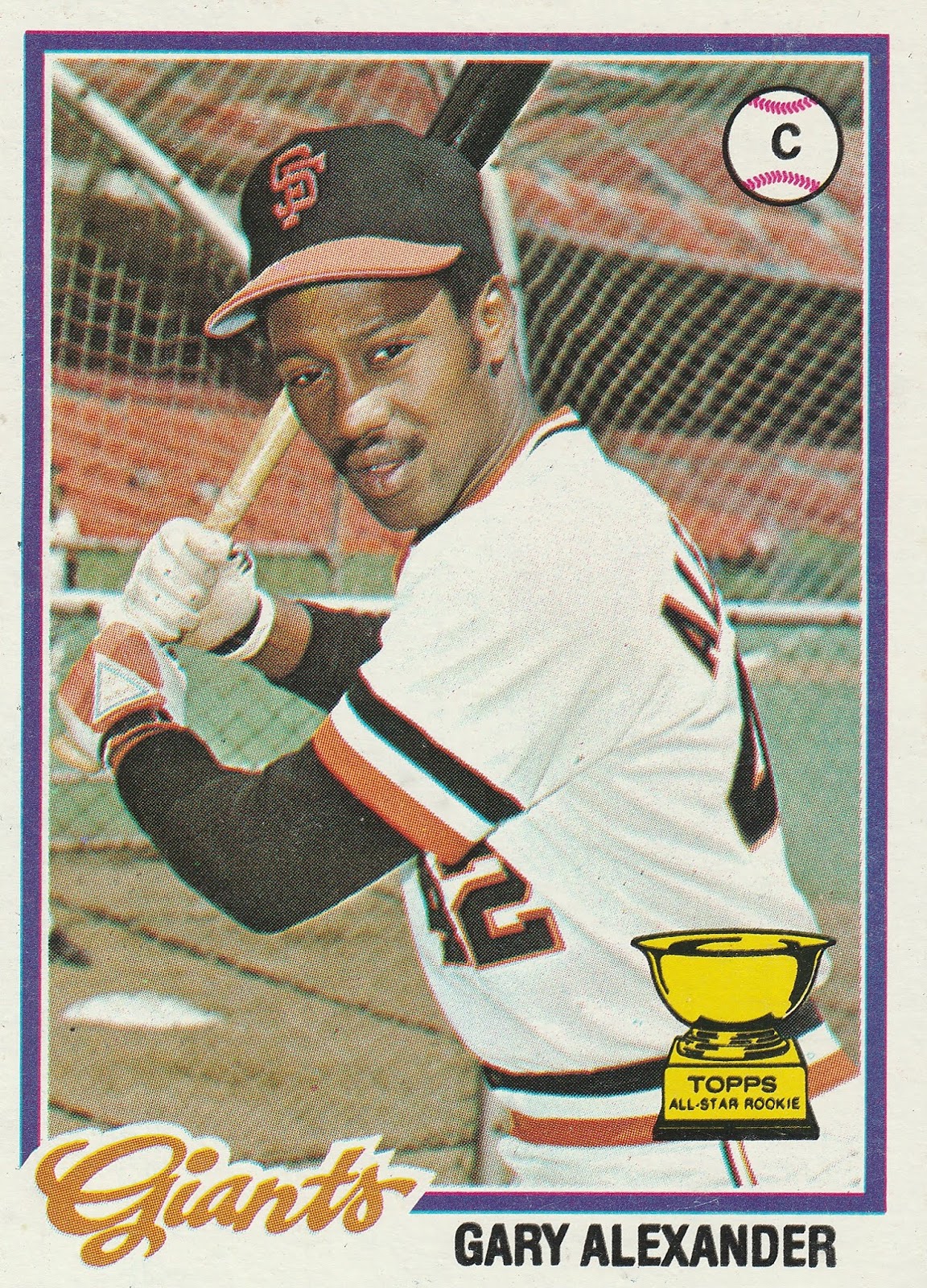
Catcher - Gary Alexander
San Francisco (N.L.) 1975 - '77, Oakland (A.L.) 1978, Cleveland (A.L.) 1978 - 1980, Pittsburgh (N.L.) 1981.

Alexander was not the Giants' primary catcher in 1977, appearing in just 55 games. His rookie season was sandwiched between catching John Montefusco's no-hitter in 1976, and a career high water mark in 1978, hitting 27 homers and 84 RBI. He did have a career high .303 average in 1977, and the other rookie catchers had similarly uninspiring stat lines. Alexander was the Texas League player of the year in 1975, so there was good reason to think he would have a strong career ahead of him. He would have another good season in 1979 with Cleveland, hitting 15 homers.

Gary's rookie card is 1977 Topps #476 shared with Dale Murphy, Rick Cerone and Kevin Palsey
Saturday, August 11, 2018

You Say Sat-ur-day, I Say Card-Show-Day


OK, I know I said I wasn't a fan of 1953 Topps, but every rule has its exceptions. They look fantastic in hand, and if they have been kept in good condition, they look great. This is just my 3rd '53 card, along with Player Collection guys Minnie Minoso and Elmer Valo.


I'm not going to run out and build the set, but this was a fun addition.


I'm still a big fan of the Horizontal '52 Topps cards - Sievers was available for a steal!


Things are moving ahead on the 1959 Topps set build.


My first two All-Stars from the back end of the set, I have a feeling some of these will have me muttering to myself before this set is completed.


I really like the backs on the All-Star subset.


The cartoon on Whitey Ford's card cracked me up - it was the batter's expression that did it for me.


Found a quarter box! I knew I'd find a Ranger Vlad in there eventually.


Some '80s goodness!


I don't know what I'm doing with these.


Or these...


But hey, Here's Tony Gwynn wearing Scott Sanders' jersey in a spring training game!


This was a special Eddie Murray Rookie card.


It's O-Pee-Chee! I had a great day at the card show - it's been a few months since I made it out, so I was happy to finally make the trip.