Showing posts with label 1994 Topps. Show all posts

Monday, July 8, 2019

1993 Topps All-Star Rookie Catcher - Mike Piazza


I started profiling the 1993 Topps All-Star Rookie team all the way back in March, and now we come to the end of the line - 1993 NL Rookie of the Year Mike Piazza. The burly catcher is the only member of this roster to make the Hall of Fame, but was famously the last one drafted.


The story goes that Piazza was drafted by the Dodgers as a favor - Mike's dad was a long-time close friend to Dodger legend Tommy Lasorda. The next chapter was all about Piazza struggling to succeed as a first baseman in the minors. Piazza even left his team briefly and if not for the encouragement of family and coaches, would have retired from baseball as a largely unknown player.


After returning, and after some very hard work to convert to a new position behind the plate, Piazza began to flourish in 1991 with Bakersfield. His 29 homers were a revelation. By the end of 1992, Piazza would climb three more minor league levels and make his MLB debut in a September call-up just a few days shy of his 24th birthday.


Once he made it to the big leagues, Piazza became a star. His Rookie campaign included an All-Star appearance, a Silver Slugger, a 9th place finish in the MVP race, and of course Rookie of the Year honors. He hit .318 with 35 homers and 112 RBI his rookie season. His 7.0 Wins above replacement was 2nd only to MVP Barry Bonds among position players.


This debut, coupled with the bright lights of Hollywood, made Piazza a frequent subject of insert sets in the crazy card world of the 1990s. The various card companies would work overtime to devise new ways to show Piazza's Prodigious Power.


Piazza spent his first 7 seasons with the Dodgers, hitting .331 with 177 homers. Good things don't last forever, and in 1998 the team and Piazza were at an impasse in negotiating a new contract. As often happens, newspapers spilled vast amounts of ink about player loyalty, and questioned Piazza's motives. For his own part, Piazza responded to criticism with scorn of his own- for the writers, for Vin Scully, for the Dodgers. In what could have been a life long, mutually beneficial relationship, the Dodgers and Piazza could not find common ground. Whether you want to blame the player or blame the owners, either way it was an unfortunately end to his time in Los Angeles.


It led Piazza to spend 5 bizarre games with the Florida Marlins. Marlins owner Wayne Huizenga was ready for a firesale, acquiring Piazza (and Todd Zeile) for Gary Sheffield, Charles Johnson, Jim Eisenreich, Bobby Bonilla, and Manuel Barrios. Florida essentially traded all of those guys (and Piazza) to get Preston Wilson and Ed Yarnall from the Mets. Piazza went 5-18 with a triple and 5 RBI for the Marlins before going on the move again.


He didn't know it yet, but the Mets would end up being the most significant stop in his post Dodgers career.


The two things that come to mind most readily about Piazza with the Mets are the 2000 Subway Series, and the Mets' games immediately following the events of 9/11. Piazza had a pair of homers in the Subway series, and his deep fly ball in game 5 was the final out. It would turn out to be the closest the team would get to a championship with Piazza. The next season, the Mets were disappointing but they saved their best work for the end of the season. After 9/11, it was Piazza who punctuated the Mets' return to NYC with a walk off home run.


In 8 seasons with the Mets, Piazza had over 1,000 hits, 220 homers, and 655 RBI. He'd make 6 All-Star squads and win 4 more Silver Slugger awards as a catcher with the Mets. 


As the wear and tear of catching limited Piazza's playing time and production, he would return to West Coast to finish off his playing career. He'd reach 400 career homers with the Padres, and his final appearance as a catcher. He'd finish his career with 83 games as the A's DH, platooning with lefty Jack Cust.

He is the all-time leader for homers by a catcher, and his 10 Silver Sluggers are also tops for the position. He was inducted into the Hall of Fame in 2016.

Tuesday, May 14, 2019

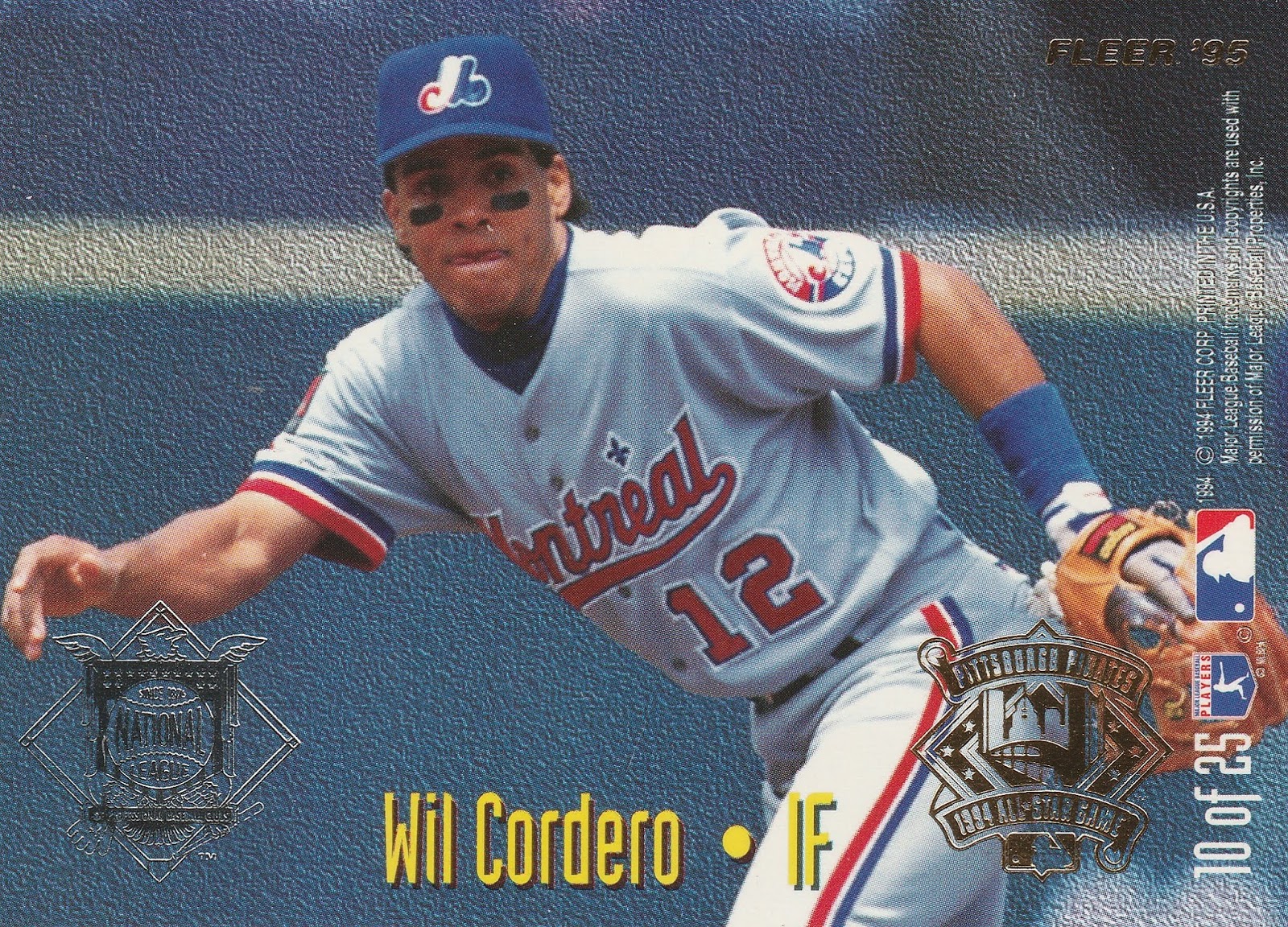
1993 Topps All-Star Rookie Short Stop - Wil Cordero


Wil Cordero had a decent rookie season, providing a little unexpected power (10 homers) to the Expos' middle infield. Along with teammate Mike Lansing, the future looked bright (Again! Still!) in Montreal. His fielding was still a work in progress (33 errors), but the Expos were content to allow Cordero to develop at the major league level. Instead of the dreaded "Sophomore Slump" Cordero would return in 1994 with arguably the best year of his major league career.


Cordero is from Mayaguez, Puerto Rico- the same city that produced Roberto Perez, Jose Vidro, Ozzie Virgil Jr., and Omar Olivares on the diamond and NBA player J.J. Barea. Cordero was signed by the Expos in 1988 just shy of his 17th birthday, and he made steady progress through the minors. In 1992, he was invited to major league camp in Spring Training, but an ill-timed slump and a pile of strike outs saw him returning to AAA Indianapolis for a second year. He would make his MLB debut in July, going 2 for 3 against the Dodgers, scoring 2 runs in a 4-3 victory. 


He'd play in 45 games for the Expos down the stretch in 1992, hitting .302 with minimal power (just 7 of his 38 hits went for extra bases.) He wasn't especially fast and his defense left a little to be desired, but he had the raw tools that a team operating on the strength of their next prospect crop would covet. He did show flashes of power in the minors (11 homers in '91) as well as being strikeout prone (122 Ks in  '90).


He put it all together in 1994 - making the All-Star team, and winning a Silver Slugger award as a Short Stop. He hit 15 homers for the Expos in the strike-shortened campaign.


The big season would make him an attractive trade chip, and he would be sent over to Boston in a trade for 4 players, the biggest name being pitcher Rheal Cormier. He'd play in Boston, Chicago, Cleveland, Pittsburgh, Florida, and back with the Expos again just in time for their move to Washington in 2005. He had a rough start was was released by the Nationals mid season. He'd finish 2005 playing for the Mets' AAA affiliate. He'd try again to make a comeback with the Mets in 2007, but was released prior to the start of the season.


Cordero played in 14 major league seasons, including the lone All-Star appearance in 1994, and two trips to the post season with Cleveland in 1999 and 2001. He hit .556 for Cleveland in the '99 ALDS including a home run in the ninth inning of a crazy game that ended with a score more like a football game, with Boston winning 23 to 7. The series went the distance, with Boston edging out Cleveland 3 games to 2.

Any fond Wil Cordero memories?

Tuesday, May 7, 2019

1993 Topps All-Star Rookie Left Handed Pitcher Steve Cooke


Lefty starter Steve Cooke was born in Hawaii, a descendant of some of the earliest U.S. citizens to travel to the island chain. His ancestors played baseball with innovator Alexander Cartwright while he was a firefighter in Honolulu in the 1800s. Cooke's own baseball journey began on the islands, but he would attend high school in Tigard, OR.


After pitching in college at Southern Idaho, Cooke was a 35th round selection of the Pirates in 1989. In the minors he made steady progress by displaying impeccable control and limiting damage. Cooke made his MLB debut in July of 1992, pitching the last 2 frames of a blowout loss to the Cubs. He made 10 more appearances that year for the major league club, setting the stage for his rookie year in 1993, where he would slot into the middle of the rotation.


Cooke's rookie season was something Pirates fans had not seen in some time. He led the team in strikeouts, Innings pitched, ERA, and finished second in victories behind the legend Bob Walk. The last time a rookie led the Pirates in strikeouts was aaaallll the way back in 1949! His 10 victories were the third most among rookies in 1992, and a lefty with a pulse, he was a highly coveted asset for the Pirates. As is often the case with young pitchers, injuries can quickly derail even the most promising of starts. Cooke had shoulder issues crop up which would require surgery, and knock him out of major league action for nearly 2 full seasons. He would make a comeback for the Pirates in 1997.


Cooke would find rough sailing upon his return but it was still a thrill and a pleasure to be back in a big league uniform. He'd top 100 strikeouts again in 1997, for the first time since his rookie campaign, and had 9 victories for the Buccos over 32 starts.


In 1998, he'd make one start for the Cincinnati Reds, allowing 1 run over 6 innings, but injuries again would limit his time on the field. He was diagnosed with tendinitis in his elbow after missing his second start, and would not pitch again in 1998. He'd sign with the Rays for 1999, but did not make the team. He pitched 5 games for the Padres' AAA affiliate, then spent 2 seasons in independent baseball before retiring.

Monday, April 29, 2019

1993 Topps All-Star Rookie Right Handed Pitcher Greg McMichael


Greg's big league career was nearly over before it started. In 1990 as a starter in the Cleveland minor league system, McMichael tore the meniscus in his knee, Cleveland would grant him his release and gave him some harsh advice - to retire.


Greg had other plans, and despite the injury to his knee, he was not looking long to find a new home. He joined the Durham Bulls in 1991, picking up where he left off. Atlanta's rotation already boasted Smoltz, Glavine, and Steve Avery when they added free agent Greg Maddux. McMichael's best path to the big leagues would have to be through the bullpen.


Greg was a non-roster invitee in 1993 for the Braves' spring training squad. He forced his way onto the roster by being the best pitcher all spring long. McMichael was used a middle reliever to start the season, but his ability to miss bats saw him move into higher and higher leverage situations, becoming the team's closer for the second half.


In his new role, McMichael shined. He would convert his first 15 save opportunities, and was the team's closer throughout the 1993 playoffs as well. His 2.06 ERA and 19 saves in the regular season earned him a 2nd place finish in the NL ROY balloting.


He would be the Braves' closer again to start 1994, saving 21 games to lead the team again. He'd pitch in a pair of World Series, in 1995 and 1996- and earned a save in the 1995 NLCS against the Reds. After the 1996 season, McMichael was traded to the Mets for Paul Byrd. In New York he'd have a few more solid seasons as a late innings reliever. He was traded to the Dodgers for a month in 1998 for Hideo Nomo, then traded back to the Mets for Brian Bohanon. Shoulder issues would plague the rest of his career, heading to Oakland in a trade in 1999. He'd have off-season surgery on the shoulder, then return for one last ride in Atlanta before a rotator cuff injury would force his retirement. In over 500 MLB innings, McMichael would strikeout 459 batters while surrendering just 42 homers. He retired with a 3.25 career ERA. He's now the Braves' alumni coordinator and coaches pitching at Emory.

Monday, April 22, 2019

Laser, Focused - 1993 Topps All-Star Rookie Third Baseman Mike Lansing


I learned something new today! Mike Lansing was drafted by the Baltimore Orioles in the 9th Round of the 1989 draft, but opted to return to college at Wichita State for another year. Here comes the crazy part - in 1990, Lansing was drafted by the Miami Miracle in the 6th Round of the 1990 MLB draft. What? Was the Miami Miracle just a name being used by the Marlins before they started with their official MLB games? Nope. The Miracle were an independent Minor League team. Major league baseball's rules allowed minor league clubs to participate in the June amateur draft, for some reason. In 1990, it was the Erie Sailors of the NY-Penn League and the Miracle, both Class-A teams making selections out from under the noses of the MLB clubs. The Miracle actually made 16 selections in the 1990 Draft and signed 15 players- the best known was Mike Lansing.


In his 2nd season in Miami, Lansing stole 29 bases and hit close to .300. As the Miracle were winding down their operations (they later relocated to Ft. Myers and are the Twins' high A affiliate now) in 1991, they sold off as many of their players as they could. Lansing was the biggest prize, a slick fielding and speedy middle infield prospect with a little bit of pop in his bat. The Expos jumped at the chance to add Lansing, and he spent 1992 with AA Harrisburg.


Lansing would have a fantastic rookie campaign in 1993, hitting .287 and stealing 23 bases. He played all over the infield, Topps gave him the nod as the All-Star Rookie squad's 3rd Baseman. He had a slow first half in 1994, but starting in June of that year, Lansing tapped into his potential and started to spray the ball all over the field. Each season would bring a different milestone - career high in steals in 1995, career highs in runs scored (99) and hits (185) in '96. Then in his final season in Montreal, he put it all together.


Lansing smashed career highs of 45 doubles, 20 homers, and drove in 70 runs for the Expos, while hitting .281. Lansing was the right mold of player to help out in Colorado, and certainly the thought was that playing at altitude would only improve on those career numbers. The Rockies gave up Jake Westbrook and a pair of other minor league prospects to get him.


While he didn't hit 20 homers again in Colorado, he did have his share of highlights, including the very first Rockies hit at Coors Field.


A serious back injury in 1999 ended what was a promising start - he was hitting .310 after his first 35 games.


In 2000, Lansing would come back with a strong season, and even hit for the cycle:


He was traded again mid-season in 2000 to the Boston Red Sox, his name being the biggest of the seven player group with three Rockies heading to Beantown and two pairs of Sox coming back in the deal. He'd play a full season in Boston in 2001, a year with Cleveland's AAA team in 2002, and retire following another back injury. Originally from Casper, Wyoming, Lansing is still active in the Colorado area often providing interviews for the local Rockies coverage.

Monday, April 1, 2019

King Fish - 1993 Topps All-Star Rookie Outfielder Tim Salmon


Last week I covered Mr. Marlin, and this week it's "King Fish," Angels outfielder Tim Salmon. Salmon was a no-brainer for the Topps All-Star Rookie Roster, winning the 1993 AL Rookie of the Year award with 31 homers and a .283 batting average.


Salmon was already swimming on the Angels' sonar when he was drafted in 1989. The SoCal kid had already been drafted once before in 1986 by the Braves, but Salmon opted to go to school instead, attending Grand Canyon University in Phoenix, AZ. He is the school's All-Time leader in Homers, runs scored, and RBI. His #10 was retired in 2002, and he was named to the GCU Hall of Fame in 2010. He still holds an NAIA record for walks in a season, drawing 81 free passes in 1989. His patience at the plate would continue throughout his career, with a .385 OBP in his 14 major league seasons. He'd play in the Cape Cod league in the summer of 1988 along with 39 other future major leaguers, possibly the best season in that league's history.


In his first 2 pro seasons, Salmon had some bad luck with a pair of beanings. The second pitch, in 1990, shattered his jaw and put him on the shelf for 2 months. Undeterred, Salmon made quick work of the low minors and swam swiftly upstream to become the 1992 Minor League Player of the year. His 31 homers in 1993 were impressive enough, but he would hit 30+ homers again in '95, '96, and '97. He joined Don Baylor as the only other Angel to hit 30+ homers in consecutive seasons.


His 1995 season was perhaps his best. Following a strike shortened 1994 in which he had a 132 OPS+ but only played in 100 games, Salmon would tip the scales in his favor as one of the best outfield bats in the American League. He would win a Silver Slugger award while posting career highs in batting Average, OBP, Homers, Hits, Runs Scored, and total bases. He sported a gaudy 165 OPS+, and racked up 6.6 WAR.


Salmon would drive in even more runs in 1997 (a career high 129 RBI), and ultimately became the Angels' All-Time leader in homers and walks. After a power packed 2000, he would have a rough 2001, with career lows in many major categories as he played through some nagging injuries. Before the season he had signed a 4 year extension with the now Anaheim Angels, nearly taking an offer to play with the Diamonbacks instead.


He may have wanted to be a part of the Diamonbacks' 2001 championship team, but instead he was able to be a part of a very special 2002 Angels team, blasting 22 homers and being named the AL Comeback Player of the Year. He would hit 2 more homers in the Game 2 of the World Series against the Giants, and the Angels would capture their first Championship thanks to the heroics of one of their greatest players. Tim Salmon was never a member of an All-Star Roster, the AL was overcrowded with talented outfielders. Consider his best season of 1995 - the starters were Kirby Puckett, Kenny Lofton, and Albert Belle. That meant Ken Griffey Jr settled for a reserve spot, along with Manny Ramirez, Paul O'Neill, and Salmon's teammate Jim Edmonds. He remains the Angels' All-Time leader in homers and walks, and is second for RBI and runs scored behind Garret Anderson. There's another fish out there gaining on him in the Angels' record books, but Salmon remains the King Fish.

Tuesday, March 26, 2019

1993 Topps All-Star Rookie Team - Outfielder Jeff Conine


Well, well, well if it isn't Mr, Marlin himself! The Expansion Draft in 1992 netted several big names for the Marlins including their Inaugural Opening Day starter Charlie Hough, future Hall of Famer Trevor Hoffman, ace reliever Bryan Harvey, and their franchise centerpiece in their early days, Jeff Conine.

Racquetball Superstar!

Conine was a standout baseball player at UCLA, but as a relief pitcher. In fact, he only had one plate appearance in college (he was hit by a pitch), but his hitting prowess was an open secret. The Kansas City Royals' GM John Schuerholtz had the inside scoop from UCLA's pitching coach that the team's best hitter was actually in their bullpen. The Royals made Conine their 58th Round (!) pick in the 1987 MLB Draft.


Conine would put up decent numbers in 3 minor league campaigns including hitting .320 with 15 homers for the AA Memphis Chicks in 1990, earning him a September Call-up. In 1991 injuries limited him to just 51 games at AAA, and his career was in danger of ending before it began. He came back strong in 1992, blasting 20 homers in 112 games for AAA Omaha, again returning to the majors for 1992.


The expansion draft changed everything. Conine was about to hit his peak, the Marlins needed athletes all over the diamond. No longer waiting in the wings in KC, Conine would play in all 162 games for the Marlins in 1993. He rapped out 174 hits, 12 homers, and drove in 79 runs as a rookie, finishing 3rd in the NL Rookie of the Year voting.


Conine would make the All-Star Team in 1994 and 1995. He would be the All-Star MVP in the second game, hitting a solo homer in the 8th inning, which would prove to be the winning run. In 1996, he had career highs in hits, runs, doubles, homers, and total bases. While Conine put up good numbers in South Florida, the team would finish no higher than 3rd, and at least 16 games out of first place in the NL East through the 1996 season. Conine experienced a lot of losing seasons and growing pains in Florida, so winning it all in 1997 was a bittersweet victory. Bittersweet because Conine was a notable casualty of the Marlins' first fire sale.


After spending a season back in Kansas City, Conine would move on to the Baltimore Orioles as the team's DH/1B and fill in corner outfielder. He would be a bit better than league average over 6 seasons with the O's, with a heavenly 777 hits. In 2003, he'd wind up back with the Marlins just in time for another post-season run. Once again the Marlins won the Wild Card, and Conine turned up the volume in the NLCS, hitting .458 with a homer against the Cubs, and a .333 mark in the World Series, scoring 4 runs against the Bronx Bombers. His 2nd title in Florida cemented his place as a Marlins legend. He would play in the bigs until 2007, with short term stops in Philly, Cincy, and with the Mets for 21 games. He signed a 1-day contract with the Marlins in 2008 to officially retire with the team.

After his playing days, Conine competed in Triathalons, and more recently had been on the Marlins' broadcast team, until Derek Jeter purged the organization of many former Marlins in favor of a clean slate. His son Griffin was a 2nd round pick by the Blue Jays in the 2018 MLB draft, as Toronto continues to stockpile next generation talent.

Monday, March 18, 2019

1993 Topps All-Star Rookie Team - Outfielder Wayne Kirby

I see you, Jeff Reboulet.

Topps All-Star Rookies seem to fit into three categories - future stars, one year wonders, and guys that toiled for years in the minors before finally breaking through. Wayne Kirby falls squarely into that last group.

Look at all that experience!

Wayne Kirby was a Dodger prospect for several years, being drafted in the winter of 1983 out of high school. Kirby would display excellent speed in the minors, stealing 50+ bases twice. Kirby would come to Cleveland as a minor league free agent following the 1990 season. Kirby was a 29 year old rookie in 1993.


Cleveland had a lot of guys younger than Kirby, with more MLB experience that season. 1993 started with tragedy; Pitchers Steve Olin and Tim Crews were killed in a boating accident during Spring Training. 1993 was also the team's last season in Cleveland Municipal Stadium. With Albert Belle in LF and Kenny Lofton in Center, Kirby had one spot left to claim as the team's regular right fielder. His 1993 season included a league leading 19 outfield Assists. At the plate, Kirby was the team's #2 hitter, batting just after Lofton and before Carlos Baerga. He would hit .269 and drive in 60 runs. He stole 17 bases and scored 71 runs of his own.


Welp. It was a good run, Wayne. Kirby was essentially just keeping Right Field warm for Manny Ramirez, who tore up the minors in 1993 and made his MLB debut by season's end, including a 2 homer game against the Yankees in his home town of New York. But Wayne was not done in Cleveland. He was still fast, could handle the bat well, and played all three outfield positions. He would stay with the team in 1994 and 1995 as the team's fourth outfielder.


For every Manny and Jim Thome that can lead a team, there needs to be a Wayne Kirby and Alvaro Espinoza to keep the clubhouse together. Espinoza and Kirby were known as notorious pranksters throughout the 1995 World Series run. Espinoza's specialty was sticking things to a player's hat with a stealthily placed wad of gum. Of course, the bench players were more than just comic relief, and Kirby in particular played a vital role filling in for Kenny Lofton during the season, and for Albert Belle in the 1995 playoffs when they were out of the lineup with injuries.

Kirby would go on to play in a reserve role for several teams until 1998. After his playing career, Kirby found a home as a coach with Baltimore Orioles.