Showing posts with label Washington Nationals. Show all posts

Monday, February 28, 2022

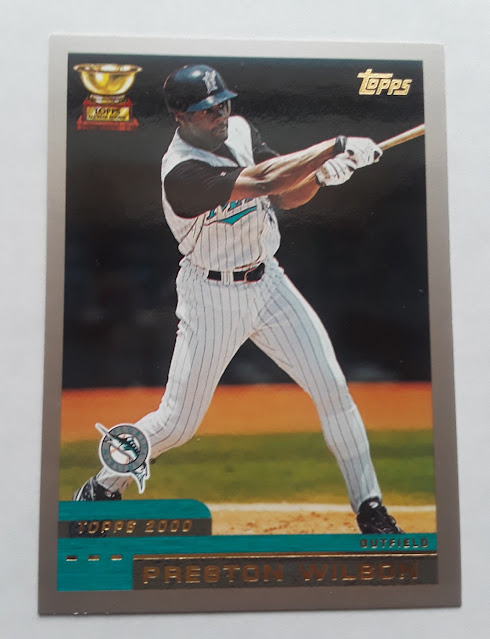
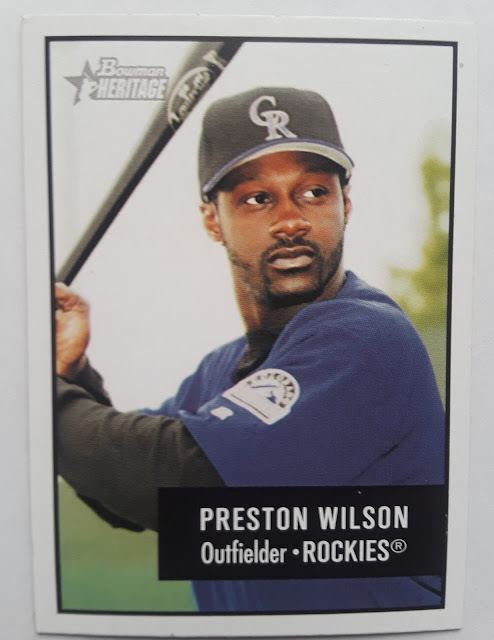
1999 Topps All-Star Rookie Outfielder Preston Wilson


Preston Wilson arrived in the big leagues after a very long journey that took him from the first round of the 1992 MLB Draft, to 4 top-100 prospect listings, to a winter spent playing baseball in Australia. After a 5 year minor league sojourn, Wilson had arrived in Queens, only to be traded away after just 8 games for the Mets. Wilson was big time prospect coming to Florida in exchange for the Marlins' brand new catcher Mike Piazza. 
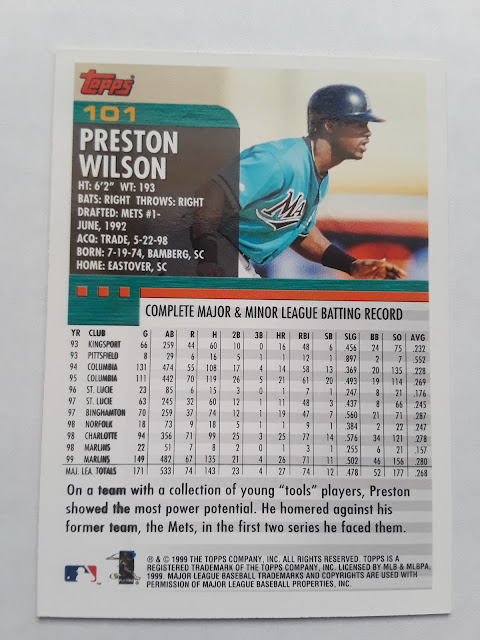

His first full season came in 1999, and he was able to show power and a little speed for an exciting and young rebuilding Marlins team. He'd finish 2nd in the NL Rookie of the Year voting and had a strong season, with a 119 OPS+ and hit 26 homers to go with 11 stolen bases. He was a great choice to join the 1999 Topps All-Star Rookie team.
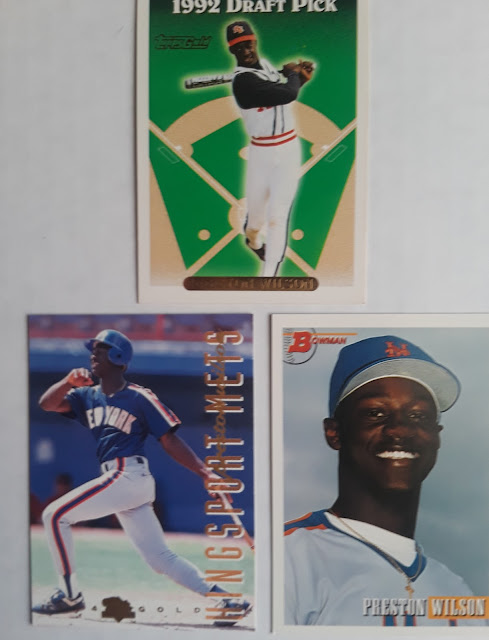

Wilson was the 9th Overall selection in the 1992 MLB draft, picked by his adopted father Mookie's former team, the New York Mets. To get the potentially awkward subject out of the way, Mookie Wilson's brother Richard was Preston's biological father, but it was Mookie that became Preston's mother Rosa's husband and raised Preston as his own son. So Mookie is technically Preston's uncle, but was also his father as far as Preston was concerned, and officially adopted him. Families are complicated, but it is clear that Preston was well loved and well raised by his parents. Preston was just 17 when he was drafted, and started his pro career with the Kingsport Mets in 1993. Before joining the Mets, he was the 1992 High School player of the year, and hit well for the 1992 18U USA National team. 

Wilson had no trouble launching the ball out of the park, hitting 17 homers in his first pro season, then at least 20 a year after that. In 1996, he played in just 23 games because of injuries to his wrist and shoulder. This had little to no impact the following season, as he hit 30 homers across 2 levels in the Mets organization, and then traveled down under for the Australian Winter League. I couldn't find any stats for his time with the Newcastle Hunter Eagles, but by the Spring of 1998, Wilson was poised to make his long awaited big league debut. He played in just 18 games for AAA Norfolk Tides before being called up in May 1998. His debut consisted of a 3 for 4 game with a stolen base and a run batted in. Each base hit, he was able to briefly visit with his dad, Mookie, who was the Mets' first base coach at the time.
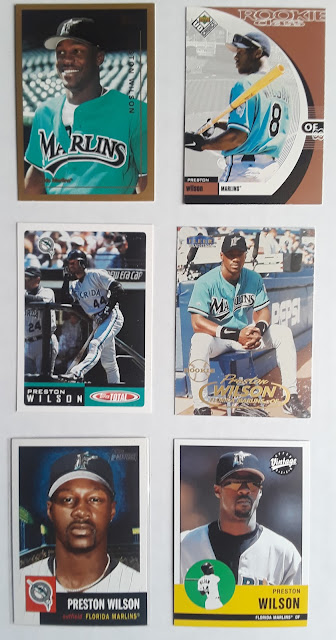

Wilson's trade to the Marlins included a demotion back to AAA, where he nearly hit 30 homers again, showing he was more than ready for a shot at the big leagues. Wilson would have an even better sophomore season, when he joined the 30-30 club in 2000. He was known for big power, but his swing also was conducive to strikeouts. In 2000, Wilson struck out 187 times, which was the most in the Majors, and nearly broke the long time record that Bobby Bonds held. Over his 4 full seasons with the Marlins, Wilson averaged 26 homers and 82 RBI per year. 

Wilson was traded to Colorado prior to the 2003 season, and the Rocky Mountain air was kind to Preston. 2003 would include career highs for Wilson across several offensive categories, and he led the National League with 141 RBI. 2003 was also Preston's lone all-star season. Wilson went 1 for 2 in the Midsummer Classic.
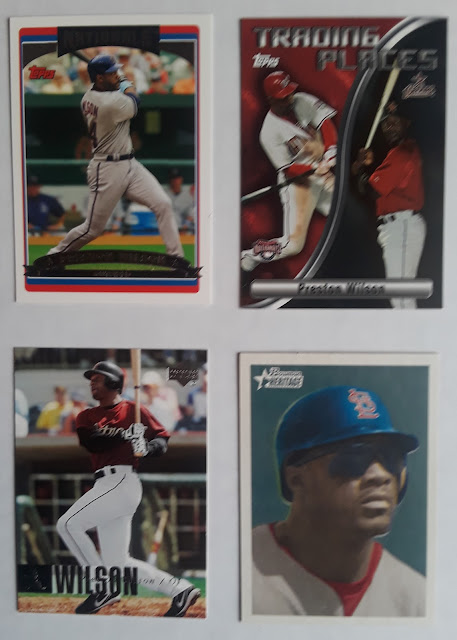

So, once a player has been a Topps All-Star Rookie, led the league in a few different offensive categories, made an All-Star team . . . what's left to check off? A World Series win, of course! Wilson started 2004 off slowly in Colorado, and was traded to the newly minted Nationals in Washington. He ended up playing what would amount to roughly one season with the Nats before being traded mid season to Houston, just in time to make a run at the post season. The Astros fell short, but the 2006 season would give Preston another chance to play the role of 2nd half star. Wilson was released at the deadline and picked up by the Cardinals, and he solidified the team's outfield rotation, providing a little power (9 homers in 33 games) and a little good old fashioned veteran leadership. Along with a strong cast of characters, the Cardinals would prevail in the World Series against the Detroit Tigers. Wilson appeared in all 5 games and picked up a pair of hits, scored a run, and drove in another. 


Following the 2006 championship, Wilson returned to St. Louis for an encore, but injuries limited his effectiveness and he played in just 25 games. Wilson worked hard to get back, and even played for the Independent League Long Island Ducks for 48 games in 2009 before deciding to retire. After his playing career, the charismatic and outspoken Wilson became a regular on Houston Astros and Florida Marlins broadcasts, and has dropped in as an MLB Network analyst from time to time as well. 

Wilson was recently interviewed for a Sports Illustrated article about declining participation of African-Americans in Major League Baseball, and his experiences and insights bring an important story into focus. You can read the article here -  and there's quite a bit to unpack inside. Wilson is also active on Twitter, his handle is @PrestonWilson44

Monday, June 8, 2020

1997 Topps All-Star Rookie Outfielder Jose Guillen


Jose Guillen  has one of the better All-Star Rookie cards of all time. Posing with the statue of the great Roberto Clemente, and poised to become the Pirates' right fielder of the future, Guillen beamed. He shared some of the same skills that made Clemente so good, in particular a throwing arm that dazzled and delighted fans. He was a Topps All-Star rookie at just the age of 20, with a long and productive MLB career ahead of him.


Guillen would have a decent season for the Pirates as their everyday Right Fielder in 1997. He hit 14 homers and drove in 70 runs. He was the 4th youngest player in the league but was still entrusted with the second most plate appearances on the Pirates' squad. While he had a great arm (9 assists as a rookie), he struggled a bit with the leather, ranking 2nd in errors among right fielders. He ranked below league average in rate stats, however was still learning the finer points of the game.


Guillen was signed in 1993 by the Pirates as a free agent out of the Dominican Republic. He would spent his minor league career in Single A clubs, with an MVP season in 1996 for the high A Lynchburg Hillcats. His final minor league season, he hit .322 with 21 homers and 24 stolen bases. The steals were somewhat of a mirage, as he never stole more than 5 bases in a season before or since. He followed up his 1997 season with a nearly identical 1998 season. He performed even better in the field, and led the NL in RF assists. Despite two seasons with 14 homers and nearly as many errors, Guillen was still considered a top prospect by many observers, who were more than willing to compare him to Roberto Clemente or Dave Winfield, who did have somewhat slow starts to their Hall of Fame careers. 


After leaving Pittsburgh, Guillen began a whirlwind tour of the big leagues, never stopping in one place for more than a couple seasons. He was either burning bridges or providing tantalizing potential at seemingly every stop along the way. Tampa picked him up in 1999 near the trade deadline, and he would muster just 15 homers over the next 2 and a half seasons before being released. The Arizona Diamondbacks gave him a chance, and after hitting .229 over 54 games, he was cut loose. The Rockies had him for just two days, and decided to go in  another direction before he hooked up with the Reds in Cincinnati to finish the 2002 season. He actually played his best baseball in Cincy, including a torrid first half in 2003, when he slashed .337/.385/.629 with a 165 OPS+. He found his power stroke, hitting 23 homers for the Reds before becoming a deadline deal to the Oakland A's. It was in Oakland the he had his only taste of post season play, hitting .455 in 4 games against Boston in the 2003 ALDS. 


He then signed a deal with AL West rivals the Angels, but butted heads with Mike Scioscia on numerous occasions. Even with a career high 104 RBI, he was on the move again after one season in Anaheim. Now in D.C., Guillen had a good season, followed by an atrocious one in which he hit just .216 with just 9 homers. The next year he was in Seattle, and managed to knock in 99 runs, but wore out his welcome there just as quickly. He then signed a 3 year deal with Kansas City, and nearly fulfilled the whole contract before being traded midway through the 2010 season to San Francisco. By that point he had publicly called his teammates babies and openly complained about K.C.'s losing culture. 


His final MLB stop was a stretch run in San Francisco for the Giants team that finally got over the hump and won a championship. Guillen missed the on field celebration, he had been left off the post season roster while being investigated for the alleged use of HGH. He hit .266 with 5 homers and 13 RBI for the Giants in the closing months of the 2010 season, and they would be the last games he would play in the league.

His Career MLB Totals

I'll leave you with a more positive note, here's video of Guillen's tremendous throwing arm taken from a game in 1998. 

Do you have any Jose Guillen Stories? I'd love to read them in the comments below. Thanks for reading!

Monday, May 11, 2020

1997 Topps All-Star Rookie First Baseman Dmitri Young


"When I was growing up, I used to draw myself on the Donruss Rated-Rookie and the Topps' Future Star cards with the trophies and the cup." Dmitri, you made it! As the Rookie All-Star Squad gets started for another season, we see the trend continue with a prospect with promising stats making the squad. Dmitri Young forced his way up to the big leagues with a gaudy batting average and power potential. While his first season was a bit below his later career totals (just 5 homers in 110 games, and a .258 average), he still gave Cardinals fans a taste of what was to come.


Even before his official rookie season in 1997, Young was given the opportunity to shine. He was placed on the 1996 post season roster for the NLCS, and he hit a respectable .286 in 4 games. His rookie season in 1997, Young was called up when Brian Jordan was lost for the season due to injury. Young came in to play first base, which had been vacated by John Mabry, who was filling in for Jordan in the outfield. When the Cards dealt for Mark McGwire at the deadline, Young moved back to the outfield to make room. While shifting all over the field, Young still had an impact, getting 86 hits and driving in 34 runs.

This is one of Dmitri's least favorite cards, with a photo taken before he got braces.

Young was a first round pick (4th Overall) by the Cardinals in 1991. Young was a USA-Today All-American in high school, hitting .425 for his final amateur season. He had anonther great season in Single A Springfield, hitting 14 homers and stealing 14 bases at the tender age of 18. He was named to the Midwest League All-Star squad, and was called a "Terry Pendleton - type" player by scouts. I mean he played 3rd Base in the Cardinals org, so I guess that is an easy comparison to make...


The 1997 season would be his last in Saint Louis, as the team was getting Brian Jordan back and had a bit of a logjam in the corner outfield and a Big Mac ready to have a real Whopper of a season in 1998. Young was traded to Cincinnati in exchange for Jeff Brantley. Before the season began, it looked like he would be on the move again - The Tampa Bay Devil Rays selected Dmitri from the Reds in the expansion draft, but Cincy was willing to double down and trade for him again. This time, the Reds gave up Mike Kelly, who was a similar rising prospect who had a promising 1997.


The Reds would get the best of that deal with the Devil (Rays). Dmitri Young revealed himself to be a great contact hitter during his days with Cincy, including four straight seasons above .300. He would also hit double digit homers each year, finishing with a then career high 21 in 2001. That number set a Reds' franchise record for home runs by a switch hitter. His slash line with the Reds was .304/.353/.488 from 1998 through 2001. The team flourished initially with Young in the lineup - finishing a close 2nd place in the division in 1998 and 1999. When the team began to struggle again, Young became one of the more valuable trade chips, and would be moved to acquire a pair of younger players as the Reds began another rebuilding process.


Young's first year in Detroit was derailed by injury, playing in just 54 games. Even so, the shortened season featured an 18 game hitting streak. The following season, 2003, would be one of his best. He posted career highs in Hits, Triples, and Homers while hitting an OPS+ of 144. He was named to his first All-Star team. In May of that year, he became the first MLB'er since Willie Mays to have 2 HR and 2 Triples in the same game. He went 5-5 (on Cinco de Mayo, no less!) and had 15 total bases, the most in a game by a Tiger since Ty Cobb in 1925. For the season, his 302 Total bases was another career high. Dmitri's great season came during one of the Tigers' worst - the team lost 119 games. The team would improve the next two seasons, and were in the thick of a playoff run in 2006 when Dmitri was released. The team had signed Rondell White in the off season to take Young's spot in Right field, despite a pair of productive seasons. Now relegated to DH duties, Young would play in just 48 games for Detroit before his release.


Young was not ready to go quietly, and he signed a deal to join the Washington Nationals. He responded with another great season, and was named Comeback Player of the Year, making his 2nd All-Star Game. He hit a career high .320 for the Nats, hitting 13 homers and driving in 74. Young was a fan favorite in Washington, just as he was in Detroit (where he was first given the moniker "D'Meat Hook"), just as he was in Cincinnati.

Young was also notable as one of the more prolific card collectors during his playing days. He sold a large portion of his collection in 2012, which focused on Rookie Cards. Some of the cards in his collection included PSA 10 rookies of Stan Musial, Roberto Clemente, Hank Aaron, Ernie Banks, Pete Rose, Carew, Seaver, Ripken (the '82 Topps Traded version), to name just a few. The proceeds from his sale helped to underwrite a new chapter in his life as the head of the Dmitri D. Young Foundation that is dedicated to helping the youth of Ventura County, California.

Do you have any Dmitri Young stories? I'd love to hear them.  Thanks for reading!

Monday, April 20, 2020

1996 Topps All Star Rookie Second Baseman Tony Batista


To make the Topps All-Star Rookie roster, you don't need to play in every game, you just need to shine at the right time. For Tony Batista, it was a torrid second half that made him the perfect choice for the 1996 Topps All-Star Rookie Second Baseman. He played in just 74 games for the A's in 1996, but they came late in the season. He became the team's regular starting second sacker in July, hitting .298 with 6 homers and 25 RBI.


Batista was signed by Oakland as a minor league free agent out of the Dominican Republic in 1991, when he was just 17 years old. After playing in the Dominican Winter League, Batista made his way the United States and was ready to take on new challenges in Single A. His career was nearly ended early in his minor league days, when he suffered a fractured skull following a collision in the outfield. Upon his return to the lineup, Batista began to show the early signs of the power hitter he would become. in 1994, Batista was making big gains in High A Modesto. He would hit 17 homers and 26 doubles for the club. He would hit 18 more in AA the following season, and his power up the middle was enough to earn him a call to the big leagues. The A's had been relying upon Brent Gates and Rafael Bournigal at second, so a little offense would go a long way.


Unfortunately for Batista, the league figured out how to pitch to him. Batista would struggle early on in his sophomore season, hitting under .200 early on, which led to a demotion back to AAA. Still just 23 years old. Batista still had plenty of work to do and plenty to prove.


The Expansion Arizona Diamondbacks selected Batista with the 27th pick of the expansion draft, and he would expect to see regular playing time for Arizona in their inaugural season. It was over the offseason that year that Batista developed his unorthodox batting stance, which involved standing parallel to the pitcher's mound and facing the pitcher head on. He did fare well in his time in the desert, clubbing 5 homers in 44 games, but he would be traded to Toronto in exchange for pitching, the one thing that expansion teams can never get enough of.


Batista would have his best individual season of his career with Toronto in 2000. He had already hit 26 homers following his trade to the Jays in 1999, but he would tear the cover off the ball in 2000, hitting 41 homers (4th best in the AL) . He had career highs in Runs Scored, hits, doubles, homers, RBI and total bases. he was also named to his first All-Star game. By June of 2001, Batista had Team records for homers by a SS and homers by a 3B in a season. He was a fan favorite in Toronto, despite being a fairly one dimensional all or nothing hitter.


Inexplicably, the Blue Jays placed Batista on waivers. This may have been an attempt to send Batista to the minors to improve his batting average, but the plan backfired as he was promptly claimed by the Baltimore Orioles. Cal Ripken was playing in his final MLB season, and Batista provided a capable reserve. He would also see a fair amount of time as a DH and as the team's shortstop. The first game of 2002, with Ripken now retired, featured Batista as the team's primary 3rd baseman. He crushed a Grand Slam, the first time the O's had an Opening Day Grand Slam since another Baltimore legend, Eddie Murray, hit one in 1986. Here's a fun article on him from Baltimore, which includes his hitting drill of hitting popcorn kernels

He would sign with the Montreal Expos in their final season, and was one of the team's few bright spots. He was ostensibly replacing Vlad Guerrero's bat in the lineup, and he filled in admirably in terms of power numbers, but they couldn't expect him to fill Vladdy's shoes. He had 32 homers and 110 RBI over 157 games with the Expos.

While Batista was hitting for power, he never in his career hit for average, and was not one to take a walk. So it was not surprising that he was unable to find a taker following the 2004 season, and ended up playing for a season in Japan with the SoftBank Hawks.

The Minnesota Twins took a flier on him in 2006, but 50 games later, they were ready to move on. He would return to Expos franchise again in 2007, and served as a pinch hitter and bench player for the Nationals.


Disappointingly, none of the cards I have of Batista in the batter's box. Thankfully YouTube has my back - check out this clip of Batista at the plate while he was playing for the Blue Jays, diving away from a brushback, then responding with a homer on the next pitch.

Batista finished his career in the majors with over 1,100 hits, 221 homers and a .299 OBP.  What are some of your memories of Tony Batista?

Sunday, April 28, 2019

Happy Birthday, Pedro Ramos!


Born on this date in 1935, Pedro Ramos is celebrating his birthday today! The right-hander from Cuba was the very first pitcher (and first winning pitcher!) in Minnesota Twins history, out-dueling Hall of Famer Whitey Ford in the Twins' first game in 1961.


From the time he came up in 1955 for the Washington Nationals/Senators, Ramos was among the best pitchers in the league. His win-loss record would never support that premise, as he would lose 10 or more games in 9 seasons, including every season he pitched in the Washington / Minnesota franchise.


Despite the ugly record, Ramos was an above average starter in 5 seasons, and would regularly be near the top of the AL in strikeouts, finishing as high as 2nd in 1960. He was prone to the homer, giving up a league leading number of homers 3 times and finishing in the top ten 8 times.


Nevertheless, Ramos anchored the Nationals/Senators rotation in the last half of the 50s, and was often the hard luck loser on a team that didn't score many runs for him. Ramos was also a very good fielder, finishing three full seasons without recording an error, while leading the league in Games Started.  He just had some unfortunate timing, coming up a few years ahead of the heavy hitters in MN, missing out on Tony Oliva and Rod Carew, and only getting a small taste of the hitting that Harmon Killebrew would bring in earnest in the 1960s and early 70s.


He'd spend just one season in Minnesota, leaving the franchise that originally signed him for Cleveland before the 1962 season. Ramos would find a second wind as a relief pitcher for New York in 1964 and 65. He came over mid season to the Bronx and saved 8 games in 13 appearances with a 1.25 ERA down the stretch to help the Yankees reach the 1964 World Series.


You can check out his SABR biography here. Ramos just turned 84! Happy Birthday!

Sunday, January 6, 2019

First in War, First in Peace-- Last in the American League


One of the fun things about a completed set is deciding how you want to organize it. I have the 1956 Topps set in a binder, sorted by team, in the same order that the teams finished in the 1955 Standings. The 1955 Washington Nationals (also known as the Senators) finished comfortably in last place, 43 games behind the AL Pennant-winning New York Yankees.

By the start of the 1956 season, the Washington Franchise had gone 23 seasons without a pennant. The long time owner / president  of the team, former MLB player Clark Griffith had just passed away. His son Calvin inherited the reins and was already looking to relocate the team, ultimately doing so for the 1961 season.


The 1956 Topps Set had fantastic team cards. The team photo on the front, and the back includes some relevant stats and a cool aerial view of the team's home ballpark.


1955 was also the Broadway debut of the musical hit "Damn Yankees" in which a beleaguered Nats fan sells his soul to the devil to become the power hitter the Senators need to finally win the Pennant and beat the Yankees.


My Favorite Nats card in this set is the team's resident power hitter, Roy Sievers. He's casually draped across an outfield fence leaping for a fly ball. Sievers is also rocking a pair of sunglasses, which fits nicely into one of my mini-collections.


Sievers was the 1949 Rookie of the Year, but it wasn't until coming to Washington in the mid 50s that his career began to take off. He led the Nats in homers and runs batted in in 1955, and nearly repeated the feat in '56, trailing the team leader by 1 RBI.


Sievers had the more conventional eye popping stats, but the team's best player was Eddie Yost. He wasn't a power hitter, but he was an elite offensive player. Yost led the American League in Walks 6 times, and ranks 11th All-Time in free passes. He even had the nickname "The Walking Man." Not very clever, but accurate! Yost was also a stout defender at the hot corner, regularly the league's best in putouts, assists, and double plays turned for third basemen. To give an idea of the kind of player Yost was, think of this guy:

Yost drew more walks, Phillips had more positional flexibility, but the two sub 6 footers were on base machines for their respective teams for more than a decade.


The only Hall of Famer in the team set was blocked by Yost for most of the 1950s - Slugger Harmon Killebrew. The timing of "Damn Yankees" is so funny because Killebrew was the big bat the team had been waiting for, but it turned into a Faustian bargain for the fans of Washington.  They had a very short window in which to cheer for the Killer before the team would pick up stakes and move to Minnesota. In exchange for getting a new expansion franchise in 1961, the city lost out on Killebrew, Oliva, Carew, etc.


In the binder, I have the first page of each team set with the position players that had the biggest impact in 1955 and 1956 in order - Catcher, First Base, Second, Short, Third, Left Field, Center, Right. Harmon gets promoted to the first page because the team's primary 1B in 1955 was Mickey Vernon who is shown with the Boston Red Sox, and Pete Runnels had the duties in 1956, but he was the team's second baseman in 1955. Carlos Paula integrated the Washington roster in 1954. The Baseball Hall of Fame has a nice article on him, check it out.


Page two is for the pitchers. The Washington franchise had a ton of player movement that left them with just 6 pitchers in the 1956 Topps set. The Senators had a pair of young pitchers from Cuba, Pedro Ramos and Camilo Pascual that were effective bullpen options for the Senators, and later became part of the Twins starting rotations in the early 1960s. Ramos, Pascual, Paula, and rookie short stop Jose Valdivielso were all signed out of Cuba by scout Joe Cambria, who ushered in an era of Cuban players coming to the U.S. to excel in the United States - here's another great article to read about Cambria and Cuban major leaguers.


After the pitchers, the final page(s) feature bench players, rookies and players recently acquired in trade. The rookie cards in the team set are Valdivielso, Ernie Oravetz, Ramos, Bob Wiesler, Jerry Schoonmaker and Lou Berberet. The team's fortunes would slightly improve with those rookies and Rookie outfielder Jim Lemon, finishing one place higher (7th) in 1956.

I plan on covering the whole set, what do you think of this format? Would you like to see all the backs?

Friday, June 5, 2015

Sorting out . . . The Washington Nationals

Yesterday I covered the Tampa Bay Rays, and today it's the second smallest stack of cards in my collection, the Washington Nationals.

Not to be confused with the Original Washington Nationals / Senators from the 20th Century,


nor the Montreal Expos,
bummer.

who I consider to be its own team (one that I hope may one day come back like the Cleveland Browns), these Washington Nationals have been around for a shorter period of time than any other MLB team.
That's . . . just confusing.

OK


They haven't had much to celebrate yet, but they have a strong core of young talented players:
Like this guy, for instance. I can't decide if I really like Harper or if I can't stand him...  


There were quite a few horizontal heroes among the Nationals

 I wouldn't mind if they always rocked the stars and stripes logo..

A lot of love for Zimmerman's glove...


 This might be my favorite card of the bunch:


Not much in the way of attractive trade bait for the Nationals in my collection, but Zistle is updated with these guys as well as plenty of base cards...

I'll take a little break from these posts, I'm heading to a card show on Saturday and I'm hoping to have more things to sort after that!