Showing posts with label Florida Marlins. Show all posts

Monday, March 21, 2022

1999 Topps All-Star Rookie First Baseman Brian Daubach


The path to the big leagues can be a long one - it was certainly the case for Brian Daubach, who was a rookie at the ripe old age of 27. It wasn't for lack of effort - in fact the slugger from Belleville, IL would become affectionately known as the charter member of the "Dirt Dogs," the role players that helped the early 2000s Red Sox finally overcome the Curse of the Bambino.


Daubach hit 21 homers in his first full season in the big leagues, while hitting a robust .294/.360/.562 slash line. He had a torrid month of August which included 7 homers and a .327 average. His slugging pct for the season would have ranked in the top 10 in the AL if he had enough plate appearances to qualify. Pair that with his long road to the big leagues, and it's a great story - worthy of a spot on Topps' All-Star Rookie Team. 


Drafted in the 17th Round by the Mets in 1990 out of high school. He would spend several seasons in the minors in the Mets' org with less than impressive totals - his highest slugging percentage in his first 6 seasons was .401, and his career season high in homers to that point was just 10. Then, his reputation took a hit during the player's strike in Spring Training of 1995. Daubach was placed on the Mets' replacement players' roster with other minor league Mets, playing in Spring Training games while the MLBPA was still on the picket line. As a result of crossing the line, Daubach was barred from ever joining the Players' Association. Heading into 1996, he'd even been told by a manager that he'd never be a major leaguer, and perhaps that was enough to motivate him to prove the critics wrong. He was just starting to see some progress (22 Homers in 1996) when he became a minor league free agent. He contemplated playing in Japan, but ultimately took an offer with the Florida Marlins. He slugged over .500 for the first time in his professional career, and the following season had his breakout with the Charlotte Knights, the Marlins' AAA affiliate. He led the International league in Extra base hits, and earned a call-up to play for the big league squad in September of 1998. 


The Red Sox were intrigued by his power potential that had blossomed at the right time. Daubach would hit 20 or more homers for the Red Sox in his first four seasons - a feat accomplished just 4 other times in team history. Ted Williams, Tony Conigliaro, Jim Rice, and Nomar Garciaparra being the others. He was rewarded with a $2.325 Million Dollar deal for 2002, where he would once again hit better than league average (111 OPS+) with another 20 homers for Boston. The Team would have the choice between bringing back Daubach to play first, or they could take a flier on a young player just cut loose by the Twins. The Sox chose Ortiz, so Daubach was on the move again.

Daubach spent a season in Chicago, where he'd play first base, DH, and both corner outfield positions. He hit just .230/.352/.388 in his lone South Side season, and was left looking for another gig that offseason. 2004 would bring him back to Boston, ostensibly as an insurance/injury replacement. He'd find his way into the lineup just 30 times that summer, but Red Sox fans were happy to have him all the same. He would return to the organization that drafted him in 2005, splitting time between the AAA Norfolk Tides and the Mets. He hit pretty well in Norfolk, with 16 homers and a .325 average. He would spend one more season in the minors, moving over to the Cardinals' AAA team in Memphis before retiring and getting into coaching. He is currently the hitting coach for the AAA Rochester Red Wings, and was the manager in Harrisburg when the Nationals drafted Bryce Harper. 


Monday, February 28, 2022

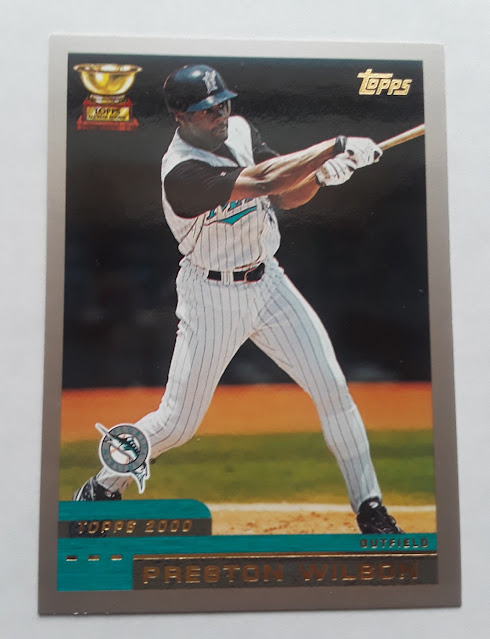
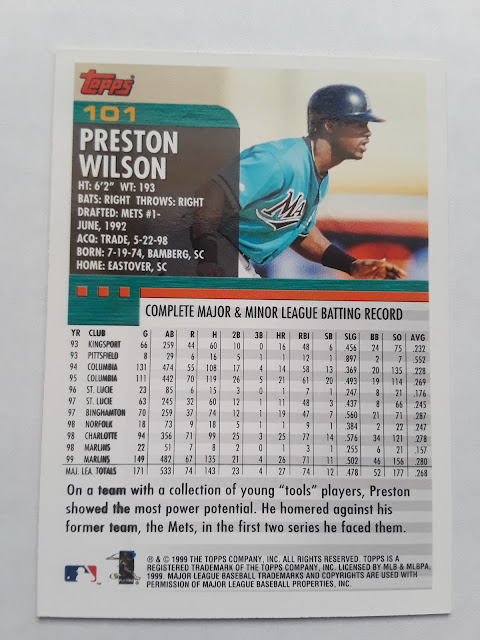
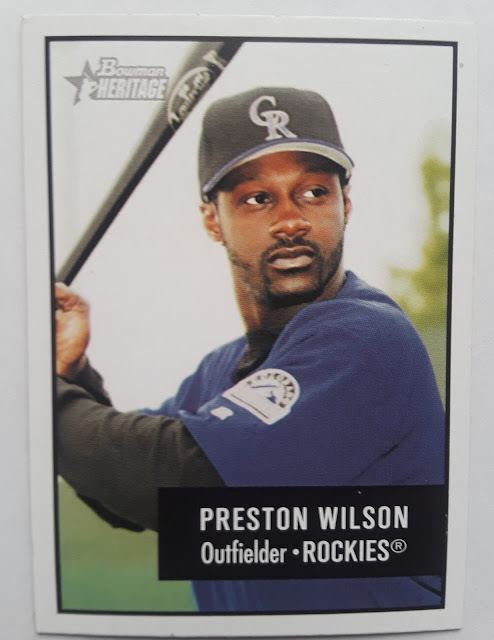
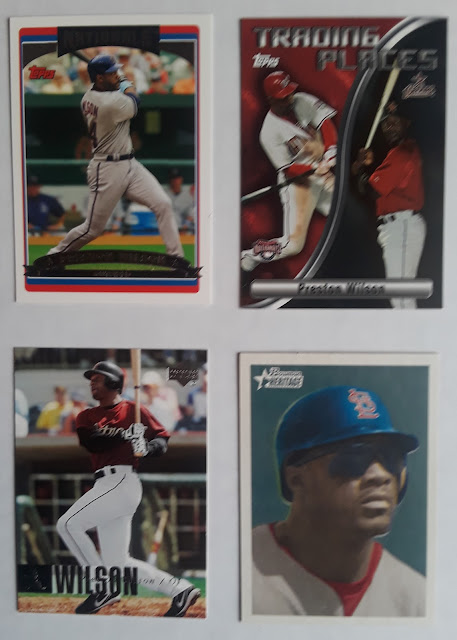
1999 Topps All-Star Rookie Outfielder Preston Wilson


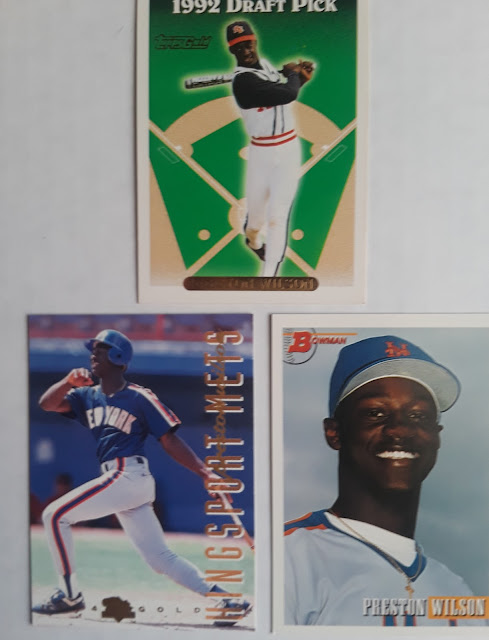
Preston Wilson arrived in the big leagues after a very long journey that took him from the first round of the 1992 MLB Draft, to 4 top-100 prospect listings, to a winter spent playing baseball in Australia. After a 5 year minor league sojourn, Wilson had arrived in Queens, only to be traded away after just 8 games for the Mets. Wilson was big time prospect coming to Florida in exchange for the Marlins' brand new catcher Mike Piazza. 


His first full season came in 1999, and he was able to show power and a little speed for an exciting and young rebuilding Marlins team. He'd finish 2nd in the NL Rookie of the Year voting and had a strong season, with a 119 OPS+ and hit 26 homers to go with 11 stolen bases. He was a great choice to join the 1999 Topps All-Star Rookie team.


Wilson was the 9th Overall selection in the 1992 MLB draft, picked by his adopted father Mookie's former team, the New York Mets. To get the potentially awkward subject out of the way, Mookie Wilson's brother Richard was Preston's biological father, but it was Mookie that became Preston's mother Rosa's husband and raised Preston as his own son. So Mookie is technically Preston's uncle, but was also his father as far as Preston was concerned, and officially adopted him. Families are complicated, but it is clear that Preston was well loved and well raised by his parents. Preston was just 17 when he was drafted, and started his pro career with the Kingsport Mets in 1993. Before joining the Mets, he was the 1992 High School player of the year, and hit well for the 1992 18U USA National team. 

Wilson had no trouble launching the ball out of the park, hitting 17 homers in his first pro season, then at least 20 a year after that. In 1996, he played in just 23 games because of injuries to his wrist and shoulder. This had little to no impact the following season, as he hit 30 homers across 2 levels in the Mets organization, and then traveled down under for the Australian Winter League. I couldn't find any stats for his time with the Newcastle Hunter Eagles, but by the Spring of 1998, Wilson was poised to make his long awaited big league debut. He played in just 18 games for AAA Norfolk Tides before being called up in May 1998. His debut consisted of a 3 for 4 game with a stolen base and a run batted in. Each base hit, he was able to briefly visit with his dad, Mookie, who was the Mets' first base coach at the time.


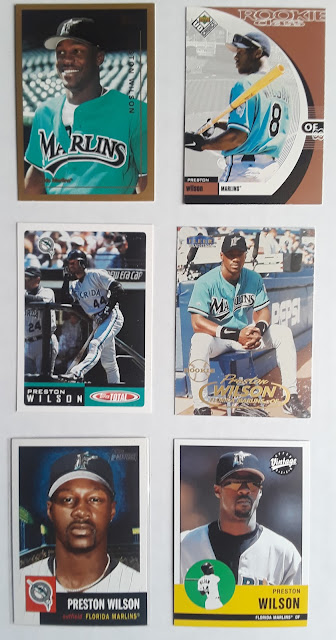
Wilson's trade to the Marlins included a demotion back to AAA, where he nearly hit 30 homers again, showing he was more than ready for a shot at the big leagues. Wilson would have an even better sophomore season, when he joined the 30-30 club in 2000. He was known for big power, but his swing also was conducive to strikeouts. In 2000, Wilson struck out 187 times, which was the most in the Majors, and nearly broke the long time record that Bobby Bonds held. Over his 4 full seasons with the Marlins, Wilson averaged 26 homers and 82 RBI per year. 


Wilson was traded to Colorado prior to the 2003 season, and the Rocky Mountain air was kind to Preston. 2003 would include career highs for Wilson across several offensive categories, and he led the National League with 141 RBI. 2003 was also Preston's lone all-star season. Wilson went 1 for 2 in the Midsummer Classic.


So, once a player has been a Topps All-Star Rookie, led the league in a few different offensive categories, made an All-Star team . . . what's left to check off? A World Series win, of course! Wilson started 2004 off slowly in Colorado, and was traded to the newly minted Nationals in Washington. He ended up playing what would amount to roughly one season with the Nats before being traded mid season to Houston, just in time to make a run at the post season. The Astros fell short, but the 2006 season would give Preston another chance to play the role of 2nd half star. Wilson was released at the deadline and picked up by the Cardinals, and he solidified the team's outfield rotation, providing a little power (9 homers in 33 games) and a little good old fashioned veteran leadership. Along with a strong cast of characters, the Cardinals would prevail in the World Series against the Detroit Tigers. Wilson appeared in all 5 games and picked up a pair of hits, scored a run, and drove in another. 


Following the 2006 championship, Wilson returned to St. Louis for an encore, but injuries limited his effectiveness and he played in just 25 games. Wilson worked hard to get back, and even played for the Independent League Long Island Ducks for 48 games in 2009 before deciding to retire. After his playing career, the charismatic and outspoken Wilson became a regular on Houston Astros and Florida Marlins broadcasts, and has dropped in as an MLB Network analyst from time to time as well. 

Wilson was recently interviewed for a Sports Illustrated article about declining participation of African-Americans in Major League Baseball, and his experiences and insights bring an important story into focus. You can read the article here -  and there's quite a bit to unpack inside. Wilson is also active on Twitter, his handle is @PrestonWilson44

Monday, January 3, 2022

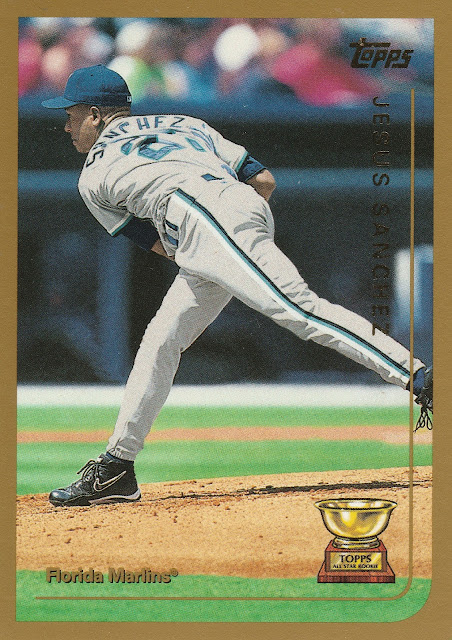
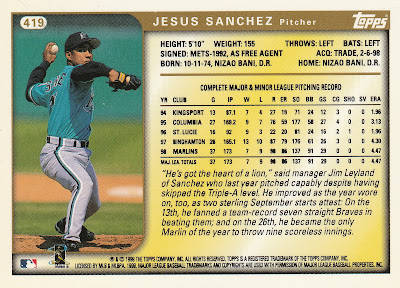
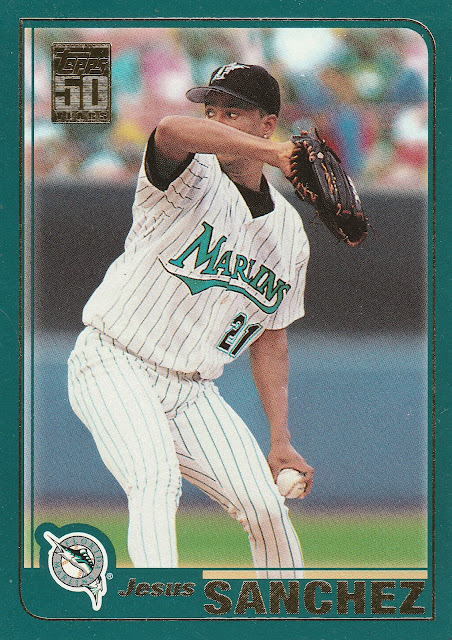
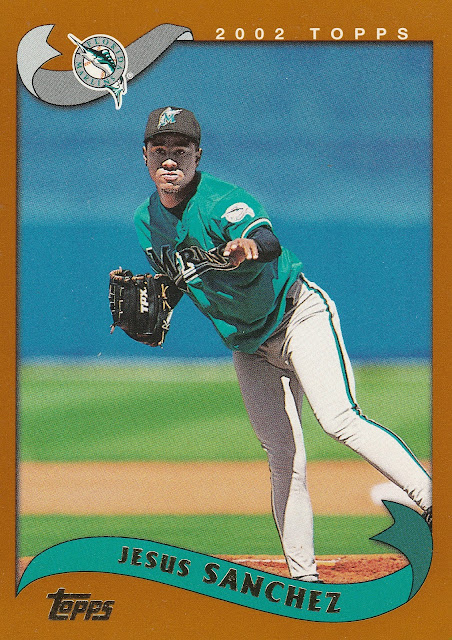
1998 Topps All-Star Rookie Left Handed Pitcher Jesús Sánchez

 Jesús Sánchez, Pitcher for the Florida Marlins, should not be confused with Jesús Sánchez, outfielder for the Miami Marlins. For one thing, Jesús Sánchez was born in the Dominican Republic. Jesús Sánchez, on the other was born in the Dominican Republic. Wait. Jesús Sánchez bats left handed, and Jesús Sánchez bats.... left handed. Hmm. Let's get more technical here. When Jesús Sánchez was born, Jesús Sánchez had just completed his 4th season of professional ball for the Binghampton Mets. Ah, now I get it. Jesús Sánchez, our Jesús Sánchez for this post, was a member of the 1998 Topps All-Star Rookie squad, while Jesús Sánchez was a literal rookie of life itself in 1998, completing his first year of being!


Jesús Sánchez was signed by the Mets as a 17 year old free agent out of the Dominican Republic in 1992, beginning a steady climb through the organization as a lefty with control and endurance. In his debut season of organized ball he finished 3 of his 12 starts. His 1.96 ERA was the lowest for any Mets' pitcher in the entire org that year. He made the jump from AA Binghampton all the way to the Marlins' rotation in one off-season. He joined the defending World Series champs and made 29 starts for manager Jim Leyland, who referred to him as having "the heart of a lion." While his season stats were not eye-popping, the fact that he was just 23 and hadn't pitched above AA previously made his season noteworthy. He saved his best start of the season for his last, scattering 5 hits and 2 walks over 9 shutout innings. The Marlins didn't score, either, and he ended up with a no-decision for his troubles.


By 2001, Sánchez had started 71 games for the Marlins over 3 seasons, but hadn't really found the consistency expected of a Major League starter. Some of it could be attributed to the way he was used - in 1999 he appeared in 59 games as a pitcher, and pinch ran 13 times. Fun fact - Sánchez was a long-distance runner in high school. He was used primarily out of the bullpen in 1999, but started 10 games. By 2000, he was once again in the rotation full time, and tossed a pair of complete game shutouts, but still ended up losing more games than he won. Sánchez had a great pickoff move, nabbing dozens of would-be base stealers in his career, setting a team record with 12 in 1998 alone. 


His pitch mix evolved over the years, with his change-up becoming his best weapon to complement his fastball. He didn't pitch with high velocity, and the transition from the minors to the majors would reflect the difficulty of bringing a less than blistering heater to the big leagues. Strikeout rates decreased, while walk rates, hits/9, and home run rates all increased.  Sánchez spent a good chunk of 2001 in AAA, not returning to the big leagues until late June. By the end of the year, he'd be traded to the Cubs, who viewed him a possible 5th starter / swing man in the bullpen. He'd spent parts of the next three seasons as a AAAA pitcher, shuttling between the big leagues and AAA for Chicago, Colorado, and Cincinnati. He then moved on to pitching in the Dominican Winter Leagues, the Mexican League, spent a year in China with the CBPL where he pitched a sub 3.00 ERA for the first time since 1996, and then returned to the U.S. to pitch in the independent Atlantic League for a pair of seasons, retiring in  2012. Sánchez today is the pitching coach for the Cleveland Guardians' Dominican Summer League team located in Boca Chica, D.R. which is located a few provinces east of his hometown of Nizao. 

Check this out - Sánchez finishes up a then-Marlins record of 7 consecutive strikeouts by tossing an "immaculate inning" - 9 pitches, 9 Strikes, 3 strikeouts!  He gets Greg Maddux with that nasty changeup.


Monday, October 12, 2020

1998 Topps All-Star Rookie Outfielder Mark Kotsay


In College, Mark Kotsay was the Big Man on Campus, starring for the Cal State Fullerton Titans in the 1995 College World Series. In 1998 with the Marlins, he looked like he might be a fish out of water. Young and unproven, Kotsay was given the tall order of taking over Right Field in place of Gary Sheffield. He finished the season with more games played than any other Marlin, and was near the top of the list in most of the team's offensive leaderboards. His 20 outfield assists were the most in the National League. You better believe that was enough to make Mark a member of the 1998 Topps All-Star Rookie team.


Kotsay found success at every level of play - in 1994 he played in the Cape Cod league following his freshman year at baseball powerhouse Cal State Fullerton. 1995 saw him set a record with a .517 average in the 1995 College World Series. His team would win their 3rd straight CWS, and he walked away with the Golden Spikes award. In 1996, he was selected by the Marlins as the #9 Overall pick in the June draft, played on Team USA in the 1996 Summer Olympic Games, and made his pro debut for the Kane County Cougars. By 1997, he had made it all the way up to the big leagues for a two week cup of coffee in July. The Marlins organization had big plans for Kotsay - little did he know that the team would win it all in 1997 - then blow it all up for the next season, totally re-making the outfield from the season before.


Kotsay would play 3 full seasons for the Marlins, playing a combo of Centerfield, Right, and 1st base. He didn't have the power numbers he displayed in college, but he definitely still had the contact skills. Kotsay was used near the top of the lineup and he piled up the hits. In the field, he continued to show off a cannon for an arm, leading the NL in assists in his rookie year and again in 1999. He would be traded to San Diego just before the 2001 season began. 


The Padres made Kotsay their everyday Centerfielder, and he continued to display line drive power to the gaps and excellent contact numbers. His outfield assists dwindled down to just 4 in his first season in San Diego, but that was mostly due to the word getting around that trying to take the extra base against him would usually end in embarrassment for the runner. From 2002 through 2004 he would again lead the league in assists as a Centerfielder, surpassing double digits each year. 2002 would also prove to be one of his best offensive seasons, hitting .292 with 17 homers and a 122 OPS+. Following the 2003 season, Kotsay was on the move again, as the Oakland A's traded Terrance Long and Ramon Hernandez to make him their leadoff man and centerfielder. 


Kotsay responded with a career high 190 hits, which was the most by a lefty in Oakland in more than 40 years. He also set a career high batting average, hitting .314 despite playing half of his games with the huge foul territory in Oakland, known to suppress those stats. One reason he was so successful in Oakland was his ability to limit strikeouts. In 2005 he struck out at a rate of once per 11.4 ABs, which was the 2nd best K rate in the American League. He'd get his first taste of post season play in 2006, hitting a home run against the Twins in the ALDS, and adding 4 more hits in the ALCS in a losing effort against the Tigers. The injury bug bit him in 2007, playing in just 56 games and a career low .214 average over that span. 


Kotsay was on the move again after that lost season, traded to Atlanta in January. He'd have a rare highlight for Atlanta in August of 2008, going 5-5 and hitting for the cycle. With Atlanta uncharacteristically out of post season contention, Kotsay was dealt again mid-season, going to the Red Sox to help their playoff push. Kotsay was happy to join Boston, as he listed playing in a World Series as his few remaining goals. He was quoted as saying after the trade "the respect of your peers is what you play the game for, and nothing else." He was eager for another shot at a championship with a talented team. He provided depth in the outfield and a valuable bat in the post season, hitting .300 in the ALDS and adding 7 more hits in the ALCS, but the Red Sox were bounced out by the Rays. He would be used as a reserve in 2009 by the Red Sox, then was dealt at the trade deadline again to Chicago. With the White Sox, he would spend more time as a DH than at any time in his career, and was no longer the everyday player he once was. His reputation was that of a "grinder / gamer" but at this point his goal was to provide leadership and defense when called upon. He'd get another post season shot in 2011 with Milwaukee reaching the LCS again, but falling just shy of the World Series.

He'd finish out his career back in San Diego, closer to his wife and kids in Southern California. He had been not so subtly hinting at a reunion for the past few years with the Padres, stating in an interview that he would call the team himself and inquire about an opening in the offseason. The veteran leadership would segue perfectly into coaching. He would retire in 2014, then return in 2015 as the Padres new hitting coach. He would move on to Oakland in 2015 as a bench coach, and recently has been one of the top names for managerial jobs in Boston, San Francisco, and Pittsburgh recently. Another spot opened up today on the South Side, could he be in line again for the role?

For his MLB career, Kotsay had 1,784 hits, scored 790 runs and drove in 720 more. He had 123 outfield assists, and was widely regarded as one of the better outfield defenders in the league by his peers. He was named to the Omaha (College World Series) Hall of Fame in 2014, and was named College Baseball's Player of the Decade for the 1990s. 

Do you have any Mark Kotsay memories? I'd love to read them in the comments below. 

Thanks for reading!


Monday, July 20, 2020

NOT 1997 Topps All-Star Rookie Tony Saunders


Before we move on from the 1997 Topps All-Star Rookie squad, there's just one more bit of business. As you know, the Topps All-Star Rookie trophy is placed on cards the year after a player makes the ASR roster. But a funny thing happened in 1998. There were two expansion teams, the Tampa Bay Devil Rays and the Arizona Diamondbacks. For some reason, Topps decided to slap a Topps All-Star Rookie Cup on Tony Saunders' card. He did have an interesting and productive 1997 season, winning a World Series with the Marlins, and becoming the first overall pick in the 1998 Expansion Draft. 


The back of his 1998 Topps card is similarly weird. This design is a departure from the rest of the set, and I can see what they are going for. So, it's true that Tony Saunders was not a Topps All-Star Rookie. But! He is still worthy of the Highly Subjective and Completely Arbitrary treatment. His story is one worth telling, for sure.


Saunders was the #1 Overall pick in the 1998 expansion draft, but that was the first time he'd been drafted at all. He finished his senior season with the Glen Burnie High School Gophers, and had a scholarship in hand to attend George Mason University. The All-County hurler was eager to get his professional career started instead. Despite being passed over in the 1992 MLB June Draft, he attended an open tryout and was signed for $1,000 to pitch for the Florida Marlins' Gulf Coast League affiliate. 

He pitched well in Rookie ball, where he was used exclusively as a reliever. In 1993, he moved up to the Single A Midwest League, getting 10 starts and pitching to a 2.27 ERA with an impressive 2.72 K/BB ratio. The injury bug would bite hard, and Saunders underwent reconstructive surgery on his elbow, limiting him to just 23 appearances over the next two seasons combined. He flourished in 1996 with the AA Portland Sea Dogs. He had the best W-L record of his pro career, going 13-4 with a 2.63 ERA. His walks were up a bit from prior seasons, but he still had a very good K/BB ratio and was striking out batters at a rate of 8.4 K/9 innings. After a decent showing in the Arizona Fall League, Saunders would be slated to join the Marlins' rotation in 1997.


In 1997, The Marlins had just about everything fall their way en route to a World Series Championship. For Saunders, he was joining a rotation with Kevin Brown and Al Leiter, both All-Stars. The Marlins also had Alex Fernandez, who had a tremendous season, his best since his days with the White Sox. This strong veteran presence gave room for Saunders to grow and learn on the job in the big leagues. He made 21 regular season starts for the Marlins, with just a 4-6 record and a career high walk rate. The positives? He led all rookies with his 8.24 K/9 rate, had a scorching hot month of July (1.44 ERA) and absolutely owned the division-rival Braves. They hit just .176 against him in 4 regular season starts, resulting in 3 victories for Saunders. Looking on the bright side, all of the coaches and teammates agreed that Saunders had the potential to be something really special.  

His regular season success against Atlanta came in handy, when the team faced them again in the NLCS. His Game 3 start may not have set the world on fire, but for 5 and a third innings, he kept a dangerous and battle-tested lineup at bay before giving way to NLCS MVP Livan Hernandez to help shut the door.  


The Marlins' fire sale began almost immediately after lifting the Commissioner's Trophy, starting with the coaching staff. Marlins pitching coach Larry Rothschild was named Tampa Bay's new Manager, so it came as no surprise to anyone that Saunders was at the top of the Devil Rays' wish list. They made Saunders their first overall pick, and he slotted into their rotation behind the 32 year old rookie and Cuban defector, Rolando Arrojo. 

In 1998, Saunders would get a career high 31 starts and 192 and a third innings pitched. He would lead the league in Walks allowed, but still had a respectable 118 ERA+. The biggest enemy of Saunders' success in 1998 was run support. Despite having Wade Boggs and Fred McGriff in the lineup, the Devil Rays had little to offer beyond that at the plate. It resulted in the worst run support (3.5 runs per 9 innings) of any starter in the American League. Saunders had his ups and downs, but he had 21 starts in which he allowed 3 or fewer runs. It might not seem that impressive on the surface, but there were only 2 pitchers in the AL with more starts like it that season- Pedro Martinez and Roger Clemens.  

Of course, the story takes a dark turn after this. Early in the 1999 season, Saunders was pitching to Juan Gonzalez of the Texas Rangers. On a 3-2 pitch, Saunders threw wildly, allowing a run to score. But the bigger story was that the errant throw was the result of a fracture in his humerus, which left Saunders in agony. (Normally this would be a time to post a link, but I'll skip that and just say you can pretty easily find it with a youtube search, I won't make it any easier than that.) Saunders was one of four pitchers to have suffered a similar injury in that past decade or so- Dave Dravecky, Norm Charlton, Tom Browning, and John Smiley. Charlton was the only one to pitch significant innings following the injury.

Miraculously, Saunders was on the mound again in 2000, returning in July with stints in AAA and AA. He was awarded the Tony Conigliaro Award as comeback player of the year. But his arm would break a second time in August, just above the first break from a year ago. He would be out of baseball for several years before coming back in 2005 to try out for the Baltimore Orioles, coming full circle back to his Maryland roots. He did not appear in any official Spring Training games as non-roster invitee before being released. He would go on to serve as a pitching coach for a Glen Burnie, MD baseball academy in the 2000s, and even pitched an inning in the 2010 Hall of Fame Classic in Cooperstown, pitching for team Killebrew. 

Any specific Tony Saunders memories you'd like to share? I'd love to read them in the comments below. Thanks for reading!

Monday, March 23, 2020

1996 Topps All-Star Rookie Outfielder Todd Hollandsworth


Todd Hollandsworth was the NL Rookie of the Year in 1996, joining the ever growing list of Dodger phenoms to break into the big leagues. With similar tools to 1994 RoY Raul Mondesi, Hollandsworth flashed power, speed, and a strong outfield arm. He spent a good part of 1995 recovering from various nagging injuries, in 1996 it was his turn to fill in for the regular centerfielder, Brett Butler.


Todd hit 12 homers, stole 21 bases and had a 113 OPS+ while playing all three outfield positions. There is quite a bit of copy written bout Todd as a "gamer" aka a player who "plays the game the right way," and Brett Butler was even quoted as saying that Todd was never thinking "How cool do I look?" in a Clint Eastwood-esque get-off-my-lawn.


Todd had a big year in 1994 for Albuquerque, paving the way for his big league debut. He bashed 19 homers, drove in 91 runs, and stole 15 bases. It was his third season in a row with double digits in homers and steals, and he finally managed to get his strikeouts under 100 for the season. He was always a doubles machine, and had 31 for the Dukes in '94, the highest total of his minor league career.


Hollandsworth was the Dodgers' 3rd round selection in 1991, having lost picks in rounds 1 and 2 as compensation for adding Darryl Strawberry and Kevin Gross. They would add a 3rd rounder though as compensation for losing Kirk Gibson to Kansas City. He was born in Dayton, OH, and went to High School in Bellevue, Washington. As a Senior he hit .368 with a pair of homers, and was named "Athlete of the Year" by the Seattle Times and was a member of the Washington All-State Team. In addition to baseball, Hollandsworth also played for the Newport High Football squad (he rushed for over 1,000 yards) and their basketball team.


Following his Dodgers tenure, Hollandsworth spent time with 7 different teams- Colorado, Texas, Florida, Atlanta, the Cubs, and in his final MLB season, he played for both Ohio franchises. Hollandsworth didn't become the toolsy superstar hinted at by his rookie year, but he was a solid 4th outfielder for 12 MLB seasons. His best seasons were 2000, split between LA and the Rockies, and 2002, which was split between the Rockies and Rangers. The following season, Hollandsworth became a World Series Champion as a member of the Florida Marlins.

After his playing career, Hollandsworth has been a broadcaster for several teams, currently a member of the Marlins tv broadcast team.

Let's hear your Hollandsworth stories! Thanks for reading!

Monday, January 20, 2020

1995 Topps All-Star Rookie Catcher Charles Johnson

 Image courtesy Gavin from Baseball Card Breakdown- used with permission.

Charles Johnson famously did not sign with Topps to appear on their cards, in solidarity with other 1991 Team USA players like Jason Varitek. Even so, Charles Johnson was still the obvious choice to be the 1995 Topps All-Star Rookie Catcher. He was just the 4th rookie to win a Gold Glove as a catcher, along with all-time greats like Johnny Bench and Carlton Fisk, and phenom Sandy Alomar, Jr. Those three were also Topps All-Star Rookies, just sayin'. 
Image courtesy Gavin from Baseball Card Breakdown- used with permission.

The fact that he didn't sign meant that he wasn't in the 1996 Topps Set, but that didn't stop me from tracking down a custom "card that never was." It was no surprise to me that Gavin had put one together, and he graciously allowed me to share it in this blog post. If you're a regular reader of my blog, but haven't read Gavin's, (first of all, really?) you're gonna love it


Charles Johnson was drafted in the first round in 1989 by the Montréal Expos, but opted to attend the University of Miami instead. after appearing with Team USA and playing for the Hurricanes, the Florida Marlins made him their 1st Round selection in 1992. Johnson spent 1993 with the Kane County Cougars. He hit .275 with 19 homers and 94 RBI. He would also hit well in 1994 with the Portland (Maine) Sea Dogs, blasting 28 homers for the AA squad. The hitting was a bonus, he was drafted for his defense and ability to call a game behind the plate, so any hitting would be icing on the cake.


His first Marlins tenure included stellar defense, and hitting when it meant the most. He would win a Gold Glove in each of his first four major league campaigns, the longest streak to start a career at catcher, again, since Johnny Bench, who won a whopping 10 consecutive Gold Gloves. Johnson would also come through big in the 1997 World Series, leading the Marlins with 10 hits while hitting for a .357 average over the 7 game series. His defense during the regular season was superlative - he caught 123 games in 1997 and had zero errors.


Johnson was part of the 1997 championship and the 1998 Marlins fire sale as well. The Marlins sent Johnson and Bobby Bonilla, Jim Eisenreich, and Gary Sheffield to the Dodgers in a deal for Mike Piazza. Mike would be flipped soon after to the Mets as well. Johnson finished the 1998 season in LA, winning his fourth Gold Glove, the first Dodger Catcher to win one since 1966. He hit just .217 down the stretch for the Dodgers, but he did have 12 homers.


After the 1998 season, Johnson was traded twice, where he briefly became Mike Piazza's teammate in New York, then moved on to Baltimore in exchange for Armando Benitez. In Baltimore, Johnson caught 135 games his first season, finishing in the top 5 in putouts, caught stealing, assists, and first in double plays turned by a catcher. Now in the AL, Johnson's Gold Glove streak came to an end with Ivan Rodriguez as a competitor.  He would add major offense in 2000, hitting a career high 31 homers, 94 RBI and a .304 average.


Most of that offense came following a July trade to the Chicago White Sox. during his time on Southside, Johnson had a OPS+ of 135 and slugged .607. The Sox were in the playoff hunt, and despite losing in the first round to Seattle, Johnson did his part, hitting .333 and reaching base at a .455 clip over the 3 games. Johnson would have his first taste of free agency following the 2000 season.


So of course, Johnson came home from the Southside to South Beach. In his second tour with the Marlins, Johnson made his second All-Star appearance, and caught his 3rd No-hitter. He's caught half of the Marlins' 6 no-hitters all-time. Johnson's streak of catching 100+ games would come to an end in 2001, when he would play in just 83 games for the Marlins in a down year. He would be traded to the Rockies (with Preston Wilson, one of the players that came to Florida from the Mets in the Piazza trade) following the 2002 season. Johnson would just miss the second Marlins' title, but also their 2nd fire sale.


Johnson would have a pair of decent seasons for the Rockies, though he didn't appear to have quite the "Coors-effect" bump that some other Colorado transplants would have. He hit 33 homers over the two seasons, and he would finish out his MLB career with a brief return to Florida, this time for the Tampa Bay Rays. He remains a mainstay in Miami, both as a University of Miami Alum, and as a Florida/Miami Marlin original. He's been on the record as a supporter of the team even through the tough re-building period that began with the Derek Jeter ownership.

For his career, he ranked 2nd only to Ivan Rodriguez in throwing out potential base stealers. Only Jason Varitek and Carlos Ruiz have caught more no-hitters in their careers.

Let's hear your Charles Johnson stories!

Tuesday, March 26, 2019

1993 Topps All-Star Rookie Team - Outfielder Jeff Conine


Well, well, well if it isn't Mr, Marlin himself! The Expansion Draft in 1992 netted several big names for the Marlins including their Inaugural Opening Day starter Charlie Hough, future Hall of Famer Trevor Hoffman, ace reliever Bryan Harvey, and their franchise centerpiece in their early days, Jeff Conine.

Racquetball Superstar!

Conine was a standout baseball player at UCLA, but as a relief pitcher. In fact, he only had one plate appearance in college (he was hit by a pitch), but his hitting prowess was an open secret. The Kansas City Royals' GM John Schuerholtz had the inside scoop from UCLA's pitching coach that the team's best hitter was actually in their bullpen. The Royals made Conine their 58th Round (!) pick in the 1987 MLB Draft.


Conine would put up decent numbers in 3 minor league campaigns including hitting .320 with 15 homers for the AA Memphis Chicks in 1990, earning him a September Call-up. In 1991 injuries limited him to just 51 games at AAA, and his career was in danger of ending before it began. He came back strong in 1992, blasting 20 homers in 112 games for AAA Omaha, again returning to the majors for 1992.


The expansion draft changed everything. Conine was about to hit his peak, the Marlins needed athletes all over the diamond. No longer waiting in the wings in KC, Conine would play in all 162 games for the Marlins in 1993. He rapped out 174 hits, 12 homers, and drove in 79 runs as a rookie, finishing 3rd in the NL Rookie of the Year voting.


Conine would make the All-Star Team in 1994 and 1995. He would be the All-Star MVP in the second game, hitting a solo homer in the 8th inning, which would prove to be the winning run. In 1996, he had career highs in hits, runs, doubles, homers, and total bases. While Conine put up good numbers in South Florida, the team would finish no higher than 3rd, and at least 16 games out of first place in the NL East through the 1996 season. Conine experienced a lot of losing seasons and growing pains in Florida, so winning it all in 1997 was a bittersweet victory. Bittersweet because Conine was a notable casualty of the Marlins' first fire sale.


After spending a season back in Kansas City, Conine would move on to the Baltimore Orioles as the team's DH/1B and fill in corner outfielder. He would be a bit better than league average over 6 seasons with the O's, with a heavenly 777 hits. In 2003, he'd wind up back with the Marlins just in time for another post-season run. Once again the Marlins won the Wild Card, and Conine turned up the volume in the NLCS, hitting .458 with a homer against the Cubs, and a .333 mark in the World Series, scoring 4 runs against the Bronx Bombers. His 2nd title in Florida cemented his place as a Marlins legend. He would play in the bigs until 2007, with short term stops in Philly, Cincy, and with the Mets for 21 games. He signed a 1-day contract with the Marlins in 2008 to officially retire with the team.

After his playing days, Conine competed in Triathalons, and more recently had been on the Marlins' broadcast team, until Derek Jeter purged the organization of many former Marlins in favor of a clean slate. His son Griffin was a 2nd round pick by the Blue Jays in the 2018 MLB draft, as Toronto continues to stockpile next generation talent.