Showing posts with label Tony Perez. Show all posts

Sunday, January 2, 2022

I love The 80s - 1982 Boston Red Sox

 This is a series of posts on a 1980's Frankenset. Each page features a different team, with 9 of my personal favorite cards from that year's team. You might find players repeated, you'll definitely see brands repeated, but hopefully you'll agree that there are some interesting selections from the 1980s!

In 1981, which was more red? The Boston baseball team's faces, or their stockings? The season began without two of the biggest stars for the 70s teams, namely Carlton Fisk and Fred Lynn. The deadline for major league teams to tender contracts to their players was December 20th, 1980. The contracts for Fisk and Lynn were not mailed until the 22nd, effectively making them free agents. While the team was appealing the decision, Lynn was traded to the Angels (technically the teams made a separate trade the same day of Lynn's free agent signing, the trade is unofficially viewed as partial compensation for losing Lynn), but Fisk was another story altogether. The team tried to re-sign him, but the catcher found greener pastures in Chicago with the White Sox. Fisk would add the extra twist of the knife Opening Day 1981 by hitting the game winning homer against his old team in his first visit to Fenway. The rest of the 1981 season was not much better - even though the Red Sox finished 10 games above .500, they still managed to end up in 5th place in the AL East.
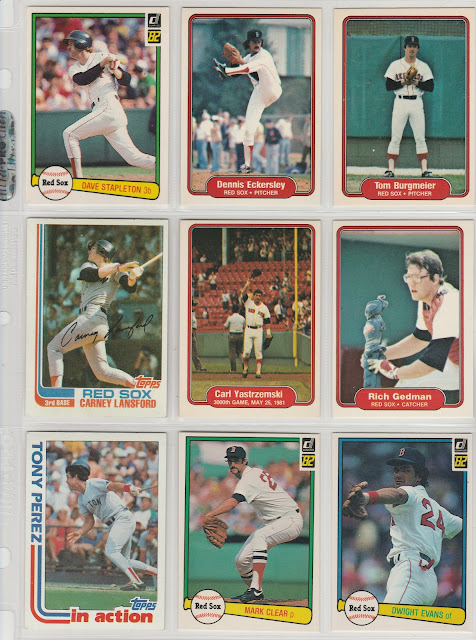


In 1982, The Red Sox surprised a lot of people by starting very hot, at one point winning 13 of 14 games during a stretch of April ball. After surging into first place, they remained atop the Eastern Division until July. There were a handful of feel-good stories as well, like the homecoming of sorts for Worcester, MA kid Mark Fidrych. "The Bird" signed a free agent deal in February with the Red Sox, but his big league career was over. Ted Williams returned to the field in the Red Sox first ever "Old-Timers" game, making a highlight in the outfield with a shoestring catch. Some might have quipped that he should have been playing alongside Ted in that game, but 42 year old Carl Yastrzemski was having an excellent season, reminding fans of the player they had cheered for two decades in the shadow of the Green Monster. As Yaz was putting the finishing touches on his career, Wade Boggs was just getting his going. While still trying to find a permanent position, Boggs forced his way into the lineup by hitting .349 over 106 games all over the Boston infield, settling at third. The good vibes weren't enough to win a pennant, however, and the Sox finished third behind the Orioles and the Division winning Brewers.
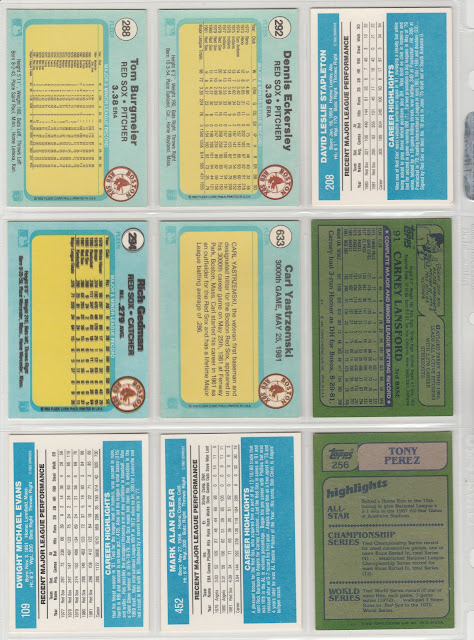

The Cards:
Donruss #208 Dave Stapleton - Runner-up for the 1980 Rookie of the Year award behind Joe Charbonneau of Cleveland, Dave Stapleton was a versatile infielder, sharing time with Yaz at first base and with Jerry Remy at second. By 1982, he'd spell Yaz and Tony Perez at first base more often than not, because of his defensive chops. And yes, Stapleton was regularly used as a late inning defensive replacement during the 1986 season. OK, yes, he replaced Buckner in Game 5. But not Game 6. . .   

Fleer #292 Dennis Eckersley - Eckersley recorded his 100th Career Win in 1982, which might not seem like that big of a deal, but it would in hindsight frame the first of two halves of his Hall of Fame career nicely. Eck was still a starter in 1982, going a not-that-lucky 13-13 for the Red Sox. He'd go on to many years of success as a bullpen arm, notably in Oakland with a World Series victory in 1989. He'd finish his career with 197 wins and 390 saves. He was the first pitcher to have both a 20 Win season and a 50 Save season.

Fleer #288 Tom Burgmeier - Born in St. Paul, MN, Tom Burgmeier was an early target for Twins' scouting Director Jim Rantz. It would take a long journey through the Houston minor league system and a few seasons with the Royals before the Twins could add him to their bullpen, and by the time he reached his prime in 1980, he was off to Boston to make his lone All-Star appearance as the Red Sox Closer. After 745 major league appearances, Burgmeier became a pitching coach, serving in that capacity for several organizations over a couple decades starting in 1991 with the Royals.  

Topps #91 Carney Lansford - Lansford arrived in Boston as part of the Fred Lynn trade, and did a lot to take the sting away from losing the former MVP. Moving from California's pitcher friendly Anaheim Stadium to Fenway prompted a significant spike in his batting average. Lansford won a batting title in 1981, but still wasn't a good enough hitter to keep his job as the Red Sox everyday 3rd baseman. Lansford would be traded to Oakland following the 1982 season, and very nearly won a 2nd batting title in 1989. He had an identical .336 batting average in 1981 and 1989, but fell just short of Kirby Puckett's .339. Lansford did beat Boggs by 6 points, so he's got that going for him, which is nice.

Fleer #633 Carl Yastrzemski - As mentioned above, Yaz was playing in his age 42 season in 1982. It was his 22nd major league season, all with Boston. You've heard the stats before, but just as a refresher, he was the Triple Crown winner in 1967, leading the AL in HR, RBI and Average. He was also the MVP that year, and led the AL in Slugging and OBP as well. Oh, and hits, and runs scored. And Total Bases. And he won a Gold Glove that year. And he stole 10 bases, too. He only ground into 5 double plays all season that year. My favorite Yaz tidbit though is from 1965. When Satchel Paige returned to pitch one final MLB game for the Kansas City A's, only Yaz was able to get a hit off the ageless wonder. Paige, supposedly 59 years old at the time, pitched 3 innings and it was the double by Yaz in the first as the only blemish on his scoresheet. 

Fleer #294 Rich Gedman - Another Worcester, MA guy (like Mark Fidrych), Rich Gedman was the 1981 runner up for the Rookie of the Year behind the Yankees' Dave Righetti. Gedman split catching duties with Gary Allenson in 1982, playing an even 92 games each. Gedman had more hits with his bat to ball skills, while Allenson's patience at the plate netted him more walks. Gedman's calling card was throwing out runners trying to steal. He led the AL in caught stealing three straight seasons from 1984 through the championship run in 1986. Following his breakout 1984 season when he hit 24 homers, he earned the reputation of "feared hitter" not unlike his teammate Jim Rice. Gedman drew intentional walks 24 times in his two All-Star seasons, almost twice as many as Rice over the same period. Gedman was set to be a top free agent following the 1986 World Series, but strangely found no takers. (The world would later learn this was a direct result of collusion by the owners, who all agreed not to offer big free agent contracts that offseason). Gedman would re-sign with the Red Sox, but missed the first month of the season and all of Spring Training, which resulted in a career worst .205 average in 52 games. He was most closely comparable to the career of Salvador Perez by age 26, but after the lost season of 1987, he never regained his potent bat or his regular gig behind the plate for the Red Sox. 

Topps #256 Tony Pérez - "Big Doggie" was several years removed from his Big Red Machine years with Cincinnati, and in 1982 managed just 6 homers for the Red Sox. While he was no longer the same hitter he was in years prior, he was still a highly respected and highly coveted bench bat. He would go on to play several more seasons first with Philadelphia then back again to Cincinnati, never far from Pete Rose, just in case he needed someone to drive him in from second base. His is often mentioned as a comp for other power hitters of his era still waiting to get into Cooperstown like Dave Parker, Dwight Evans, and until recently Harold Baines. Pérez was elected to the Hall of Fame by the BBWAA in 2000.

Donruss #452 Mark Clear - Another player acquired for Fred Lynn, Mark Clear notched 9 saves and won 8 games for the Red Sox in his first season in Boston. In 1982, he was an AL All-Star selection, and had a career high 14 victories, all coming in relief. Originally signed by the Phillies to be a starter, poor mechanics led to back problems and an early release from his contract. Clear cleaned up his delivery (thanks to his uncle, who was the Angels' bullpen coach) and rehabbed with a back brace before signing a minor league deal with California. Once converted to relief work, he thrived. He was an All-Star his rookie season with the Angels, and was well on his way to a solid MLB career. 

Donruss #109 Dwight Evans - Somehow Evans managed to fly under the radar again in 1982. Despite hitting 32 homers and driving in 98 runs and leading the league with a .402 OBP finished a distant 7th in the MVP balloting (let's be fair, though, the right guy won (Robin Yount)). Evans is the Rodney Dangerfield of the Red Sox. Did you know that he's 2nd all-time in games played by a Red Sox player, trailing only Yaz? Evans also has 8 Gold Glove awards, easily the most by a Red Sox outfielder, and trailing only the best of the best in MLB history- Mays, Griffey Jr., Clemente, and Kaline. He hit more homers in the 1980s (256) than any other AL player.


Thursday, April 7, 2016

1965 Topps All-Star Rookie Team

Here they are - the fourth class of the Topps All-Star Rookie Team, selected "by the Youth of America" following the 1965 season and featured in the 1966 Topps set.

I have completed the run of these up through 2016 Series one, at least all regular issue cards that bear the All-Star Rookie Trophy. 

  Outfielder - Ron Swoboda
You'll notice that there are a few Mets in the early to mid 60s as All-Star Rookies - Ron Swoboda is yet another young player that found a niche in Flushing and became a key contributor for the Miracle Mets of 1969. He's probably best known for the following:
What makes the catch extra special is that Swoboda's nickname among teammates was "Rocky," a not so kind description of his fielding prowess. Rocky fielding notwithstanding, Swoboda made an immediate impact with the Mets in 1965. He still holds a team record with 15 homers in the first half of his rookie campaign. Only Darryl Strawberry has more homers over a full Mets rookie season. It was the season of 1969 that had Ron's biggest highlights, however. Steve Carlton set a record with 19 strikeouts against Swoboda's Mets, but it was the Slugger's two towering home runs that gave the Mets the last laugh in that game. Manager Casey Stengel Gil Hodges (thanks for the correction, anonymous tipster!) got the most out of his lineup, using Swoboda as a platoon outfielder against lefties like Carlton. This platoon approach meant that Ron did not appear in the NLCS, but played in 4 of the 5 World Series games facing off against the Orioles' duo of Mike Cuellar and Dave McNally. He responded by leading all batters in hits. 

Ron's Rookie Card is #533 in the 1965 Topps set along with three other Mets.

 First Baseman - Tony Perez
Hall of Famer
Big Dog. Tony Perez may not have had as many hits as Pete, or the speed of Joe Morgan, or the defense of Concepcion, but no one on the Big Red Machine supplied the power like him. He was known to his teammates as "Mr. Clutch." Over 23 major league seasons, Perez was the main run producer and the most feared bat in almost every lineup he appeared on. He was a seven time All-Star and compiled some impressive numbers over the decades. His Hall of Fame case my have been boosted by his role on the Reds in the 60s and 70s including 2 World Series titles, but there's no denying his consistency. He could be routinely counted upon to slug 25-30 Homers and knock in nearly 100 runs a season.

Tony's Rookie card is in the 1965 Topps Set.


Right Handed Pitcher - Frank Linzy
The 1960s did not really have closers, but Frank Linzy was about as close as one could get in his rookie season. He finished 40 games for the '65 Giants, often coming in with the game close in the late innings. He saved 20 games that year and had a minuscule 1.43 ERA.  He appeared in a total of 57 games that year, and came in 3rd place in the NL rookie of the year vote. He was a mainstay in the Bay Area Bullpen until being traded in 1970 to the Saint Louis Cardinals. He pitched in over 500 games in his career, and finished with a winning record (62-57). He hit his only career home run in 1965 as well, a 7th inning blast at Candlestick Park off Ray Washburn of the Cardinals, Linzy's future team.

Frank's Rookie Card is in the 1965 Topps Set.

 Catcher - Pat Corrales
Corrales is probably familiar to most people that watched Braves games on TBS in the 90s and 2000s. A member of Bobby Cox's coaching staff during their impressive run of playoff and World Series appearances, Corrales had also been a manager of a handful of clubs on his own up to that point. He has the dubious honor of managing a first place team (the Phillies) and a last place team (Cleveland) in the same season (1983). He was fired mid season in Philly with the team sitting at 43-42. He was hired in Cleveland a few months later and the team limped to a last place finish in the AL East. Corrales is a curious selection for the All-Star Rookie team - he was highly regarded by teammates and opponents as a good fielder, but his hitting was so bad in 1965 that he was traded for Bob Uecker! OK, he was part of a deal that included Bill White, Dick Groat, Alex Johnson, and Art Mahaffey. But he certainly was not known for his bat. Looking at the rest of the rookie class, no catcher really stood out in 1965. Corrales played in just 63 games in 1965, splitting time in Philadelphia with two other backstops. He had a career high 39 hits that season.

Pat's Rookie Card is in the 1965 Topps Set.

Left Handed Pitcher - Marcelino Lopez
Lopez struggled to gain a foothold in the majors in the early 60s due to elbow problems. He debuted in 1963 with the Phillies, but the combination of a rough first outing and more arm troubles sent him back down to AAA before finishing a full season. Lopez was born in Cuba, and like Tony Perez and Tony Oliva made his way to the United States just in time to avoid the sanctions from the U.S. government that kept talented Cuban players from leaving Cuba to play in the majors. Lopez was determined to make the most of his situation, and continued to showcase his skills in the minors and in Winter League action in South America. He was sent to the Angels following the 1964 season and made his American League debut the next year. He impressed scouts and opponents with an improved curve ball and won 14 games for Los Angeles California. His heavy workload of pitching in the U.S. and in Venezuela (215 innings for the Angels and 150 in VZ) put more stress on his arm. Lopez would not regain the form that made him a promising rookie in 65, however he did find success as a reliever for the Orioles on their 1970 championship winning team.

Marcelino's Rookie Card was in the 1963 Topps Set, on one of the 4 player cards from the set.


Second Baseman - Joe Morgan
Hall of Famer

 1965 was the year of the NL rookie second basemen - in addition to Hall of Famer Morgan, the NL Rookie of the Year Jim Lefebvre and Cubs 2nd sacker Glenn Beckert had impressive debuts. Morgan's rookie campaign was tremendous, and his numbers look even better considering the poor hitting conditions in Houston's pre-Astrodome days. The record speaks for itself. 10 time All-Star, MVP in '75 and '76, Most homers ever hit by a second baseman in a career, 40 or more steals in a season 9 different times, league leader in walks four times, the list goes on. Morgan was named by Bill James as the greatest second baseman of all time, and he might be correct. Despite the fact that Morgan wanted to play his whole career in Houston and Cincinnati fans mourned the loss of slugger Lee May and fan favorite Tommy Helms, everyone got over the trade quickly enough when Morgan led the league in runs scored and stole 58 bases in his first season for the Reds. In addition to his speed and power and patience at the plate, Morgan also won 5 straight Gold Gloves at second base in the 70s. Truly one of the all time greats.
 Joe's Rookie Card was in the 1965 Topps Set, and apparently he's also an excellent billiard player.


 Shortstop - Rico Petrocelli
A Lifetime Boston Red Sox player, Rico was a steady presence at Shortstop and at Third Base for over a decade. He led the league in fielding percentage at short in 1968 and 1969. When the Sox acquired Hall of Famer Luis Aparicio, Rico ranged even further to his right and became a slick fielding Third Baseman instead of a slick fielding Shortstop. Before the move, Rico set a record for homers hit by a shortstop, belting 40 in 1969. He finished his career with over 200 round trippers, and is in the top five all time among third basemen in fielding percentage. Rico had a rather tame rookie campaign in '65, but his career blossomed soon after and he became a minor star for Boston for years to come.

Rico's Rookie Card is in the 1965 Topps Set.


 Third Baseman - Paul Schaal
"If it weren't for Brooks Robinson" Gold Gloves would have rained down on Paul Schaal. The hot corner was played coolly by Schaal throughout his 11 major league seasons, and his bat eventually would come around as well. His rookie season ended with a middling batting average of .224. He did not improve much the following season, and by 1968 he was swimming under the Mendoza line. Schaal's fielding prowess was not enough to protect him from the expansion draft, and the Kansas City Royals were all too happy to snap him up. He provided a solid foundation in Kansas City at third, and by the time George Brett arrived Schaal's career had started to come to its natural conclusion. In Royal Blues, Schaal was able to back up his exceptional skills in the field with respectable hitting in the .260 to .280 range for several seasons.

Paul's Rookie Card - you guessed it - 1965 Topps.
 
 Outfielder - Curt Blefary
Blefary might be the anti-Schaal. Blefary's bat was the main reason he was named AL Rookie of the Year in 1965, crushing 22 homers and driving in 70 runs. Like fellow ASR Ron Swoboda, Teammates were quick to give him an unflattering moniker for his exploits in the outfield. Frank Robinson dubbed Curt "Clank," and the name stuck. Curt was a member of the O's in 1966. His fielding was bad enough in the outfield that he tried switching positions numerous times. He even tried his hand behind the plate, catching a no hitter from Tom Phoebus in 1968. He bounced around the leagues after being traded to Houston for Mike Cuellar - becoming a pinch hitter and minor role player in the early 70s.

Curt's Rookie Card was in the 1965 Topps Set.


 Outfielder - Jose Cardenal
The third Los Angeles California Angel on the list, and the third Cuban Born player as well. Jose Cardenal was a fast Center Fielder with a great arm. He stole 37 bases in 1965, good for second in the AL. His prime years came in the early 1970s with the Cubs, where he would achieve career highs in home runs, runs scored, and batting average. For his career, he played for 9 different teams in 18 seasons, though most of his time was spent with the Angels and the Cubs. He finished with more than 1,900 hits, 900 runs scored, 300 Stolen bases, and over 750 runs batted in.  Cardenal went on to coach and won 3 World Series rings as a member of Joe Torre's staff in New York in the late 90s.

Jose's Rookie Card was also in the 1965 Topps Set.

Wednesday, February 4, 2015

Highly Subjective - Topps in the 1980's

I was so ready to write a post about the awesome cards I ripped from the 2015 Topps series 1 . . . but the local Target hasn't gotten them yet. So, instead, here's something that will more than likely not become a weekly feature:

This week's edition of Highly Subjective is a look at my favorite cards from the 1980 through 1989 Topps base sets. As usual, these selections are Highly Subjective and in some rare cases they are also completely arbitrary.

1980 Gary Carter:
The Hall of Famer with a sweet play at the plate. He thinks the runner is out and his game face is in full force.

1981 Bruce Sutter:

Another Hall of Famer, rocking the big gnarly hair that comes the territory for closing the big game. I enjoy cards that capture the ball in flight like this, too. You can see the back of the Carter card here - maybe if his brother didn't play in bell-bottoms, he'd have advanced further in the Giants system...

1982 Carlton Fisk in Action:

Three for three for Cooperstown. The early version of "Doing the Carlton" was less graceful, but no less athletic than Alfonso Ribeiro's dance moves. The front of this card is technically upside down, though I think the makes more sense for "in action" to be right side up.

1983 Bert Blyleven:

Another Hall of Famer, but I swear it's just a coincidence. Blyleven is a two-time former twin and a current t.v. broadcaster for the team, so he's around the Twin Cities often - he was just at TwinsFest a couple weeks ago and I said hello in the hallway. The best part about this card is that it looks like they made him shave his beard for the portrait on the bottom.

1984 Neil Allen:

The first non-hall member, but he is sporting a first rate jacket. Allen is now the Twins' Pitching Coach, but that did not affect the highly subjective voting at all (probably).

1985 Gary Pettis:

I mean, come on. Where is Pettis posing for this photo? Lifetouch? Or perhaps he is in The Void - a massless, featureless vacuum of gray slate. He's pondering existence here. Also, my vote for best card backs of the 80s Topps run goes to 1984. Really like the team logo there and the color scheme.
Edited to Add: Nick posted this awesome story in the comments about the Pettis card. The photo is actually Gary's younger brother Lynn! I feel this cements the choice even further.


1986 Tony Perez:

This one is a sentimental vote - all my cousins live in Ohio, and my very first baseball cards came from their castoffs and included this Tony Perez card (though in a much more mangled form). I might vote for it anyway given the Eric Davis cameo and the double high five, but since this was the first "cool card!" I ever owned, I had to vote for it.

1987 Keith Mitchell:


The sandstorm of the century! Just one of the best cards of the 80's, period. Great shot and Mitchell was on his way at the time to be a very special player.

1988 Ed Hearn:

It starts to get tough here as I feel like there was a lot of "blah" photography in 88 and 89 in the Topps set. But here Hearn is showing how tough a guy with glasses can be. You wouldn't dare hit a guy with glasses, if that guy was Ed Hearn, would you? The Manager cards from this set are actually some of the more interesting ones - Lasorda is riding a golf cart, and Pinella is showing off his W.S. ring...

1989 Kelly Downs:


Just a pleasing geometric pattern - lines. This one was pretty arbitrary.  

There you have it, now I'll be looking to score some 2015 Topps again for tomorrow!