This is a series of posts on a 1980's Frankenset. Each page features a different team, with 9 of my personal favorite cards from that year's team. You might find players repeated, you'll definitely see brands repeated, but hopefully you'll agree that there are some interesting selections from the 1980s!
In 1981, which was more red? The Boston baseball team's faces, or their stockings? The season began without two of the biggest stars for the 70s teams, namely Carlton Fisk and Fred Lynn. The deadline for major league teams to tender contracts to their players was December 20th, 1980. The contracts for Fisk and Lynn were not mailed until the 22nd, effectively making them free agents. While the team was appealing the decision, Lynn was traded to the Angels (technically the teams made a separate trade the same day of Lynn's free agent signing, the trade is unofficially viewed as partial compensation for losing Lynn), but Fisk was another story altogether. The team tried to re-sign him, but the catcher found greener pastures in Chicago with the White Sox. Fisk would add the extra twist of the knife Opening Day 1981 by hitting the game winning homer against his old team in his first visit to Fenway. The rest of the 1981 season was not much better - even though the Red Sox finished 10 games above .500, they still managed to end up in 5th place in the AL East.
In 1982, The Red Sox surprised a lot of people by starting very hot, at one point winning 13 of 14 games during a stretch of April ball. After surging into first place, they remained atop the Eastern Division until July. There were a handful of feel-good stories as well, like the homecoming of sorts for Worcester, MA kid Mark Fidrych. "The Bird" signed a free agent deal in February with the Red Sox, but his big league career was over. Ted Williams returned to the field in the Red Sox first ever "Old-Timers" game, making a highlight in the outfield with a shoestring catch. Some might have quipped that he should have been playing alongside Ted in that game, but 42 year old Carl Yastrzemski was having an excellent season, reminding fans of the player they had cheered for two decades in the shadow of the Green Monster. As Yaz was putting the finishing touches on his career, Wade Boggs was just getting his going. While still trying to find a permanent position, Boggs forced his way into the lineup by hitting .349 over 106 games all over the Boston infield, settling at third. The good vibes weren't enough to win a pennant, however, and the Sox finished third behind the Orioles and the Division winning Brewers.
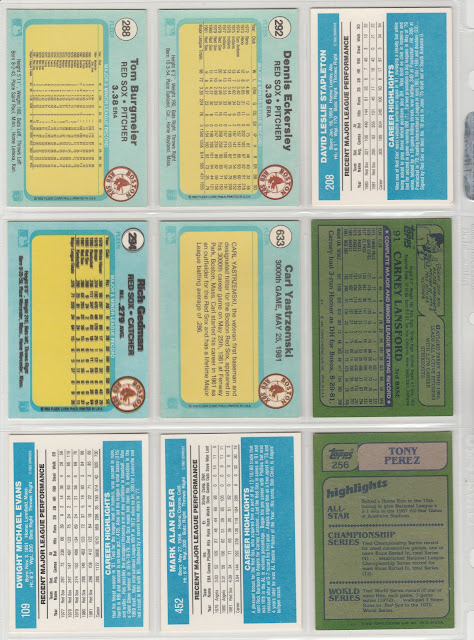
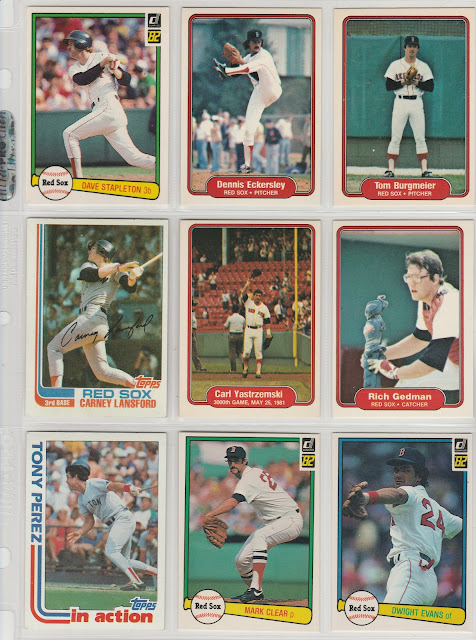
The Cards:Donruss #208 Dave Stapleton - Runner-up for the 1980 Rookie of the Year award behind Joe Charbonneau of Cleveland, Dave Stapleton was a versatile infielder, sharing time with Yaz at first base and with Jerry Remy at second. By 1982, he'd spell Yaz and Tony Perez at first base more often than not, because of his defensive chops. And yes, Stapleton was regularly used as a late inning defensive replacement during the 1986 season. OK, yes, he replaced Buckner in Game 5.
But not Game 6. . .
Fleer #292 Dennis Eckersley - Eckersley recorded his 100th Career Win in 1982, which might not seem like that big of a deal, but it would in hindsight frame the first of two halves of his Hall of Fame career nicely. Eck was still a starter in 1982, going a not-that-lucky 13-13 for the Red Sox. He'd go on to many years of success as a bullpen arm, notably in Oakland with a World Series victory in 1989. He'd finish his career with 197 wins and 390 saves. He was the first pitcher to have both a 20 Win season and a 50 Save season.
Fleer #288 Tom Burgmeier - Born in St. Paul, MN, Tom Burgmeier was an early target for Twins' scouting Director Jim Rantz. It would take a long journey through the Houston minor league system and a few seasons with the Royals before the Twins could add him to their bullpen, and by the time he reached his prime in 1980, he was off to Boston to make his lone All-Star appearance as the Red Sox Closer. After 745 major league appearances, Burgmeier became a pitching coach, serving in that capacity for several organizations over a couple decades starting in 1991 with the Royals.
Topps #91 Carney Lansford - Lansford arrived in Boston as part of the Fred Lynn trade, and did a lot to take the sting away from losing the former MVP. Moving from California's pitcher friendly Anaheim Stadium to Fenway prompted a significant spike in his batting average. Lansford won a batting title in 1981, but still wasn't a good enough hitter to keep his job as the Red Sox everyday 3rd baseman. Lansford would be traded to Oakland following the 1982 season, and very nearly won a 2nd batting title in 1989. He had an identical .336 batting average in 1981 and 1989, but fell just short of Kirby Puckett's .339. Lansford did beat Boggs by 6 points, so he's got that going for him, which is nice.
Fleer #633 Carl Yastrzemski - As mentioned above, Yaz was playing in his age 42 season in 1982. It was his 22nd major league season, all with Boston. You've heard the stats before, but just as a refresher, he was the Triple Crown winner in 1967, leading the AL in HR, RBI and Average. He was also the MVP that year, and led the AL in Slugging and OBP as well. Oh, and hits, and runs scored. And Total Bases. And he won a Gold Glove that year. And he stole 10 bases, too. He only ground into 5 double plays all season that year. My favorite Yaz tidbit though is from 1965. When Satchel Paige returned to pitch one final MLB game for the Kansas City A's, only Yaz was able to get a hit off the ageless wonder. Paige, supposedly 59 years old at the time, pitched 3 innings and it was the double by Yaz in the first as the only blemish on his scoresheet.
Fleer #294 Rich Gedman - Another Worcester, MA guy (like Mark Fidrych), Rich Gedman was the 1981 runner up for the Rookie of the Year behind the Yankees' Dave Righetti. Gedman split catching duties with Gary Allenson in 1982, playing an even 92 games each. Gedman had more hits with his bat to ball skills, while Allenson's patience at the plate netted him more walks. Gedman's calling card was throwing out runners trying to steal. He led the AL in caught stealing three straight seasons from 1984 through the championship run in 1986. Following his breakout 1984 season when he hit 24 homers, he earned the reputation of "feared hitter" not unlike his teammate Jim Rice. Gedman drew intentional walks 24 times in his two All-Star seasons, almost twice as many as Rice over the same period. Gedman was set to be a top free agent following the 1986 World Series, but strangely found no takers. (The world would later learn this was a direct result of collusion by the owners, who all agreed not to offer big free agent contracts that offseason). Gedman would re-sign with the Red Sox, but missed the first month of the season and all of Spring Training, which resulted in a career worst .205 average in 52 games. He was most closely comparable to the career of Salvador Perez by age 26, but after the lost season of 1987, he never regained his potent bat or his regular gig behind the plate for the Red Sox.
Topps #256 Tony Pérez - "Big Doggie" was several years removed from his Big Red Machine years with Cincinnati, and in 1982 managed just 6 homers for the Red Sox. While he was no longer the same hitter he was in years prior, he was still a highly respected and highly coveted bench bat. He would go on to play several more seasons first with Philadelphia then back again to Cincinnati, never far from Pete Rose, just in case he needed someone to drive him in from second base. His is often mentioned as a comp for other power hitters of his era still waiting to get into Cooperstown like Dave Parker, Dwight Evans, and until recently Harold Baines. Pérez was elected to the Hall of Fame by the BBWAA in 2000.
Donruss #452 Mark Clear - Another player acquired for Fred Lynn, Mark Clear notched 9 saves and won 8 games for the Red Sox in his first season in Boston. In 1982, he was an AL All-Star selection, and had a career high 14 victories, all coming in relief. Originally signed by the Phillies to be a starter, poor mechanics led to back problems and an early release from his contract. Clear cleaned up his delivery (thanks to his uncle, who was the Angels' bullpen coach) and rehabbed with a back brace before signing a minor league deal with California. Once converted to relief work, he thrived. He was an All-Star his rookie season with the Angels, and was well on his way to a solid MLB career.
Donruss #109 Dwight Evans - Somehow Evans managed to fly under the radar again in 1982. Despite hitting 32 homers and driving in 98 runs and leading the league with a .402 OBP finished a distant 7th in the MVP balloting (let's be fair, though, the right guy won (Robin Yount)). Evans is the Rodney Dangerfield of the Red Sox. Did you know that he's 2nd all-time in games played by a Red Sox player, trailing only Yaz? Evans also has 8 Gold Glove awards, easily the most by a Red Sox outfielder, and trailing only the best of the best in MLB history- Mays, Griffey Jr., Clemente, and Kaline. He hit more homers in the 1980s (256) than any other AL player.


